


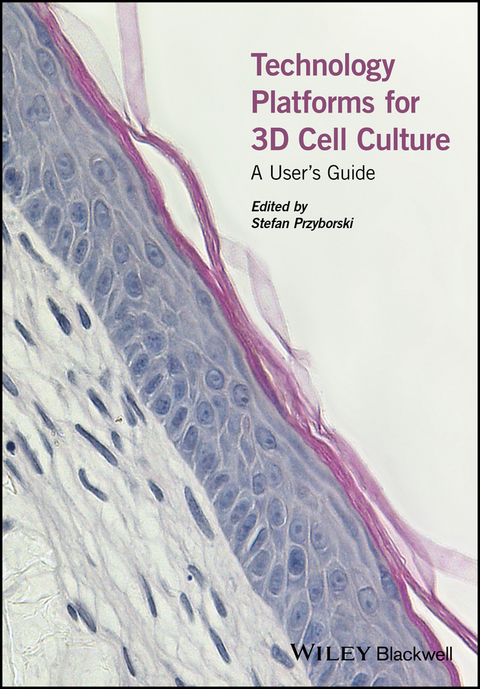
Technology Platforms for 3D Cell Culture (eBook)
John Wiley & Sons (Verlag)
978-1-118-85163-0 (ISBN)
Technology Platforms for 3D Cell Culture: A Users Guide points to the options available to perform 3D culture, shows where such technology is available, explains how it works, and reveals how it can be used by scientists working in their own labs.
- Offers a comprehensive, focused guide to the current state-of-the-art technologies available for 3D cell culture
- Features contributions from leading developers and researchers active in 3D cell technology
- Gives clear instruction and guidance on performing specific 3D culture methods, along with colour illustrations and examples of where such technologies have been successfully applied
- Includes information on resources and technical support to help initiate the use of 3D culture methods
Stefan Przyborski is Professor of Cell Technology in the Department of Biosciences, Durham University, UK. He is also the Chief Scientific Officer for ReproCELL Europe, UK. A recognised leader in the field of 3D cell culture, Professor Przyborski has published extensively in this field and presents his work regularly at international events.
Technology Platforms for 3D Cell Culture: A Users Guide points to the options available to perform 3D culture, shows where such technology is available, explains how it works, and reveals how it can be used by scientists working in their own labs. Offers a comprehensive, focused guide to the current state-of-the-art technologies available for 3D cell culture Features contributions from leading developers and researchers active in 3D cell technology Gives clear instruction and guidance on performing specific 3D culture methods, along with colour illustrations and examples of where such technologies have been successfully applied Includes information on resources and technical support to help initiate the use of 3D culture methods
Stefan Przyborski is Professor of Cell Technology in the Department of Biosciences, Durham University, UK. He is also the Chief Scientific Officer for ReproCELL Europe, UK. A recognised leader in the field of 3D cell culture, Professor Przyborski has published extensively in this field and presents his work regularly at international events.
Title Page 5
Copyright Page 6
Contents 7
List of contributors 9
Preface 13
List of abbreviations 16
Chapter 1 An introduction to the third dimension for routine cell culture 21
Introduction 21
Aggregate-based technologies 25
Scaffold-based technologies 28
3D bioreactors 33
Barriers to adoption and future directions 35
References 36
Part I Aggregate-based technologies 41
Chapter 2 Gravity-enforced microtissue engineering 43
Introduction 43
Product description 46
Tumour microtissue size profiling for drug testing 53
Conclusions 65
Troubleshooting and notes (Table 2.3) 66
Summary 67
References 68
Chapter 3 Physiologically relevant spheroid models for three-dimensional cell culture 70
Introduction 70
Description of technology 75
Experimental results obtained using the Perfecta3D hanging drop plates 80
Troubleshooting 86
Conclusion 92
References 93
Chapter 4 NanoCulture Plate: A scaffold-based high-throughput three-dimensional cell culture system suitable for live imaging and co-culture 94
Introduction 94
Description of technology 96
Example of application 100
Troubleshooting 112
Summary 113
References 113
Chapter 5 Micro-moulded non-adhesive hydrogels to form multicellular microtissues – the 3D Petri Dish® 117
Introduction 117
Description of technology 119
Applications 125
Protocols 136
Troubleshooting 138
Conclusion 139
References 140
Chapter 6 Organotypic microtissues on an air-liquid interface 143
Introduction 143
Description of technology 146
3D neural OrganDOT™ tissues for neurotoxicology studies 150
Troubleshooting 159
References 160
Part II Hydrogels 163
Chapter 7 Materials and assay systems used for three?dimensional cell culture 165
Introduction 165
Description of technology 168
Applications of 3D cultures in vitro 172
Conclusion 185
References 186
Chapter 8 HyStem®, a customisable hyaluronan?based hydrogel matrix for 3D cell culture 193
Introduction 193
Description of technology 200
Applications 201
Troubleshooting 209
Conclusion 211
Appendix 211
References 214
Chapter 9 3-D Life biomimetic hydrogels: A modular system for cell environment design 217
Introduction 217
Applications 220
Description of technology 222
A tumour-stroma model: 3D co-culture of MCF-7 cells and primary fibroblasts 230
Troubleshooting 238
Conclusion 238
References 240
Part III Scaffolds 243
Chapter 10 Alvetex®, a highly porous polystyrene scaffold for routine three-dimensional cell culture 245
Introduction 245
Description of technology 247
Example applications of Alvetex Scaffold technology 256
Troubleshooting 264
Conclusion 266
References 267
Chapter 11 CelluSponge™ and Go Matrix as innovative three?dimensional cell culture platforms 270
Introduction 270
Macroporous 3D CelluSponge development as 3D cell culture platform 272
CelluSponge applications 276
Go Matrix applications 299
Conclusion 299
References 301
Chapter 12 Mimetix® electrospun scaffold: An easy-to-use tool for 3D cell culture in drug discovery and regenerative medicine 304
Introduction 304
Description of technology 308
Application of Mimetix for 3D breast cancer cells 313
Troubleshooting 318
Conclusion 319
References 320
Part IV 3D bioreactor technologies 323
Chapter 13 Quasi Vivo® bioreactor technology 325
Introduction 325
Description of technology 326
Co-culture: Using the Quasi Vivo system to build systemic models 339
Troubleshooting 345
Conclusion 345
References 345
Chapter 14 Three-dimensional cell-based assays in hollow fibre bioreactors 347
Introduction 347
The hollow fibre bioreactor 348
Applications for cell-based assays 355
Examples of hollow fibre-based cell assays 356
Assays using more than one cell type 362
Conclusion 368
References 369
Chapter 15 Three-dimensional engineered tissues for high-throughput compound screening: Mechanical properties of skin and ageing 371
Introduction 371
Description of technology 375
Example of application 380
Troubleshooting 384
Conclusion 384
Appendix 385
Data reproducibility and statistical significance 385
The Z-factor 385
References 387
Chapter 16 Three-dimensional cell culture in the Rotary Cell Culture System™ 390
Introduction 390
Description and operation of the RCCS 396
Example application: 3D neural tissue engineering 399
Troubleshooting 403
Conclusion 403
References 404
Glossary 406
Index 413
EULA 427
| Erscheint lt. Verlag | 3.3.2017 |
|---|---|
| Sprache | englisch |
| Themenwelt | Medizin / Pharmazie ► Gesundheitsfachberufe |
| Medizin / Pharmazie ► Medizinische Fachgebiete | |
| Naturwissenschaften ► Biologie ► Zellbiologie | |
| Technik ► Umwelttechnik / Biotechnologie | |
| Schlagworte | 2D cell culture • 3d cell culture • biomedical engineering • Biomedizinische Technik • Biomedizintechnik • Biotechnologie • Biotechnologie i. d. Biowissenschaften • Biotechnology • Biowissenschaften • cancer cell biology • cell biologists • Cell Biology • Life Sciences • Medical Cell Biology • Medizinische Zellbiologie • Stem Cells • Tissue, Cell, and Genetic Engineering • Tissue engineering • Zell-, Gewebe- u. Gen-Engineering • Zellkultur |
| ISBN-10 | 1-118-85163-3 / 1118851633 |
| ISBN-13 | 978-1-118-85163-0 / 9781118851630 |
| Informationen gemäß Produktsicherheitsverordnung (GPSR) | |
| Haben Sie eine Frage zum Produkt? |
 PDF (Adobe DRM)
Kopierschutz: Adobe-DRM
Adobe-DRM ist ein Kopierschutz, der das eBook vor Mißbrauch schützen soll. Dabei wird das eBook bereits beim Download auf Ihre persönliche Adobe-ID autorisiert. Lesen können Sie das eBook dann nur auf den Geräten, welche ebenfalls auf Ihre Adobe-ID registriert sind.
Details zum Adobe-DRM
Dateiformat: PDF (Portable Document Format)
Mit einem festen Seitenlayout eignet sich die PDF besonders für Fachbücher mit Spalten, Tabellen und Abbildungen. Eine PDF kann auf fast allen Geräten angezeigt werden, ist aber für kleine Displays (Smartphone, eReader) nur eingeschränkt geeignet.
Systemvoraussetzungen:
PC/Mac: Mit einem PC oder Mac können Sie dieses eBook lesen. Sie benötigen eine
eReader: Dieses eBook kann mit (fast) allen eBook-Readern gelesen werden. Mit dem amazon-Kindle ist es aber nicht kompatibel.
Smartphone/Tablet: Egal ob Apple oder Android, dieses eBook können Sie lesen. Sie benötigen eine
Geräteliste und zusätzliche Hinweise
Buying eBooks from abroad
For tax law reasons we can sell eBooks just within Germany and Switzerland. Regrettably we cannot fulfill eBook-orders from other countries.


