


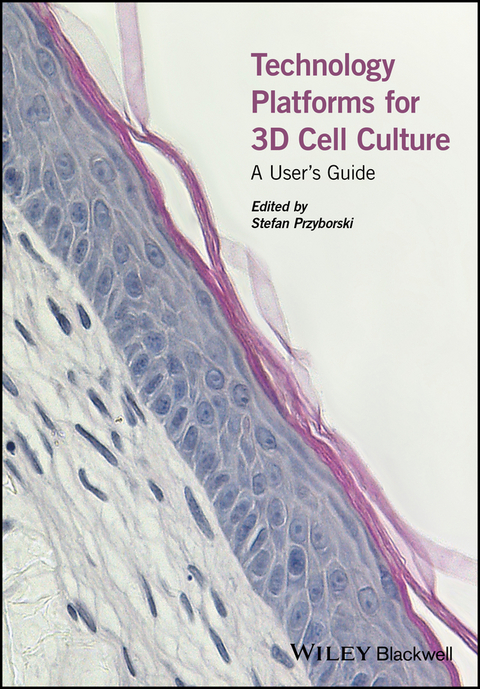
Technology Platforms for 3D Cell Culture (eBook)
John Wiley & Sons (Verlag)
978-1-118-85153-1 (ISBN)
Technology Platforms for 3D Cell Culture: A Users Guide points to the options available to perform 3D culture, shows where such technology is available, explains how it works, and reveals how it can be used by scientists working in their own labs.
- Offers a comprehensive, focused guide to the current state-of-the-art technologies available for 3D cell culture
- Features contributions from leading developers and researchers active in 3D cell technology
- Gives clear instruction and guidance on performing specific 3D culture methods, along with colour illustrations and examples of where such technologies have been successfully applied
- Includes information on resources and technical support to help initiate the use of 3D culture methods
Stefan Przyborski is Professor of Cell Technology in the Department of Biosciences, Durham University, UK. He is also the Chief Scientific Officer for ReproCELL Europe, UK. A recognised leader in the field of 3D cell culture, Professor Przyborski has published extensively in this field and presents his work regularly at international events.
Technology Platforms for 3D Cell Culture: A Users Guide points to the options available to perform 3D culture, shows where such technology is available, explains how it works, and reveals how it can be used by scientists working in their own labs. Offers a comprehensive, focused guide to the current state-of-the-art technologies available for 3D cell culture Features contributions from leading developers and researchers active in 3D cell technology Gives clear instruction and guidance on performing specific 3D culture methods, along with colour illustrations and examples of where such technologies have been successfully applied Includes information on resources and technical support to help initiate the use of 3D culture methods
Stefan Przyborski is Professor of Cell Technology in the Department of Biosciences, Durham University, UK. He is also the Chief Scientific Officer for ReproCELL Europe, UK. A recognised leader in the field of 3D cell culture, Professor Przyborski has published extensively in this field and presents his work regularly at international events.
List of contributors, vii
Preface, xi
List of abbreviations, xiv
1 An introduction to the third dimension for routine cell culture, 1
Antonio Romo-Morales and Stefan Przyborski
Part I: Aggregate-based technologies
2 Gravity-enforced microtissue engineering, 23
Randy Strube, Johannes Haugstetter, Markus Furter, Andreia Fernandez, David Fluri and Jens M. Kelm
3 Physiologically relevant spheroid models for three-dimensionalcell culture, 50
Nicole A. Slawny and MaryAnn Labant
4 NanoCulture Plate: A scaffold-based high-throughput three-dimensional cell culture system suitable for live imaging and co-culture, 74
Manabu Itoh, Kazuya Arai, Hiromi Miura and M. Mamunur Rahman
5 Micro-moulded non-adhesive hydrogels to form multicellular microtissues - the 3D Petri Dish¯®, 97
Elizabeth Leary, Sean Curran, Michael Susienka, Kali L. Manning, Andrew M. Blakely and Jeffrey R. Morgan
6 Organotypic microtissues on an air-liquid interface, 123
Lars E. Sundstrom, Igor Charvet and Luc Stoppini
Part II: Hydrogels
7 Materials and assay systems used for three-dimensional cell culture, 145
Suparna Sanyal and Marshall Kosovsky
8 HyStem¯®, a customisable hyaluronan-based hydrogel matrix for 3D cell culture, 173
T. I. Zarembinski, B. J. Engel, N. J. Doty, P. E. Constantinou, M. V. Onorato, I. E. Erickson, E. L. S. Fong, M. Martinez, R. L. Milton, B. P. Danysh, N. A. Delk, D. A. Harrington, M. C. Farach-Carson and D. D. Carson
9 3-D Life biomimetic hydrogels: A modular system for cell environment design, 197
Brigitte M. Angres and Helmut Wurst
Part III: Scaffolds
10 Alvetex¯®, a highly porous polystyrene scaffold for routine three-dimensional cell culture, 225
Antonio Romo-Morales, Eleanor Knight and Stefan Przyborski
11 CelluSponge(TM) and Go Matrix as innovative three-dimensional cell culture platforms, 250
Bramasta Nugraha
12 Mimetix¯® electrospun scaffold: An easy-to-use tool for 3D cell culture in drug discovery and regenerative medicine, 284
Robert J. McKean and Elena Heister
Part IV: 3D bioreactor technologies
13 Quasi Vivo¯® bioreactor technology, 305
J. Malcolm Wilkinson
14 Three-dimensional cell-based assays in hollow fibre bioreactors, 327
John J. S. Cadwell and William G. Whitford
15 Three-dimensional engineered tissues for high-throughput compound screening: Mechanical properties of skin and ageing, 351
Michael Conway, Ayla Annac and Tetsuro Wakatsuki
16 Three-dimensional cell culture in the Rotary Cell Culture System(TM), 370
Stephen S. Navran
Glossary, 386
Index, 393
List of abbreviations
| 2D | Two‐dimensional |
| 3D | Three‐dimensional |
| 5‐FU | 5‐Fluorouracil |
| A1AT | α1 Antitrypsin |
| ADME Tox | Absorption, distribution, metabolism, excretion and toxicity |
| ALI | Air‐liquid interface |
| ASC | Adipose‐derived stem cells |
| ATP | Adenosine‐5’‐triphosphate |
| ATRA | All trans‐retinoic acid |
| BBB | Blood–brain barrier |
| bFGF | Basic fibroblast growth factor |
| BME | Basement membrane extracts |
| BNDF | Brain‐derived neurotrophic factor |
| CAF | Cancer‐associated fibroblast |
| CD | Cytochalasin D; cluster of differentiation |
| CDI | 1,1’‐Carbonyldiimidazole |
| CDM‐HD | Chemically defined medium for high‐density cell culture |
| C/EBPa | CCAAT‐enhancer‐binding proteins |
| CHO | Chinese hamster ovary |
| CLL | Chronic lymphocytic leukaemia |
| CNS | Central nervous system |
| CP | Cortical plate |
| CTG | CellTracker green; CellTiter‐Glo |
| CV | Coefficient of variation |
| CYP1A1 | Cytochrome P450, family 1, subfamily A, polypeptide 1 |
| CYP2E1 | Cytochrome P450 2E1 |
| CYP3A4 | Cytochrome P450 3A4 |
| d4T | 2′,3′‐Didehydro‐3′deoxythymidine |
| DNA | Deoxyribonucleic acid |
| DCIS | Ductal carcinoma in situ |
| DLS | Dynamic light scattering |
| DMEM | Dulbecco’s modified eagle medium |
| DMSO | Dimethyl sulfoxide |
| DNP | Dinitrophenol |
| DOX | Doxorubicin |
| DPMK | Drug metabolism and pharmacokinetics |
| DRG | Dorsal root ganglia |
| DTT | Dithiothreitol |
| EthD | Ethidium homodimer‐1 |
| EB | Embryoid body |
| ECM | Extracellular matrix |
| ECS | Extracapillary space |
| EDTA | Ethylenediamine tetra‐acetic acid |
| EEF1 | Elongation factor 1 complex |
| EFP | Evoked field potential |
| EGF | Epidermal growth factor |
| EGFR | Epidermal growth factor receptor |
| EHS | Engelbreth‐Holm‐Swarm |
| EHT | Engineered heart tissue |
| ELISA | Enzyme‐linked immunosorbent assay |
| EMT | Epithelial‐mesenchymal transition |
| ESC | Embryonic stem cell |
| ET | Engineered tissue |
| EVS | Extravascular space |
| FA | Focal adhesion |
| FACS | Fluorescence activated cell sorting |
| FBS | Fetal bovine serum |
| FDA | Food and Drug Administration; fluorescein diacetate |
| GABA | γ‐Aminobutyric acid |
| GAG | Glycosaminoglycan |
| GFAP | Glial fibrillary acid protein |
| GFP | Green fluorescent protein |
| GMP | Good Manufacturing Practice |
| GSH | Glutathione synthase |
| GSSG | Oxidised glutathione |
| HA | Hyaluronic acid |
| HARV | High aspect ratio vessel |
| HCA | High‐content analysis |
| HCV | Hepatitis C virus |
| HCVpp | Hepatitis C virus pseudoparticles |
| HD | Hanging drop |
| HDMEC | Human dermal microvascular endothelial cell |
| HDP | Hanging drop plate |
| H&E | Haematoxylin and eosin |
| HF | Hollow fibre |
| HFBR | Hollow fibre bioreactor |
| HFIM | Hollow fibre infection model |
| HIPE | High internal phase emulsion |
| HiPSC | Human induced pluripotent stem cell |
| HIV | Human immunodeficiency virus |
| HMEC | Human microvascular endothelial cell |
| hMSC | Human mesenchymal stem cell |
| HNF4α | Hepatocyte nuclear factor 4 α |
| HPC | Hydroxypropylcellulose |
| HSC | Haematopoietic stem cell |
| HS | Heparan sulfate |
| HTS | High‐throughput screening |
| HUVEC | Human umbilical vein endothelial cell |
| ICM | Inner cell mass |
| ID | Internal diameter |
| IDC | Invasive ductal carcinoma |
| IgG | Immunoglobulin G |
| iPSC | Induced pluripotent stem cell |
| LC‐MS | Liquid chromatography‐mass spectrometry |
| LCST | Liquid crystal solution temperature |
| LDH | Lactate dehydrogenase |
| NF | Neurofilament |
| M‐dPEG‐NHS | Maleimide‐dPEG8‐N‐hydroxysuccinimide ester |
| Mal‐PVA | Maleimide‐functionalised polyvinyl alcohol |
| MAP | Microtubule‐associated protein |
| MCR | Multicellular... |
| Erscheint lt. Verlag | 3.3.2017 |
|---|---|
| Sprache | englisch |
| Themenwelt | Medizin / Pharmazie ► Gesundheitsfachberufe |
| Medizin / Pharmazie ► Medizinische Fachgebiete | |
| Naturwissenschaften ► Biologie ► Zellbiologie | |
| Technik ► Umwelttechnik / Biotechnologie | |
| Schlagworte | 2D cell culture • 3d cell culture • biomedical engineering • Biomedizinische Technik • Biomedizintechnik • Biotechnologie • Biotechnologie i. d. Biowissenschaften • Biotechnology • Biowissenschaften • cancer cell biology • cell biologists • Cell Biology • Life Sciences • Medical Cell Biology • Medizinische Zellbiologie • Stem Cells • Tissue, Cell, and Genetic Engineering • Tissue engineering • Zell-, Gewebe- u. Gen-Engineering • Zellkultur |
| ISBN-10 | 1-118-85153-6 / 1118851536 |
| ISBN-13 | 978-1-118-85153-1 / 9781118851531 |
| Informationen gemäß Produktsicherheitsverordnung (GPSR) | |
| Haben Sie eine Frage zum Produkt? |
 EPUB (Adobe DRM)
Kopierschutz: Adobe-DRM
Adobe-DRM ist ein Kopierschutz, der das eBook vor Mißbrauch schützen soll. Dabei wird das eBook bereits beim Download auf Ihre persönliche Adobe-ID autorisiert. Lesen können Sie das eBook dann nur auf den Geräten, welche ebenfalls auf Ihre Adobe-ID registriert sind.
Details zum Adobe-DRM
Dateiformat: EPUB (Electronic Publication)
EPUB ist ein offener Standard für eBooks und eignet sich besonders zur Darstellung von Belletristik und Sachbüchern. Der Fließtext wird dynamisch an die Display- und Schriftgröße angepasst. Auch für mobile Lesegeräte ist EPUB daher gut geeignet.
Systemvoraussetzungen:
PC/Mac: Mit einem PC oder Mac können Sie dieses eBook lesen. Sie benötigen eine
eReader: Dieses eBook kann mit (fast) allen eBook-Readern gelesen werden. Mit dem amazon-Kindle ist es aber nicht kompatibel.
Smartphone/Tablet: Egal ob Apple oder Android, dieses eBook können Sie lesen. Sie benötigen eine
Geräteliste und zusätzliche Hinweise
Buying eBooks from abroad
For tax law reasons we can sell eBooks just within Germany and Switzerland. Regrettably we cannot fulfill eBook-orders from other countries.


