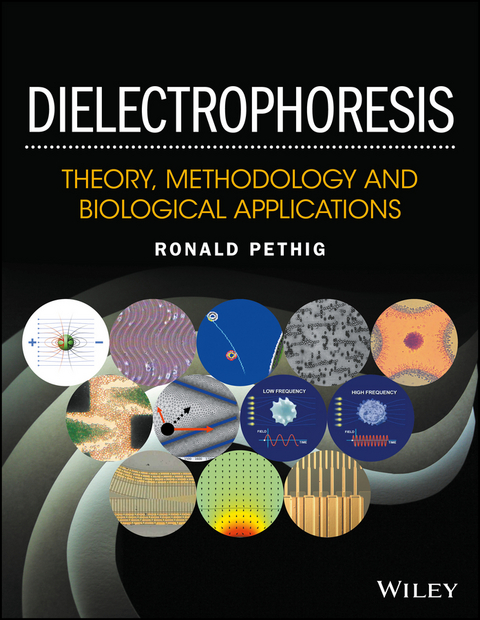
Dielectrophoresis (eBook)
John Wiley & Sons (Verlag)
978-1-118-67141-2 (ISBN)
Comprehensive coverage of the basic theoretical concepts and applications of dielectrophoresis from a world-renowned expert.
- Features hot application topics including: Diagnostics, Cell-based Drug Discovery, Sensors for Biomedical Applications, Characterisation and Sorting of Stem Cells, Separation of Cancer Cells from Blood and Environmental Monitoring
- Focuses on those aspects of the theory and practice of dielectrophoresis concerned with characterizing and manipulating cells and other bioparticles such as bacteria, viruses, proteins and nucleic acids.
- Features the relevant chemical and biological concepts for those working in physics and engineering
Comprehensive coverage of the basic theoretical concepts and applications of dielectrophoresis from a world-renowned expert. Features hot application topics including: Diagnostics, Cell-based Drug Discovery, Sensors for Biomedical Applications, Characterisation and Sorting of Stem Cells, Separation of Cancer Cells from Blood and Environmental Monitoring Focuses on those aspects of the theory and practice of dielectrophoresis concerned with characterizing and manipulating cells and other bioparticles such as bacteria, viruses, proteins and nucleic acids. Features the relevant chemical and biological concepts for those working in physics and engineering
Ronald Pethig Emeritus Professor of Bioelectronics, The University of Edinburgh, UK
Preface
Herb Pohl's seminal book, Dielectrophoresis: The Behavior of Neutral Matter in Nonuniform Electric Fields, was published in 1978. The aim of this present text is to describe the development since then of the theory and practice of this subject. The primary focus is on the biomedical applications of dielectrophoresis (DEP), so many of the chapters are written with a multidiscipliniary readership in mind. However, the theories and techniques described here are valid for all types of particles – animate and inanimate. The subject has changed dramatically since 1978. Up to that time only 16 scientific reports on biological applications of DEP had appeared in the scientific literature, with 12 of them describing work performed by Herb and his postgraduate students at Oklahoma State University. One of these papers deserves special mention, namely that written in 1966 with his MSc student, Ira Hawk. They describe, in the journal Science (vol. 152, 1966), the first demonstration of a purely physical technique (i.e., DEP) that can be used to distinguish and separate live and dead cells simultaneously. Furthermore, the live cells that had been exposed to the DEP field for several minutes were found to be viable and capable of cell culture. A macroscopic pin-plate electrode arrangement, composed of a rounded 0.66 mm stainless-steel wire facing a flat steel plate, was used in these experiments. Microfabrication and microfluidic techniques, taken for granted now in this subject, were not available to Herb in 1978. Apart from the impact of microtechnologies, this present book has also to take into account the fact that, at its time of completion (July 2016), more than 300 published papers are devoted solely to the DEP behaviour of yeast cells, with more than 3000 other papers of relevance to biomedical applications of DEP. Herb's initial interest in the motion of particles induced by nonuniform AC fields (an effect he was later to term dielectrophoresis) was directed towards industrial applications such as the removal of carbon-black filler from polyvinyl chloride samples. However, as I was privileged to witness at first hand, he gained most amusement from observing the DEP behaviour of bioparticles. In this way, Herb was able to describe in his book, in some detail, the DEP characterization of yeast cells and several types of bacteria, as well as preliminary results for blood cells, chloroplasts, green algae and mitochondria. These results act as the springboard for this book.
I suspect that I am not alone in finding more enjoyment in writing and reading about the biomedical applications of DEP than of its use to separate carbon black from PVC, or particulate matter from petroleum, for example. How can other such studies (potentially important as they may be) induce the same ‘buzz’ as viewing the geometrical distinction between life and death in the form of the Argand plots shown in Figure 11.9 of this book? Can studies of inanimate particles be as amusing as observing viable Giardia rotating in the opposite sense to nonviable ones in a rotating electric field? Such entertainment will not occur with particles extracted from oil, for example, unless they are bacteria such as oil-eating Alcanovorax. This explains, in part, why this present text is restricted to the DEP behaviour of biological particles. An exception is the inclusion of polymer beads because they are used widely in biomedical and biosensor devices, with DEP able to monitor the extent of attachment to them of target bioparticles. There is also a pragmatic reason for focussing on biomedical applications of DEP. A search in the autumn of 2015, using the Web of Science Core Collection and other library data bases, revealed the existence of at least 4000 publications on the theory, technology and application of DEP. Of relevance to the subject matter of this present text are also the many hundreds of scientific papers on the theories of dielectric phenomena, as well as those that describe the dielectric and electrokinetic properties of cells, bacteria, viruses together with bio-macromolecules such as proteins and nucleic acids. By largely excluding conference abstracts for possible citation, as well as papers not addressing a bio-related topic or not readily available through normal library resources, the number of candidates for citation was reduced to around 3000 publications. To avoid the text assuming the character of a list of disjointed citations, an attempt has been made to summarize the development of bio-DEP over the past half-century through only around 800 references to relevant work. This does not completely mirror important contributions to the subject made by my own co-workers and many researchers from other laboratories. I apologize to those who inspect the index of cited authors and are disappointed to find that their innovative work has either not been described adequately or is not cited at all. Among past colleagues not cited at all is John Morgan, who submitted his PhD thesis ‘Dielectrophoretic Studies of Biological Materials’ in 1978, whilst for Paul Carnochan only one image (Figure 11.2) from his PhD thesis ‘Dielectric Properties of Biological Cell Suspensions’, submitted in 1982, records his valuable contribution. An omission of work from the citation index does not reflect its perceived lack of novelty or importance – it has simply suffered from the culling exercise performed for reasons explained above (or from an unfortunate oversight on my part).
Another objective of this book is to make large parts of its content agreeably accessible to those trained in the biomedical sciences – not just engineering and physical science graduates. For those engaged in biomedical applications of DEP, the guidance and involvement of those trained in the molecular and life sciences is greatly desired and in most cases can be considered as essential. However, most published works on DEP appear in journals of engineering or the physical sciences and are largely unhelpful in addressing the ‘so what, who cares?’ questions of interest and relevance to those trained in the life and medical sciences. Chapter 1 addresses a common question about how the technique of DEP can compete against other microfluidic methods for cell manipulation and separation, such as flow cytometry, electrophoresis and magnetophoresis. Electrophoresis is a method well understood by biologists, but its similarity to the term dielectrophoresis is not helpful in discouraging the impression that DEP represents no more than an esoteric extension of what they already know. The purpose of Chapter 2 is to describe, in broad terms, how the special features of DEP lend to it the promise of providing important contributions to cell biology, particularly to such areas as drug discovery, medical diagnostics and regenerative medicine. As already stated, bearing in mind that an increasing number of scientists trained in the biomedical fields are entering the subject area, the nontheoretical sections of the text, throughout this book, are written in a style that is hopefully suitable for an interdisciplinary readership. To assist this and to help maintain the narrative, separate boxes and worked examples are used throughout the book to act as pedagogical material and to divert the more formal and quantitative details away from the main text.
In the preface of a special issue of the Journal of Electrostatics (Vol. 21, 119–364, 1988) to honour the memory of Herb Pohl, I mentioned that his devotion to science and generous nature had once been revealed to me by his statement that ‘senior scientists should act rather as oak trees, to give shelter and provide growing conditions to the younger ones’. I also suggested that he would have gained much satisfaction and pleasure to see how some of his acorns had matured. In this spirit, I wish to take this opportunity to thank and acknowledge the contributions that the following, as young researchers at Bangor, made to my own understanding of DEP and to the content of this book: Talal Al-Ameen, W. Michael Arnold, Julian P. H. Burt, Paul Carnochan, Ka-Lok Chan, Colin Dalton, Peter R. C. Gascoyne, Andrew D. Goater, Clair Hodgson, Michael P. Hughes, Ying Huang, Richard S. Lee, Gary M. Lock, Zu-Hong Lu, Gerard H. Markx, Anoop Menachery, Hywel Morgan, John R. Morgan, Jonathan A. R. Price, Mark S. Talary, Xiao-Bo Wang and Xiao-Feng Zhou. It is with some pride that I know the DEP community will recognize the names of some fine oak trees in this list. We benefited from having the following with us on sabbatical leave or year-long fellowships: Ralph Hölzel, Takashi Inoue, Thomas B. Jones, Juliette Rousselet, Miguel Sancho, Herman P. Schwan and Junya Suehiro. A special mention should be given to John Tame, who operated the photolithography and clean-room facilities at Bangor. In the summer of 1986 he was asked if he could fabricate for us an array of gold, interdigitated, microelectrodes on a microscope slide. After being informed what we intended to do with it, he impishly responded: “We usually keep our electronic devices away from water, but I'll give it a try”. For nearly 20 years thereafter (until his untimely death in 2004) he provided various microelectrode arrays for the DEP and electrokinetic studies of the researchers mentioned above. In 2005 a new clean-room facility at Bangor was named and dedicated to his memory.
At the School of Engineering in Edinburgh I have appreciated moral support and helpful interactions...
| Erscheint lt. Verlag | 2.3.2017 |
|---|---|
| Sprache | englisch |
| Themenwelt | Naturwissenschaften ► Chemie ► Analytische Chemie |
| Technik ► Umwelttechnik / Biotechnologie | |
| Schlagworte | Analytical Chemistry • Analytische Chemie • Biodielectrics • biomedical engineering • Biomedizintechnik • Bioparticles • Biotechnology • cell separation • Chemie • Chemistry • Dielectrophoresis • Electrokinetics • Lab-on-Chip • Microfabrication • microfluidics • Molecular Bioengineering • Molekulares Bioengineering • nanotechnology • Pharmaceutical & Medicinal Chemistry • Pharmazeutische u. Medizinische Chemie |
| ISBN-10 | 1-118-67141-4 / 1118671414 |
| ISBN-13 | 978-1-118-67141-2 / 9781118671412 |
| Informationen gemäß Produktsicherheitsverordnung (GPSR) | |
| Haben Sie eine Frage zum Produkt? |
 EPUB (Adobe DRM)
Kopierschutz: Adobe-DRM
Adobe-DRM ist ein Kopierschutz, der das eBook vor Mißbrauch schützen soll. Dabei wird das eBook bereits beim Download auf Ihre persönliche Adobe-ID autorisiert. Lesen können Sie das eBook dann nur auf den Geräten, welche ebenfalls auf Ihre Adobe-ID registriert sind.
Details zum Adobe-DRM
Dateiformat: EPUB (Electronic Publication)
EPUB ist ein offener Standard für eBooks und eignet sich besonders zur Darstellung von Belletristik und Sachbüchern. Der Fließtext wird dynamisch an die Display- und Schriftgröße angepasst. Auch für mobile Lesegeräte ist EPUB daher gut geeignet.
Systemvoraussetzungen:
PC/Mac: Mit einem PC oder Mac können Sie dieses eBook lesen. Sie benötigen eine
eReader: Dieses eBook kann mit (fast) allen eBook-Readern gelesen werden. Mit dem amazon-Kindle ist es aber nicht kompatibel.
Smartphone/Tablet: Egal ob Apple oder Android, dieses eBook können Sie lesen. Sie benötigen eine
Geräteliste und zusätzliche Hinweise
Buying eBooks from abroad
For tax law reasons we can sell eBooks just within Germany and Switzerland. Regrettably we cannot fulfill eBook-orders from other countries.
aus dem Bereich