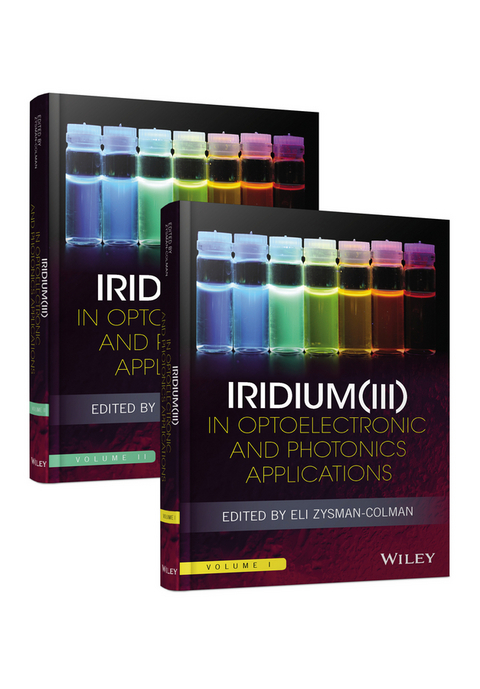
Iridium(III) in Optoelectronic and Photonics Applications (eBook)
John Wiley & Sons (Verlag)
978-1-119-00715-9 (ISBN)
The fundamental photophysical properties of iridium(III) materials make this class of materials the pre-eminent transition metal complex for use in optoelectronic applications.
Iridium(III) in Optoelectronic and Photonics Applications represents the definitive account of photoactive iridium complexes and their use across a wide variety of applications. This two-volume set begins with an overview of the synthesis of these complexes and discusses their photophysical properties. The text highlights not only mononuclear complexes but also the properties of multinuclear and polymeric iridium-based materials and the assembly of iridium complexes into larger supramolecular architectures such as MOFs and soft materials. Chapters devoted to the use of these iridium-based materials in diverse optoelectronic applications follow, including: electroluminescent devices such as organic light emitting diodes (OLEDs) and light-emitting electrochemical cells (LEECs); electrochemiluminescence (ECL); bioimaging; sensing; light harvesting in the context of solar cell applications; in photoredox catalysis and as components for solar fuels.
Although primarily targeting a chemistry audience, the wide applicability of these compounds transcends traditional disciplines, making this text also of use to physicists, materials scientists or biologists who have interests in these areas.
The fundamental photophysical properties of iridium(III) materials make this class of materials the pre-eminent transition metal complex for use in optoelectronic applications. Iridium(III) in Optoelectronic and Photonics Applications represents the definitive account of photoactive iridium complexes and their use across a wide variety of applications. This two-volume set begins with an overview of the synthesis of these complexes and discusses their photophysical properties. The text highlights not only mononuclear complexes but also the properties of multinuclear and polymeric iridium-based materials and the assembly of iridium complexes into larger supramolecular architectures such as MOFs and soft materials. Chapters devoted to the use of these iridium-based materials in diverse optoelectronic applications follow, including: electroluminescent devices such as organic light emitting diodes (OLEDs) and light-emitting electrochemical cells (LEECs); electrochemiluminescence (ECL); bioimaging; sensing; light harvesting in the context of solar cell applications; in photoredox catalysis and as components for solar fuels. Although primarily targeting a chemistry audience, the wide applicability of these compounds transcends traditional disciplines, making this text also of use to physicists, materials scientists or biologists who have interests in these areas.
Edited by Eli Zysman-Colman EaStCHEM School of Chemistry, University of St Andrews, UK
1
Archetypal Iridium(III) Compounds for Optoelectronic and Photonic Applications: Photophysical Properties and Synthetic Methods
Joseph C. Deaton and Felix N. Castellano
Department of Chemistry, North Carolina State University, Raleigh, NC, USA
1.1 Introduction
In the early years following the discovery and isolation of the element iridium, it was regarded as “not useful for anything” because of its apparent chemical inertness as a noble metal and the high temperatures required for forging iridium‐based metal objects [1]. But steady advances in the fields of metallurgy, chemistry, physics, and materials science have culminated in numerous applications for the element. In particular, the succeeding chapters of this volume will each describe in detail an application utilizing the extraordinary photophysical properties and reversible electrochemistry of organometallic complexes of iridium. In this opening chapter, the photophysical properties and synthesis of the archetypal complexes suitable for these applications will be presented.
1.2 Iridium Complex Ion Dopants in Silver Halide Photographic Materials
Before proceeding with the review of their modern optoelectronic applications, it is worth noting that iridium complexes have already been in use for decades in a special type of optoelectronic product: silver halide photographic films and papers. The silver halide process is a unique optical process in a semiconductor because of a remarkable combination of solid state properties of the material [2, 3]. Well into the twentieth century, development of this technology proceeded in an empirical manner, mainly in industrial laboratories where trade secrets were more highly valued than scientific publications and sometimes even patents. Therefore the origin of the use of iridium complexes and their effects can be difficult to discern from the early literature and patents [4, 5 and references therein]. But in more recent literature, it has been shown that iridium complexes such as [IrCl6]3−, [IrBr6]3−, and even molecules containing small organic ligands may be incorporated as impurity ion dopants into silver halide crystals or microcrystals where they function as traps for photoelectrons generated during light exposure, thus modulating the life cycle of the photoelectrons in the latent image forming process [6, 7]. In more recent patent disclosures, it was shown that an important effect of these dopants is to control what is known as reciprocity law failure for photographic exposures [8, 9]. Ideally, according to the reciprocity law, the image optical density formed after development of an exposed photographic film should be the same for the same value of total exposure, E, regardless of the combination of intensity, i, and exposure time, t, used to produce that exposure according to Equation 1.1:
In practice, photographic films and papers exhibit lower developed optical density for exposures made with relatively low intensity over longer time (low‐intensity reciprocity failure) or for exposures made with high intensity over shorter time (high‐intensity reciprocity failure) or both. Doping the silver halide microcrystals during precipitation with small concentrations of iridium complexes such as [IrCl6]3− has been shown to reduce reciprocity law failure, although it cannot be totally eliminated for exposure extremes [8, 9]. The effect of the iridium dopant is not based on a photophysical property in the same sense as for the iridium complexes in applications described in succeeding chapters. Rather, the presence of the iridium dopant and its naturally accompanying charge compensation defect introduces a trap for electrons below the conduction band of the silver halide and thereby modulates the lifecycle of photoelectrons in the microcrystal. Dopants, such as the iridium complexes and a special class known as chemical sensitizers [2], do not affect how much light is absorbed by the silver halide, at least to a first approximation, but rather control how efficiently the light is used to form the latent image. Chemical sensitizers and dopants are therefore distinguished from organic sensitizing dyes, known as spectral sensitizers, which function through increasing light absorption and injecting the resultant photoelectrons into the silver halide conduction band [2], much like the Ru(II) dyes found in Grätzel‐type dye sensitized solar cells.
1.3 Overview of the Photophysical Properties of C^N and C^C: Cyclometalated Ir(III) Complexes
Ir(III) complexes bearing C^N and C^C: cyclometalated ligands possess impressive photophysical properties that make these compounds highly desirable for the optoelectronic and photonic applications covered in this volume. Stereochemical illustrations of representative archetypal Ir(III) cyclometalates (Section 1.4) are presented in Scheme 1.1, and structural formulae for additional examples are shown in Scheme 1.2 in 2D. In these structures, the C^N and C^C: bidentate ligands are monoanionic, and the negative charge is donated by a C atom occupying one coordination site. In the case of the C^C: cyclometalates, the second coordination site is occupied by the neutral C‐donor (designated C:) of the carbene moiety (Scheme 1.3). The :C^N and :C^C: types of carbene ligands are charge neutral and have been incorporated in heteroleptic complexes with monoanionic C^N or C^C: ligands. Examples of Ir(III) cyclometalates with tridentate ligands are shown in Scheme 1.4. A list of abbreviations for ligands illustrated in the schemes and used in the text may be found at the end of the chapter. The Ir(III) complexes are generally obtained as racemic mixtures, and the structural diagrams in Schemes 1.1, 1.2, 1.3, and 1.4 are not meant to limit the representations to specific enantiomers. Because the properties of enantiomers differ only in optical activity, their properties will not be covered in succeeding sections, but the preparation and isolation of enantiomers and diastereomers will be covered in Section 1.9.
Scheme 1.1 Sterochemical diagrams of representative archetypal Ir(III) cyclometalates.
Scheme 1.2 Structural formulae of additional examples of Ir(III) cyclometalates.
Scheme 1.3 Structural formulae of representative Ir(III) cyclometalates comprising carbene ligands.
Scheme 1.4 Sterochemical diagrams of representative Ir(III) cyclometalates comprising tridentate ligands.
The proper nomenclature, for example, of the prototype compound is fac‐tris(2‐phenylpyridinato‐N^C2′)iridium(III) (fac‐Ir(ppy)3, Scheme 1.1). But often in the literature the prefix is omitted, and it is assumed that the facial isomer is being discussed because these are generally much more emissive than the meridional isomers (mer‐Ir(ppy)3, Scheme 1.1), at least in the case of the more common C^N cyclometalates (Section 1.4). The nomenclature is often further simplified to Ir(phenylpyridine)3, for example, with the assumption that it is understood that the ortho‐deprotonated form of the ligand (2′ carbon) is intended, not the neutral form. The C on the phenyl ring that is bonded to the pyridine ring is designated the 1′ position, and in numbering substituents on the phenyl ring, the point of metalation takes precedence as the 2′ position. Numbering positions of further substituents on the phenyl ring can therefore be different in the complex than in the free ligand and sometimes may be a point of confusion. Still other researchers designate the site of metalation as the 1′ C atom and number substituents accordingly.
The cyclometalated Ir(III) compounds are highly emissive because the lowest energy excited states are a mixture of metal‐to‐ligand charge transfer (MLCT) and ligand‐centered (LC) π–π* states, not the non‐radiative d–d states (Section 1.4). Schematic energy level diagrams of the frontier one‐electron orbitals and the resultant zero‐order many‐electron states are shown in Figures 1.1 and 1.2, respectively. Note that the zero‐order (i.e., prior to any mixing interactions) MLCT state is the lowest energy excited state within the singlet manifold, but as shown in Figure 1.2 often the LC is lowest within the triplet manifold because of greater electron‐exchange interaction (Section 1.6).
Figure 1.1 Energy level diagram for one‐electron orbitals in d6 MLCT–LC complexes.
Figure 1.2 Jablonski diagram for the many‐electron states in d6 MLCT–LC complexes.
In heteroleptic complexes wherein the HOMO comprises a mixture of Ir dπ orbitals and π orbitals of one ligand while the LUMO comprises a π* orbital on another ligand such that the latter becomes the chromophoric ligand, the lowest triplet excited state may be described as a mixture of MLCT and ligand‐to‐ligand charge transfer (LLCT), sometimes referred to as metal–ligand‐to‐ligand charge transfer (MLLCT). This is commonly the case in cationic complexes of the type [Ir(C^N)2(N^N)]+ where N^N is a diimine (Section 1.4) and is the chromophoric ligand. A less commonly encountered situation occurs...
| Erscheint lt. Verlag | 7.3.2017 |
|---|---|
| Sprache | englisch |
| Themenwelt | Naturwissenschaften ► Chemie ► Anorganische Chemie |
| Technik ► Maschinenbau | |
| Schlagworte | Anorganische Chemie • Anorganische Elektronik • Chemie • Chemistry • Inorganic Chemistry • Inorganic Electronics • iridium, optoelectronics, photophysics, organic light emitting diodes, light emitting electrochemical cells, solar fuels, photoredox catalysis, bioimaging, sensing, electrochemiluminescence, light harvesting • Materials Science • Materialwissenschaften • Optics & Photonics • Optik u. Photonik • Physics • Physik |
| ISBN-10 | 1-119-00715-1 / 1119007151 |
| ISBN-13 | 978-1-119-00715-9 / 9781119007159 |
| Informationen gemäß Produktsicherheitsverordnung (GPSR) | |
| Haben Sie eine Frage zum Produkt? |
 EPUB (Adobe DRM)
Kopierschutz: Adobe-DRM
Adobe-DRM ist ein Kopierschutz, der das eBook vor Mißbrauch schützen soll. Dabei wird das eBook bereits beim Download auf Ihre persönliche Adobe-ID autorisiert. Lesen können Sie das eBook dann nur auf den Geräten, welche ebenfalls auf Ihre Adobe-ID registriert sind.
Details zum Adobe-DRM
Dateiformat: EPUB (Electronic Publication)
EPUB ist ein offener Standard für eBooks und eignet sich besonders zur Darstellung von Belletristik und Sachbüchern. Der Fließtext wird dynamisch an die Display- und Schriftgröße angepasst. Auch für mobile Lesegeräte ist EPUB daher gut geeignet.
Systemvoraussetzungen:
PC/Mac: Mit einem PC oder Mac können Sie dieses eBook lesen. Sie benötigen eine
eReader: Dieses eBook kann mit (fast) allen eBook-Readern gelesen werden. Mit dem amazon-Kindle ist es aber nicht kompatibel.
Smartphone/Tablet: Egal ob Apple oder Android, dieses eBook können Sie lesen. Sie benötigen eine
Geräteliste und zusätzliche Hinweise
Buying eBooks from abroad
For tax law reasons we can sell eBooks just within Germany and Switzerland. Regrettably we cannot fulfill eBook-orders from other countries.
aus dem Bereich