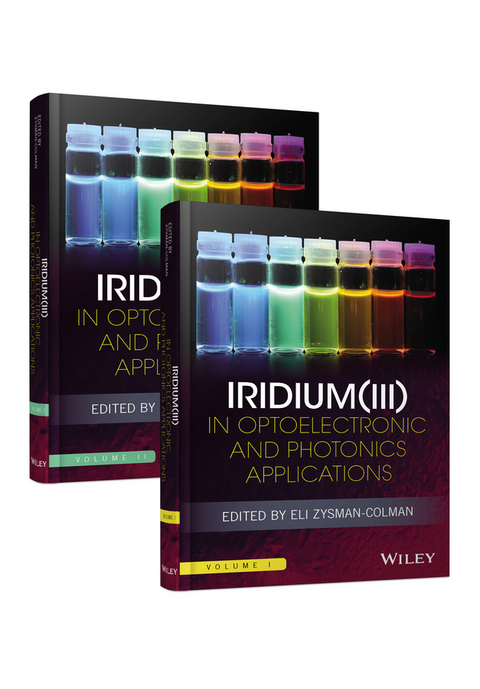
Iridium(III) in Optoelectronic and Photonics Applications (eBook)
John Wiley & Sons (Verlag)
978-1-119-00714-2 (ISBN)

The fundamental photophysical properties of iridium(III) materials make this class of materials the pre-eminent transition metal complex for use in optoelectronic applications.
Iridium(III) in Optoelectronic and Photonics Applications represents the definitive account of photoactive iridium complexes and their use across a wide variety of applications. This two-volume set begins with an overview of the synthesis of these complexes and discusses their photophysical properties. The text highlights not only mononuclear complexes but also the properties of multinuclear and polymeric iridium-based materials and the assembly of iridium complexes into larger supramolecular architectures such as MOFs and soft materials. Chapters devoted to the use of these iridium-based materials in diverse optoelectronic applications follow, including: electroluminescent devices such as organic light emitting diodes (OLEDs) and light-emitting electrochemical cells (LEECs); electrochemiluminescence (ECL); bioimaging; sensing; light harvesting in the context of solar cell applications; in photoredox catalysis and as components for solar fuels.
Although primarily targeting a chemistry audience, the wide applicability of these compounds transcends traditional disciplines, making this text also of use to physicists, materials scientists or biologists who have interests in these areas.
Edited by
Eli Zysman-Colman EaStCHEM School of Chemistry, University of St Andrews, UK
The fundamental photophysical properties of iridium(III) materials make this class of materials the pre-eminent transition metal complex for use in optoelectronic applications. Iridium(III) in Optoelectronic and Photonics Applications represents the definitive account of photoactive iridium complexes and their use across a wide variety of applications. This two-volume set begins with an overview of the synthesis of these complexes and discusses their photophysical properties. The text highlights not only mononuclear complexes but also the properties of multinuclear and polymeric iridium-based materials and the assembly of iridium complexes into larger supramolecular architectures such as MOFs and soft materials. Chapters devoted to the use of these iridium-based materials in diverse optoelectronic applications follow, including: electroluminescent devices such as organic light emitting diodes (OLEDs) and light-emitting electrochemical cells (LEECs); electrochemiluminescence (ECL); bioimaging; sensing; light harvesting in the context of solar cell applications; in photoredox catalysis and as components for solar fuels. Although primarily targeting a chemistry audience, the wide applicability of these compounds transcends traditional disciplines, making this text also of use to physicists, materials scientists or biologists who have interests in these areas.
Edited by Eli Zysman-Colman EaStCHEM School of Chemistry, University of St Andrews, UK
Volume 1 3
Title Page 5
Copyright Page 6
Contents 9
List of Contributors 17
Foreword 19
Preface 21
Chapter 1 Archetypal Iridium(III) Compounds for Optoelectronic and Photonic Applications: Photophysical Properties and Synthetic Me... 23
1.1 Introduction 23
1.2 Iridium Complex Ion Dopants in Silver Halide Photographic Materials 23
1.3 Overview of the Photophysical Properties of CN and CC: Cyclometalated Ir(III) Complexes 24
1.4 Importance of IrC Bonds in the Archetypal Ir(III) Complexes for Optoelectronic and Photonic Applications 31
1.5 Tuning Emission Color 36
1.6 Absorbance and Photoluminescence of CN Cyclometalated Ir(III) Complexes 39
1.7 SOC Mechanism: Radiative Decay Rates and ZFS 45
1.8 Non-Radiative Decay Rates 61
1.9 Synthetic Methods Targeting CN Cyclometalated Ir(III) Compounds 64
1.10 Synthetic Methods for Cyclometalated Ir(III) Compounds Containing Carbenes 69
1.11 Conclusions 70
Acknowledgements 71
Abbreviations for Ligands in Ir(III) Complexes 71
References 72
Chapter 2 Multinuclear Iridium Complexes 93
2.1 Introduction 93
2.2 Compounds Incorporating `Single Atom Bridges´: ?-Chloro, ?-Oxo and ?-Aza 94
2.2.1 ?-Chloro-Bridged Complexes 94
2.2.2 ?-Aza-Bridged Complexes 96
2.2.3 ?-Hydroxo-Bridged Complexes 98
2.3 Polyatomic Acyclic Bridges: Acetylides, Cyanides and Hydrazides 100
2.4 Compounds with Heterocyclic Bridges 104
2.4.1 Bis-(NN)-Coordinating Ligands and Related Systems Incorporating At Least One NN Unit 105
2.4.2 Bis-(NC)-Coordinating Ligands 111
2.5 Multinuclear Complexes Featuring Conjugated Bridges between Iridium-Bound Polypyridyl or Arylpyridyl Ligands 115
2.5.1 Systems Incorporating CC or NN Bridges with One or More [Ir(NC)2(NN)]+ Units 117
2.5.2 Multinuclear Complexes Incorporating Phenyl and Polyphenylene Bridges between the Ligands: `Supramolecular Assemblies´ 118
2.6 Concluding Remarks 126
Acknowledgements 126
References 126
Chapter 3 Soft Materials and Soft Salts Based on Iridium Complexes 133
3.1 Introduction 133
3.2 Liquid Crystals 134
3.3 Gels 137
3.4 Micelles 138
3.5 Langmuir–Blodgett Films 140
3.6 Soft Salts 140
3.7 Conclusion 145
Acknowledgements 145
References 145
Chapter 4 Porous Materials Based on Precious Metal Building Blocks for Solar Energy Applications 149
4.1 Introduction 149
4.2 The Luminescent Nature of MOFs and Their Use in Chemical Applications 151
4.3 Energy Transfer in Porous Materials 156
4.4 Porous Materials for Water Oxidation 158
4.5 Porous Materials for Proton Reduction 160
4.6 Porous Materials for CO2 Reduction 162
4.7 Conclusions and Outlook 163
References 163
Chapter 5 Polymeric Architectures Containing Phosphorescent Iridium(III) Complexes 167
5.1 Introduction 167
5.2 Ir(III)-Containing Polymers: Classification, Design Principles, and Syntheses 168
5.2.1 Classification of Ir(III)-Containing Polymers 168
5.2.2 Design Principles for Metal-Containing Polymers 169
5.2.2.1 Decoration of Preformed Polymers with Ir(III) Complexes 171
5.2.2.2 Coordination of Ir(III) Precursor Complexes to Preformed Polymers 173
5.2.2.3 (Co)Polymerization of Ir(III)-Containing Monomers 179
5.2.2.4 Electropolymerization of Ir(III)-Containing Complexes 204
5.2.2.5 Synthetic Approaches Toward Ir(III)-Containing Polymers: The Roads Not Taken 208
5.3 Hyperbranched and Dendritic Architectures 209
5.3.1 Ir(III)-Containing Hyperbranched Polymers 209
5.3.2 Ir(III)-Containing Dendritic Systems 210
5.4 Concluding Remarks 213
References 214
Chapter 6 Iridium(III) Complexes for OLED Application 227
6.1 Introduction 227
6.2 Iridium Complexes 228
6.2.1 General Synthesis of Ir(III) Complexes 229
6.2.2 Luminescence of Iridium(III) Complexes 230
6.2.3 Emission Color Tuning in Iridium(III) Complexes 231
6.2.3.1 Influence of the (CN) Ligand 232
6.2.3.2 Influence of the Ancillary Ligand 234
6.3 Organic Light-Emitting Diodes 238
6.3.1 Device Architecture and Fabrication 239
6.3.2 Device Lifetime 240
6.3.3 Device Efficiency 242
6.3.4 Phosphorescent Materials 243
6.3.5 Host Materials 244
6.4 Iridium(III) Complexes for PHOLED Application 249
6.4.1 Green Emitters 249
6.4.1.1 Role of the Ancillary Ligand 250
6.4.1.2 Modification of the Phenylpyridine Ring 251
6.4.1.3 Use of Different Tris-cyclometalated Motifs 252
6.4.2 Red Emitters 254
6.4.3 Blue Emitters 260
6.5 Conclusions and Perspectives 284
References 284
Chapter 7 A Comprehensive Review of Luminescent Iridium Complexes Used in Light-Emitting Electrochemical Cells (LEECs) 297
7.1 Introduction 297
7.2 Device Fundamentals 300
7.3 Green Emitters 302
7.3.1 Archetypal Emitters 304
7.3.2 Pyrazoles 311
7.3.3 Imidazoles 314
7.3.4 Triazoles and Tetrazoles 315
7.3.5 Oxadiazoles 316
7.3.6 Thiophenes 318
7.3.7 Intramolecular ?-Stacked Emitters 318
7.3.8 Supramolecular Emitters 322
7.4 Blue Emitters 323
7.4.1 [Ir(ppy)2(bpy)]+-Type Emitters 324
7.4.2 Pyrazoles 329
7.4.3 Imidazoles 334
7.4.4 Triazoles 335
7.4.5 Oxadiazoles 338
7.4.6 N-Heterocyclic Carbenes 342
7.4.7 Phosphines 344
7.5 Yellow Emitters 345
7.5.1 [Ir(ppy)2(bpy)]+-Type Emitters 346
7.5.2 Imidazole Emitters 349
7.5.3 Anionic Emitters 350
7.5.4 Intramolecularly ?-Stacked Emitters 350
7.5.5 Multifunctional or Supramolecular Emitters 354
7.6 Orange-Red Emitters 356
7.6.1 [Ir(ppy)2(bpy)]+-Type Emitters 357
7.6.2 Emitters Bearing Five-Membered Heterocyclic Rings 362
7.6.3 Intramolecular ?-Stacked Emitters 363
7.6.4 Multifunctional Emitters 367
7.7 Conclusions and Outlook 370
Acknowledgements 371
References 371
Supplemental Images 381
Volume 2 389
Title Page 391
Copyright Page 392
Contents 395
List of Contributors 403
Foreword 405
Preface 407
Chapter 8 Electrochemiluminescence of Iridium Complexes 409
8.1 Background and Overview of Electrochemiluminescence 409
8.1.1 ECL from Metal Complexes 412
8.2 Iridium ECL 413
8.2.1 First Examples 413
8.2.2 Renewed Interest in Iridium ECL Stimulated by Progress in the Field of Light-Emitting Devices 414
8.2.3 Early Advances in Theoretical Understanding and Electrochemiluminophore Design 416
8.2.4 Modified Electrode Systems 420
8.2.5 ECL-Based Sensing Strategies 422
8.2.6 Issues Related to ECL of Iridium Complexes in Aqueous Media and Quenching by Oxygen 434
8.2.7 Tuning ECL Emission Colour and Redox Properties 436
8.2.8 Potential-Resolved Multicolour ECL 449
8.2.8.1 Miscellaneous ECL Systems Involving Iridium Complexes 455
8.2.9 Conclusion and Future Prospects 456
List of Ligand Abbreviations Used in Text 456
References 457
Chapter 9 Strategic Applications of Luminescent Iridium(III) Complexes as Biomolecular Probes, Cellular Imaging Reagents, and Photo... 465
9.1 Introduction 465
9.2 General Cellular Staining Reagents 466
9.3 Hypoxia Sensing Probes 473
9.4 Molecular and Ion Intracellular Probes 477
9.4.1 Intracellular Probes for Sulfur-Containing Species 477
9.4.2 Intracellular Probes for Metal Ions 483
9.4.3 Intracellular Probes for Hypochlorous Acid and Hypochlorite 487
9.4.4 Intracellular Probes for Nitric Oxide 489
9.5 Organelle-Targeting Bioimaging Reagents 491
9.5.1 Nucleus 491
9.5.2 Nucleoli 493
9.5.3 Golgi Apparatus 495
9.5.4 Mitochondria 497
9.6 Functionalized Polypeptides for Bioimaging 500
9.7 Polymers and Nanoparticles for Bioimaging 504
9.8 Photocytotoxic Reagents and Photodynamic Therapeutics 508
9.9 Conclusion 516
Acknowledgements 516
Abbreviations 516
References 519
Chapter 10 Iridium Complexes in the Development of Optical Sensors 529
10.1 Generalities of Optical Sensors 529
10.2 Ir(III) Used as Optical Probes 531
10.2.1 Optical Probes for the Detection of Gaseous Species 531
10.2.1.1 Oxygen 532
10.2.1.2 Other Gaseous Species 533
10.2.2 Optical Probes for the Detection of Ionic Species 535
10.2.2.1 Cations 535
10.2.2.2 pH 541
10.2.2.3 Anions 543
10.2.3 Optical Probes for the Detection of Biomolecules 548
10.2.3.1 Amino Acids and Proteins 548
10.2.3.2 Nucleotides and Nucleic Acids 556
10.2.4 Optical Probes for the Detection of Other Small Molecules 556
10.2.4.1 Explosives 556
10.2.4.2 Free Radicals 557
10.2.4.3 H2O2 558
10.2.4.4 Amines 558
10.2.4.5 Silver Salts 558
10.2.4.6 Hypochlorous Acid (HOCl) 558
10.3 Ir(III) Used in the Development of Sensing Phases 559
10.3.1 Sensing Phases for the Detection of Gases 559
10.3.1.1 Oxygen 559
10.3.1.2 Other Gases 566
10.3.2 Sensing Phases for the Detection of Ions 566
10.3.3 Sensing Phases for the Detection of Biomolecules 567
10.3.3.1 Glucose 568
10.3.3.2 BSA 570
10.3.3.3 Cysteine and Homocysteine 570
10.3.3.4 Heparin 570
10.3.3.5 Histone 571
10.3.4 Sensing Phases for Multiparametric Sensing 571
10.4 Conclusion and Future Challenges 572
Acronyms Used in the Names of the Complexes 575
References 578
Chapter 11 Photoredox Catalysis of Iridium(III)-Based Photosensitizers 591
11.1 Introduction 591
11.1.1 Photoredox Catalysis 591
11.1.2 Principles of Photoredox Catalysis 592
11.1.3 Iridium(III) Photocatalyst Design 592
11.1.4 Ir(III) Photocatalyst synthesis 595
11.2 Iridium-Based Photoredox Catalysis in Organic Synthesis 597
11.2.1 Net Oxidative Reactions 597
11.2.1.1 Amine Oxidation and Functionalization 597
11.2.1.2 Arene Oxidation 601
11.2.2 Net Reductive Reactions 601
11.2.2.1 Dehalogenation Reactions 601
11.2.2.2 Ketyl Radical Chemistry 603
11.2.3 Redox-Neutral Reactions 604
11.2.3.1 Atom Transfer Radical Addition 605
11.2.3.2 Radical-Based Arene Addition Reactions 611
11.2.3.3 Tandem Catalysis Methods 615
11.2.4 Amine Fragmentation 621
11.3 Conclusion 624
References 624
Chapter 12 Solar Fuel Generation 633
12.1 Introduction 633
12.2 Fundamentals of [Ir(CN)2(NN)]+ Photosensitizers 635
12.2.1 Synthesis and Structure 635
12.2.2 Electronics: Photophysics and Electrochemistry 635
12.2.3 Complexes Made to Order 638
12.3 Application of [Ir(CN)2(NN)]+ in Photocatalytic Water Reduction 639
12.3.1 Initial Exploration 639
12.3.2 Systems with Non-precious Components 641
12.3.3 Strategies for Improved Efficiency 644
12.3.3.1 New CN Ligands 644
12.3.3.2 New NN Ligands 647
12.3.3.3 Orchestration 649
12.4 Alternative Iridium Structures 653
12.4.1 Tridentate Coordination 653
12.4.2 Tris-Cyclometalated Complexes 655
12.4.3 Dinuclear Iridium Complexes 656
12.5 Outlook 657
Acknowledgements 659
References 660
Chapter 13 Iridium Complexes in Water Oxidation Catalysis 667
13.1 Introduction 667
13.2 Sacrificial Oxidants 669
13.2.1 Cerium(IV) Ammonium Nitrate 670
13.2.2 Sodium Periodate 670
13.3 Molecular Iridium Catalyst for Water Oxidation 671
13.3.1 Ir WOCs without Cp* 671
13.3.2 Ir WOCs with Cp* 674
13.3.3 Cp*Ir WOCs Based on Carbene-Type Ligands 682
13.3.3.1 Cp*Ir WOCs Bearing Normal Carbene-Type Ligands 683
13.3.3.2 Cp*Ir WOCs Bearing Abnormal Carbene-Type Ligands 686
13.3.3.3 Comparison of Catalytic Activity of Cp*Ir Bearing Mesoionic Imidazolylidene Ligand or the Mesoionic Triazolylidene... 688
13.3.4 Heterogenized Molecular Iridium Catalyst for Water Oxidation 690
13.3.5 Iridium WOC as Photocatalyst for Water Oxidation under Visible Light Irradiation 695
13.4 Conclusions 697
Acknowledgements 698
Glossary of Terms and Abbreviations 698
References 699
Chapter 14 Iridium Complexes as Photoactive Center for Light Harvesting and Solar Cell Applications 705
14.1 Introduction 705
14.2 Photoinduced Electron Transfer in Multicomponent Arrays 706
14.2.1 Ir(tpy)2 Fragment (tpy=2,2:6-2-terpyridine) 706
14.2.2 Cyclometalated Iridium(III) 710
14.3 Iridium Complexes as Photoactive Center for Solar Cell Applications 715
14.3.1 Sensitizer for Dye-Sensitized Solar Cells 715
14.3.2 Iridium Complexes for Organic Photovoltaic Devices 723
14.4 Conclusions 726
References 727
Index 733
Supplemental Images 737
EULA 753
| Erscheint lt. Verlag | 3.3.2017 |
|---|---|
| Sprache | englisch |
| Themenwelt | Naturwissenschaften ► Chemie ► Anorganische Chemie |
| Technik ► Maschinenbau | |
| Schlagworte | Anorganische Chemie • Anorganische Elektronik • Chemie • Chemistry • Inorganic Chemistry • Inorganic Electronics • iridium, optoelectronics, photophysics, organic light emitting diodes, light emitting electrochemical cells, solar fuels, photoredox catalysis, bioimaging, sensing, electrochemiluminescence, light harvesting • Materials Science • Materialwissenschaften • Optics & Photonics • Optik u. Photonik • Physics • Physik |
| ISBN-10 | 1-119-00714-3 / 1119007143 |
| ISBN-13 | 978-1-119-00714-2 / 9781119007142 |
| Informationen gemäß Produktsicherheitsverordnung (GPSR) | |
| Haben Sie eine Frage zum Produkt? |
 PDF (Adobe DRM)
Kopierschutz: Adobe-DRM
Adobe-DRM ist ein Kopierschutz, der das eBook vor Mißbrauch schützen soll. Dabei wird das eBook bereits beim Download auf Ihre persönliche Adobe-ID autorisiert. Lesen können Sie das eBook dann nur auf den Geräten, welche ebenfalls auf Ihre Adobe-ID registriert sind.
Details zum Adobe-DRM
Dateiformat: PDF (Portable Document Format)
Mit einem festen Seitenlayout eignet sich die PDF besonders für Fachbücher mit Spalten, Tabellen und Abbildungen. Eine PDF kann auf fast allen Geräten angezeigt werden, ist aber für kleine Displays (Smartphone, eReader) nur eingeschränkt geeignet.
Systemvoraussetzungen:
PC/Mac: Mit einem PC oder Mac können Sie dieses eBook lesen. Sie benötigen eine
eReader: Dieses eBook kann mit (fast) allen eBook-Readern gelesen werden. Mit dem amazon-Kindle ist es aber nicht kompatibel.
Smartphone/Tablet: Egal ob Apple oder Android, dieses eBook können Sie lesen. Sie benötigen eine
Geräteliste und zusätzliche Hinweise
Buying eBooks from abroad
For tax law reasons we can sell eBooks just within Germany and Switzerland. Regrettably we cannot fulfill eBook-orders from other countries.
aus dem Bereich