Aquatic Pollution (eBook)
John Wiley & Sons (Verlag)
978-1-119-30459-3 (ISBN)
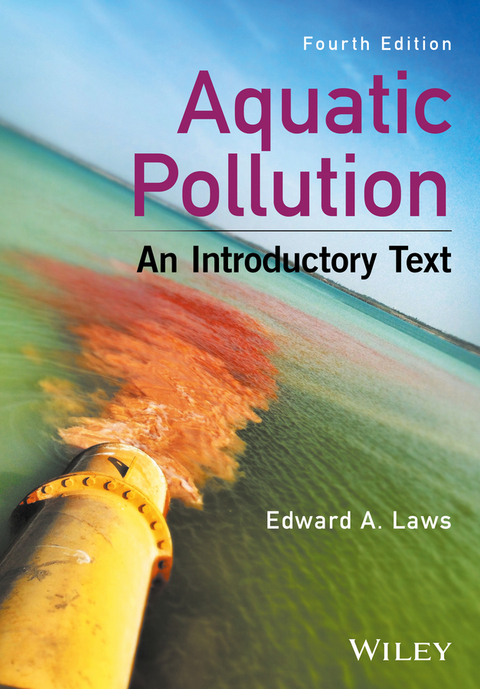
Fully updated to reflect current understanding and discussing these major recent developments, this fourth edition of Aquatic Pollution covers every aspect of pollution associated with urban runoff, acid rain, sewage disposal, pesticides, oil spills, nutrient loading, and more. Case studies of major pollution sites, all original to this new edition, help to illustrate points made in general discussion.
Offering unprecedented depth of coverage, and discussing both fresh and sea water environments, this unique text provides a key teaching and learning tool for courses in environmental science, zoology, oceanography, biology, and civil or sanitary engineering, as well as a vital book for government policy makers. It is also an excellent primer for policymakers and activists focused on environmental issues.
Edward Laws is a professor in the Department of Environmental Sciences in the College of the Coast & Environment at Louisiana State University and a founding team member and investigator in the Center for Microbial Oceanography: Research and Education at the University of Hawaii, Manoa. In addition to the earlier editions of Aquatic Pollution, he is the author of El Nino and the Peruvian Anchovy Fishery (1996) and Mathematical Methods for Oceanographers (Wiley, 1997).
Since the publication of the third edition of Aquatic Pollution in 2000, there have been many major developments within the field in terms of research, regulations, and also large-scale catastrophes that have had a significant impact on the aquatic environment; the Deepwater Horizon oil spill and the Fukushima nuclear disaster have taken their toll, and research on ocean acidification has developed enormously over the last decade. Recognizing, controlling, and mitigating aquatic pollution on a global scale is one of the most important and most difficult challenges facing society today.Fully updated to reflect current understanding and discussing these major recent developments, this fourth edition of Aquatic Pollution covers every aspect of pollution associated with urban runoff, acid rain, sewage disposal, pesticides, oil spills, nutrient loading, and more. Case studies of major pollution sites, all original to this new edition, help to illustrate points made in general discussion.Offering unprecedented depth of coverage, and discussing both fresh and sea water environments, this unique text provides a key teaching and learning tool for courses in environmental science, zoology, oceanography, biology, and civil or sanitary engineering, as well as a vital book for government policy makers. It is also an excellent primer for policymakers and activists focused on environmental issues.
Edward Laws is a professor in the Department of Environmental Sciences in the College of the Coast & Environment at Louisiana State University and a founding team member and investigator in the Center for Microbial Oceanography: Research and Education at the University of Hawaii, Manoa. In addition to the earlier editions of Aquatic Pollution, he is the author of El Nino and the Peruvian Anchovy Fishery (1996) and Mathematical Methods for Oceanographers (Wiley, 1997).
Preface
Since the first edition of Aquatic Pollution was published in 1980, the book has served as an introduction to the subject of water pollution for many undergraduate students. The fourth edition is organized in a similar way to the first three editions. The first three chapters serve as an introduction to physical, chemical, and biological concepts that are essential to understanding the impact of pollutants and stresses on aquatic systems. Chapter 8 is likewise an introduction to toxicological concepts relevant to the remaining chapters in the book. Each of the other chapters focuses on a particular kind of pollution, and in each of these chapters, the subject is illustrated with one or more case studies. The case studies include numerous examples from events and developments that had happened since the third edition of Aquatic Pollution was published in 2000.
Some of the news since 2000 has certainly been good. Phase I of the City of Chicago’s tunnels and reservoir project (TARP) was completed in 2006; TARP is now capable of handling about 85% of the pollution caused by combined sewer overflows from an area of 842 km2. The concentration of phosphorus in Onondaga Lake, New York, sometimes characterized as the most polluted lake in the United States, dropped from 730 µg L−1 in 1970 to less than 20 µg L−1 in 2010 as a result of restrictions on the use of phosphorus in laundry detergents and tertiary treatment for phosphorus removal from wastewater. Brown pelicans, whose populations had been seriously impacted by the use of dichlorodiphenyltrichloroethane (DDT) and similar pesticides, were taken off the endangered species list in the United States in 2009. Likewise, bald eagles, whose population in the contiguous 48 states had been reduced to 417 pairs in 1963, have now increased to more than 11,000 pairs. The use of insecticides on corn declined by a factor of 10 between 1995 and 2010 as a result of the planting of genetically modified corn resistant to insect pests. In 2001, the EPA issued regulations that required closed cycle cooling systems on all new electric power plants to eliminate the killing of organisms drawn into once-cycle cooling systems, and in 2014, it promulgated additional regulations that required existing power plants that draw more than 2 million gallons per day of cooling water to take steps to minimize internal plant kills. In 2016, most use of mercury in the United States had been phased out, with the exception of its use in dental amalgams, and in 2008, the European Union issued a directive that restricted most uses of cadmium. The directive was amended in 2013 to specifically prohibit the use of cadmium in most nickel–cadmium batteries, which account for over 80% of cadmium use globally. Modifications to the International Convention for the Prevention of Pollution from Ships required a transition to double-hull oil tankers for all oil tankers greater than 20,000 deadweight tons by 2007, and analogous stipulations of the US Oil Pollution Act required a phaseout of single-hull tankers that operate in US waters by January 1, 2015, in order to reduce the frequency of oil spills from tanker accidents. Emissions of sulfur oxides from electric power plants in the United States declined by 84% between 1970 and 2014, primarily as a result of the installation of scrubbers to eliminate emissions of sulfur oxides in stack gases. In 2015, the US Department of Agriculture announced the Ogallala Aquifer Initiative, which addresses the problem of overdrafting the Ogallala Aquifer, the largest aquifer in the United States. And in 2006, the US Congress passed the Marine Debris Research, Prevention, and Reduction Act, with the goal of reducing the amount of marine debris and its adverse effects on marine organisms. Under the auspices of the US Environment Program, the Stockholm Convention on Persistent Organic Pollutants was adopted in 2001 by 179 nations with the goal of protecting human health and the environment from persistent organic pollutants. The convention initially identified 12 persistent organic pollutants, the so-called dirty dozen, the use of which was to be banned or greatly restricted. The original list of 12 has now been extended to 22.
Unfortunately, not all the news has been good. Despite considerable efforts aimed at improving the water quality of the Chesapeake Bay, the area of benthic grasses in the bay has not increased since 2000 and is far below the target of 750 km2 that was established in 2003. The catch of eastern oysters in the Chesapeake Bay declined from more than 10,000 tonnes in 1980 to 40 tonnes in 2004, and although there has been some improvement since then, the productivity of the eastern oysters is very much constrained by poor water quality and infection by parasites. Although water quality standards have been established, they are met only 30–40% of the time and seasonal hypoxia is a problem throughout the Chesapeake Bay.
Literally billions of dollars have been spent to improve the water quality of Lake Erie, but problems persist. The biggest problems have been the benthification of the lake by zebra mussels and quagga mussels; the ongoing nonpoint source runoff of nutrients, particularly from the Maumee River; and the domination of the phytoplankton community by cyanobacteria of the genus Microcystis, which produce a very potent liver toxin called microcystin. On August 2, 2014, the 500,000 residents of Toledo, Ohio, were advised not to drink their tap water when microcystin was detected at unacceptable concentrations in the water supply.
Monitoring of recreational waters to ensure that they are safe for water contact remains a very unsatisfactory state of affairs. Counts of indicator bacteria vary widely over time and space. The fecal indicator bacteria being used (Escherichia coli and enterococcus) are not uniquely associated with human feces1; some human pathogens (e.g., leptospira) are not even associated with feces. The length of time required to assay for fecal indicator bacteria, combined with the temporal variability of their abundance, confounds interpretation of monitoring results. Although the use of molecular methods may greatly improve the specificity of the assays and reduce the time required to obtain a result, the use of such methods will first require careful epidemiological studies that relate assay results to human health outcomes.
The number of malaria cases in countries such as Sri Lanka, Mexico, and Namibia has declined dramatically since 2000; the use of bed nets and other forms of integrated pest management has been an important component of successful strategies to reduce the incidence of the disease. However, there were still 214 million cases and 438,000 deaths from malaria in 2015, primarily in sub-Saharan Africa.
Although flesh-eating screwworm flies were eradicated in the United States in 1983, they reappeared in 2016 in the Florida Keys, where they were responsible for the deaths of 10% of the population of Key deer, an endangered species. Eradication of the screwworm flies via release of sterile males is expected to take six months.
In 2014, the public water supply of the City of Flint, Michigan, became contaminated with lead, and the state of Michigan subsequently identified 43 people suffering from elevated levels of lead. The problem was caused by leaching of lead from pipes in the water distribution system, the result of an unfortunate decision to switch the water supply from Lake Huron to the Flint River. Water from the latter turned out to be highly corrosive to the pipes in the distribution system.
The largest accidental oil spill ever occurred in 2010 as a result of the blowout of the Deepwater Horizon oil platform in the Gulf of Mexico approximately 80 km from the coast of Louisiana. About 700,000 tonnes of oil and the oil equivalent of an additional 280,000 tonnes in the form of gaseous hydrocarbons were released. About 0.77 million gallons of a dispersant, Corexit 9500, was applied to the oil emerging from the wellhead in an attempt to break it up into small droplets that would remain submerged, and an additional 1.4 million gallons of a combination of two dispersants, Corexit 9500 and Corexit 9527, was applied to the oil that reached the surface. The full extent of the damage caused by the oil and dispersant may not be known for several years, but more than 400 km2 of coastal land was lost as a result of the killing of wetland vegetation along the shoreline.
The following year, an undersea earthquake, the fourth most powerful earthquake to occur in the world since modern record keeping began in 1900, generated a tsunami that breached the 10-m seawall protecting the Fukushima Daiichi nuclear power plant in Japan. Loss of electrical power resulted in failure of the pumps that provided cooling water to three of the plant’s nuclear reactors, which subsequently overheated as a result of the radiation emitted by fission products in their fuel elements. A series of chemical reactions then resulted in a number of hydrogen–air explosions during the next several days that blew the roof off one of the reactors and destroyed the upper part of the building housing another. The accident resulted in a release of radioactivity equal to 6–15% of the radioactivity released 25 years earlier by the Chernobyl power plant accident in Ukraine. Roughly 80% of the radioactivity entered the Pacific Ocean. Approximately 300,000 people were evacuated from the area surrounding the reactor. As a result of the accident, Japan shut down all but two of its nuclear reactors and Germany announced that it would close all of its nuclear power plants by 2022.
In addition to these recent developments, the book also...
| Erscheint lt. Verlag | 24.2.2017 |
|---|---|
| Sprache | englisch |
| Themenwelt | Naturwissenschaften ► Biologie ► Limnologie / Meeresbiologie |
| Naturwissenschaften ► Biologie ► Ökologie / Naturschutz | |
| Technik | |
| Schlagworte | aquatic ecology • Bauingenieur- u. Bauwesen • Biowissenschaften • BOD • Chain • Chronic • Civil Engineering & Construction • Concepts • Ecological • Ecotoxicology & Pollution Science • Environmental Studies • Filter • Filters • florida correctives • Food • fundamental • Life Sciences • magnification • microbial • Ökologie / Aquatische Lebensräume • Ökotoxikologie • Ökotoxikologie, Umweltverschmutzung • pros • questions • References • removal • Secondary • Sewage • Simple • Sludge • theory • Treatment • twonumber • Umweltforschung • Wasserverschmutzung • Wasserversorgung • Water • Water Supply Engineering • webs |
| ISBN-10 | 1-119-30459-8 / 1119304598 |
| ISBN-13 | 978-1-119-30459-3 / 9781119304593 |
| Informationen gemäß Produktsicherheitsverordnung (GPSR) | |
| Haben Sie eine Frage zum Produkt? |
 EPUB (Adobe DRM)
Kopierschutz: Adobe-DRM
Adobe-DRM ist ein Kopierschutz, der das eBook vor Mißbrauch schützen soll. Dabei wird das eBook bereits beim Download auf Ihre persönliche Adobe-ID autorisiert. Lesen können Sie das eBook dann nur auf den Geräten, welche ebenfalls auf Ihre Adobe-ID registriert sind.
Details zum Adobe-DRM
Dateiformat: EPUB (Electronic Publication)
EPUB ist ein offener Standard für eBooks und eignet sich besonders zur Darstellung von Belletristik und Sachbüchern. Der Fließtext wird dynamisch an die Display- und Schriftgröße angepasst. Auch für mobile Lesegeräte ist EPUB daher gut geeignet.
Systemvoraussetzungen:
PC/Mac: Mit einem PC oder Mac können Sie dieses eBook lesen. Sie benötigen eine
eReader: Dieses eBook kann mit (fast) allen eBook-Readern gelesen werden. Mit dem amazon-Kindle ist es aber nicht kompatibel.
Smartphone/Tablet: Egal ob Apple oder Android, dieses eBook können Sie lesen. Sie benötigen eine
Geräteliste und zusätzliche Hinweise
Buying eBooks from abroad
For tax law reasons we can sell eBooks just within Germany and Switzerland. Regrettably we cannot fulfill eBook-orders from other countries.
aus dem Bereich