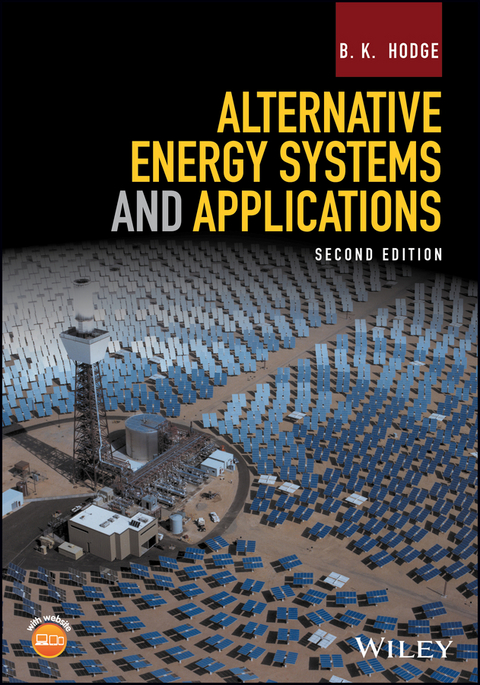
Alternative Energy Systems and Applications (eBook)
John Wiley & Sons (Verlag)
978-1-119-10922-8 (ISBN)
The comprehensive guide to engineering alternative and renewable energy systems and applications-updated for the latest trends and technologies
This book was designed tohelp engineers develop new solutions for the current energy economy. To that end it provides technical discussions, along with numerous real-world examples of virtually all existing alternative energy sources, applications, systems and system components. All chapters focus on first-order engineering calculations, and consider alternative uses of existing and renewable energy resources. Just as important, the author describes how to apply these concepts to the development of new energy solutions.
Since the publication of the critically acclaimed first edition of this book, the alternative, renewable and sustainable energy industries have witnessed significant evolution and growth. Hydraulic fracturing, fossil fuel reserve increases, the increasing popularity of hybrid and all-electric vehicles, and the decreasing cost of solar power already have had a significant impact on energy usage patterns worldwide. Updated and revised to reflect those and other key developments, this new edition features expanded coverage of topics covered in the first edition, as well as entirely new chapters on hydraulic fracturing and fossil fuels, hybrid and all-electric vehicles, and more.
- Begins with a fascinating look at the changing face of global energy economy
- Features chapters devoted to virtually all sources of alternative energy and energy systems
- Offers technical discussions of hydropower, wind, passive solar and solar-thermal, photovoltaics, fuel cells, CHP systems, geothermal, ocean energy, biomass, and nuclear
- Contains updated chapter review questions, homework problems, and a thoroughly revised solutions manual, available on the companion website
While Alternative Energy Systems and Applications, Second Edition is an ideal textbook/reference for advanced undergraduate and graduate level engineering courses in energy-related subjects, it is also an indispensable professional resource for engineers and technicians working in areas related to the development of alternative/renewable energy systems.
B. K. Hodge is Professor Emeritus of Mechanical Engineering at Mississippi State University (MSU) where he continues to be involved in MSU mechanical engineering education and research activities. His research areas include enhanced heat transfer, thermal systems simulation, and energy engineering. He also served as the Director of the MSU Industrial Assessment Center. Prior to retirement, B. K. Hodge held the Tennessee Valley Authority Professorship in Energy Systems and the Environment and was Giles Distinguished Professor of Mechanical Engineering and a Grisham Master Teacher. He has served as Chair of the ASEE Mechanical Engineering Division and as President of the ASEE Southeastern Section. He is a Fellow of the American Society for Engineering Education and the American Society of Mechanical Engineers and an Associate Fellow of the American Institute of Aeronautics and Astronautics.
The comprehensive guide to engineering alternative and renewable energy systems and applications updated for the latest trends and technologies This book was designed tohelp engineers develop new solutions for the current energy economy. To that end it provides technical discussions, along with numerous real-world examples of virtually all existing alternative energy sources, applications, systems and system components. All chapters focus on first-order engineering calculations, and consider alternative uses of existing and renewable energy resources. Just as important, the author describes how to apply these concepts to the development of new energy solutions. Since the publication of the critically acclaimed first edition of this book, the alternative, renewable and sustainable energy industries have witnessed significant evolution and growth. Hydraulic fracturing, fossil fuel reserve increases, the increasing popularity of hybrid and all-electric vehicles, and the decreasing cost of solar power already have had a significant impact on energy usage patterns worldwide. Updated and revised to reflect those and other key developments, this new edition features expanded coverage of topics covered in the first edition, as well as entirely new chapters on hydraulic fracturing and fossil fuels, hybrid and all-electric vehicles, and more. Begins with a fascinating look at the changing face of global energy economy Features chapters devoted to virtually all sources of alternative energy and energy systems Offers technical discussions of hydropower, wind, passive solar and solar-thermal, photovoltaics, fuel cells, CHP systems, geothermal, ocean energy, biomass, and nuclear Contains updated chapter review questions, homework problems, and a thoroughly revised solutions manual, available on the companion website While Alternative Energy Systems and Applications, Second Edition is an ideal textbook/reference for advanced undergraduate and graduate level engineering courses in energy-related subjects, it is also an indispensable professional resource for engineers and technicians working in areas related to the development of alternative/renewable energy systems.
B. K. Hodge is Professor Emeritus of Mechanical Engineering at Mississippi State University (MSU) where he continues to be involved in MSU mechanical engineering education and research activities. His research areas include enhanced heat transfer, thermal systems simulation, and energy engineering. He also served as the Director of the MSU Industrial Assessment Center. Prior to retirement, B. K. Hodge held the Tennessee Valley Authority Professorship in Energy Systems and the Environment and was Giles Distinguished Professor of Mechanical Engineering and a Grisham Master Teacher. He has served as Chair of the ASEE Mechanical Engineering Division and as President of the ASEE Southeastern Section. He is a Fellow of the American Society for Engineering Education and the American Society of Mechanical Engineers and an Associate Fellow of the American Institute of Aeronautics and Astronautics.
Alternative Energy Systems and Applications 1
Contents 9
Preface to the Second Edition 15
Preface to the First Edition 17
About the Companion Website 19
1: Energy Usage in the USA and the World 21
1.1 Energy and Power 21
1.2 Energy Usage and Standard of Living 21
1.3 A Historical Perspective of Energy Usage in the USA 24
1.4 US Energy Usage in 2014 27
1.5 Worldwide Energy Use 37
1.6 Efficiencies 39
1.7 Closure 41
References 41
2: Fundamentals of Turbomachinery 43
2.1 Definition of a Turbomachine 43
2.2 Turbomachine Classifications 43
2.3 Turbomachine Analysis 43
2.4 Example Problems 48
2.5 Closure 53
References 53
Further reading 53
3: Hydropower 55
3.1 Introduction 55
3.2 Examples of Hydroelectric Dams 55
3.3 Hydraulic Analysis 59
3.4 Turbine Specific Speed Considerations 64
3.5 Energy Transfer in Turbines 68
3.6 Closure 77
References 80
Further Reading 81
4: Wind Energy 83
4.1 Introduction 83
4.2 Fundamental Concepts 84
4.3 Wind Energy Resources 92
4.4 Wind Turbine Operation 98
4.5 Commercial Wind Turbine Examples 103
4.6 Growth in Wind Power Capacity 108
4.7 Closure 110
References 112
Further Reading 112
5: Combustion Turbines 113
5.1 Introduction 113
5.2 The Combustion Turbine 113
5.3 The Air-Standard Brayton Cycle 115
5.4 Actual Gas Turbine Cycle Analysis 116
5.5 Combustion Turbine Cycle Variations 124
5.6 Examples of Commercially Available Combustion Turbines 125
5.6.1 Solar Turbines 126
5.6.2 GE Energy 127
5.6.3 Capstone Turbines 130
5.6.4 Other Gas Turbine Suppliers 132
5.7 Closure 133
References 133
Further Reading 133
6: Solar Energy Fundamentals 135
6.1 Introduction 135
6.2 Radiation Heat Transfer Review 135
6.3 Sun Path Description and Calculation 146
6.4 Sun Path Development Using Mathcad 151
6.5 The National Solar Energy Database 157
6.6 Closure 160
References 160
7: Active Solar Thermal Applications 163
7.1 Introduction 163
7.2 Flat-Plate Collector Fundamentals 168
7.3 Solar Collector and Weather Data 172
7.4 The f-Chart Method 179
7.5 Other Solar Thermal Systems 185
7.6 Closure 186
References 187
8: Passive Solar Energy 189
8.1 Fundamental Concepts of Passive Solar Energy 189
8.2 Quantifying Passive Solar Features 192
8.3 The First-Level Method (Rules of Thumb) 196
8.4 The Second-Level Method (the Load Collector Ratio Method) 197
8.5 Daylighting 198
8.6 Passive Solar Simulation Software 200
8.7 Closure 201
References 201
9: Photovoltaic Systems 203
9.1 Introduction 203
9.2 Photovoltaic Cell Fundamentals 203
9.3 Photovoltaic Components 210
9.4 Photovoltaic Systems 216
9.5 Growth in Photovoltaic Capacity 221
9.6 Closure 222
References 223
10: Fuel Cells 225
10.1 Introduction 225
10.2 Fuel Cell Fundamentals 225
10.3 Fuel Cell Thermodynamics Fundamentals 227
10.4 Fuel Cell Types 233
10.5 Fuel Cell Availability 240
10.6 Closure 243
References 243
11: Combined Heat and Power Systems 245
11.1 Introduction 245
11.2 Combined Heat and Power System Fundamentals 247
11.3 Combined Heat and Power System Economics and Operation 251
11.4 Economic Assessment of Combined Heat and Power Suitability 256
11.5 Thermal and Federal Energy Regulatory Commission Combined Heat and Power Metrics 260
11.6 Combined Heat and Power System Example 261
11.7 Closure 265
References 266
12: Biomass 269
12.1 Introduction 269
12.2 Biomass Availability 270
12.3 Biomass Fundamentals 273
12.4 Biomass Characteristics 275
12.5 Biomass-Based Fuels and Products 275
12.5.1 Ethanol 275
12.5.2 Methanol 281
12.5.3 Biodiesel/Vegetable Oil 281
12.5.4 Pyrolysis liquids 283
12.5.5 Biogas 284
12.5.6 Producer Gas 285
12.5.7 Synthesis Gas 287
12.5.8 Biopower and Biofuels Statistics 290
12.6 Municipal Solid Waste 290
12.7 Closure 298
References 298
Further Reading 300
13: Geothermal Energy 301
13.1 Introduction 301
13.2 Geothermal Resources 301
13.3 Geothermal Energy Systems 306
13.3.1 Hydrothermal 306
13.3.2 Geopressurized 315
13.3.3 Magma 316
13.3.4 Enhanced Geothermal Systems 317
13.4 Geothermal Examples 317
13.5 Ground-Source Heat Pumps 320
13.6 Closure 324
References 325
Further Reading 326
14: Ocean Energy 327
14.1 Introduction 327
14.2 Ocean Thermal Energy Conversion 327
14.2.1 Open Ocean Thermal Energy Conversion Systems 328
14.2.2 Closed Ocean Thermal Energy Conversion Systems 332
14.2.3 Hybrid Ocean Thermal Energy Conversion Systems 335
14.2.4 Ocean Thermal Energy Conversion System Outputs 335
14.2.5 Ocean Thermal Energy Conversion Assessment 335
14.3 Tidal energy 339
14.4 Marine and Hydrokinetic Energy 344
14.4.1 Rotating devices 350
14.5 Closure 351
References 352
15: Nuclear Energy 353
15.1 Introduction 353
15.2 Fundamentals of Nuclear Energy 354
15.3 Nuclear Power 359
15.3.1 Chernobyl 368
15.3.2 Fukashima Daiichi 369
15.3.3 Nuclear Power in the Twenty-First Century 371
15.4 Fusion Power 374
15.5 Closure 379
References 379
16: Transportation and Hybrid and Electric Vehicles 381
16.1 Transportation Energy Usage Alternatives to Internal Combustion Engines 381
16.2 Hybrid and Electric Vehicles 384
16.3 Hybrid and Electric Vehicles Past, Present, and Future 390
16.4 Closure 395
References 395
17: Hydraulic Fracturing, Oil, Natural Gas, and the New Reality 397
17.1 Introduction 397
17.2 Unconventional Oil and Gas 397
17.3 Reservoir Engineering Concepts 401
17.4 Oil and Gas Recovery from Tight Plays 406
17.5 The New Reality 412
17.6 Closure 419
References 419
Further Reading 420
Appendix A 421
Appendix B 435
Index 451
End User License Agreement 463
| Erscheint lt. Verlag | 22.2.2017 |
|---|---|
| Sprache | englisch |
| Themenwelt | Naturwissenschaften ► Physik / Astronomie |
| Technik ► Bauwesen | |
| Technik ► Elektrotechnik / Energietechnik | |
| Technik ► Maschinenbau | |
| Schlagworte | alternative energy applications • alternative energy system design • alternative energy system models • alternative energy systems engineering • alternative energy thermodynamic processes • alternative energy thermodynamics • building renewable energy systems • combined heat and power systems engineering • combined heat and power systems models • complete guide to alternative energy system components • complete guide to alternative energy systems • electric vehicles</p> • Energie • Energy • Erneuerbare Energien • geothermal energy systems engineering • Hybrid Vehicles • Hydraulic Fracturing • hydroelectric energy systems design • <p>alternative energy systems • Maschinenbau • mechanical engineering • nuclear fission power • nuclear fusion power • passive solar energy systems engineering • renewable energy • renewable energy conversion processes • renewable energy system design • renewable energy system engineering • Renewable energy systems • renewable energy systems engineering • renewable energy systems models • renewable energy thermodynamics • solar thermal energy systems engineering • wind power energy systems design • wind power energy systems engineering |
| ISBN-10 | 1-119-10922-1 / 1119109221 |
| ISBN-13 | 978-1-119-10922-8 / 9781119109228 |
| Informationen gemäß Produktsicherheitsverordnung (GPSR) | |
| Haben Sie eine Frage zum Produkt? |
 PDF (Adobe DRM)
Kopierschutz: Adobe-DRM
Adobe-DRM ist ein Kopierschutz, der das eBook vor Mißbrauch schützen soll. Dabei wird das eBook bereits beim Download auf Ihre persönliche Adobe-ID autorisiert. Lesen können Sie das eBook dann nur auf den Geräten, welche ebenfalls auf Ihre Adobe-ID registriert sind.
Details zum Adobe-DRM
Dateiformat: PDF (Portable Document Format)
Mit einem festen Seitenlayout eignet sich die PDF besonders für Fachbücher mit Spalten, Tabellen und Abbildungen. Eine PDF kann auf fast allen Geräten angezeigt werden, ist aber für kleine Displays (Smartphone, eReader) nur eingeschränkt geeignet.
Systemvoraussetzungen:
PC/Mac: Mit einem PC oder Mac können Sie dieses eBook lesen. Sie benötigen eine
eReader: Dieses eBook kann mit (fast) allen eBook-Readern gelesen werden. Mit dem amazon-Kindle ist es aber nicht kompatibel.
Smartphone/Tablet: Egal ob Apple oder Android, dieses eBook können Sie lesen. Sie benötigen eine
Geräteliste und zusätzliche Hinweise
Buying eBooks from abroad
For tax law reasons we can sell eBooks just within Germany and Switzerland. Regrettably we cannot fulfill eBook-orders from other countries.
aus dem Bereich