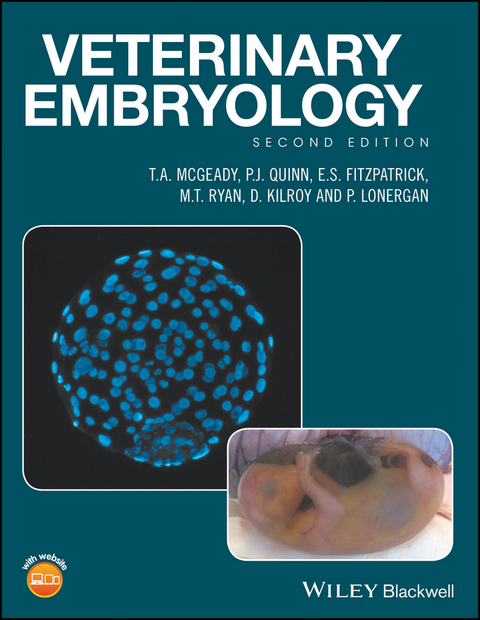
Veterinary Embryology (eBook)
John Wiley & Sons (Verlag)
978-1-118-94060-0 (ISBN)
Veterinary Embryology, 2nd Edition, has been updated to reflect the many changes that have developed in the field; the text has been fully revised and expanded and is now in full colour and many pedagogical features and a companion website have been developed.
- A new edition of this highly successful student textbook, updated to reflect the latest developments in the field of embryology, with the inclusion of four new chapters
- Written by a team of authors with extensive experience of teaching this subject
- Short concise chapters on key topics describe complex concepts in a user-friendly way
- Additional tables, flow diagrams and numerous hand-drawn illustrations support the concepts presented in the text
Thomas A. McGeady is former Dean of the Veterinary Faculty at University College Dublin. His academic career was spent in the Department of Veterinary Anatomy, Faculty of Veterinary Medicine, UCD, where he taught comparative embryology and developmental anatomy to veterinary students. His lectures and class notes provided the basis for many of the chapters in the first edition of Veterinary Embryology.
P.J. Quinn was Professor of Veterinary Microbiology and Parasitology and Head of the Department in the School of Veterinary Medicine, University College Dublin, from 1985 to 2002. He is the senior co-author of, amongst others, Veterinary Microbiology and Microbial Disease (2nd edition 2011), and Concise Review of Veterinary Microbiology (2nd edition 2016). He was awarded the title Professor Emeritus by University College Dublin in 2002. In 2006, he was recipient of the Association of Veterinary Teachers and Research Workers outstanding teaching award.
Eamonn S. FitzPatrick is former Chief Technical Officer in the School of Veterinary Medicine, University College Dublin. He is a Fellow of the Institute of Biomedical Science, and taught veterinary anatomy and histology for over 25 years. He is co-author of Veterinary Microbiology and Microbial Disease (2nd edition 2011) and Concise Review of Veterinary Microbiology (2nd edition 2016).
Marion T. Ryan is Senior Technical Officer and provides molecular biology support to the School of Veterinary Medicine, University College Dublin. She has published papers in a wide range of peer-reviewed journals encompassing the areas of veterinary and biomedical science education, animal genetics and host/pathogen interactions, having worked in the field of molecular biology and genetics for over 20 years.
David Kilroy is College Lecturer in Veterinary Biosciences in the School of Veterinary Medicine, University College Dublin. He has previously taught anatomy and embryology to students of science and veterinary medicine at the Royal Veterinary College, London. He is co-author of The Canine Abdomen for CLIVE (Computer-aided Learning In Veterinary Education) (2000).
Patrick Lonergan is Professor of Animal Reproduction in the School of Agriculture and Food Science, University College Dublin. His main areas of interest are early embryo development in vivo and in vitro, embryo-maternal communication and understanding embryo mortality. He has supervised numerous Masters and PhD students and Post-doctoral Fellows. He has a large volume of refereed research publications, recognised by the award of a D.Sc. Degree from National University of Ireland in 2005 and his election to the Royal Irish Academy in 2012. He is former President of the International Embryo Transfer Society, and currently serves on the Editorial Boards of the journals Biology of Reproduction and Reproduction Fertility and Development.
Veterinary Embryology, 2nd Edition, has been updated to reflect the many changes that have developed in the field; the text has been fully revised and expanded and is now in full colour and many pedagogical features and a companion website have been developed. A new edition of this highly successful student textbook, updated to reflect the latest developments in the field of embryology, with the inclusion of four new chapters Written by a team of authors with extensive experience of teaching this subject Short concise chapters on key topics describe complex concepts in a user-friendly way Additional tables, flow diagrams and numerous hand-drawn illustrations support the concepts presented in the text
Thomas A. McGeady is former Dean of the Veterinary Faculty at University College Dublin. His academic career was spent in the Department of Veterinary Anatomy, Faculty of Veterinary Medicine, UCD, where he taught comparative embryology and developmental anatomy to veterinary students. His lectures and class notes provided the basis for many of the chapters in the first edition of Veterinary Embryology. P.J. Quinn was Professor of Veterinary Microbiology and Parasitology and Head of the Department in the School of Veterinary Medicine, University College Dublin, from 1985 to 2002. He is the senior co-author of, amongst others, Veterinary Microbiology and Microbial Disease (2nd edition 2011), and Concise Review of Veterinary Microbiology (2nd edition 2016). He was awarded the title Professor Emeritus by University College Dublin in 2002. In 2006, he was recipient of the Association of Veterinary Teachers and Research Workers outstanding teaching award. Eamonn S. FitzPatrick is former Chief Technical Officer in the School of Veterinary Medicine, University College Dublin. He is a Fellow of the Institute of Biomedical Science, and taught veterinary anatomy and histology for over 25 years. He is co-author of Veterinary Microbiology and Microbial Disease (2nd edition 2011) and Concise Review of Veterinary Microbiology (2nd edition 2016). Marion T. Ryan is Senior Technical Officer and provides molecular biology support to the School of Veterinary Medicine, University College Dublin. She has published papers in a wide range of peer-reviewed journals encompassing the areas of veterinary and biomedical science education, animal genetics and host/pathogen interactions, having worked in the field of molecular biology and genetics for over 20 years. David Kilroy is College Lecturer in Veterinary Biosciences in the School of Veterinary Medicine, University College Dublin. He has previously taught anatomy and embryology to students of science and veterinary medicine at the Royal Veterinary College, London. He is co-author of The Canine Abdomen for CLIVE (Computer-aided Learning In Veterinary Education) (2000). Patrick Lonergan is Professor of Animal Reproduction in the School of Agriculture and Food Science, University College Dublin. His main areas of interest are early embryo development in vivo and in vitro, embryo-maternal communication and understanding embryo mortality. He has supervised numerous Masters and PhD students and Post-doctoral Fellows. He has a large volume of refereed research publications, recognised by the award of a D.Sc. Degree from National University of Ireland in 2005 and his election to the Royal Irish Academy in 2012. He is former President of the International Embryo Transfer Society, and currently serves on the Editorial Boards of the journals Biology of Reproduction and Reproduction Fertility and Development.
About the authors, vii
Preface, ix
Acknowledgements, xi
About the companion website, xii
1 Historical aspects of embryology, 1
2 Division, growth and differentiation of cells, 13
3 Gametogenesis, 20
4 Fertilisation, 26
5 Cleavage, 33
6 Gastrulation, 39
7 Cell signalling and gene functioning during development, 45
8 Stem cells, 59
9 Establishment of the basic body plan, 67
10 Coelomic cavities, 73
11 Foetal membranes, 81
12 Forms of implantation and placentation, 92
13 Embryo mortality in domestic species, 112
14 Cardiovascular system, 119
15 Embryological and postnatal features of haematopoiesis, 148
16 Nervous system, 167
17 Muscular and skeletal systems, 195
18 Digestive system, 214
19 Respiratory system, 232
20 Urinary system, 240
21 Male and female reproductive systems, 251
22 Structures in the head and neck, 274
23 Endocrine system, 289
24 Eye and ear, 298
25 Integumentary system, 314
26 Age determination of the embryo and foetus, 331
27 Assisted reproductive technologies used in domestic species, 338
28 Genetic, chromosomal and environmental factors which
adversely affect prenatal development, 351
Glossary, 371
Useful websites, 377
Index, 379
"Overall, this is a great resource for anyone new to the field of embryology/developmental biology or related fields. The book is written in a way that is easy to follow and understand. The extensive use of illustrations throughout the book makes it a great learning tool, especially for concepts that are difficult to visualize...One of the major improvements in this edition is the incorporation of color in the illustrations, which greatly enhances the interpretation of the images." (Doody Enterprises 07/04/2017)
"The second edition of Veterinary Embryology is the best available source of current information on the topic. The content is comprehensive, authoritative, logically organized, and amply complemented with color illustrations that are generous in size and generally effective in highlighting stages of embryo development. Those illustrations are also available from a companion website"...."Tables in the book contain a wealth of information regarding embryo features and gestational timing for various domestic animals. Additionally, the book highlights molecular details of gene expression, stem cell lineage related to twinning, and a comprehensive description of hematopoietic development. This book is a good value for the price. I highly recommend it as the best available resource for information related to veterinary embryology. As a textbook, students will appreciate the key points and color illustrations" (Reviewed by Thomas F. Fletcher, DVM, PhD, University of Minnesota 15th June 2017 AVMA)
Chapter 1
Historical aspects of embryology
Key Points
- Up to the eighteenth century, the prevailing view of many scientists and scholars interested in embryology was that of preformation, namely that organisms develop from miniatures of themselves.
- An alternative hypothesis of embryonic development, referred to as epigenesis, proposed that the structure of an animal emerges gradually from a relatively formless egg. The epigenesis theory, first proposed by the Greek philosopher Aristotle, preceded the preformation theory by two millennia.
- Major advances in reproductive and developmental biology took place in the seventeenth century. Until that time, early civilisations held the view that a foetus resulted from the mixing of two parental ‘seeds’.
- In human embryology, ovists believed in generation from oocytes while spermists believed that males contributed the essential characteristics of their offspring with females contributing only a material substrate. This theory was the dominant view of embryonic development until the late seventeenth century.
- As microscopy improved during the eighteenth century, biologists observed that embryos developed in a series of progressive steps and epigenesis displaced preformation as the basis of embryological development.
- Progress in understanding and manipulation of reproductive biology from a point in the past when the origins of human life were not understood to a point where early embryos can be generated in vitro represents a phenomenal scientific achievement.
Introduction
Embryology, as it relates to domestic animals, is concerned with the sequential stages of embryonic and foetal development, beginning with fertilisation. This dynamic science utilises cell biology, genetics and biochemistry to explain the complexities of development.
All mammals begin life as embryos. Despite the steadily increasing understanding of embryonic development and its underlying regulatory mechanisms, much remains to be discovered. For students of animal biology, veterinary medicine and related health sciences, embryology offers an insight into the development of the mammalian body at both the microscopic and anatomical levels. It also provides an important introduction to animal genetics, organ systems and reproductive biology.
At a superficial level, the basis of human reproduction is widely understood in most modern societies. In previous centuries, however, biological aspects of reproduction in the human population and among animal populations were a cause of considerable debate and much uncertainty prevailed. In the seventeenth and eighteenth centuries, the issue of ‘generation’, as the formation of new life was called, evoked strong religious and philosophical responses on the part of theologians and scholars, generating more heat than light. Indeed, the term ‘reproduction’ was not used until the eighteenth century. Prior to that time, there was no understanding that an organism was being copied, as the term implied.
Dominant theories of generation in the seventeenth and eighteenth centuries
In the history of embryology, preformationism was a theory of generation widely accepted from the late seventeenth to the end of the eighteenth century. This concept proposed that organisms develop from miniature versions of themselves, already fully formed in the eggs or sperm of their parents prior to conception. Epigenesis, the alternative theory to preformationism, contended that through a series of stages each embryo or organism was gradually produced from an undifferentiated mass.
Ovism, which held that the maternal egg was the location of the preformed embryo, was one of two models of preformationism. The other model, known as spermism, contended that offspring develop from a tiny, fully formed, embryo contained within the head of a sperm. The origin of spermism derived from the microscopic demonstration of the existence of sperm in the late 1670s. Support for ovism peaked in the mid to late eighteenth century but, by the turn of the nineteenth century, it had declined. While spermism was never as dominant as ovist preformationism, it had ardent followers whose work and writings greatly influenced the development of embryology during this period.
The origins of life
The art forms which were a feature of Stone Age civilisations conveyed the thinking of the time in relation to generation. Some of the earliest images created by humans are Venus figurines carved from soft stone, bone or ivory, or made of fired clay, most of which date from the Gravettian period, 28,000 to 22,000 years ago. In some of these figurines, certain parts of the female anatomy including the abdomen, hips, breasts, thighs and vulva were exaggerated. Archaeologists speculate that these figurines may be fertility symbols and may represent the earliest images of humans endeavouring to understand their own biological origins.
Prior to the seventeenth century, assumptions relating to the origin of life varied. It was generally believed that in mammals, including humans, ‘like bred like’, although it was not certain that this always occurred. Some believed, for example, that women could give birth to other species; claims that an English woman, Mary Toft from Godalming, Surrey, gave birth to rabbits in 1726 were widely accepted before she confessed that her story was untrue.
As recently as the beginning of the last century, the Polish anthropologist Bronisław Kasper Malinowski (1884 to 1942) claimed that the inhabitants of the Trobriand Islands in the South Pacific were unaware that babies resulted from sexual intercourse. In their native language, the word for ‘father’ literally means ‘my mother’s husband’, suggesting a social rather than biological relationship. While perhaps surprising at first, there are good reasons why a link between the sexual act and the birth of a child may not have been obvious, since women can have sex without becoming pregnant. Furthermore, even when conception did occur, the two events, sex and birth, were separated by 9 months and were therefore not immediately associated with each other. Indeed, it has been postulated that human understanding of the association between mating and reproduction came through the domestication of animals some 10,000 years ago. In these animals, mating only occurs during a defined period of sexual receptivity termed oestrus, creating an observable link between mating and pregnancy.
On the basis of these observations, the realisation that male semen or ‘seed’, the only clearly and immediately observable product of copulation, was fundamental to the creation of life became central to the concept of generation. In religious beliefs and in mythology, the male’s role in the creation of new life rapidly became dominant. For example, in the Book of Genesis, it is written that Onan ‘spilled his seed on the ground’ in order to avoid making his sister‐in‐law pregnant. In Egyptian mythology, the story of creation relates that Atum‐Ra created the earth, and the first god and goddess, from his seed through masturbation. This semen/seed analogy dominated all subsequent thinking about generation.
Contributions of the Ancient Greeks
In Europe, up to the second half of the seventeenth century, beliefs on virtually every question relating to life science were dominated by the teaching of Ancient Greek philosophers. In the fifth century BCE, the Greek physician Hippocrates (circa 460 to 370 BCE), considered to be one of the most outstanding figures in the history of medicine, argued that generation took place through the joint action of two kinds of semen, one from the male ejaculate, the other from the female’s menstrual blood. A century later, the Greek philosopher and scientist Aristotle (384 to 322 BCE) published De generatione animalium (The Generation of Animals) about 350 BCE, the first work to provide a comprehensive theory of the mechanisms of reproduction in a variety of animals. He described the concepts of oviparity (birth from eggs), viviparity (live birth) and ovoviviparity (production of an egg that hatches inside the body). He also described the holoblastic and meroblastic patterns of cell division (see Chapter 5). He made the important observation that the organs develop gradually in the embryo (epigenesis) and are not preformed. In contrast to Hippocrates, Aristotle believed that only the male’s semen or ‘seed’ contributed to the ‘form’ of the foetus and that this form was imprinted onto the ‘matter’ which was provided by the menstrual blood of the female, much like a seal stamping hot wax. Another analogy, which has persisted to the present day, was that semen was like a seed which was sown on fertile ground. Aristotle argued that lower animals such as insects generated spontaneously from decay. This theory corresponded with the everyday experience of observing maggots appearing suddenly on rotting matter, but this concept was ultimately refuted by Francesco Redi (1626 to 1698) in the mid 1600s (see below).
In the second century CE, Galen (129 to circa 200), a prominent Greek physician, surgeon and philosopher in the Roman Empire, supported the...
| Erscheint lt. Verlag | 8.2.2017 |
|---|---|
| Sprache | englisch |
| Themenwelt | Medizin / Pharmazie |
| Naturwissenschaften ► Biologie | |
| Veterinärmedizin ► Klinische Fächer | |
| Schlagworte | Animal Development • Biowissenschaften • Cardiovascular System • cell differentiation • cell division • cell growth • cell signaling • Cell signalling • Cleavage • coelomic cavities • Embryology • Embryonic cells • Fertilisation • Fertilization • fetal membranes • foetal membranes • gametogenesis • Gastrulation • gene functioning • haematopoiesis • Life Sciences • <p>Veterinary embryology • organogenesis</p> • Stem Cells • Tiermedizin • Veterinäranatomie u. -physiologie • Veterinärmedizin • Veterinäranatomie u. -physiologie • Veterinärmedizin • Veterinary Anatomy & Physiology • Veterinary Medicine • Zoologie / Individualentwicklung |
| ISBN-10 | 1-118-94060-1 / 1118940601 |
| ISBN-13 | 978-1-118-94060-0 / 9781118940600 |
| Informationen gemäß Produktsicherheitsverordnung (GPSR) | |
| Haben Sie eine Frage zum Produkt? |
 EPUB (Adobe DRM)
Kopierschutz: Adobe-DRM
Adobe-DRM ist ein Kopierschutz, der das eBook vor Mißbrauch schützen soll. Dabei wird das eBook bereits beim Download auf Ihre persönliche Adobe-ID autorisiert. Lesen können Sie das eBook dann nur auf den Geräten, welche ebenfalls auf Ihre Adobe-ID registriert sind.
Details zum Adobe-DRM
Dateiformat: EPUB (Electronic Publication)
EPUB ist ein offener Standard für eBooks und eignet sich besonders zur Darstellung von Belletristik und Sachbüchern. Der Fließtext wird dynamisch an die Display- und Schriftgröße angepasst. Auch für mobile Lesegeräte ist EPUB daher gut geeignet.
Systemvoraussetzungen:
PC/Mac: Mit einem PC oder Mac können Sie dieses eBook lesen. Sie benötigen eine
eReader: Dieses eBook kann mit (fast) allen eBook-Readern gelesen werden. Mit dem amazon-Kindle ist es aber nicht kompatibel.
Smartphone/Tablet: Egal ob Apple oder Android, dieses eBook können Sie lesen. Sie benötigen eine
Geräteliste und zusätzliche Hinweise
Buying eBooks from abroad
For tax law reasons we can sell eBooks just within Germany and Switzerland. Regrettably we cannot fulfill eBook-orders from other countries.
aus dem Bereich