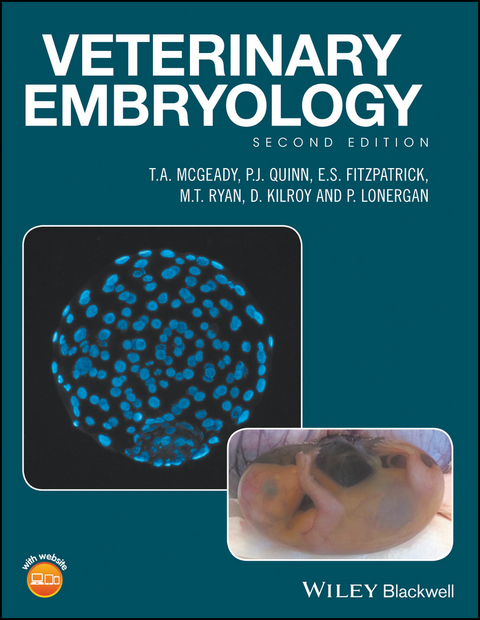
Veterinary Embryology (eBook)
John Wiley & Sons (Verlag)
978-1-118-94059-4 (ISBN)
Veterinary Embryology, 2nd Edition, has been updated to reflect the many changes that have developed in the field; the text has been fully revised and expanded and is now in full colour and many pedagogical features and a companion website have been developed.
- A new edition of this highly successful student textbook, updated to reflect the latest developments in the field of embryology, with the inclusion of four new chapters
- Written by a team of authors with extensive experience of teaching this subject
- Short concise chapters on key topics describe complex concepts in a user-friendly way
- Additional tables, flow diagrams and numerous hand-drawn illustrations support the concepts presented in the text
Thomas A. McGeady is former Dean of the Veterinary Faculty at University College Dublin. His academic career was spent in the Department of Veterinary Anatomy, Faculty of Veterinary Medicine, UCD, where he taught comparative embryology and developmental anatomy to veterinary students. His lectures and class notes provided the basis for many of the chapters in the first edition of Veterinary Embryology.
P.J. Quinn was Professor of Veterinary Microbiology and Parasitology and Head of the Department in the School of Veterinary Medicine, University College Dublin, from 1985 to 2002. He is the senior co-author of, amongst others, Veterinary Microbiology and Microbial Disease (2nd edition 2011), and Concise Review of Veterinary Microbiology (2nd edition 2016). He was awarded the title Professor Emeritus by University College Dublin in 2002. In 2006, he was recipient of the Association of Veterinary Teachers and Research Workers outstanding teaching award.
Eamonn S. FitzPatrick is former Chief Technical Officer in the School of Veterinary Medicine, University College Dublin. He is a Fellow of the Institute of Biomedical Science, and taught veterinary anatomy and histology for over 25 years. He is co-author of Veterinary Microbiology and Microbial Disease (2nd edition 2011) and Concise Review of Veterinary Microbiology (2nd edition 2016).
Marion T. Ryan is Senior Technical Officer and provides molecular biology support to the School of Veterinary Medicine, University College Dublin. She has published papers in a wide range of peer-reviewed journals encompassing the areas of veterinary and biomedical science education, animal genetics and host/pathogen interactions, having worked in the field of molecular biology and genetics for over 20 years.
David Kilroy is College Lecturer in Veterinary Biosciences in the School of Veterinary Medicine, University College Dublin. He has previously taught anatomy and embryology to students of science and veterinary medicine at the Royal Veterinary College, London. He is co-author of The Canine Abdomen for CLIVE (Computer-aided Learning In Veterinary Education) (2000).
Patrick Lonergan is Professor of Animal Reproduction in the School of Agriculture and Food Science, University College Dublin. His main areas of interest are early embryo development in vivo and in vitro, embryo-maternal communication and understanding embryo mortality. He has supervised numerous Masters and PhD students and Post-doctoral Fellows. He has a large volume of refereed research publications, recognised by the award of a D.Sc. Degree from National University of Ireland in 2005 and his election to the Royal Irish Academy in 2012. He is former President of the International Embryo Transfer Society, and currently serves on the Editorial Boards of the journals Biology of Reproduction and Reproduction Fertility and Development.
Veterinary Embryology, 2nd Edition, has been updated to reflect the many changes that have developed in the field; the text has been fully revised and expanded and is now in full colour and many pedagogical features and a companion website have been developed. A new edition of this highly successful student textbook, updated to reflect the latest developments in the field of embryology, with the inclusion of four new chapters Written by a team of authors with extensive experience of teaching this subject Short concise chapters on key topics describe complex concepts in a user-friendly way Additional tables, flow diagrams and numerous hand-drawn illustrations support the concepts presented in the text
Thomas A. McGeady is former Dean of the Veterinary Faculty at University College Dublin. His academic career was spent in the Department of Veterinary Anatomy, Faculty of Veterinary Medicine, UCD, where he taught comparative embryology and developmental anatomy to veterinary students. His lectures and class notes provided the basis for many of the chapters in the first edition of Veterinary Embryology. P.J. Quinn was Professor of Veterinary Microbiology and Parasitology and Head of the Department in the School of Veterinary Medicine, University College Dublin, from 1985 to 2002. He is the senior co-author of, amongst others, Veterinary Microbiology and Microbial Disease (2nd edition 2011), and Concise Review of Veterinary Microbiology (2nd edition 2016). He was awarded the title Professor Emeritus by University College Dublin in 2002. In 2006, he was recipient of the Association of Veterinary Teachers and Research Workers outstanding teaching award. Eamonn S. FitzPatrick is former Chief Technical Officer in the School of Veterinary Medicine, University College Dublin. He is a Fellow of the Institute of Biomedical Science, and taught veterinary anatomy and histology for over 25 years. He is co-author of Veterinary Microbiology and Microbial Disease (2nd edition 2011) and Concise Review of Veterinary Microbiology (2nd edition 2016). Marion T. Ryan is Senior Technical Officer and provides molecular biology support to the School of Veterinary Medicine, University College Dublin. She has published papers in a wide range of peer-reviewed journals encompassing the areas of veterinary and biomedical science education, animal genetics and host/pathogen interactions, having worked in the field of molecular biology and genetics for over 20 years. David Kilroy is College Lecturer in Veterinary Biosciences in the School of Veterinary Medicine, University College Dublin. He has previously taught anatomy and embryology to students of science and veterinary medicine at the Royal Veterinary College, London. He is co-author of The Canine Abdomen for CLIVE (Computer-aided Learning In Veterinary Education) (2000). Patrick Lonergan is Professor of Animal Reproduction in the School of Agriculture and Food Science, University College Dublin. His main areas of interest are early embryo development in vivo and in vitro, embryo-maternal communication and understanding embryo mortality. He has supervised numerous Masters and PhD students and Post-doctoral Fellows. He has a large volume of refereed research publications, recognised by the award of a D.Sc. Degree from National University of Ireland in 2005 and his election to the Royal Irish Academy in 2012. He is former President of the International Embryo Transfer Society, and currently serves on the Editorial Boards of the journals Biology of Reproduction and Reproduction Fertility and Development.
Title Page 5
Copyright Page 6
Contents 7
About the authors 9
Preface 11
Acknowledgements 13
About the companion website 14
Chapter 1 Historical aspects of embryology 15
Introduction 15
Dominant theories of generation in the seventeenth and eighteenth centuries 15
The origins of life 16
Contributions of the Ancient Greeks 16
The emergence of comparative embryology 17
The discovery of sperm 19
Experimental embryology 20
Evolutionary embryology 22
Genes and heredity 24
Creating life in vitro 24
Further reading 26
Chapter 2 Division, growth and differentiation of cells 27
The cell cycle 27
Mitosis 28
Stages of mitosis 28
Regulation of mitosis 30
Meiosis 31
The first meiotic division 31
The second meiotic division 31
Consequences of non?disjunction of chromosomes during meiosis 33
Further reading 33
Chapter 3 Gametogenesis 34
Spermatogenesis 34
Oogenesis 36
Ovulation 37
Transport of oocytes in the uterine tube 39
In utero migration of embryos 39
Optimal time for fertilisation of the oocyte 39
Retention of fertilising capacity of spermatozoa 39
Further reading 39
Chapter 4 Fertilisation 40
Capacitation 41
Cellular events in the process of fertilisation 41
Barriers to polyspermy 42
Oocyte activation 42
Comparative fertilisation rates 45
Sex determination 45
Parthenogenesis 45
Sex ratio 45
Chromosomes of domestic animals 46
Further reading 46
Chapter 5 Cleavage 47
Cleavage in primitive chordates, amphibians, avian species and mammals 49
Primitive chordates 49
Amphibians 49
Avian species 49
Mammals 49
Further reading 52
Chapter 6 Gastrulation 53
Primitive chordates 53
Amphibians 53
Avian species 54
Mammals 56
Establishment of left–right symmetry in vertebrates 56
Twinning 57
Conjoined twins 58
Further reading 58
Chapter 7 Cell signalling and gene functioning during development 59
Types of signalling 59
Paracrine signalling 59
Contact-dependent signalling 60
Autocrine signalling 60
Synaptic signalling 60
Endocrine signalling 60
Signalling pathways 60
Signal regulation during development 60
Induction and competence 61
Cellular messengers and receptors 62
Paracrine and contact-dependent signalling during embryological development 62
Hedgehog family 62
Fibroblast growth factor family 62
Wingless family 62
Transforming growth factor superfamily 63
Notch signalling 64
Apoptosis 65
Adhesion and migration 66
Morphogens 67
Gene structure and organisation 67
DNA methylation and parental imprinting in mammals 67
X-chromosome inactivation 67
Histone modifications 68
Gene regulation 68
Transcription factors 68
Gene systems essential for development 68
Hox genes and segmental identity in Drosophila 68
Experimental measurement of gene expression 71
Experimental evaluation of gene function 71
Concluding comments 71
Further reading 72
Chapter 8 Stem cells 73
Stem cells in the embryo 74
Stem cells in adult mammals 74
Stem cells and embryological development 77
Induced pluripotent stem cells and their applications 77
Stem cells in domestic animals 79
Further reading 80
Chapter 9 Establishment of the basic body plan 81
Further reading 86
Chapter 10 Coelomic cavities 87
Pleural and pericardial cavities 87
Pleural cavities 87
Pericardial cavity 88
Diaphragm 88
Anomalies of the diaphragm 90
Peritoneal cavity 92
Omenta 92
Further reading 94
Chapter 11 Foetal membranes 95
Development of the foetal membranes 97
Avian species 97
Yolk sac 97
Amnion and chorion 98
Allantois 98
Mammals 100
Yolk sac 100
Amnion and chorion 102
Allantois 102
Foetal fluids 102
Structures associated with foetal membranes 104
Umbilical cord 104
Anomalies associated with foetal membranes 105
Further reading 105
Chapter 12 Forms of implantation and placentation 106
Implantation 106
In utero spacing and embryo orientation 107
Endocrine control of implantation 108
Delayed implantation 108
Ectopic pregnancy 108
Embryonic mortality 108
Placentation in mammals 109
Choriovitelline placenta 109
Chorioallantoic placenta 109
Classification of chorioallantoic placentation 109
Histological classification of placentation 110
Placental haemophagous organs 112
Implantation and placentation in pigs 112
Implantation and placentation in cattle and sheep 114
Implantation and placentation in horses 118
Implantation and placentation in dogs and cats 121
Functional aspects of the placenta 122
Immunological aspects of foetal–maternal relationships 124
Further reading 125
Chapter 13 Embryo mortality in domestic species 126
Introduction 126
Establishment of pregnancy in cattle 127
Causes of embryonic mortality 127
Genetic factors involved in early embryonic mortality 127
Oocyte quality 127
Origin of the embryo 128
Role of progesterone in the establishment of pregnancy 128
Nutrition and energy balance 128
Embryonic mortality in high?producing dairy cows 129
Heat stress 129
Immune system 129
Time of occurrence and incidence of embryo loss in cattle 130
Embryo mortality in sheep 130
Embryo mortality in pigs 130
Embryo mortality in horses 131
Embryo mortality in dogs 131
Embryo mortality in cats 131
Further reading 131
Chapter 14 Cardiovascular system 133
Development of the cardiac tubes 134
Molecular aspects of cardiac development 138
Formation of the cardiac chambers 138
Partitioning of the atrio-ventricular canal 140
Partitioning of the common foetal atrium 140
Final form of the right atrium 140
Final form of the left atrium 141
Formation of the left and right ventricles 141
Partitioning of the conus cordis and truncus arteriosus 143
Closure of the inter?ventricular foramen 143
Formation of cardiac valves 143
Conducting system of the heart 143
Development of the arterial system 145
Derivatives of the aortic arch arteries 145
Development of the venous system 150
Foetal and neonatal circulation 152
Circulatory changes at birth 154
Developmental anomalies of the cardiovascular system 156
Patent ductus arteriosus 156
Pulmonary stenosis 156
Aortic stenosis 157
Tetralogy of Fallot 158
Inter-atrial septal defects 158
Inter-ventricular septal defects 158
Ectopia cordis cervicalis 158
Congenital venous (portosystemic) shunts 158
Vascular ring anomalies 160
Further reading 161
Chapter 15 Embryological and postnatal features of haematopoiesis 162
Ontogeny of haematopoiesis 162
Sites of haematopoiesis in the developing embryo 163
Cellular activity and other factors in the adult bone marrow which influence HSC development and activity 166
Acellular factors involved in haematopoiesis 167
Haematopoiesis in avian species 168
Immunodeficiency 173
Primary immunodeficiencies relating to innate immunity 173
Congenital neutropenia 173
Canine cyclical neutropenia 173
Chédiak-Higashi syndrome 173
Chronic granulomatous disease 175
Leukocyte adhesion deficiency 175
Genetic deficiencies of complement components 177
Primary immunodeficiencies relating to adaptive immunity 177
Severe combined immunodeficiency diseases 177
Thymic aplasia or hypoplasia 179
Wiskott-Aldrich syndrome 179
Primary immunodeficiency diseases involving B lymphocytes 179
Further reading 180
Chapter 16 Nervous system 181
Dorsal?ventral patterning of the neural tube 182
Neural crest 183
Differentiation of the cellular components of the neural tube 183
Development of glial cells 183
Development of neurons 185
Spinal nerves 185
Myelination of peripheral nerve fibres 187
The final position of the spinal cord relative to the developing vertebral column 187
Anomalies of the spinal cord 188
Differentiation of the brain subdivisions 188
Rhombencephalon 189
Myelencephalon 189
Metencephalon 191
Cerebellum 191
Mesencephalon 195
Differentiation of the prosencephalon or forebrain 196
Ventricular system of the brain and cerebrospinal fluid circulation 198
Blood–brain barrier 199
Molecular aspects of brain development 199
Brain anomalies 201
Exencephaly 201
Microencephaly 201
Hydranencephaly 201
Hydrocephalus 201
Cyclopia 201
Arnold–Chiari malformation 201
Cerebellar hypoplasia 202
Brain stem and spinal cord 202
Cranial nerves 202
Special sensory nerves 202
Cranial nerves with exclusively motor functions 202
Cranial nerves with both sensory and motor function 204
Peripheral nervous system 204
Autonomic nervous system 204
Sympathetic nervous system 204
Parasympathetic nervous system 206
Enteric nervous system 206
Meninges 206
Further reading 208
Chapter 17 Muscular and skeletal systems 209
Differentiation of somites 209
Muscular system 209
Skeletal muscle 210
Cytodifferentiation of muscle 211
Smooth muscle 211
Cardiac muscle 211
Histogenesis of skeletal muscle fibres 211
Skeletal system 212
Histogenesis of cartilage 212
Bone formation 213
Cells of bone 213
Structural and functional aspects of bone 214
Osteogenesis 214
Skeletal anomalies 225
Achondroplasia 225
Osteogenesis imperfecta 225
Osteopetrosis 225
Vertebral defects 225
Rib defects 227
Sternal defects 227
Limb defects 227
Further reading 227
Chapter 18 Digestive system 228
Molecular regulation of alimentary tract development 229
Cranial–caudal pattern of development 229
Dorsal–ventral pattern of development 230
Positioning of the alimentary tract along the left–right axis of the embryo 230
Radial development of the alimentary tract 230
Oesophagus 230
Stomach 231
Bovine stomach 233
Avian stomach and related structures 235
Liver 235
Pancreas 236
Spleen 238
Development and rotation of the intestines in domestic animals 239
Comparative features of the intestines 239
Ruminant intestines 239
Porcine intestines 239
Equine intestines 242
Hindgut 242
Developmental anomalies of the alimentary tract 243
Stenosis of specific regions of the alimentary tract 243
Atresia 243
Imperforate anus 243
Urorectal fistula 243
Omphalocoele 243
Congenital umbilical hernia 243
Vitelline duct anomalies 243
Situs inversus 244
Congenital megaoesophagus 244
Megacolon (Hirschsprung’s disease) 245
Further reading 245
Chapter 19 Respiratory system 246
Formation of the larynx 246
Trachea, bronchi and lungs 247
Subdivision of the lung 249
Molecular aspects of respiratory development 250
Anomalies of the respiratory system 252
Further reading 253
Chapter 20 Urinary system 254
Kidney 254
Pronephros 254
Mesonephros 255
Metanephros 256
Molecular basis of metanephros development 256
Specification of ureteric buds 256
Branching of the ureteric buds 256
Unilobar kidneys 259
Multilobar kidneys 259
Kidneys of aquatic mammals 259
Kidneys of domestic animals 262
Bladder 263
Developmental anomalies of the urinary system 264
Renal agenesis 264
Ectopic kidney 264
Ectopic ureter 264
Horseshoe kidney 264
Congenital cystic kidney 264
Further reading 264
Chapter 21 Male and female reproductive systems 265
Primordial germ cells 265
Undifferentiated stage of gonad formation 265
Differentiation and maturation of the testes 266
Differentiation and maturation of the ovaries 268
Features of equine gonadal development 268
Genital ducts 269
Differentiation of the male duct system in mammals 269
Differentiation of the female duct system in mammals 270
Avian gonads and associated ducts 272
Formation of the genital fold 272
External genitalia 272
Differentiation of the external genitalia 272
Factors which influence sexual differentiation in mammals 274
Molecular aspects of sexual differentiation and gonadogenesis 274
Influence of hormones on development of genital ducts and external genitalia 276
Sexual differentiation, associated brain function and subsequent sexual behaviour at puberty 276
Anomalies of sexual development 278
Freemartinism in cattle 279
Freemartinism in species other than cattle 280
Segmental aplasia of the paramesonephric ducts 280
Descent of the testes 280
Ovarian migration 282
Cryptorchidism 282
Development of the mammary gland 283
Monotremes 283
Marsupials 283
Eutheria 283
Development of mammary glands in domestic animals 283
Development of the bovine mammary gland 283
Comparative features of mammary gland development in domestic animals 285
Sheep and goats 285
Mares 285
Sows 285
Bitches and queens 285
Further reading 287
Chapter 22 Structures in the head and neck 288
Pharyngeal region 288
Derivatives of the pharyngeal apparatus 289
Pharyngeal arch derivatives 289
Pharyngeal pouch derivatives 289
Pharyngeal clefts 291
Aortic arch artery derivatives 291
Muscles in the head which develop from somitomeres and somites 291
Face 291
Nasal cavities 292
Conchae 294
Vomeronasal organ 296
Paranasal sinuses 296
Oral cavity 296
Tongue 296
Salivary glands 297
Teeth 297
Development of a brachyodont tooth 298
Development of a hypsodont tooth 300
Comparative aspects of dentition 300
Molecular aspects of tooth development 300
Development of the skull 300
Membranous neurocranium 300
Cartilaginous neurocranium 301
Membranous viscerocranium 301
Cartilaginous viscerocranium 301
Congenital malformations of face and oral cavity 301
Cleft lip and palate 301
Agnathia 302
Brachygnathia 302
Prognathia (Maxillary brachygnathia) 302
Choanal atresia or stenosis 302
Atresia of the naso?lacrimal duct 302
Anomalies of the tongue 302
Pharyngeal cysts 302
Abnormal dentition 302
Further reading 302
Chapter 23 Endocrine system 303
Pituitary gland 303
Molecular regulation of pituitary gland development 304
Pineal gland 305
Adrenal glands 306
Thyroid gland 306
Molecular regulation of thyroid gland development 309
Parathyroid glands 309
Thymus 309
Pancreatic islets 311
Further reading 311
Chapter 24 Eye and ear 312
Eye 312
Molecular aspects of development of the eye 312
Differentiation of the optic cup 314
Lens 316
Formation of the eyelids 317
Muscles of the eye 320
Anomalies of the eye 320
Ear 320
Inner ear 321
Middle ear 324
External ear 325
Otic induction 325
Further reading 327
Chapter 25 Integumentary system 328
Epidermis 328
Dermis 330
Hypodermis 330
Hair 331
Sinus hair follicle 333
Hair growth cycle 333
Mammalian skin glands 333
Sebaceous glands 333
Sweat glands 334
Avian skin 335
Feathers 335
Congenital and inherited defects of the skin 337
Hooves and claws 337
Equine hoof 337
Chestnuts and ergots 339
Ruminant and porcine hooves 339
Canine and feline claws 339
Footpads 340
Horns and related structures 340
Further reading 343
Chapter 26 Age determination of the embryo and foetus 345
Further reading 351
Chapter 27 Assisted reproductive technologies used in domestic species 352
The impact of reproductive technologies on animal breeding 353
Assisted reproductive technologies in cattle 353
Artificial insemination 353
Multiple ovulation embryo transfer (MOET) 354
In vitro fertilisation (IVF) 356
Transvaginal oocyte recovery or ‘ovum pick-up’ (OPU) 357
Sex-sorting of spermatozoa 357
Cloning 357
Transgenesis 359
Genome editing 360
Assisted reproductive technologies in other domestic species 360
ARTs in small ruminants (sheep and goats) 360
ARTs in pigs 361
ARTs in horses 361
ARTs in dogs 362
ARTs in cats 363
ARTs in endangered species 363
Further reading 363
Chapter 28 Genetic, chromosomal and environmental factors which adversely affect prenatal development 365
Mutations 366
Chromosomal abnormalities 367
Teratogens 368
Therapeutic drugs and chemicals 369
Cytotoxic drugs used for treating neoplastic diseases 369
Poisonous plants 369
Infectious agents 369
Assessing the aetiology of congenital disease 383
Concluding comments 383
Further reading 384
Glossary 385
Useful websites 391
Index 393
EULA 401
"Overall, this is a great resource for anyone new to the field of embryology/developmental biology or related fields. The book is written in a way that is easy to follow and understand. The extensive use of illustrations throughout the book makes it a great learning tool, especially for concepts that are difficult to visualize...One of the major improvements in this edition is the incorporation of color in the illustrations, which greatly enhances the interpretation of the images." (Doody Enterprises 07/04/2017)
"The second edition of Veterinary Embryology is the best available source of current information on the topic. The content is comprehensive, authoritative, logically organized, and amply complemented with color illustrations that are generous in size and generally effective in highlighting stages of embryo development. Those illustrations are also available from a companion website"...."Tables in the book contain a wealth of information regarding embryo features and gestational timing for various domestic animals. Additionally, the book highlights molecular details of gene expression, stem cell lineage related to twinning, and a comprehensive description of hematopoietic development. This book is a good value for the price. I highly recommend it as the best available resource for information related to veterinary embryology. As a textbook, students will appreciate the key points and color illustrations" (Reviewed by Thomas F. Fletcher, DVM, PhD, University of Minnesota 15th June 2017 AVMA)
| Erscheint lt. Verlag | 2.2.2017 |
|---|---|
| Sprache | englisch |
| Themenwelt | Medizin / Pharmazie |
| Naturwissenschaften ► Biologie | |
| Veterinärmedizin ► Klinische Fächer | |
| Schlagworte | Animal Development • Biowissenschaften • Cardiovascular System • cell differentiation • cell division • cell growth • cell signaling • Cell signalling • Cleavage • coelomic cavities • Embryology • Embryonic cells • Fertilisation • Fertilization • fetal membranes • foetal membranes • gametogenesis • Gastrulation • gene functioning • haematopoiesis • Life Sciences • <p>Veterinary embryology • organogenesis</p> • Stem Cells • Tiermedizin • Veterinäranatomie u. -physiologie • Veterinärmedizin • Veterinäranatomie u. -physiologie • Veterinärmedizin • Veterinary Anatomy & Physiology • Veterinary Medicine • Zoologie / Individualentwicklung |
| ISBN-10 | 1-118-94059-8 / 1118940598 |
| ISBN-13 | 978-1-118-94059-4 / 9781118940594 |
| Informationen gemäß Produktsicherheitsverordnung (GPSR) | |
| Haben Sie eine Frage zum Produkt? |
 PDF (Adobe DRM)
Kopierschutz: Adobe-DRM
Adobe-DRM ist ein Kopierschutz, der das eBook vor Mißbrauch schützen soll. Dabei wird das eBook bereits beim Download auf Ihre persönliche Adobe-ID autorisiert. Lesen können Sie das eBook dann nur auf den Geräten, welche ebenfalls auf Ihre Adobe-ID registriert sind.
Details zum Adobe-DRM
Dateiformat: PDF (Portable Document Format)
Mit einem festen Seitenlayout eignet sich die PDF besonders für Fachbücher mit Spalten, Tabellen und Abbildungen. Eine PDF kann auf fast allen Geräten angezeigt werden, ist aber für kleine Displays (Smartphone, eReader) nur eingeschränkt geeignet.
Systemvoraussetzungen:
PC/Mac: Mit einem PC oder Mac können Sie dieses eBook lesen. Sie benötigen eine
eReader: Dieses eBook kann mit (fast) allen eBook-Readern gelesen werden. Mit dem amazon-Kindle ist es aber nicht kompatibel.
Smartphone/Tablet: Egal ob Apple oder Android, dieses eBook können Sie lesen. Sie benötigen eine
Geräteliste und zusätzliche Hinweise
Buying eBooks from abroad
For tax law reasons we can sell eBooks just within Germany and Switzerland. Regrettably we cannot fulfill eBook-orders from other countries.
aus dem Bereich