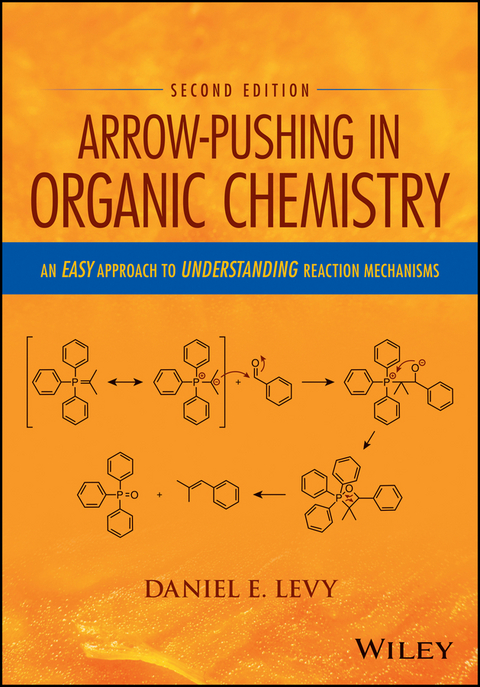
Arrow-Pushing in Organic Chemistry (eBook)
John Wiley & Sons (Verlag)
978-1-118-99120-6 (ISBN)
• Includes new chapters, an expanded index, and additional problem sets complete with detailed solutions
• Focuses on understanding the mechanics and logic of organic reaction mechanisms
• Introduces ionic and non-ionic reactive species and reaction mechanisms
• Teaches strategies to predict reactive species, sites of reactions, and reaction products
• Provides a solid foundation upon which organic chemistry students can advance with confidence
DANIEL E. LEVY, PhD, is the owner of DEL BioPharma LLC, USA. He previously worked at Glycomed, COR Therapeutics, Scios, and Intradigm. Dr. Levy developed, with Dr. Péter Fügedi, short courses entitled 'Modern Synthetic Carbohydrate Chemistry' and 'The Organic Chemistry of Sugars.' He has three books to his credit, including the rst edition of Arrow-Pushing in Organic Chemistry (Wiley, 2008). He received his bachelors in chemistry from the University of California- Berkeley and his doctorate in organic chemistry from the Massachusetts Institute of Technology.
DANIEL E. LEVY, PhD, is the owner of DEL BioPharma LLC, USA. He previously worked at Glycomed, COR Therapeutics, Scios, and Intradigm. Dr. Levy developed, with Dr. Péter Fügedi, short courses entitled "Modern Synthetic Carbohydrate Chemistry" and "The Organic Chemistry of Sugars." He has three books to his credit, including the rst edition of Arrow-Pushing in Organic Chemistry (Wiley, 2008). He received his bachelors in chemistry from the University of California- Berkeley and his doctorate in organic chemistry from the Massachusetts Institute of Technology.
Chapter 1
Introduction
The study of organic chemistry focuses on the chemistry of elements and materials essential for the existence of life. In addition to carbon, the most common elements present in organic molecules are hydrogen, oxygen, nitrogen, sulfur, and various halogens. Through the study of organic chemistry, our understanding of the forces binding these elements to one another and how these bonds can be manipulated are explored. In general, our ability to manipulate organic molecules is influenced by several factors that include the nature of functional groups near sites of reaction, the nature of reagents utilized in reactions, and the nature of potential leaving groups. In addition, these three factors impart further variables that influence the course of organic reactions. For example, the nature of the reagents used in given reactions can influence the reaction mechanisms and ultimately the reaction products. By recognizing the interplay between these factors and by applying principles of arrow‐pushing, which in reality represents bookkeeping of electrons, reasonable predictions of organic mechanisms and products can be realized without the burden of committing to memory the wealth of organic reactions studied in introductory courses. In this chapter, the concept of arrow‐pushing is defined in context with various reaction types, functional groups, mechanism types, reagents/nucleophiles, and leaving groups.
1.1 DEFINITION OF ARROW‐PUSHING
Organic chemistry is generally presented through a treatment of how organic chemicals are converted from starting materials to products. For example, the Wittig reaction (Scheme 1.1) is used for the conversion of aldehydes and ketones to olefins, and the Diels–Alder reaction (Scheme 1.2) is used for the formation of six‐membered ring systems and treatment of alkyl halides with reagents such as tributyltin hydride (Scheme 1.3), resulting in removal of the associated halides. However, by presenting these reactions as illustrated in Schemes 1.1, 1.2, and 1.3, no explanation is provided as to how the starting materials end up as their respective products.
Scheme 1.1 Example of the Wittig reaction.
Scheme 1.2 Example of the Diels–Alder reaction.
Scheme 1.3 Example of a tin hydride dehalogenation.
By definition, the outcome of any chemical reaction is the result of a process resulting in the breaking and formation of chemical bonds. Referring to material covered in most general chemistry courses, bonds between atoms are defined by sets of two electrons. Specifically, a single bond between two atoms is made of two electrons, a double bond between atoms is made of two sets of two electrons, and a triple bond between atoms is made of three sets of two electrons. These types of bonds can generally be represented by Lewis structures using pairs of dots to illustrate the presence of an electron pair. In organic chemistry, these dots are most commonly replaced with lines. Figure 1.1 illustrates several types of chemical bonds using both electron dot notation and line notation. The list of bond types shown in Figure 1.1 is not intended to be exhaustive with respect to functional groups or potential combinations of atoms.
Figure 1.1 Examples of chemical bonds.
While chemical bonds are represented by lines connecting atoms, electron dot notation is commonly used to represent lone pairs (nonbonding pairs) of electrons. Lone pairs are found on heteroatoms (atoms other than carbon or hydrogen) that do not require bonds with additional atoms to fill their valence shell of eight electrons. For example, atomic carbon possesses four valence electrons. In order for carbon to achieve a full complement of eight valence electrons in its outer shell, it must form four chemical bonds, leaving no electrons as lone pairs. Atomic nitrogen, on the other hand, possesses five valence electrons. In order for nitrogen to achieve a full complement of eight valence electrons, it must form three chemical bonds, leaving two electrons as a lone pair. Similarly, atomic oxygen possesses six valence electrons. In order for oxygen to achieve a full complement of eight valence electrons, it must form two chemical bonds, leaving four electrons as two sets of lone pairs. In the examples of chemical bonds shown in Figure 1.1, lone pairs are not represented in order to focus on the bonds themselves. In Figure 1.2 the missing lone pairs are added where appropriate. Lone pairs are extremely important in understanding organic mechanisms because they frequently provide the sources of electron density necessary to drive reactions as will be discussed throughout this book.
Figure 1.2 Examples of chemical bonds and lone pairs.
As organic reactions proceed through the breaking and subsequent formation of chemical bonds, it is now important to understand the various ways in which atomic bonds can be broken. In general, there are three ways in which this process can be initiated. As shown in Scheme 1.4, the first is simple separation of a single bond where one electron from the bond resides on one atom and the other electron resides on the other atom. This type of bond cleavage is known as homolytic cleavage because the electron density is equally shared between the separate fragments and no charged species are generated. It is this process that leads to free radical reactions.
Scheme 1.4 Illustration of homolytic cleavage.
Unlike homolytic cleavage, heterolytic cleavage (Scheme 1.5) of a chemical bond results in one species retaining both electrons from the bond and one species retaining no electrons from the bond. In general, this also results in the formation of ionic species where the fragment retaining the electrons from the bond becomes negatively charged while the other fragment becomes positively charged. These charged species then become available to participate in ion‐based transformations governed by the electronic nature of reactants or adjacent functional groups.
Scheme 1.5 Illustration of heterolytic cleavage.
Having introduced homolytic cleavage and heterolytic cleavage as the first two ways in which bonds are broken at the initiation of organic reactions, attention must be drawn to the possibility that bonds can rearrange into lower energy configurations through concerted mechanisms where bonds are simultaneously broken and formed. This third process, associated with pericyclic reactions, is illustrated in Scheme 1.6 using the Cope rearrangement and does not involve free radicals or ions as intermediates. Instead, it relies on the overlap of atomic orbitals, thus allowing the transfer of electron density that drives the conversion from starting material to product. Regardless, whether reactions rely on free radicals, ions, or concerted mechanisms, all can be explained and/or predicted using the principles of arrow‐pushing.
Scheme 1.6 Illustration of a concerted reaction (Cope rearrangement).
Arrow‐pushing is a term used to define the process of using arrows to conceptually move electrons in order to describe the mechanistic steps involved in the transition of starting materials to products. An example of arrow‐pushing is illustrated in Scheme 1.7 as applied to the Cope rearrangement introduced in Scheme 1.6. As the Cope rearrangement proceeds through a concerted mechanism, the movement of electrons is shown in a single step. As will become apparent, arrow‐pushing is broadly useful to explain even very complex and multistep mechanisms. However, while arrow‐pushing is useful to explain and describe diverse mechanistic types, it is important to note that different types of arrows are used depending on the type of bond cleavage involved in a given reaction. Specifically, when homolytic cleavage is involved in the reaction mechanism, single‐barbed arrows are used to signify the movement of single electrons. Alternatively, when heterolytic cleavage or concerted steps are involved in the reaction mechanism, double‐barbed arrows are used to signify the movement of electron pairs. Schemes 1.8 and 1.9 illustrate the use of appropriate arrows applied to homolytic cleavage and heterolytic cleavage, respectively.
Scheme 1.7 Illustration of arrow‐pushing applied to the Cope rearrangement.
Scheme 1.8 Application of arrow‐pushing to homolytic cleavage using single‐barbed arrows.
Scheme 1.9 Application of arrow‐pushing to heterolytic cleavage using double‐barbed arrows.
1.2 FUNCTIONAL GROUPS
Having presented the...
| Erscheint lt. Verlag | 13.2.2017 |
|---|---|
| Sprache | englisch |
| Themenwelt | Naturwissenschaften ► Biologie ► Biochemie |
| Naturwissenschaften ► Chemie ► Organische Chemie | |
| Naturwissenschaften ► Chemie ► Physikalische Chemie | |
| Technik | |
| Schlagworte | Biochemie • biochemistry • Biowissenschaften • Chemie • Chemistry • Life Sciences • Organic Chemistry • Organic chemistry, arrow-pushing, reaction mechanisms, reactive species, free radicals, carbenes, heterolytic, homolytic, pericyclic • Organische Chemie • Pharmaceutical & Medicinal Chemistry • Pharmazeutische u. Medizinische Chemie |
| ISBN-10 | 1-118-99120-6 / 1118991206 |
| ISBN-13 | 978-1-118-99120-6 / 9781118991206 |
| Informationen gemäß Produktsicherheitsverordnung (GPSR) | |
| Haben Sie eine Frage zum Produkt? |
 EPUB (Adobe DRM)
Kopierschutz: Adobe-DRM
Adobe-DRM ist ein Kopierschutz, der das eBook vor Mißbrauch schützen soll. Dabei wird das eBook bereits beim Download auf Ihre persönliche Adobe-ID autorisiert. Lesen können Sie das eBook dann nur auf den Geräten, welche ebenfalls auf Ihre Adobe-ID registriert sind.
Details zum Adobe-DRM
Dateiformat: EPUB (Electronic Publication)
EPUB ist ein offener Standard für eBooks und eignet sich besonders zur Darstellung von Belletristik und Sachbüchern. Der Fließtext wird dynamisch an die Display- und Schriftgröße angepasst. Auch für mobile Lesegeräte ist EPUB daher gut geeignet.
Systemvoraussetzungen:
PC/Mac: Mit einem PC oder Mac können Sie dieses eBook lesen. Sie benötigen eine
eReader: Dieses eBook kann mit (fast) allen eBook-Readern gelesen werden. Mit dem amazon-Kindle ist es aber nicht kompatibel.
Smartphone/Tablet: Egal ob Apple oder Android, dieses eBook können Sie lesen. Sie benötigen eine
Geräteliste und zusätzliche Hinweise
Buying eBooks from abroad
For tax law reasons we can sell eBooks just within Germany and Switzerland. Regrettably we cannot fulfill eBook-orders from other countries.
aus dem Bereich