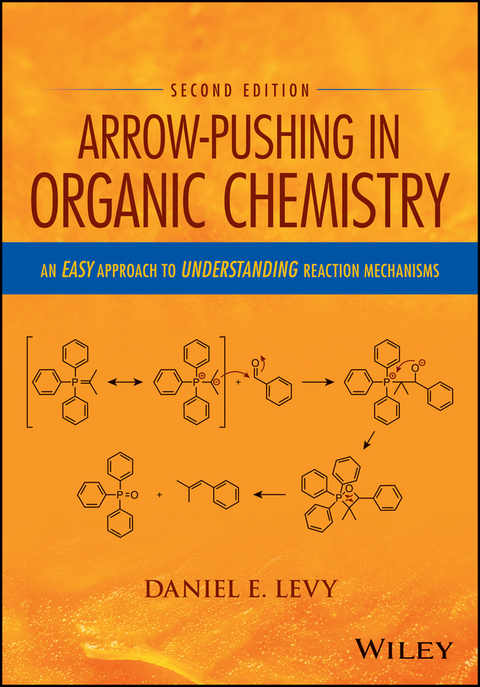
Arrow-Pushing in Organic Chemistry (eBook)
John Wiley & Sons (Verlag)
978-1-118-99134-3 (ISBN)
• Includes new chapters, an expanded index, and additional problem sets complete with detailed solutions
• Focuses on understanding the mechanics and logic of organic reaction mechanisms
• Introduces ionic and non-ionic reactive species and reaction mechanisms
• Teaches strategies to predict reactive species, sites of reactions, and reaction products
• Provides a solid foundation upon which organic chemistry students can advance with confidence
DANIEL E. LEVY, PhD, is the owner of DEL BioPharma LLC, USA. He previously worked at Glycomed, COR Therapeutics, Scios, and Intradigm. Dr. Levy developed, with Dr. Péter Fügedi, short courses entitled 'Modern Synthetic Carbohydrate Chemistry' and 'The Organic Chemistry of Sugars.' He has three books to his credit, including the rst edition of Arrow-Pushing in Organic Chemistry (Wiley, 2008). He received his bachelors in chemistry from the University of California- Berkeley and his doctorate in organic chemistry from the Massachusetts Institute of Technology.
Organic chemistry is required coursework for degrees in life, food, and medical sciences. To help the students discouraged by the belief that this topic cannot be mastered without significant memorization, Arrow Pushing in Organic Chemistry serves as a handy supplement for understanding the subject. Includes new chapters, an expanded index, and additional problem sets complete with detailed solutions Focuses on understanding the mechanics and logic of organic reaction mechanisms Introduces ionic and non-ionic reactive species and reaction mechanisms Teaches strategies to predict reactive species, sites of reactions, and reaction products Provides a solid foundation upon which organic chemistry students can advance with confidence
DANIEL E. LEVY, PhD, is the owner of DEL BioPharma LLC, USA. He previously worked at Glycomed, COR Therapeutics, Scios, and Intradigm. Dr. Levy developed, with Dr. Péter Fügedi, short courses entitled "Modern Synthetic Carbohydrate Chemistry" and "The Organic Chemistry of Sugars." He has three books to his credit, including the rst edition of Arrow-Pushing in Organic Chemistry (Wiley, 2008). He received his bachelors in chemistry from the University of California- Berkeley and his doctorate in organic chemistry from the Massachusetts Institute of Technology.
Title Page 5
Copyright Page 6
Contents 9
Preface 13
Acknowledgements 15
About the Author 17
Chapter 1 Introduction 19
1.1 DEFINITION OF ARROW?PUSHING 19
1.2 FUNCTIONAL GROUPS 23
1.3 NUCLEOPHILES AND LEAVING GROUPS 25
1.4 SUMMARY 26
PROBLEMS 27
Chapter 2 Free Radicals 37
2.1 WHAT ARE FREE RADICALS? 37
2.2 HOW ARE FREE RADICALS FORMED? 39
2.2.1 Free Radical Initiators 40
2.2.2 Electron Transfer 41
2.3 FREE RADICAL STABILITY 41
2.4 WHAT TYPES OF REACTIONS INVOLVE FREE RADICALS? 43
2.4.1 Halogenation Reactions 44
2.4.2 Polymerization Reactions 46
2.4.3 Oxidation Reactions 48
2.5 SUMMARY 49
PROBLEMS 50
Chapter 3 Acids 55
3.1 WHAT ARE ACIDS? 55
3.2 WHAT IS RESONANCE? 56
3.3 HOW IS ACIDITY MEASURED? 59
3.4 RELATIVE ACIDITIES 60
3.5 INDUCTIVE EFFECTS 65
3.6 INDUCTIVE EFFECTS AND RELATIVE ACIDITIES 67
3.7 RELATIVE ACIDITIES OF HYDROCARBONS 68
3.8 SUMMARY 69
PROBLEMS 70
Chapter 4 Bases and Nucleophiles 79
4.1 WHAT ARE BASES? 79
4.2 WHAT ARE NUCLEOPHILES? 84
4.3 LEAVING GROUPS 88
4.4 SUMMARY 88
PROBLEMS 89
Chapter 5 SN2 Substitution Reactions 99
5.1 WHAT IS AN SN2 REACTION? 99
5.2 WHAT ARE LEAVING GROUPS? 101
5.3 WHERE CAN SN2 REACTIONS OCCUR? 102
5.4 SN2? REACTIONS 103
5.5 SUMMARY 106
PROBLEMS 107
Chapter 6 SN1 Substitution Reactions 115
6.1 WHAT IS AN SN1 REACTION? 115
6.2 HOW ARE SN1 REACTIONS INITIATED? 116
6.3 THE CARBOCATION 117
6.3.1 Molecular Structure and Orbitals 118
6.3.2 Stability of Carbocations 121
6.4 CARBOCATION REARRANGEMENTS 123
6.4.1 1,2?Hydride Shifts 123
6.4.2 1,2?Alkyl Shifts 124
6.4.3 Preventing Side Reactions 127
6.5 SUMMARY 127
PROBLEMS 128
Chapter 7 Elimination Reactions 133
7.1 E1 ELIMINATIONS 133
7.2 E1cB ELIMINATIONS 136
7.3 E2 ELIMINATIONS 138
7.4 HOW DO ELIMINATION REACTIONS WORK? 139
7.5 E1cB ELIMINATIONS VERSUS E2 ELIMINATIONS 142
7.6 SUMMARY 142
PROBLEMS 144
Chapter 8 Addition Reactions 151
8.1 ADDITION OF HALOGENS TO DOUBLE BONDS 151
8.2 MARKOVNIKOV’S RULE 153
8.3 ADDITIONS TO CARBONYLS 155
8.3.1 1,2?Additions 155
8.3.2 1,4?Additions 156
8.3.3 Addition–Elimination Reactions 159
8.4 SUMMARY 161
PROBLEMS 162
Chapter 9 Carbenes 171
9.1 WHAT ARE CARBENES? 171
9.2 HOW ARE CARBENES FORMED? 172
9.3 REACTIONS WITH CARBENES 174
9.3.1 Carbene Dimerization 174
9.3.2 Cyclopropanation Reactions 175
9.3.3 O-H Insertion Reactions 179
9.4 CARBENES VERSUS CARBENOIDS 180
9.5 SUMMARY 181
PROBLEMS 182
Chapter 10 Pericyclic Reactions 189
10.1 WHAT ARE PERICYCLIC REACTIONS? 189
10.2 ELECTROCYCLIC REACTIONS 190
10.3 CYCLOADDITION REACTIONS 193
10.3.1 The Diels–Alder Reaction 193
10.3.2 The Ene Reaction 196
10.3.3 Dipolar Cycloaddition Reactions 198
10.4 SIGMATROPIC REACTIONS 200
10.4.1 The Cope Rearrangement 201
10.4.2 The Claisen Rearrangement 202
10.5 SUMMARY 205
PROBLEMS 207
Chapter 11 Moving Forward 213
11.1 FUNCTIONAL GROUP MANIPULATIONS 213
11.2 NAME REACTIONS 214
11.3 REAGENTS 226
11.4 FINAL COMMENTS 226
PROBLEMS 227
Appendix 1 pKa Values of Protons Associated with Common Functional Groups 237
Appendix 2 Answers and Explanations to Problems 241
Appendix 3 Student Reaction Glossary 387
Index 391
Periodic Table of Elements 419
EULA 420
| Erscheint lt. Verlag | 13.2.2017 |
|---|---|
| Sprache | englisch |
| Themenwelt | Naturwissenschaften ► Biologie ► Biochemie |
| Naturwissenschaften ► Chemie ► Organische Chemie | |
| Naturwissenschaften ► Chemie ► Physikalische Chemie | |
| Technik | |
| Schlagworte | Biochemie • biochemistry • Biowissenschaften • Chemie • Chemistry • Life Sciences • Organic Chemistry • Organic chemistry, arrow-pushing, reaction mechanisms, reactive species, free radicals, carbenes, heterolytic, homolytic, pericyclic • Organische Chemie • Pharmaceutical & Medicinal Chemistry • Pharmazeutische u. Medizinische Chemie |
| ISBN-10 | 1-118-99134-6 / 1118991346 |
| ISBN-13 | 978-1-118-99134-3 / 9781118991343 |
| Informationen gemäß Produktsicherheitsverordnung (GPSR) | |
| Haben Sie eine Frage zum Produkt? |
 PDF (Adobe DRM)
Kopierschutz: Adobe-DRM
Adobe-DRM ist ein Kopierschutz, der das eBook vor Mißbrauch schützen soll. Dabei wird das eBook bereits beim Download auf Ihre persönliche Adobe-ID autorisiert. Lesen können Sie das eBook dann nur auf den Geräten, welche ebenfalls auf Ihre Adobe-ID registriert sind.
Details zum Adobe-DRM
Dateiformat: PDF (Portable Document Format)
Mit einem festen Seitenlayout eignet sich die PDF besonders für Fachbücher mit Spalten, Tabellen und Abbildungen. Eine PDF kann auf fast allen Geräten angezeigt werden, ist aber für kleine Displays (Smartphone, eReader) nur eingeschränkt geeignet.
Systemvoraussetzungen:
PC/Mac: Mit einem PC oder Mac können Sie dieses eBook lesen. Sie benötigen eine
eReader: Dieses eBook kann mit (fast) allen eBook-Readern gelesen werden. Mit dem amazon-Kindle ist es aber nicht kompatibel.
Smartphone/Tablet: Egal ob Apple oder Android, dieses eBook können Sie lesen. Sie benötigen eine
Geräteliste und zusätzliche Hinweise
Buying eBooks from abroad
For tax law reasons we can sell eBooks just within Germany and Switzerland. Regrettably we cannot fulfill eBook-orders from other countries.
aus dem Bereich