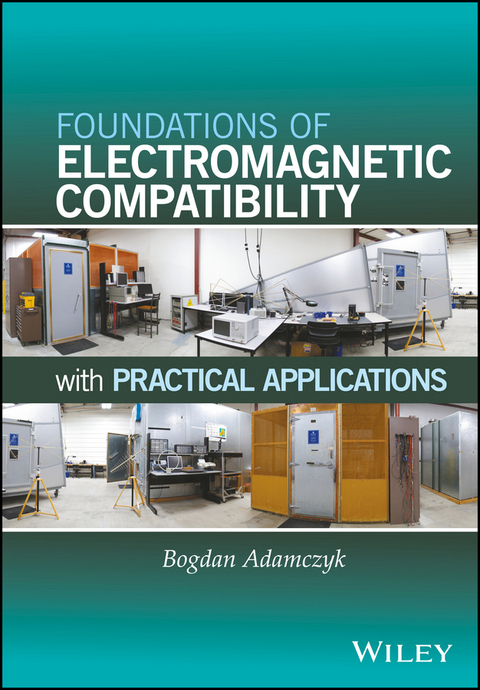
Foundations of Electromagnetic Compatibility (eBook)
John Wiley & Sons (Verlag)
978-1-119-12079-7 (ISBN)

There is currently no single book that covers the mathematics, circuits, and electromagnetics backgrounds needed for the study of electromagnetic compatibility (EMC). This book aims to redress the balance by focusing on EMC and providing the background in all three disciplines. This background is necessary for many EMC practitioners who have been out of study for some time and who are attempting to follow and confidently utilize more advanced EMC texts.
The book is split into three parts: Part 1 is the refresher course in the underlying mathematics; Part 2 is the foundational chapters in electrical circuit theory; Part 3 is the heart of the book: electric and magnetic fields, waves, transmission lines and antennas. Each part of the book provides an independent area of study, yet each is the logical step to the next area, providing a comprehensive course through each topic. Practical EMC applications at the end of each chapter illustrate the applicability of the chapter topics. The Appendix reviews the fundamentals of EMC testing and measurements.
About the Author
Bogdan Adamczyk is Professor of Engineering and the founder and director of the EMC Center at Grand Valley State University, Grand Rapids, USA. He is also the founder and principal educator of EMC Educational Services LLC, which specializes in EMC courses for industry. Professor Adamczyk's area of expertise is EMC education and EMC pre-compliance testing.
He is an iNARTE-certified EMC Master Design Engineer, a founding member and the chair of the IEEE EMC Chapter of West Michigan, and a member of the IEEE EMC Society Education Committee. He was a 2016 IEEE EMC Symposium Global University and Fundamentals of EMC instructor. This book has evolved from his participation at several IEEE EMC Symposia, EMC pre-compliance testing at the EMC Center, and his teaching of the Foundations of Electromagnetic Compatibility certificate courses for industry.
There is currently no single book that covers the mathematics, circuits, and electromagnetics backgrounds needed for the study of electromagnetic compatibility (EMC). This book aims to redress the balance by focusing on EMC and providing the background in all three disciplines. This background is necessary for many EMC practitioners who have been out of study for some time and who are attempting to follow and confidently utilize more advanced EMC texts. The book is split into three parts: Part 1 is the refresher course in the underlying mathematics; Part 2 is the foundational chapters in electrical circuit theory; Part 3 is the heart of the book: electric and magnetic fields, waves, transmission lines and antennas. Each part of the book provides an independent area of study, yet each is the logical step to the next area, providing a comprehensive course through each topic. Practical EMC applications at the end of each chapter illustrate the applicability of the chapter topics. The Appendix reviews the fundamentals of EMC testing and measurements.
Bogdan Adamczyk is Professor of Engineering and the founder and director of the EMC Center at Grand Valley State University, Grand Rapids, USA. He is also the founder and principal educator of EMC Educational Services LLC, which specializes in EMC courses for industry. Professor Adamczyk's area of expertise is EMC education and EMC pre-compliance testing. He is an iNARTE-certified EMC Master Design Engineer, a founding member and the chair of the IEEE EMC Chapter of West Michigan, and a member of the IEEE EMC Society Education Committee. He was a 2016 IEEE EMC Symposium Global University and Fundamentals of EMC instructor. This book has evolved from his participation at several IEEE EMC Symposia, EMC pre-compliance testing at the EMC Center, and his teaching of the Foundations of Electromagnetic Compatibility certificate courses for industry.
Title Page 5
Copyright Page 6
Contents 7
Preface 15
Part I Math Foundations of EMC 17
Chapter 1 Matrix and Vector Algebra 19
1.1 Basic Concepts and Operations 19
1.2 Matrix Multiplication 21
1.3 Special Matrices 22
1.4 Matrices and Determinants 23
1.5 Inverse of a Matrix 25
1.6 Matrices and Systems of Equations 26
1.7 Solution of Systems of Equations 27
1.8 Cramer’s Rule 28
1.9 Vector Operations 29
1.9.1 Scalar Product 29
1.9.2 Vector Product 29
1.10 EMC Applications 30
1.10.1 Crosstalk Model of Transmission Lines 30
1.10.2 Radiated Susceptibility Test 33
1.10.3 s Parameters 36
References 37
Chapter 2 Coordinate Systems 39
2.1 Cartesian Coordinate System 39
2.2 Cylindrical Coordinate System 41
2.3 Spherical Coordinate System 43
2.4 Transformations between Coordinate Systems 45
2.4.1 Transformation between Cartesian and Cylindrical Systems 45
2.4.2 Transformation between Cartesian and Spherical Systems 48
2.5 EMC Applications 49
2.5.1 Radiation Fields of an Electric Dipole Antenna 49
References 51
Chapter 3 Vector Differential Calculus 53
3.1 Derivatives 53
3.1.1 Basic Definition and Formulas 53
3.1.2 Composite Function and Chain Rule 55
3.1.3 Partial Derivative 55
3.2 Differential Elements 56
3.2.1 Differential Length Element 56
3.2.2 Differential Surface Element 59
3.2.3 Differential Volume Element 61
3.3 Constant-Coordinate Surfaces 61
3.3.1 Cartesian Coordinate System 62
3.3.2 Cylindrical Coordinate System 62
3.3.3 Spherical Coordinate System 63
3.3.4 Differential Elements on Constant Coordinate Surfaces 64
3.4 Differential Operators 66
3.4.1 Gradient 66
3.4.2 Divergence 67
3.4.3 Curl 68
3.4.4 Laplacian 70
3.5 EMC Applications 71
3.5.1 Transmission-Line Equations 71
3.5.2 Maxwell’s Equations in a Differential Form 72
3.5.3 Electromagnetic Wave Equation 73
References 73
Chapter 4 Vector Integral Calculus 75
4.1 Line Integrals 75
4.1.1 Indefinite and Definite Integrals 75
4.1.2 Line Integral 77
4.1.3 Properties of Line Integrals 79
4.2 Surface Integrals 82
4.2.1 Double Integrals 82
4.2.2 Surface Integrals 83
4.3 Volume Integrals 87
4.4 Divergence Theorem of Gauss 87
4.5 Stokes’s Theorem 87
4.6 EMC Applications 88
4.6.1 Maxwell’s Equations in an Integral Form 88
4.6.2 Loop and Partial Inductance 88
4.6.3 Ground Bounce and Power Rail Collapse 90
References 95
Chapter 5 Differential Equations 97
5.1 First Order Differential Equations – RC and RL Circuits 97
5.1.1 RC Circuit 97
5.1.2 RL Circuit 99
5.2 Second-Order Differential Equations – Series and Parallel RLC Circuits 101
5.2.1 Series RLC Circuit 101
5.2.2 Parallel RLC Circuit 110
5.3 Helmholtz Wave Equations 111
5.4 EMC Applications 115
5.4.1 Inductive Termination of a Transmission Line 115
5.4.2 Ringing on a Transmission Line 119
References 124
Chapter 6 Complex Numbers and Phasors 125
6.1 Definitions and Forms 125
6.2 Complex Conjugate 127
6.3 Operations on Complex Numbers 129
6.4 Properties of Complex Numbers 134
6.5 Complex Exponential Function 134
6.6 Sinusoids and Phasors 135
6.6.1 Sinusoids 135
6.6.2 Phasors 137
6.7 EMC Applications 139
6.7.1 Maxwell’s Equations in a Phasor Form 139
6.7.2 Transmission Line Equations in a Phasor Form 141
6.7.3 Magnetic Vector Potential 141
6.7.4 Radiated Fields of an Electric Dipole 144
6.7.5 Electric Dipole Antenna Radiated Power 153
References 156
Part II Circuits Foundations of EMC 157
Chapter 7 Basic Laws and Methods of Circuit Analysis 159
7.1 Fundamental Concepts 159
7.1.1 Current 159
7.1.2 Voltage 159
7.1.3 Power 160
7.1.4 Average Power in Sinusoidal Steady State 161
7.2 Laplace Transform Basics 163
7.2.1 Definition of Laplace Transform 163
7.2.2 Properties of Laplace Transform 165
7.2.3 Inverse Laplace Transform 166
7.3 Fundamental Laws 168
7.3.1 Resistors and Ohm’s Law 168
7.3.2 Inductors and Capacitors 170
7.3.3 Phasor Relationships for Circuit Elements 172
7.3.4 s Domain Relationships for Circuit Elements 174
7.3.5 Impedance in Phasor Domain 176
7.3.6 Impedance in the s Domain 179
7.3.7 Kirchhoff’s Laws in the Time Domain 180
7.3.8 Kirchhoff’s Laws in the Phasor Domain 183
7.3.9 Kirchhoff’s Laws in the s Domain 184
7.3.10 Resistors in Series and the Voltage Divider 185
7.3.11 Resistors in Parallel and the Current Divider 188
7.3.12 Impedance Combinations and Divider Rules in Phasor Domain 192
7.4 EMC Applications 199
7.4.1 Crosstalk between PCB Traces 199
7.4.2 Capacitive Termination of a Transmission Line 200
References 203
Chapter 8 Systematic Methods of Circuit Analysis 205
8.1 Node Voltage Analysis 205
8.1.1 Node Analysis for the Resistive Circuits 205
8.2 Mesh Current Analysis 208
8.2.1 Mesh Analysis for the Resistive Circuits 208
8.3 EMC Applications 211
8.3.1 Power Supply Filters – Common- and Differential-Mode Current Circuit Model 211
References 218
Chapter 9 Circuit Theorems and Techniques 219
9.1 Superposition 219
9.2 Source Transformation 223
9.3 Thévenin Equivalent Circuit 227
9.4 Norton Equivalent Circuit 233
9.5 Maximum Power Transfer 236
9.5.1 Maximum Power Transfer – Resistive Circuits 236
9.5.2 Maximum Power Transfer – Sinusoidal Steady State 239
9.6 Two-Port Networks 240
9.7 EMC Applications 252
9.7.1 Fourier Series Representation of Signals 252
9.7.2 Maximum Power Radiated by an Antenna 254
9.7.3 s Parameters 256
References 257
Chapter 10 Magnetically Coupled Circuits 259
10.1 Self and Mutual Inductance 259
10.2 Energy in a Coupled Circuit 264
10.3 Linear (Air-Core) Transformers 266
10.4 Ideal (Iron-Core) Transformers 267
10.5 EMC Applications 271
10.5.1 Common-Mode Choke 271
References 274
Chapter 11 Frequency-Domain Analysis 275
11.1 Transfer Function 275
11.2 Frequency-Transfer Function 283
11.2.1 Sinusoidal Steady-State Output 284
11.3 Bode Plots 288
11.4 Passive Filters 293
11.4.1 RL and RC Low-Pass Filters 293
11.4.2 RL and RC High-Pass Filters 296
11.4.3 Series and Parallel RLC Bandpass Filters 300
11.4.4 Series and Parallel RLC Band-Reject Filters 305
11.5 Resonance in RLC Circuits 310
11.5.1 Resonance in Series RLC Bandpass Filter 310
11.5.2 Resonance in Parallel RLC Bandpass Filter 316
11.5.3 Resonance in Other RLC Circuits 320
11.6 EMC Applications 324
11.6.1 Non-Ideal Behavior of Capacitors and Inductors 324
11.6.2 Decoupling Capacitors 326
11.6.3 EMC Filters 334
References 343
Chapter 12 Frequency Content of Digital Signals 345
12.1 Fourier Series and Frequency Content of Signals 345
12.1.1 Trigonometric Fourier Series 345
12.1.2 Exponential Fourier Series 351
12.1.3 Spectrum of the Digital Clock Signals 353
12.1.4 Spectral Bounds on Digital Clock Signals 361
12.2 EMC Applications 363
12.2.1 Effect of the Signal Amplitude, Fundamental Frequency, and Duty Cycle on the Frequency Content of Trapezoidal Signals 363
References 367
Part III Electromagnetics Foundations of EMC 369
Chapter 13 Static and Quasi-Static Electric Fields 371
13.1 Charge Distributions 371
13.2 Coulomb’s Law 372
13.3 Electric Field Intensity 373
13.4 Electric Field Due to Charge Distributions 374
13.5 Electric Flux Density 375
13.6 Gauss’s Law for the Electric Field 376
13.7 Applications of Gauss’s Law 376
13.8 Electric Scalar Potential and Voltage 383
13.9 Voltage Calculations due to Charge Distributions 385
13.10 Electric Flux Lines and Equipotential Surfaces 389
13.11 Maxwell’s Equations for Static Electric Field 390
13.12 Capacitance Calculations of Structures 390
13.12.1 Definition of Capacitance 390
13.12.2 Calculations of Capacitance 392
13.13 Electric Boundary Conditions 396
13.14 EMC Applications 401
13.14.1 Electrostatic Discharge (ESD) 401
13.14.2 Human-Body Model 408
13.14.3 Capacitive Coupling and Shielding 410
References 418
Chapter 14 Static and Quasi?Static Magnetic Fields 419
14.1 Magnetic Flux Density 419
14.2 Magnetic Field Intensity 420
14.3 Biot–Savart Law 420
14.4 Current Distributions 421
14.5 Ampere’s Law 422
14.6 Applications of Ampere’s Law 423
14.7 Magnetic Flux 425
14.8 Gauss’s Law for Magnetic Field 426
14.9 Maxwell’s Equations for Static Fields 426
14.10 Vector Magnetic Potential 427
14.11 Faraday’s Law 428
14.12 Inductance Calculations of Structures 432
14.13 Magnetic Boundary Conditions 434
14.14 EMC Applications 439
14.14.1 Current Probes 439
14.14.2 Magnetic Flux and Decoupling Capacitors 442
14.14.3 Magnetic Coupling and Shielding 444
References 453
Chapter 15 Rapidly Varying Electromagnetic Fields 455
15.1 Eddy Currents 455
15.2 Charge-Current Continuity Equation 456
15.3 Displacement Current 457
15.4 EMC Applications 460
15.4.1 Grounding and Current Return Path 460
15.4.2 Common-Impedance Coupling 464
References 468
Chapter 16 Electromagnetic Waves 469
16.1 Uniform Waves – Time Domain Analysis 469
16.2 Uniform Waves – Sinusoidal Steady?State Analysis 476
16.3 Reflection and Transmission of Uniform Waves at Boundaries 480
16.4 EMC Applications 483
16.4.1 Electromagnetic Wave Shielding 483
References 490
Chapter 17 Transmission Lines 491
17.1 Transient Analysis 491
17.1.1 Reflections on Transmission Lines 494
17.1.2 Bounce Diagram 509
17.1.3 Reflections at an Inductive Load 512
17.1.4 Reflections at a Capacitive Load 515
17.1.5 Transmission Line Discontinuity 517
17.2 Steady-State Analysis 525
17.2.1 Lossy Transmission Lines 525
17.2.2 Standing Waves 528
17.3 s Parameters 536
17.4 EMC Applications 543
17.4.1 Crosstalk between PCB traces 543
17.4.2 LISN Impedance Measurement 551
17.4.3 Preamp Gain and Attenuator Loss Measurement 556
References 558
Chapter 18 Antennas and Radiation 559
18.1 Bridge between the Transmission Line and Antenna Theory 559
18.2 Hertzian Dipole Antenna 560
18.3 Far Field Criteria 564
18.3.1 Wire-Type Antennas 564
18.3.2 Surface-Type Antennas 565
18.4 Half-Wave Dipole Antenna 567
18.5 Quarter-Wave Monopole Antenna 570
18.6 Image Theory 570
18.7 Differential- and Common-Mode Currents and Radiation 573
18.7.1 Differential- and Common-Mode Currents 573
18.7.2 Radiation from Differential- and Common-Mode Currents 575
18.8 Common Mode Current Creation 581
18.8.1 Circuits with a Shared Return Path 581
18.8.2 Differential Signaling 585
18.8.3 Common-Mode Current Creation 586
18.9 Antenna Circuit Model 587
18.9.1 Transmitting-Mode Model 587
18.9.2 Receiving-Mode Model 589
18.10 EMC Applications 591
18.10.1 EMC Antenna Measurements 591
18.10.2 Antenna VSWR and Impedance Measurements 593
18.10.3 Comb Transmitter Measurements 595
References 598
Appendix A: EMC Tests and Measurements 599
A.1 Introduction– FCC Part 15 and CISPR 22 Standards 599
A.1.1 Peak vs Quasi-Peak vs Average Measurements 599
A.1.2 FCC and CISPR 22 Limits 601
A.2 ConductedEmissions 604
A.2.1 FCC and CISPR 22 Voltage Method 607
A.2.2 CISPR 25 Voltage Method 608
A.2.3CISPR 25 Current Probe Method 612
A.3 RadiatedEmissions 616
A.3.1 Open-Area Test Site (OATS) Measurements 618
A.3.2 Semi-Anechoic Chamber Measurements 619
A.4 ConductedImmunity – ISO 11452-4 624
A.4.1 Substitution Method 629
A.4.2 Closed-Loop Method with Power Limitation 629
A.5 RadiatedImmunity 631
A.5.1 Radiated Immunity – ISO 11452-11 631
A.5.2 Radiated Immunity – ISO 11452-2 635
A.6 ElectrostaticDischarge (ESD) 636
References 643
Index 645
EULA 649
| Erscheint lt. Verlag | 14.2.2017 |
|---|---|
| Sprache | englisch |
| Themenwelt | Naturwissenschaften ► Physik / Astronomie ► Elektrodynamik |
| Technik ► Elektrotechnik / Energietechnik | |
| Technik ► Nachrichtentechnik | |
| Schlagworte | beginning electromagnetic theory • Circuit Theory & Design • Electrical & Electronics Engineering • Electrical Circuit Theory • electrical engineering text • Electric and Magnetic fields • Electromagnetic Compatibility • Elektromagnetische Verträglichkeit • Elektrotechnik u. Elektronik • (EMC) • IEEE EMC • mathematics for electricity and electronics • Numerical Methods & Algorithms • Numerische Methoden u. Algorithmen • Schaltkreise - Theorie u. Entwurf • Schaltkreistechnik |
| ISBN-10 | 1-119-12079-9 / 1119120799 |
| ISBN-13 | 978-1-119-12079-7 / 9781119120797 |
| Informationen gemäß Produktsicherheitsverordnung (GPSR) | |
| Haben Sie eine Frage zum Produkt? |
 PDF (Adobe DRM)
Kopierschutz: Adobe-DRM
Adobe-DRM ist ein Kopierschutz, der das eBook vor Mißbrauch schützen soll. Dabei wird das eBook bereits beim Download auf Ihre persönliche Adobe-ID autorisiert. Lesen können Sie das eBook dann nur auf den Geräten, welche ebenfalls auf Ihre Adobe-ID registriert sind.
Details zum Adobe-DRM
Dateiformat: PDF (Portable Document Format)
Mit einem festen Seitenlayout eignet sich die PDF besonders für Fachbücher mit Spalten, Tabellen und Abbildungen. Eine PDF kann auf fast allen Geräten angezeigt werden, ist aber für kleine Displays (Smartphone, eReader) nur eingeschränkt geeignet.
Systemvoraussetzungen:
PC/Mac: Mit einem PC oder Mac können Sie dieses eBook lesen. Sie benötigen eine
eReader: Dieses eBook kann mit (fast) allen eBook-Readern gelesen werden. Mit dem amazon-Kindle ist es aber nicht kompatibel.
Smartphone/Tablet: Egal ob Apple oder Android, dieses eBook können Sie lesen. Sie benötigen eine
Geräteliste und zusätzliche Hinweise
Buying eBooks from abroad
For tax law reasons we can sell eBooks just within Germany and Switzerland. Regrettably we cannot fulfill eBook-orders from other countries.
aus dem Bereich