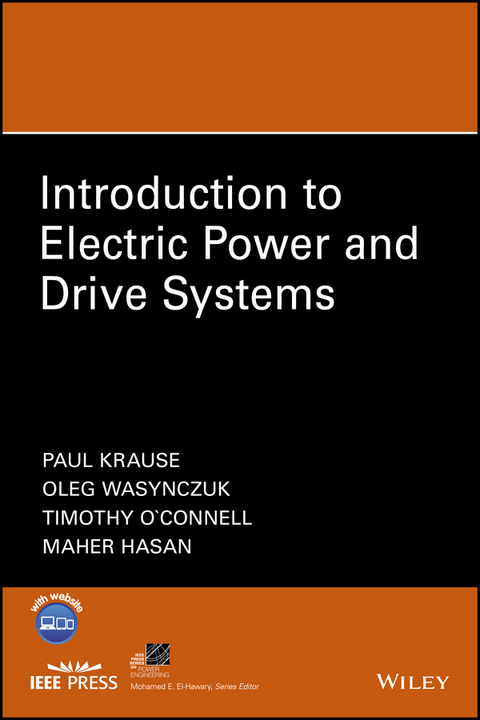
Introduction to Electric Power and Drive Systems (eBook)
John Wiley & Sons (Verlag)
978-1-119-21427-4 (ISBN)
An introduction to the analysis of electric machines, power electronic circuits, electric drive performance, and power systems
This book provides students with the basic physical concepts and analysis tools needed for subsequent coursework in electric power and drive systems with a focus on Tesla's rotating magnetic field. Organized in a flexible format, it allows instructors to select material as needed to fit their school's power program. The first chapter covers the fundamental concepts and analytical methods that are common to power and electric drive systems. The subsequent chapters offer introductory analyses specific to electric machines, power electronic circuits, drive system performance and simulation, and power systems. In addition, this book:
- Provides students with an analytical base on which to build in advanced follow-on courses
- Examines fundamental power conversions (dc-dc, ac-dc and dc-ac), harmonics, and distortion
- Describes the dynamic computer simulation of a brushless dc drive to illustrate its performance with both a sinusoidal inverter voltage approximation and more realistic stator six-step drive applied voltages
- Includes in-chapter short problems, numerous worked examples, and end-of-chapter problems to help readers review and more fully understand each topic
Paul C. Krause is Board Chairman of PC Krause and Associates Inc. (PCKA), and a retired Professor of Electrical and Computer Engineering at Purdue University. He has authored or co-authored more than 100 technical papers and is the co-author of Analysis of Electric Machinery and Drive Systems, Third Edition (Wiley-IEEE Press), and Electromechanical Motion Devices, Second Edition (Wiley-IEEE Press). He is a Life Fellow of the IEEE and was the 2010 recipient of the IEEE Nikola Tesla Award.
Oleg Wasynczuk is Professor of Electrical and Computer Engineering at Purdue University and Chief Technical Officer of PCKA. He has authored or co-authored more than 100 technical papers and is the co-author of Analysis of Electric Machinery and Drive Systems, Third Edition (Wiley-IEEE Press), and Electromechanical Motion Devices, Second Edition (Wiley-IEEE Press). He is a Fellow of the IEEE and was the 2008 recipient of the IEEE PES Cyril Veinott Electromechanical Energy Conversion Award.
Timothy O'Connell is a Senior Lead Engineer at PCKA, where he leads a multi-member industry modeling and simulation team supporting the design and analysis of more electric aircraft. He has authored or co-authored over 20 technical papers on electric machine analysis and design, aerospace power systems, and modeling and simulation. He is a Senior Member of IEEE.
Maher Hasan is a Senior Lead Engineer at PCKA, where he has led several software development efforts for the simulation of circuits and electromechanical and power systems, and is involved in modeling and simulation in support of multiple efforts. He has authored or co-authored several technical papers in the fields of dynamic simulation and numerical methods.Paul C. Krause is Board Chairman of PC Krause and Associates Inc. (PCKA), and a retired Professor of Electrical and Computer Engineering at Purdue University. He has authored or co-authored more than 100 technical papers and is the co-author of Analysis of Electric Machinery and Drive Systems, Third Edition (Wiley-IEEE Press), and Electromechanical Motion Devices, Second Edition (Wiley-IEEE Press). He is a Life Fellow of the IEEE and was the 2010 recipient of the IEEE Nikola Tesla Award. Oleg Wasynczuk is Professor of Electrical and Computer Engineering at Purdue University and Chief Technical Officer of PCKA. He has authored or co-authored more than 100 technical papers and is the co-author of Analysis of Electric Machinery and Drive Systems, Third Edition (Wiley-IEEE Press), and Electromechanical Motion Devices, Second Edition (Wiley-IEEE Press). He is a Fellow of the IEEE and was the 2008 recipient of the IEEE PES Cyril Veinott Electromechanical Energy Conversion Award. Timothy O'Connell is a Senior Lead Engineer at PCKA, where he leads a multi-member industry modeling and simulation team supporting the design and analysis of more electric aircraft. He has authored or co-authored over 20 technical papers on electric machine analysis and design, aerospace power systems, and modeling and simulation. He is a Senior Member of IEEE. Maher Hasan is a Senior Lead Engineer at PCKA, where he has led several software development efforts for the simulation of circuits and electromechanical and power systems, and is involved in modeling and simulation in support of multiple efforts. He has authored or co-authored several technical papers in the fields of dynamic simulation and numerical methods.
ABOUT THE AUTHORS ix
PREFACE AND ACKNOWLEDGMENT xi
CHAPTER 1 BASIC CONCEPTS 1
1.1 Introduction 1
1.2 Phasor Analysis and Power Calculations 1
Power and Reactive Power 5
1.3 Elementary Magnetic Circuits 8
Field Energy and Coenergy 13
1.4 Stationary Coupled Circuits 16
Magnetically Linear Transformer 16
Field Energy 20
1.5 Coupled Circuits in Relative Motion 22
Field Energy 25
1.6 Electromagnetic Force and Torque 26
1.7 Elementary Electromechanical Device 32
1.8 Two- and Three-Phase Systems 35
Two-Phase Systems 35
Three-Phase Systems 37
References 40
Problems 40
CHAPTER 2 ELECTRIC MACHINES 43
2.1 Introduction 43
2.2 Fundamentals of Electric Machine Analysis 44
Concentrated Winding 44
Distributed Windings 47
Rotating Air-Gap MMF - Tesla's Rotating Magnetic Field 52
Two-Pole Two-Phase Stator 52
Three-Phase Stator 56
P-Pole Machines 58
Machine Inductances 62
2.3 Two-Phase Permanent-Magnet AC Machine 63
2.4 Analysis of a Two-Phase Permanent-Magnet AC Machine 69
Transformation 70
Steady-State Analysis 77
2.5 Three-Phase Permanent-Magnet AC Machine 81
Voltage Equations and Winding Inductances 82
Torque 83
The qsr-, dsr-, and 0s- Equations 84
References 89
Problems 89
CHAPTER 3 POWER ELECTRONICS 91
3.1 Introduction 91
3.2 Switching-Circuit Fundamentals 91
Power Conversion Principles 92
Fourier Analysis 95
Switches and Switching Functions 97
Energy Storage Elements 101
3.3 DC-DC Conversion 103
Buck Converter 104
Boost Converter 113
Advanced Circuit Topologies 118
3.4 AC-DC Conversion 118
Half-Wave Rectifier 118
Full-Wave Rectifier 125
3.5 DC-AC Conversion 133
Single-Phase Inverter 133
Three-Phase Inverter 136
3.6 Harmonics and Distortion 144
References 147
Problems 147
CHAPTER 4 PERFORMANCE AND SIMULATION OF AN ELECTRIC DRIVE 149
4.1 Introduction 149
4.2 Operating Modes of a Brushless DC Motor 149
Brushless DC Motor Operation with = 0 150
Maximum Torque Per Volt Operation of a Brushless DC Motor ( = MT?MV ) 155
Maximum Torque Per Ampere Operation of a Brushless DC Motor ( = MT?MA) 160
4.3 Operation of a Brushless DC Drive 164
Operation of Brushless DC Drive with = 0 166
Operation of Brushless DC Drive with = MT?MV 170
Operation of Brushless DC Drive with = MT?MA 172
Modes of Control of a Brushless DC Drive 174
4.4 Simulation of a Brushless DC Drive 180
Simulation of Coupled Circuits 180
Simulation of Drive Inverter and Transformation 181
Simulation of Permanent-Magnet AC Machine 183
References 186
Problems 186
CHAPTER 5 POWER SYSTEMS 187
5.1 Introduction 187
5.2 Three-Phase Transformer Connections 187
Wye-Wye Connection 188
Delta-Delta Connection 190
Wye-Delta or Delta-Wye Connection 191
Ideal Transformers 192
5.3 Synchronous Generator 193
Damper Windings 198
Torque 198
Steady-State Operation and Rotor Angle 198
5.4 Reactive Power and Power Factor Correction 204
5.5 Per Unit System 209
Per Unitizing the Synchronous Generator 210
5.6 Discussion of Transient Stability 215
Three-Phase Fault 215
References 220
Problems 220
APPENDIXA TRIGONOMETRIC RELATIONS, CONSTANTS AND CONVERSION FACTORS, AND ABBREVIATIONS 221
APPENDIX B WINDING INDUCTANCES 225
APPENDIXC ANIMATIONS 229
INDEX 231
CHAPTER 1
Basic Concepts
1.1 Introduction
The twentieth century began with the electric power industry in its infancy; Thomas Edison and Nikola Tesla were locked in battle with Edison advocating direct current (dc) and Tesla alternating current (ac). The century ended with the electric power industry expanding rapidly from the traditional power generation, transmission, and utilization into propulsion of air, ground, and sea transportation. The advent of the computer and the silicon-controlled rectifier in the mid-1900s brought about an expansion of the power area to include the smart grid, microgrids, efficient and robust electric drives, more-electric aircraft, ships, and land vehicles. This growth is likely to continue into the foreseeable future.
Before the advent of the computer, engineers were essentially limited to steady-state analysis and therefore unable to conveniently deal with the analytical challenges of the expanding power industry. This chapter sets forth some of the basic concepts and analysis tools that are part of the present-day power and electric drives area. Although not inclusive, the material covered in this chapter is representative and common to all disciplines of the power area.
1.2 Phasor Analysis and Power Calculations
Since the early twentieth century, we have lived in an alternating current (ac) world. Thanks to George Westinghouse and Nikola Tesla, power systems are predominately ac; power is generated by large ac generators, transmitted by high voltage transmission lines, and transformed to a low voltage and distributed to homes and factories. The evolution of the ac power system brought about many engineering challenges and, as we look back, it is difficult to comprehend how these problems were solved without a computer. Even steady-state ac-circuit analysis posed a problem until the early 1900s when Charles Stienmetz, who was a less flamboyant colleague of Edison and Tesla, came up with the concept of what is now known as phasors. Some may consider the phasor a casualty of the computer age along with the slide rule. It is, however, still a very useful means for understanding and portraying the steady-state performance of electric machines, power systems, and electric drives. Moreover, the phasor concept provides a means of visualizing sinusoidal variations from different frames of reference and in Chapter 2 we will find that the voltage and current phasors combined with Tesla's rotating magnetic field provides a straightforward means of analyzing and portraying the steady-state operation of ac machines.
The phasor can be established by expressing a steady-state sinusoidal variable as
where the a subscript is used here to denote sinusoidal quantities. The sinusoidal variations are expressed as cosines, capital letters are used to denote steady-state quantities, and Fp is the peak value of the sinusoidal variation. Generally, F or f represents voltage (V or v) or current (I or i) in circuit analysis, but it could be any sinusoidal variable. For steady-state conditions, θef may be written as
where ωe is the electrical angular velocity in radians/second (2π times the frequency) and θef(0) is the time-zero position of the electrical variable. Substituting (1.2-2) into (1.2-1) yields
Now, Euler's Identity is
and since we are expressing the sinusoidal variation as a cosine, (1.2-3) may be written as
where Re is the shorthand for “real part of.” Equations (1.2-3) and (1.2-5) are equivalent. Let us rewrite (1.2-5) as
We need to take a moment to define what is referred to as the root-mean-square (rms) of a sinusoidal variation. In particular, the rms value is defined as
where F is the rms value of Fa(t) and T is the period of the sinusoidal variation. It is left to the reader to show that the rms value of (1.2-3) is . Therefore, we can express (1.2-6) as
By definition, the phasor representing Fa(t), which is denoted with a raised tilde, is
which is a complex number. The reason for using the rms value as the magnitude of the phasor will be addressed later in this section. Equation (1.2-6) may now be written as
A shorthand notation for (1.2-9) is
Equation (1.2-11) is commonly referred to as the polar form of the phasor. The Cartesian form is
When using phasors to calculate steady-state voltages and currents, we think of the phasors as being stationary at t = 0; however, we know that a phasor is related to the instantaneous value of the sinusoidal quantity it represents. Let us take a moment to consider this aspect of the phasor and thereby, give some physical meaning to it. From (1.2-4), we realize that is a line of unity length rotating counterclockwise at an angular velocity of ωe. Therefore, backing up for a minute
is a line with a constant amplitude of rotating counterclockwise in the real-imaginary plane at an angular velocity of ωe with a time-zero displacement from the positive real axis of θef(0). Since is the peak value of the sinusoidal variation, the instantaneous value of Fa(t) expressed as a cosine is the real part of (1.2-13). In other words, the real projection of the phasor rotating counterclockwise at ωe is the instantaneous value of . Thus, with θef(0) = 0 in (1.2-3)
the phasor representing (1.2-14) is
For
the phasor is
We will use degrees and radians interchangeably when expressing phasors. Although there are several ways to arrive at (1.2-17) from (1.2-16), it is helpful to ask yourself where the rotating phasor must be positioned at time-zero so that, when it rotates counterclockwise at ωe, its real projection is . It follows that a phasor of amplitude F positioned at 90° represents .
In other words, we are viewing a sinusoidal variation as the real projection in the real-imaginary plane of a rotating line equal in magnitude to the positive peak value of the variation and rotating at the electrical angular velocity of the sinusoidal variation. Since we are dealing with a steady-state variation, we can stop the rotation at any time and view it as a fixed line, but knowing full well that it, in fact, represents a sinusoidal variation and to represent the sinusoidal variation we must rotate it counterclockwise at ωe and take the real projection. Please understand that if we ran at ωe in unison with the rotating line it would appear as a constant to us; therefore, in viewing a sinusoidal variation in this manner it would appear to us as a constant. This is no different than stopping the phasor at some arbitrary time-zero; but realizing that it actually represents a sinusoidal variation. We will talk more about this important aspect as we go along; in particular, see Example 1A.
In order to show the facility of the phasor in the analysis of steady-state performance of ac circuits and devices, it is useful to consider a series circuit consisting of a resistance, an inductance L, and a capacitance C. Thus, using uppercase letters to indicate steady-state variables
Throughout the text, we will use either R or r to represent resistance. For steady-state operation, let
where we have dropped the functional notation and the subscript a helps to distinguish the instantaneous value from the rms value of the steady-state variables. The steady-state voltage equation may be obtained by substituting (1.2-19) and (1.2-20) into (1.2-18), whereupon we can write
The second term on the right-hand side of (1.2-21), which is , can be written
Since , from (1.2-21), we can write
Since , (1.2-23) may be written
If we follow a similar procedure, we can show that
Differentiation of a steady-state sinusoidal variable rotates the phasor counterclockwise by or j; integration rotates the phasor clockwise by or − j.
The steady-state voltage equation given by (1.2-21) can now be written in phasor form as
We can express (1.2-26) compactly as
where the impedance, Z, is a complex number; it is not a phasor. It may be expressed...
| Erscheint lt. Verlag | 8.2.2017 |
|---|---|
| Reihe/Serie | IEEE Press Series on Power and Energy Systems |
| IEEE Press Series on Power Engineering | IEEE Press Series on Power Engineering |
| Sprache | englisch |
| Themenwelt | Naturwissenschaften ► Physik / Astronomie |
| Technik ► Elektrotechnik / Energietechnik | |
| Schlagworte | Electrical & Electronics Engineering • electric drives • Electric Power Electronics • electric power systems • Elektrische Energietechnik • Elektrotechnik u. Elektronik • Energie • Energy • Leistungselektronik • Machine Design • Power Electronics • Simulations • winding inductances |
| ISBN-10 | 1-119-21427-0 / 1119214270 |
| ISBN-13 | 978-1-119-21427-4 / 9781119214274 |
| Informationen gemäß Produktsicherheitsverordnung (GPSR) | |
| Haben Sie eine Frage zum Produkt? |
 EPUB (Adobe DRM)
Kopierschutz: Adobe-DRM
Adobe-DRM ist ein Kopierschutz, der das eBook vor Mißbrauch schützen soll. Dabei wird das eBook bereits beim Download auf Ihre persönliche Adobe-ID autorisiert. Lesen können Sie das eBook dann nur auf den Geräten, welche ebenfalls auf Ihre Adobe-ID registriert sind.
Details zum Adobe-DRM
Dateiformat: EPUB (Electronic Publication)
EPUB ist ein offener Standard für eBooks und eignet sich besonders zur Darstellung von Belletristik und Sachbüchern. Der Fließtext wird dynamisch an die Display- und Schriftgröße angepasst. Auch für mobile Lesegeräte ist EPUB daher gut geeignet.
Systemvoraussetzungen:
PC/Mac: Mit einem PC oder Mac können Sie dieses eBook lesen. Sie benötigen eine
eReader: Dieses eBook kann mit (fast) allen eBook-Readern gelesen werden. Mit dem amazon-Kindle ist es aber nicht kompatibel.
Smartphone/Tablet: Egal ob Apple oder Android, dieses eBook können Sie lesen. Sie benötigen eine
Geräteliste und zusätzliche Hinweise
Buying eBooks from abroad
For tax law reasons we can sell eBooks just within Germany and Switzerland. Regrettably we cannot fulfill eBook-orders from other countries.
aus dem Bereich