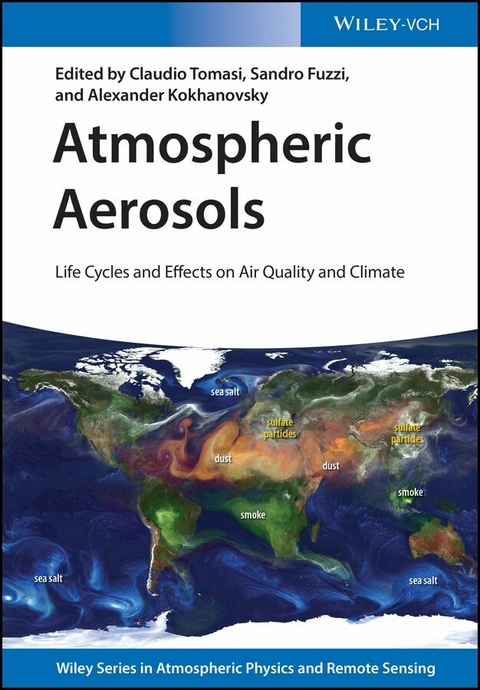
Atmospheric Aerosols (eBook)
Wiley-VCH Verlag GmbH & Co. KGaA
978-3-527-33643-2 (ISBN)
Claudio Tomasi graduated at the Department of Physics of the University of Bologna, Italy. He worked as researcher at the National Council of Research CNR and became director of research in 1991. After his retirement, he still continues his research activity as Associate Researcher at the Institute for Atmospheric Sciences and Climate, ISAC-CNR.
He was P. I. from 2005 to 2009 of the national project QUITSAT supported by the Italian Space Agency to evaluate the air quality parameters on the Po Valley area from polar and geostationary satellite-borne observations integrated with ground-based remote sensing and in situ sampling measurements and with Chemical-Transport-Meteorological model simulations of the PM and gaseous concentrations at the surface. Since 2007, he is leader of the international research project POLAR-AOD, dedicated to study the radiative parameters of polar aerosols and their direct radiative forcing effects.
Sandro Fuzzi is Professor of Global Change at the University of Bologna and holds a doctoral degree in Physical Chemistry from the University of Bologna, Italy. He is at present Research Director at the Institute of Atmospheric Sciences and Climate of the National Research Council, CNR. His main research interests are the physical and chemical processes involving atmospheric aerosols and clouds and their effects on atmospheric composition change, climate, ecosystems and human health. Is has been a member of several international Committees and Panels including the Science Panel of the European Commission on Atmospheric Composition Change and the Chairmanship of the International Global Atmospheric Chemistry Project of the International Global Geosphere-Biosphere program. He has coordinated several national and international programs in the field of atmospheric composition change.
Alexander A. Kokhanovsky graduated from the Physical Department of the Belarusian State University, Minsk, Belarus. Alexander Kokhanovsky is a member the SCIAMACHY/ENVISAT algorithm development team at the Institute of Environmental Physics at the University of Bremen. His research interests are directed towards modeling light propagation and scattering in the terrestrial atmosphere. He has published more than 160 papers in the field of environmental optics, radiative transfer, and light scattering.
Claudio Tomasi graduated at the Department of Physics of the University of Bologna, Italy. He worked as researcher at the National Council of Research CNR and became director of research in 1991. After his retirement, he still continues his research activity as Associate Researcher at the Institute for Atmospheric Sciences and Climate, ISAC-CNR. He was P. I. from 2005 to 2009 of the national project QUITSAT supported by the Italian Space Agency to evaluate the air quality parameters on the Po Valley area from polar and geostationary satellite-borne observations integrated with ground-based remote sensing and in situ sampling measurements and with Chemical-Transport-Meteorological model simulations of the PM and gaseous concentrations at the surface. Since 2007, he is leader of the international research project POLAR-AOD, dedicated to study the radiative parameters of polar aerosols and their direct radiative forcing effects. Sandro Fuzzi is Professor of Global Change at the University of Bologna and holds a doctoral degree in Physical Chemistry from the University of Bologna, Italy. He is at present Research Director at the Institute of Atmospheric Sciences and Climate of the National Research Council, CNR. His main research interests are the physical and chemical processes involving atmospheric aerosols and clouds and their effects on atmospheric composition change, climate, ecosystems and human health. Is has been a member of several international Committees and Panels including the Science Panel of the European Commission on Atmospheric Composition Change and the Chairmanship of the International Global Atmospheric Chemistry Project of the International Global Geosphere-Biosphere program. He has coordinated several national and international programs in the field of atmospheric composition change. Alexander A. Kokhanovsky graduated from the Physical Department of the Belarusian State University, Minsk, Belarus. Alexander Kokhanovsky is a member the SCIAMACHY/ENVISAT algorithm development team at the Institute of Environmental Physics at the University of Bremen. His research interests are directed towards modeling light propagation and scattering in the terrestrial atmosphere. He has published more than 160 papers in the field of environmental optics, radiative transfer, and light scattering.
Cover 1
Title Page 5
Copyright 6
Contents 7
List of Contributors 17
Preface 21
Foreword 23
Acknowledgments 25
Chapter 1 Primary and Secondary Sources of Atmospheric Aerosol 27
1.1 Introduction 27
1.2 A General Classification of Aerosol Sources 32
1.3 Primary Aerosols of Natural Origin 33
1.3.1 Sea-Salt Particles 34
1.3.2 Mineral Dust 39
1.3.3 Biogenic Aerosols 46
1.3.4 Forest Fire Smoke 49
1.3.5 Volcanic Dust in the Troposphere 53
1.3.6 Cosmic Dust 56
1.4 Secondary Aerosols of Natural Origin 57
1.4.1 Natural Sulfate Particles from Tropospheric SO2 and Sulfur Compounds 58
1.4.2 Natural Nitrate Particles from Tropospheric Nitrogen Oxides 63
1.4.3 Organic Aerosols from Biogenic Volatile Organic Compounds 67
1.4.4 Sulfate Particles from Marine and Volcanic SO2 Formed in the Stratosphere 68
1.5 Primary Anthropogenic Aerosols 74
1.5.1 Industrial Dust 76
1.5.2 Anthropogenic Aerosols from Fossil Fuel Combustion and Carbonaceous (Soot) Particles 77
1.5.3 Anthropogenic Aerosols from Waste and Biomass Burning 84
1.6 Secondary Anthropogenic Aerosols 85
1.6.1 Secondary Particles from SO2 86
1.6.2 Secondary Particles from NOx 90
1.6.3 Secondary Organic Aerosols 94
1.7 Concluding Remarks on the Global Annual Emission Fluxes of Natural and Anthropogenic Aerosol Mass 96
Abbreviations 101
List of Symbols 101
References 102
Chapter 2 Aerosol Nucleation in the Terrestrial Atmosphere 113
2.1 Introduction 113
2.2 Theoretical Basis of Nucleation and Growth of New Particles in the Atmosphere 114
2.2.1 Introduction to Nucleation Theories Useful in Atmospheric Sciences 114
2.2.1.1 The Unary System Model 115
2.2.1.2 The H2SO4-H2O Binary System 117
2.2.1.3 The H2SO4-NH3-H2O Ternary System 119
2.2.1.4 The Role of Amines 119
2.2.1.5 The Ion-Induced Nucleation 120
2.2.2 The Growth of New Particles 121
2.2.2.1 The Condensation Process 121
2.3 Observation and Detection Tools 123
2.3.1 Detection Tools 124
2.3.1.1 Physical Characterization 124
2.3.1.2 Chemical Characterization 125
2.3.2 Metrics for Characterizing New Particle Formation Events 126
2.3.3 Occurrence of New Particle Formation Events in the Troposphere 128
2.3.3.1 Pristine and Polluted Continental Boundary Layer 128
2.3.3.2 Coastal and Marine Boundary Layer Sites 129
2.3.3.3 High-Altitude Environments and Free Troposphere 129
2.4 Precursor Candidates for Nucleation and Early Growth from Observations 130
2.4.1 Continental Planetary Boundary Layer 130
2.4.2 Marine Planetary Boundary Layer 130
2.5 Parameterizations and Chamber Experiments 131
2.6 Importance of Nucleation for the Production of Aerosols and CCN at the Global Scale 133
2.7 Conclusions 134
Abbreviations 135
List of Symbols 136
References 136
Chapter 3 Coagulation, Condensation, Dry and Wet Deposition, and Cloud Droplet Formation in the Atmospheric Aerosol Life Cycle 141
3.1 Introduction 141
3.2 Physical Growth Processes 146
3.2.1 Brownian Coagulation 147
3.2.2 Growth by Condensation of Gases onto Preexisting Particles 154
3.2.3 The Kelvin Effect 156
3.2.4 Hygroscopic Growth of Particles by Water Vapor Condensation 159
3.3 Aerosol Removal Processes 165
3.3.1 Dry Deposition of Aerosol Particles 167
3.3.2 Wet Deposition of Aerosol Particles 170
3.3.2.1 In-Cloud Scavenging (Rainout) 171
3.3.2.2 Interstitial Aerosol Scavenging by Cloud Droplets 173
3.3.2.3 Precipitation Scavenging 175
3.3.2.4 Wet Deposition in Fogs 183
3.3.2.5 Nucleation of Ice Particles 183
3.4 Formation of Cloud Particles 187
3.4.1 Water Vapor Condensation 188
3.4.2 The Köhler Theory 189
3.4.3 The Cloud Condensation Nuclei 195
3.5 Concluding Remarks 196
Abbreviations 201
List of Symbols 201
References 206
Chapter 4 Chemical Composition of Aerosols of Different Origin 209
4.1 Introduction 209
4.2 Global Distribution and Climatology of the Main Aerosol Chemical Constituents 210
4.2.1 Definition of Primary and Secondary Inorganic and Organic Aerosol Compounds 210
4.2.2 Aerosol Global Budgets 212
4.2.2.1 Organic Aerosol 212
4.2.2.2 Black Carbon Aerosol 213
4.2.2.3 Sulfur Aerosol 214
4.2.2.4 Nitrogen Aerosol Species 215
4.2.2.5 Dust Aerosol 217
4.2.3 Main Regional Differences and Seasonal Variations of Aerosol Chemical Composition 218
4.2.3.1 Urban Aerosol 218
4.2.3.2 Rural Aerosol 219
4.2.3.3 Continental Regional Background Aerosol 220
4.2.3.4 Marine Background Aerosol 221
4.3 Size Distributions of Aerosol Chemical Compounds 222
4.3.1 Aerosol Size-Resolved Chemical Composition in Polluted Areas 222
4.3.1.1 Secondary Inorganic Aerosol (Ammonium Sulfate and Nitrate) 223
4.3.1.2 Organic Aerosol 223
4.3.1.3 Black Carbon 224
4.3.1.4 Dust 226
4.3.2 Aerosol Size-Resolved Chemical Composition in Unperturbed Environments 226
4.3.2.1 Rain Forest 226
4.3.2.2 High Altitude Mountain Regions 226
4.3.2.3 Polar Regions 228
4.3.3 Long-Term Changes of Aerosol Chemical Components 229
4.4 Issues Related to Aerosol Chemical Composition 231
4.4.1 Characterization of the Aerosol Carbonaceous Fraction 231
4.4.1.1 Soot: BC or EC 231
4.4.1.2 Organic Aerosol 233
4.4.2 Sources of BC and OA 235
4.4.2.1 Black Carbon 235
4.4.2.2 Organic Aerosol 237
4.4.3 Effect of Organic and Inorganic Chemical Composition on Aerosol Activity as Cloud Condensation Nuclei and Ice Nuclei 239
4.4.3.1 Cloud Condensation Nuclei 239
4.4.3.2 Ice Nuclei 240
Abbreviations 242
List of Symbols 243
References 244
Chapter 5 Aerosol Optics 249
5.1 Introduction 249
5.2 Absorption 250
5.3 Scattering 255
5.4 Polarization 260
5.5 Extinction 263
5.6 Radiative Transfer 265
5.7 Image Transfer 268
Abbreviations 270
List of Symbols 270
References 271
Chapter 6 Aerosol Models 273
6.1 Introduction 273
6.2 Modeling of the Optical and Microphysical Characteristics of Atmospheric Aerosol 275
6.2.1 The 6S Code Aerosol Extinction Models 280
6.2.1.1 The Four 6S Basic Aerosol Components 280
6.2.1.2 The Three 6S Aerosol Models 284
6.2.2 The 6S Additional Aerosol Models 288
6.2.3 The 6S Modified (M-Type) Aerosol Models 297
6.2.4 The OPAC Aerosol Models 303
6.2.5 The Aerosol Models of Shettle and Fenn (1979) 314
6.2.6 The Seven Additional Aerosol Models of Tomasi et al. (2013) 321
6.2.7 The Polar Aerosol Models 330
6.3 General Remarks on the Aerosol Particle Number, Surface, and Volume Size-Distribution Functions 332
6.3.1 The Aerosol Particle Number Size-Distribution Function 336
6.3.2 The Aerosol Surface, Volume, and Mass Size Distributions 340
6.4 Size-Distribution Characteristics of Various Aerosol Types 343
6.4.1 Remote Continental Aerosols 343
6.4.2 Free Tropospheric Aerosols 345
6.4.3 Rural-Continental Aerosols 345
6.4.4 Continental-Polluted Aerosols 348
6.4.5 Maritime Clean Aerosols 348
6.4.6 Maritime-Polluted Aerosols 350
6.4.7 Desert Dust 350
6.4.8 Biomass Burning Aerosols 352
6.4.9 Urban Aerosols 352
6.4.10 Polar Arctic Aerosols 354
6.4.11 Polar Antarctic Aerosols 355
6.4.12 Stratospheric Volcanic Aerosols 357
6.5 Concluding Remarks 358
Abbreviations 359
List of Symbols 360
References 363
Chapter 7 Remote Sensing of Atmospheric Aerosol 367
7.1 Introduction 367
7.2 Ground-Based Aerosol Remote Sensing Measurements 368
7.2.1 The Multispectral Sun-Photometry Method 371
7.2.1.1 Calibration of a Sun Photometer Using the Langley Plot Method 372
7.2.1.2 Determination of Aerosol Optical Thickness 374
7.2.1.3 Determination of Aerosol Optical Parameters from Sun-Photometer Measurements 386
7.2.1.4 Relationship between the Fine Particle Fraction and Ångström Wavelength Exponent 396
7.2.2 Measurements of Volume Extinction, Scattering, and Absorption Coefficients at Ground Level Using Nephelometer and PSAP Techniques 399
7.2.3 Vertical Profiles of Backscatter and Extinction Coefficients from LIDAR Measurements 401
7.2.4 Measurements of the Aerosol Size Distribution Using an Optical Particle Counter 404
7.3 Airborne Remote Sensing Measurements of Aerosol Optical Properties 406
7.3.1 Main Results Derived from the Second Airborne Arctic Stratospheric Expedition (AASE-II) Measurements 411
7.3.2 Airborne Remote Sensing Measurements during the Army LIDAR Verification Experiment (ALIVE) 412
7.3.3 Airborne Measurements Performed during the Sulfate Clouds and Radiation-Atlantic (SCAR-A) Experiment 412
7.3.4 Airborne Measurements Conducted during the Tropospheric Aerosol Radiative Forcing Observational Experiment (TARFOX) 413
7.3.5 The Aerosol Characterization Experiment 2 (ACE-2) Airborne Remote Sensing Measurements 414
7.3.6 Airborne Remote Sensing Measurements during the Puerto Rico Dust Experiment (PRIDE) 417
7.3.7 The ARCTAS/ARCPAC Airborne Remote Sensing Measurements in the Western Arctic 418
7.3.8 The Airborne Measurements Conducted during the Pan-Arctic Measurements and Arctic Regional Climate Model Intercomparison Project (PAM-ARCMIP) 425
7.4 Satellite-Borne Aerosol Remote Sensing Measurements 429
7.4.1 Satellite Instrumentation 429
7.4.2 Methods 437
7.4.2.1 The Algorithms Based on the Single-View Spectral Observations 437
7.4.2.2 Double-View Spectral Observations 438
7.4.2.3 Multiview Spectral Observations 439
7.4.2.4 Multiview Spectral and Polarimetric Observations 439
7.4.2.5 Retrievals over Ocean Using Multiangle Polarimetric Observations 440
7.4.2.6 Retrievals over Land 440
7.4.2.7 Aerosol Retrieval Using an Artificial Neural Network Technique 440
7.4.3 Examples of Aerosol Retrievals 441
7.4.3.1 Global View of Aerosol Distribution from Passive Sensor 441
7.4.3.2 Aerosol Retrieval from Different Sensors and Retrieval Algorithms 442
7.4.3.3 Time-Resolved Observation from Geostationary Platform 445
7.4.3.4 Atmospheric Anatomy from the Active Sensing Platform 446
Abbreviations 448
List of Symbols 449
References 453
Chapter 8 Aerosol and Climate Change: Direct and Indirect Aerosol Effects on Climate 463
8.1 Introduction 463
8.2 The Instantaneous DARF Effects at the ToA and BoA Levels and in the Atmosphere 465
8.2.1 The Spectral Characteristics of Solar Radiation 465
8.2.2 Vertical Features of Aerosol Volume Extinction Coefficient 469
8.2.3 Aerosol Extinction Models and Optical Characteristics 470
8.2.4 Modeling the Underlying Surface Reflectance Characteristics 473
8.2.5 Calculations of Instantaneous DARF Terms at the ToA and BoA Levels and within the Atmosphere 485
8.2.6 Dependence Features of Instantaneous DARF Terms on Aerosol Optical Parameters and Surface Reflectance 489
8.2.6.1 Dependence of Instantaneous DARF on Aerosol Optical Thickness 490
8.2.6.2 Dependence of Instantaneous DARF on Aerosol Single Scattering Albedo 493
8.2.6.3 Dependence of Instantaneous DARF on Underlying Surface Albedo 497
8.2.6.4 Dependence of Instantaneous DARF on Solar Zenith Angle 500
8.3 The Diurnally Average DARF Induced by Various Aerosol Types over Ocean and Land Surfaces 502
8.3.1 Description of the Calculation Method Based on the Field Measurements of Aerosol Optical Parameters 504
8.3.2 Calculations of the Diurnally Average DARF Terms and Efficiency Parameters for Eleven Aerosol Types 524
8.3.2.1 Remote Continental Aerosols 524
8.3.2.2 Rural-Continental Aerosols 526
8.3.2.3 Free Tropospheric Aerosols 528
8.3.2.4 Continental-Polluted Aerosols 530
8.3.2.5 Maritime Clean Aerosols 532
8.3.2.6 Maritime-Continental Aerosols 534
8.3.2.7 Desert Dust 538
8.3.2.8 Biomass Burning Aerosols 542
8.3.2.9 Urban and Industrial Aerosols 545
8.3.2.10 Polar Aerosols 548
8.3.2.11 Stratospheric Volcanic Aerosols 551
8.4 Variations of DARF Efficiency as a Function of Aerosol Single Scattering Albedo 551
8.5 Concluding Remarks on the DARF Effects over the Global Scale 555
8.6 On the Indirect Aerosol Effects Acting in the Earth's Climate System 557
Abbreviations 563
List of Symbols 564
References 567
Chapter 9 Aerosol and Air Quality 579
9.1 Introduction 579
9.1.1 Aerosol Air Pollution 579
9.1.2 Aerosol Sources and Size Distribution in Relation to Human Health Effects 579
9.1.3 Aerosol Chemical Composition and Health Effects 581
9.1.4 Atmospheric Aerosols, Air Pollution, and Climate Change 583
9.1.5 Aerosol Load in Different Areas of the World 584
9.2 Aerosol Load as Derived from Satellite-Based Measurements 586
9.2.1 VIS/NIR/SWIR Multispectral Satellite Observations for Evaluating PM Concentrations: An Example over the Northern Italy Area 586
9.2.1.1 MODIS-Based PM Concentration Estimates at the Surface 587
9.2.1.2 Data Set and Results 589
9.2.1.3 Satellite PM Multiannual Monitoring: Looking for Compliance to European Air Quality Directive 592
9.2.2 PM Estimations over Osaka (Japan) Based on Satellite Observations 595
9.2.2.1 Introduction 595
9.2.2.2 Aerosol Remote Sensing 597
9.2.2.3 Estimation of PM from Satellite-Based AOT 600
9.3 Characterization of Mass Concentration and Optical Properties of Desert Dust in Different Areas of the Earth 603
9.3.1 Dust Storms in the Southwestern United States 604
9.3.2 Saharan Dust Transport over the Southeastern United States and the Caribbean Region 605
9.3.3 Saharan Dust Transport over the Tropical Atlantic Ocean and the Western Coast of Africa 606
9.3.4 Saharan Dust Transport Toward Southern Europe 607
9.3.5 Saharan Dust Transport Toward the Middle Eastern and the Persian Gulf 610
9.3.6 Asian Dust Transport Over Central Asia and China 610
9.3.7 Asian Dust Transport Over Korea and Japan 614
9.3.8 Desert Dust Transport Over Oceanic Areas 615
Abbreviations 615
List of Symbols 616
References 617
Chapter 10 Impact of the Airborne Particulate Matter on the Human Health 623
10.1 Introduction 623
10.2 Epidemiological Evidences 626
10.2.1 Exacerbation of Lung Diseases 628
10.2.2 Effects on the Cardiovascular System 629
10.2.3 Life Expectancy and PM Concentration 632
10.3 Toxicological Evidences 635
10.3.1 Particle Dosimetry, Particle Deposition, and Real Exposure 635
10.3.2 In Vivo Evidences 638
10.3.2.1 Lung Inflammation 639
10.3.2.2 Cardiovascular Damages 641
10.3.2.3 Brain and Other Target Organs 644
10.3.3 In Vitro Evidences 648
10.3.3.1 Inflammatory Response 648
10.3.3.2 Oxidative Stress 650
10.3.3.3 DNA Damage 652
10.3.3.4 Cell Death 653
10.4 Mechanism of Effects 656
10.4.1 The Inflammatory Paradigm 656
10.4.2 The Reactive Oxygen Species 658
10.4.3 Translocation of Particles: If Yes Then Where 660
10.4.4 Dimension versus Composition: Two Heads of the "PM Hydra" 662
10.5 Conclusions 663
Abbreviations 664
List of Symbols 665
References 665
Chapter 11 Aerosol Impact on Cultural Heritage: Deterioration Processes and Strategies for Preventive Conservation 671
11.1 Introduction 671
11.2 Monitoring for Cultural Heritage Conservation 671
11.3 Damage and Black Crusts Formation on Building Materials 678
11.3.1 Damage to Carbonate Stone 679
11.3.2 Damage to Silicate Stone 681
11.3.3 Anthropogenic Aerosol in Crusts 682
11.3.4 Organic and Elemental Carbon 683
11.3.5 Damage to Coastal Areas 684
11.4 Bioaerosol Effects on Cultural Heritage 685
11.5 Guidelines for the Preventive Conservation of Cultural Heritage in Urban Areas 690
Abbreviations 691
List of Symbols 691
References 692
Index 697
EULA 707
| Erscheint lt. Verlag | 1.2.2017 |
|---|---|
| Reihe/Serie | Wiley Series in Atmospheric Physics and Remote Sensing |
| Wiley Series in Atmospheric Physics and Remote Sensing | Wiley Series in Atmospheric Physics and Remote Sensing |
| Sprache | englisch |
| Themenwelt | Naturwissenschaften ► Biologie ► Ökologie / Naturschutz |
| Naturwissenschaften ► Geowissenschaften ► Meteorologie / Klimatologie | |
| Naturwissenschaften ► Physik / Astronomie ► Atom- / Kern- / Molekularphysik | |
| Technik | |
| Schlagworte | Aerosol • Aerosols • Atmosphärenphysik • Atmospheric • Atmospheric Physics & Chemistry • Chemie • Chemistry • Claudio • contributors • earth sciences • Environmental Chemistry • environmental physics • Foreword • general classification • Geowissenschaften • List • NATURAL • Natural Origin • origin • Photochemie • Physics • Physik • Physik u. Chemie der Atmosphäre • preface • References • Secondary • Sources • tomasi • Umweltchemie • Umweltphysik |
| ISBN-10 | 3-527-33643-5 / 3527336435 |
| ISBN-13 | 978-3-527-33643-2 / 9783527336432 |
| Informationen gemäß Produktsicherheitsverordnung (GPSR) | |
| Haben Sie eine Frage zum Produkt? |
 PDF (Adobe DRM)
Kopierschutz: Adobe-DRM
Adobe-DRM ist ein Kopierschutz, der das eBook vor Mißbrauch schützen soll. Dabei wird das eBook bereits beim Download auf Ihre persönliche Adobe-ID autorisiert. Lesen können Sie das eBook dann nur auf den Geräten, welche ebenfalls auf Ihre Adobe-ID registriert sind.
Details zum Adobe-DRM
Dateiformat: PDF (Portable Document Format)
Mit einem festen Seitenlayout eignet sich die PDF besonders für Fachbücher mit Spalten, Tabellen und Abbildungen. Eine PDF kann auf fast allen Geräten angezeigt werden, ist aber für kleine Displays (Smartphone, eReader) nur eingeschränkt geeignet.
Systemvoraussetzungen:
PC/Mac: Mit einem PC oder Mac können Sie dieses eBook lesen. Sie benötigen eine
eReader: Dieses eBook kann mit (fast) allen eBook-Readern gelesen werden. Mit dem amazon-Kindle ist es aber nicht kompatibel.
Smartphone/Tablet: Egal ob Apple oder Android, dieses eBook können Sie lesen. Sie benötigen eine
Geräteliste und zusätzliche Hinweise
Buying eBooks from abroad
For tax law reasons we can sell eBooks just within Germany and Switzerland. Regrettably we cannot fulfill eBook-orders from other countries.
aus dem Bereich