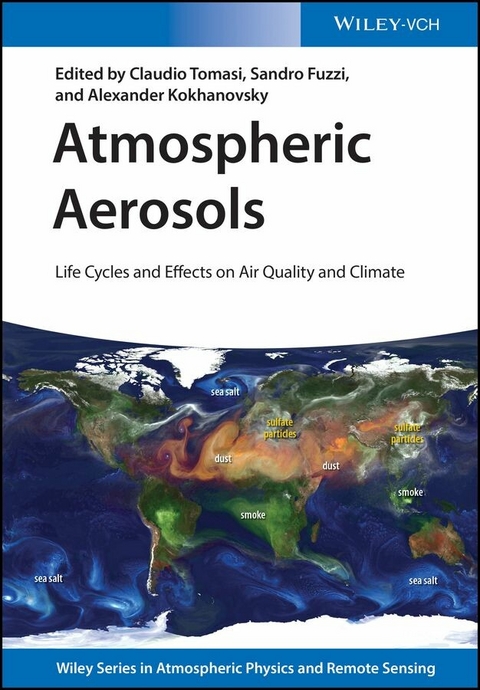
Atmospheric Aerosols (eBook)
Wiley-VCH Verlag GmbH & Co. KGaA
978-3-527-33641-8 (ISBN)
Claudio Tomasi graduated at the Department of Physics of the University of Bologna, Italy. He worked as researcher at the National Council of Research CNR and became director of research in 1991. After his retirement, he still continues his research activity as Associate Researcher at the Institute for Atmospheric Sciences and Climate, ISAC-CNR.
He was P. I. from 2005 to 2009 of the national project QUITSAT supported by the Italian Space Agency to evaluate the air quality parameters on the Po Valley area from polar and geostationary satellite-borne observations integrated with ground-based remote sensing and in situ sampling measurements and with Chemical-Transport-Meteorological model simulations of the PM and gaseous concentrations at the surface. Since 2007, he is leader of the international research project POLAR-AOD, dedicated to study the radiative parameters of polar aerosols and their direct radiative forcing effects.
Sandro Fuzzi is Professor of Global Change at the University of Bologna and holds a doctoral degree in Physical Chemistry from the University of Bologna, Italy. He is at present Research Director at the Institute of Atmospheric Sciences and Climate of the National Research Council, CNR. His main research interests are the physical and chemical processes involving atmospheric aerosols and clouds and their effects on atmospheric composition change, climate, ecosystems and human health. Is has been a member of several international Committees and Panels including the Science Panel of the European Commission on Atmospheric Composition Change and the Chairmanship of the International Global Atmospheric Chemistry Project of the International Global Geosphere-Biosphere program. He has coordinated several national and international programs in the field of atmospheric composition change.
Alexander A. Kokhanovsky graduated from the Physical Department of the Belarusian State University, Minsk, Belarus. Alexander Kokhanovsky is a member the SCIAMACHY/ENVISAT algorithm development team at the Institute of Environmental Physics at the University of Bremen. His research interests are directed towards modeling light propagation and scattering in the terrestrial atmosphere. He has published more than 160 papers in the field of environmental optics, radiative transfer, and light scattering.
Claudio Tomasi graduated at the Department of Physics of the University of Bologna, Italy. He worked as researcher at the National Council of Research CNR and became director of research in 1991. After his retirement, he still continues his research activity as Associate Researcher at the Institute for Atmospheric Sciences and Climate, ISAC-CNR. He was P. I. from 2005 to 2009 of the national project QUITSAT supported by the Italian Space Agency to evaluate the air quality parameters on the Po Valley area from polar and geostationary satellite-borne observations integrated with ground-based remote sensing and in situ sampling measurements and with Chemical-Transport-Meteorological model simulations of the PM and gaseous concentrations at the surface. Since 2007, he is leader of the international research project POLAR-AOD, dedicated to study the radiative parameters of polar aerosols and their direct radiative forcing effects. Sandro Fuzzi is Professor of Global Change at the University of Bologna and holds a doctoral degree in Physical Chemistry from the University of Bologna, Italy. He is at present Research Director at the Institute of Atmospheric Sciences and Climate of the National Research Council, CNR. His main research interests are the physical and chemical processes involving atmospheric aerosols and clouds and their effects on atmospheric composition change, climate, ecosystems and human health. Is has been a member of several international Committees and Panels including the Science Panel of the European Commission on Atmospheric Composition Change and the Chairmanship of the International Global Atmospheric Chemistry Project of the International Global Geosphere-Biosphere program. He has coordinated several national and international programs in the field of atmospheric composition change. Alexander A. Kokhanovsky graduated from the Physical Department of the Belarusian State University, Minsk, Belarus. Alexander Kokhanovsky is a member the SCIAMACHY/ENVISAT algorithm development team at the Institute of Environmental Physics at the University of Bremen. His research interests are directed towards modeling light propagation and scattering in the terrestrial atmosphere. He has published more than 160 papers in the field of environmental optics, radiative transfer, and light scattering.
PRIMARY SOURCES AND SECONDARY FORMATION PROCESSES OF ATMOSPHERIC AEROSOLS
Introduction
A General Classification of Aerosol Sources
Primary Aerosols of Natural Origin
Secondary Aerosols of Natural Origin
Primary Anthropogenic Aerosols
Secondary Anthropogenic Aerosols
Global Annual Mass Emission Fluxes of Natural and Anthropogenic Aerosols
NUCLEATION OF ULTRAFINE PARTICLES
Introduction
Principles of New Atmospheric Particle Formation
Chemical and Physical Factors Driving or Inhibiting New-Particle Formation
Occurrence of New-Particle Formation in the Global Troposphere
Importance of Nucleation for the Production of Aerosols and Ccn at the Global Scale
ROLE OF COAGULATION, CONDENSATION, CLOUD FORMATION AND WET AND DRY REMOVAL PROCESSES IN THE ATMOSPHERIC AEROSOL LIFE
Introduction
Physical Growth Processes
Formation of Cloud Particles
Aerosol Sinks (Removal Processes)
CHEMICAL COMPOSITION OF AEROSOLS OF DIFFERENT ORIGINS
Introduction
Global Distributions and Climatologies of the Main Aerosol Chemical Constituents
Size-Distributions of Aerosol Chemical Compounds
Open Questions
MEASURING AEROSOL IN SITU AND REMOTE SENSING
Introduction
Characterization of Aerosol Variables with in-Situ Techniques
Detection of Aerosol Properties by Remote Sensing
Observing Climate Change
NUMBER, SURFACE AND VOLUME SIZE-DISTRIBUTIONS OF AEROSOL POLYDISPERSIONS OF DIFFERENT ORIGINS
Introduction
Concentration and Multimodal Characteristics of the Number, Surface and Volume Size-Distributions of Aerosol Polydispersions
Vertical Profiles of Aerosols from Lidar Measurements
Global Distributions of Aerosols from Satellite-Borne Images
AEROSOL OPTICS
Introduction
Maxwell Theory
Light Scattering and Absorption by Small Solid and Liquid Particles
IMAGE AND RADIATION TRANSFER THROUGH AEROSOL LAYERS
AEROSOL-INDUCED DIRECT FORCING EFFECTS BY NATURAL AND ANTHROPOGENIC AEROSOL
POLYDISPERSIONS
Introduction
Field Measurements of Aerosol Optical Thickness Aot
Characterization of the Aerosol Radiative Properties of Different Origins
Direct Aerosol-Induced Radiative Forcing for Different Particle Polydispersions
THE AEROSOL INDIRECT EFFECTS ON CLIMATE
AEROSOL EFFECTS ON AIR QUALITY THROUGH IN-SITU AND REMOTE SENSING TECHNIQUES
Pollution Due to Natural Sources (Pollen, Desert Dust)
Anthropogenic Pollution
Aerosol Effects on Air Quality
Air Quality from in-Situ and Satellite-Based Measurements
EU and USA Limitations to the Aerosol Emissions and Rules for the Air Quality
IMPACT OF PARTICULATE MATTER (PM) ON THE HUMAN HEALTH
Introduction
Epidemiological Evidences
Toxicological Evidences
Mechanism of Effects
AEROSOL IMPACT ON CULTURAL HERITAGE: DETERIORATION PROCESSES AND STRATEGIES FOR PREVENTIVE CONSERVATION
Introduction
Damage Layers and Black Crusts on Building Materials (Stone-Mortars, Carbonate-Silicate)
Bioaerosol Effects on Cultural Heritage
Monitoring for Cultural Heritage Conservation
Aesthetic Impact on Architectural Surfaces: Implications on Restoration and Maintenance Actions
Future Scenarios
Guidelines for the Preventive Conservation of Cultural Heritage in Urban Areas
Chapter 1
Primary and Secondary Sources of Atmospheric Aerosol
Claudio Tomasi and Angelo Lupi
1.1 Introduction
Atmospheric aerosols are suspensions of any substance existing in the solid and/or liquid phase in the atmosphere (except pure water) under normal conditions and having a minimum stability in air assuring an atmospheric lifetime of at least 1 h. Generated by natural sources (i.e., wind-borne dust, sea spray, volcanic debris, biogenic aerosol) and/or anthropogenic activities (i.e., sulfates and nitrates from industrial emissions, wind-forced mineral dust mobilized in areas exploited for agricultural activities, fossil fuel combustion, and waste and biomass burning), aerosol particles range in size from a few nanometers to several tens of microns. As a result of internal cohesive forces and their negligible terminal fall speeds, aerosol particles can first assume sizes appreciably larger than the most common air molecules and subsequently increase to reach sizes ranging most frequently from less than 10−3 to no more than 100 µm (Heintzenberg, 1994). Particles with sizes smaller than 20–30 Å (1 Å = 10−10 m) are usually classified as clusters or small ions, while mineral and tropospheric volcanic dust particles with sizes greater than a few hundred microns are not considered to belong to the coarse aerosol class, since they have very short lifetimes. Aerosol particles grown by condensation to become cloud droplets are not classified as aerosols, although a cloud droplet needs a relatively small aerosol particle acting as a condensation nucleus for its formation under normal atmospheric conditions. Similarly, precipitation elements such as rain droplets, snowflakes, and ice crystals are not classified as aerosols (Heintzenberg, 1994). Although present in considerably lower concentrations than those of the main air molecules, aerosol particles play a very important role in numerous meteorological, physical, and chemical processes occurring in the atmosphere, such as the electrical conductivity of air, condensation of water vapor on small nuclei and subsequent formation of fog and cloud droplets, acid rains, scattering, and absorption of both incoming solar (shortwave) radiation and thermal terrestrial (longwave) radiation. The interaction processes between atmospheric aerosols and the downwelling and upwelling radiation fluxes of solar and terrestrial radiation at the surface play a major role in defining the radiation budget of our planet and, hence, the Earth's climate (Chylek and Coakley, 1974).
To give an idea of the shape of an aerosol particle suspended in dry air, a schematic representation of a particle originating from the aggregation of various kinds of particulate matter fragments is shown in Figure 1.1. It consists of several small unit structures of different chemical composition and origin (soluble acid substances, sodium chloride crystals of marine origin, ammonium sulfates, insoluble carbonaceous matter, insoluble mineral dust, and insoluble organic substances), held together by interparticle adhesive forces in such a way that an aerosol particle behaves as a single unit in suspension. Thus, the same particle often contains distinct homogeneous entities, which are internally mixed to form aggregates of different components.
Figure 1.1 Schematic representation of an aerosol particle for dry air conditions (left) and humid air (for relative humidity (RH) = 75–80%) conditions (right), consisting of particulate matter pieces of soluble (i.e., soluble acid substances, sea-salt crystal, ammonium sulfates) and insoluble substances (carbonaceous matter, mineral dust, organic substances), which remain suspended inside the moist particle gradually growing by condensation until becoming a water droplet with soluble salts, acids, and organic compounds. (Adapted from a draft presented by Gottfried Hänel in a seminar given in 1985 at the FISBAT-CNR Institute, Bologna, Italy.)
The insoluble carbonaceous and organic substances often consist of gas-borne particulate matter pieces from incomplete combustion, which predominantly contain carbon and other combustion-produced materials. When the surrounding air relative humidity (RH) increases to reach values higher than 65–70%, the same particle (containing soluble substances) grows gradually by condensation of water vapor to become a water droplet in which pieces of insoluble matter are suspended, as can be seen in the (b) of Figure 1.1 (see also Hänel, 1976), while the various soluble materials reach different solution states as a result of their appreciably differing deliquescence properties. In this way, an internally mixed particle evolves assuming the characteristics of an aggregate consisting of different particulate phases. Figure 1.1 also shows that dry aerosol particles can often exhibit irregular shapes, which can considerably differ from the spherical one. Thus, the size of each real aerosol particle is generally evaluated in terms of an “equivalent” diameter a, for which the volume of such an ideal spherical particle is equal to that of the real particle.
Aerosol particles cover a size range of more than five orders of magnitude, with “equivalent” sizes ranging from 5 × 10⁻³ to 2.5 µm for fine particles and greater than 2.5 µm for coarse particles (Hinds, 1999). The fine particles include both (i) the so-called Aitken nuclei, having sizes mainly ranging from 5 × 10⁻³ to 5 × 10⁻² µm, and (ii) the so-called “accumulation” particles having sizes ranging from 5 × 10⁻² to about 2 µm. In this classification, it is worth mentioning that (i) the nuclei constitute the most important part of the so-called ultrafine particles (which have sizes <10−1 µm) and mainly form through condensation of hot vapors during combustion processes and/or nucleation of atmospheric gaseous species to form fresh particles and (ii) the accumulation particles are mainly generated through coagulation of small particles belonging to the nuclei class and condensation of vapors onto existing particles, inducing them to grow appreciably. Consequently, the particle concentration within this size subrange increases, and the accumulation mode becomes gradually more evident, so named because the particle removal mechanisms are poorly efficient in limiting the concentration of such an intermediate-size class of particles. Therefore, such particles have longer residence times than the nuclei, and their number concentration tends to increase through “accumulation” of these particles within such a size class. Among the coarse particles, those having sizes ranging from 10 µm to the previously established upper limit of 100 µm are often called “giant” particles. They mainly contain man-made, sea-salt, and natural dust aerosols, being subject to sufficiently high sedimentation velocities and, hence, very efficiently removed in rather short times.
As shown in Figure 1.2, aerosols with diameters ranging from 10−3 to 2 × 10⁻¹ µm can play an important role in cloud and precipitation physics, because water and ice aerosols form cloud droplets and ice crystals with diameters varying mainly from about 2 × 10⁻² to more than 103 µm. These growth processes lead to the incorporation of particulate matter into cloud droplets during the formation of precipitation and hence contribute to removing aerosols from the atmosphere through the so-called wet deposition processes.
Figure 1.2 Size range of aerosol particles in the atmosphere and their role in atmospheric physics and chemistry.
Aerosols also play a fundamental role in enhancing the electricity characteristics of the atmosphere, mainly due to molecular aggregates carrying an electric charge. These particles are called ions and are divided into (i) small ions, with sizes varying from 3 × 10⁻⁴ to no more than 10−3 µm, and (ii) large ions, with sizes varying from 10−3 to about 5 × 10⁻¹ µm. The presence of these ions determine the electrical conductivity of air. Therefore, their increase in concentration can change the magnitude of the fair weather atmospheric electric field. In the lower atmosphere, ions are mainly produced by cosmic rays and, to a lesser extent, by ionization due to crustal radioactive materials within the surface layer of the atmosphere. Ions are removed from the atmosphere through the combination of ions of opposite sign. Small ions are not much larger than molecules and have electrical mobility (defined as their velocity in an electric field equal to 1 V m−1) ranging from about 1 to 2 × 10⁴ m s−1 at normal temperature and pressure (NTP) conditions. Conversely, the electrical mobility of large ions is very low, generally varying from 3 × 10⁻⁸ to 8 × 10⁻⁷ m s−1. Thus, the concentration of small ions usually varies from about 40 to 1500 cm−3 at sea level, and that of large ions from about 200 cm−3 in maritime air to more than 8 × 105 cm−3 in the most polluted urban areas. Electrical conductivity of the air is proportional to the product of ion mobility by ion concentration, so it is generally produced by small ions in unpolluted areas. Conversely, the concentration of small ions in polluted urban areas tends to decrease as a result of their capture by both large ions and uncharged aerosols, which all exhibit very high concentrations in highly polluted areas. Consequently, the electrical conductivity of air...
| Erscheint lt. Verlag | 8.11.2016 |
|---|---|
| Reihe/Serie | Wiley Series in Atmospheric Physics and Remote Sensing |
| Wiley Series in Atmospheric Physics and Remote Sensing | Wiley Series in Atmospheric Physics and Remote Sensing |
| Sprache | englisch |
| Themenwelt | Naturwissenschaften ► Geowissenschaften |
| Naturwissenschaften ► Physik / Astronomie | |
| Technik | |
| Schlagworte | Aerosol • Aerosols • Atmosphärenphysik • Atmosphärenphysik • Atmospheric • Atmospheric Physics & Chemistry • Chemie • Chemistry • Claudio • contributors • earth sciences • Environmental Chemistry • environmental physics • Foreword • general classification • Geowissenschaften • List • NATURAL • Natural Origin • origin • Photochemie • Physics • Physik • Physik u. Chemie der Atmosphäre • Physik u. Chemie der Atmosphäre • preface • References • Secondary • Sources • tomasi • Umweltchemie • Umweltphysik |
| ISBN-10 | 3-527-33641-9 / 3527336419 |
| ISBN-13 | 978-3-527-33641-8 / 9783527336418 |
| Informationen gemäß Produktsicherheitsverordnung (GPSR) | |
| Haben Sie eine Frage zum Produkt? |
 EPUB (Adobe DRM)
Kopierschutz: Adobe-DRM
Adobe-DRM ist ein Kopierschutz, der das eBook vor Mißbrauch schützen soll. Dabei wird das eBook bereits beim Download auf Ihre persönliche Adobe-ID autorisiert. Lesen können Sie das eBook dann nur auf den Geräten, welche ebenfalls auf Ihre Adobe-ID registriert sind.
Details zum Adobe-DRM
Dateiformat: EPUB (Electronic Publication)
EPUB ist ein offener Standard für eBooks und eignet sich besonders zur Darstellung von Belletristik und Sachbüchern. Der Fließtext wird dynamisch an die Display- und Schriftgröße angepasst. Auch für mobile Lesegeräte ist EPUB daher gut geeignet.
Systemvoraussetzungen:
PC/Mac: Mit einem PC oder Mac können Sie dieses eBook lesen. Sie benötigen eine
eReader: Dieses eBook kann mit (fast) allen eBook-Readern gelesen werden. Mit dem amazon-Kindle ist es aber nicht kompatibel.
Smartphone/Tablet: Egal ob Apple oder Android, dieses eBook können Sie lesen. Sie benötigen eine
Geräteliste und zusätzliche Hinweise
Buying eBooks from abroad
For tax law reasons we can sell eBooks just within Germany and Switzerland. Regrettably we cannot fulfill eBook-orders from other countries.
aus dem Bereich