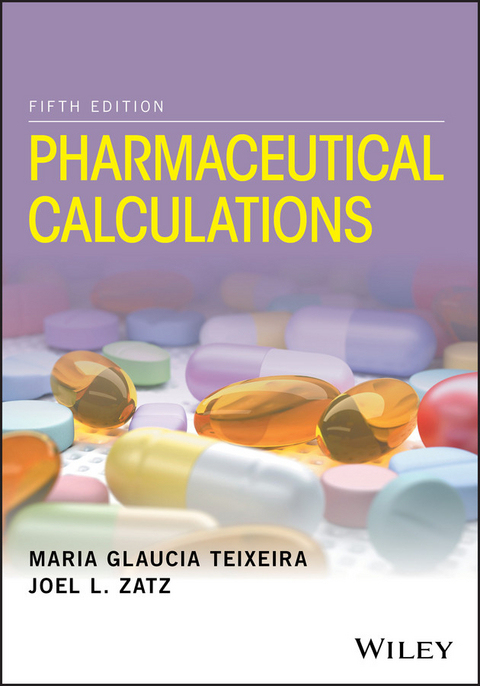
Pharmaceutical Calculations (eBook)
John Wiley & Sons (Verlag)
978-1-118-97853-5 (ISBN)
Retaining the successful previous editions' programmed instructional format, this book improves and updates an authoritative textbook to keep pace with compounding trends and calculations - addressing real-world calculations pharmacists perform and allowing students to learn at their own pace through examples.
- Connects well with the current emphasis on self-paced and active learning in pharmacy schools
- Adds a new chapter dedicated to practical calculations used in contemporary compounding, new appendices, and solutions and answers for all problems
- Maintains value for teaching pharmacy students the principles while also serving as a reference for review by students in preparation for licensure exams
- Rearranges chapters and rewrites topics of the previous edition, making its content ideal to be used as the primary textbook in a typical dosage calculations course for any health care professional
- Reviews of the prior edition: '...a well-structured approach to the topic...' (Drug Development and Industrial Pharmacy) and '...a perfectly organized manual that serves as a expert guide...' (Electric Review)
Maria Glaucia Teixeira, PhD, is Associate Professor Emeritus in the School of Pharmacy at the University of Wyoming, where she retired after 23 years on the faculty, following 10 years as Professor at the Federal University of Ceará in Fortaleza, Brazil. She has received numerous recognitions for her teaching, including the Top Prof and Excellence in Teaching awards while at University of Wyoming. She received her PhD in Pharmacology at Paul Sabatier University, Toulouse, France.
Joel L. Zatz, PhD, is Professor Emeritus at Rutgers, The State University of New Jersey.
Maria Glaucia Teixeira, PhD, is Associate Professor Emeritus in the School of Pharmacy at the University of Wyoming, where she retired after 23 years on the faculty, following 10 years as Professor at the Federal University of Ceará in Fortaleza, Brazil. She has received numerous recognitions for her teaching, including the Top Prof and Excellence in Teaching awards while at University of Wyoming. She received her PhD in Pharmacology at Paul Sabatier University, Toulouse, France. Joel L. Zatz, PhD, is Professor Emeritus at Rutgers, The State University of New Jersey.
Chapter 1
Review of Basic Mathematical Principles
Learning Objectives After completing this chapter the student should be able to:
- Recall the skills of basic mathematical operations required to work in the health field.
- Use estimation as a means of preventing errors.
- Perform mathematical operations containing units.
- Compare two quantities (ratio).
- Apply ratio, proportion, and dimensional analysis in problem solving.
Pharmacists, nurses, doctors, and most health-related professionals perform basic calculations as a daily practice. While working in a variety of settings, pharmacists, for example, need to calculate doses and determine the number of dosage units required to fill prescriptions accurately, must determine the quantities of pharmaceutical ingredients required to compound formulas, and perform calculations related to dose adjustments for disease state management, and so on. The correct drug, strength, and amount of each medication prescribed that is dispensed in pharmacies must be finally checked by the pharmacist, who is legally accountable for an incorrect dose or dispensing of a wrong drug. The fact that most pharmaceuticals are prefabricated and not prepared inside the pharmacy does not lessen the pharmacist's responsibility.
Modern drugs are effective, potent, and therefore potentially toxic if not taken correctly. An overdose may be fatal. Knowing “how to” calculate the amount of each drug and “how to” combine them is not sufficient. Of course, dispensing a subpotent dose is not satisfactory either. The drug(s) given will probably not elicit the desired therapeutic effect and will therefore be of no benefit to the patient. Clearly, the only satisfactory approach is one that is completely free of error. Absolute accuracy is any health professional's goal. Since our goal when performing calculations is the correct answer, it is logical to suppose that any rational approach to a problem that results in the correct answer is acceptable. While this is true, some approaches are more coherent and practical than others. In this text we strive to use a method that requires as few steps as possible and that with which you will feel comfortable. Usually, the simplest, most direct pathway to the solution allows less opportunity for error in computation than does one that is more complicated.
In this chapter, we will review some techniques basic to all types of calculations. To help you regain the basic mathematical operations required to work in the health field, we will briefly review significant figures, rounding off, fractions, exponents, power-of-10 notation, and estimation, and will make sure that you can solve simple algebraic expressions. We will go over how units participate in arithmetic operations and how we can take advantage of units in our calculations. Finally, we will review dimensional analysis, ratio, and proportion.
You will probably find that you are already familiar with all or most of these techniques. After this refreshing, you will make rapid progress through the self-study format of this text. If you need further review or instruction, that will be provided.
1.1. Significant Figures
Significant figures are digits that have practical consequences in pharmacy. Sometimes, in a calculated dose at a clinical setting, or in a weighed or measured amount at a compounding pharmacy, zeros are significant; other times they just designate the order of magnitude of the other digits indicating the location of the decimal point. Since the majority of medications currently prescribed are manufactured products, significant figures have minor significance to the counter pharmacist, if no compounding is involved on a daily basis. For the compounding pharmacist, however, all weighing and measuring will have a degree of accuracy that is only approximate, due to the many sources of error related to the type and limitations of the instrument used, room temperature, personal skills, attentiveness, and so on.
While compounding pharmacists must achieve the highest accuracy possible with their equipment, one could never claim to have weighed 5 mg of a solid substance on a torsion balance with sensitivity of 10 mg, or that 33.45 mL of a liquid was measured in a 50 mL graduate with only 1 mL graduations. Consequently, when writing quantities, the numbers should contain only the digits that are significant within the precision of the instrument. However, when performing calculations, all digits should be retained until the end. The final result will then be rounded so that the accuracy is implied by the number of significant figures.
The following illustrate the practical meaning of significant figures:
- If 0.0125 g is weighed, the zeros are not significant and only indicate the location of the decimal point.
- For a measured weight of 1250.0 g, the last zero may or may not be significant, depending on the method of measurement. The zero will not be significant if indicating the decimal point; alternatively, it may indicate that the weight is closer to 1249 or 1251 g, in which case the zero is significant.
- For some recorded measurements, the last significant figure is “approximate,” while all preceding figures are “accurate.” For example, in a measured volume of 398.0 mL, all digits are significant but it is accurate to the nearest 0.1 mL, which means the measurement falls between 397.5 and 398.5, or that the measurement was made within ±0.05 mL. In 39.86 mL, the 6 is approximate, with the true volume being between 39.855 and 39.865 mL. This means that 39.8 mL is accurate to the nearest 0.01 mL, or that the measurement was made within ±0.005 mL.
- It is thus possible to calculate the maximum error incurred in every measurement. Using the examples above, we would have
- When establishing the number of significant figures in mathematical operations, use the following practical rules:
- The result of addition and subtraction should contain the same number of decimal places as the component with the fewest decimal places. For example, 12.5 g + 10.65 g + 8.30 g = 31.45 g = 31.5 g.
- The result of products and quotients should have no more significant figures than the component with the smallest number of significant figures. For example, 2.466 mg/dose × 15 doses = 36.99 = 37 mg.
Now practice with the following:
- What is the maximum percentage error experienced in the measurement of 248.0 mL? 12.60 g?
- Determine the number of significant figures.
Amounts weighed Number of significant figures - 4.58 g
- 4.580
- 0.0458
- 0.0046
- Which of the following has the greatest degree of accuracy (solve as in 3.5 mL ± 0.05 mL, accurate to the nearest 0.1 mL)?
- 15.7 mL ±
- 15.70 mL ±
- 15.700 mL ±
- Using significant figure practical rules, calculate the following:
- 5.5 g + 12.35 g + 4.40 g =
- 2.533 mg/day × 5 days =
Answers
- 0.02%; 0.04%
- (i) 3, (ii) 4, (iii) 3, (iv) 2 significant figures
- 15.700 mL has the greatest degree of accuracy
- 22.3 g; 12.7 or 13 mg
Solutions
- The zero in 248.0 mL is a significant figure, implying that the measurement was made within the limits 247.95 and 248.05 mL. The possible error is then calculated as Applying the same reasoning for 12.60 g, the maximum error is
- 3, 4, 3, 2 significant figures, respectively.
-
15.7 mL = 15.7 mL ± 0.05 mL, accurate to the nearest 0.1mL.
15.70 mL = 15.70 mL ± 0.005 mL, accurate to the nearest 0.01 mL.
15.700 mL = 15.700 mL ± 0.0005 mL, accurate to the nearest 0.001 mL. (The last measurement has the greatest degree of accuracy.)
-
5.5 g + 12.35 g + 4.40 g = 22.25 g = 22.3 g
2.533 mg/day × 5 days = 12.665 = 12.7 mg = 13 mg
1.2. Rounding Off
The number of decimal places to which a medical calculation can be precisely calculated is determined by the number of significant figures. As mentioned earlier, when performing calculations, all figures should be retained until the end, when rounding off is performed. Rounding off is based on the last decimal place. If it is ≥5, the preceding decimal place is rounded up to the next digit, for example, 2.356 = 2.36. If it is <5, the preceding decimal place is left as it is, for example, 2.33 = 2.3.
Practice rounding off with the following measurements:
- 2.344 g = ________________
- 1.5 × 2.1114 mg = _________________
- 5.246 mL (using a pipette calibrated 1/10 mL) = _________________
- How many powder charts (individual doses) would a compounding pharmacist be able to prepare from a 10.5 g mixture of powders, if each chart should contain 1.33 g?
Answers
- 2.34 g
- 3.2 mg
- 5.3 mL
- 7.9 charts = 7 powder charts (doses must be accurate) and 0.9 g waste
Solutions
- In 2.344 the last decimal place is <5, so it is rounded to 2.34...
| Erscheint lt. Verlag | 2.2.2017 |
|---|---|
| Sprache | englisch |
| Themenwelt | Medizin / Pharmazie ► Gesundheitsfachberufe |
| Medizin / Pharmazie ► Medizinische Fachgebiete ► Pharmakologie / Pharmakotherapie | |
| Medizin / Pharmazie ► Pflege | |
| Medizin / Pharmazie ► Pharmazie ► PTA / PKA | |
| Naturwissenschaften ► Chemie ► Technische Chemie | |
| Technik | |
| Schlagworte | Biostatistics • Biostatistik • Chemie • Chemistry • Medical Science • Medizin • Pharmaceutical & Medicinal Chemistry • Pharmaceutical calculations, pharmacy practice, pharmaceutical measurements, method calculations, dosage calculations, drug concentration, compounding, veterinary pharmacy • Pharmacy • Pharmazeutische u. Medizinische Chemie • Pharmazie • Statistics • Statistik |
| ISBN-10 | 1-118-97853-6 / 1118978536 |
| ISBN-13 | 978-1-118-97853-5 / 9781118978535 |
| Informationen gemäß Produktsicherheitsverordnung (GPSR) | |
| Haben Sie eine Frage zum Produkt? |
 EPUB (Adobe DRM)
Kopierschutz: Adobe-DRM
Adobe-DRM ist ein Kopierschutz, der das eBook vor Mißbrauch schützen soll. Dabei wird das eBook bereits beim Download auf Ihre persönliche Adobe-ID autorisiert. Lesen können Sie das eBook dann nur auf den Geräten, welche ebenfalls auf Ihre Adobe-ID registriert sind.
Details zum Adobe-DRM
Dateiformat: EPUB (Electronic Publication)
EPUB ist ein offener Standard für eBooks und eignet sich besonders zur Darstellung von Belletristik und Sachbüchern. Der Fließtext wird dynamisch an die Display- und Schriftgröße angepasst. Auch für mobile Lesegeräte ist EPUB daher gut geeignet.
Systemvoraussetzungen:
PC/Mac: Mit einem PC oder Mac können Sie dieses eBook lesen. Sie benötigen eine
eReader: Dieses eBook kann mit (fast) allen eBook-Readern gelesen werden. Mit dem amazon-Kindle ist es aber nicht kompatibel.
Smartphone/Tablet: Egal ob Apple oder Android, dieses eBook können Sie lesen. Sie benötigen eine
Geräteliste und zusätzliche Hinweise
Buying eBooks from abroad
For tax law reasons we can sell eBooks just within Germany and Switzerland. Regrettably we cannot fulfill eBook-orders from other countries.
aus dem Bereich