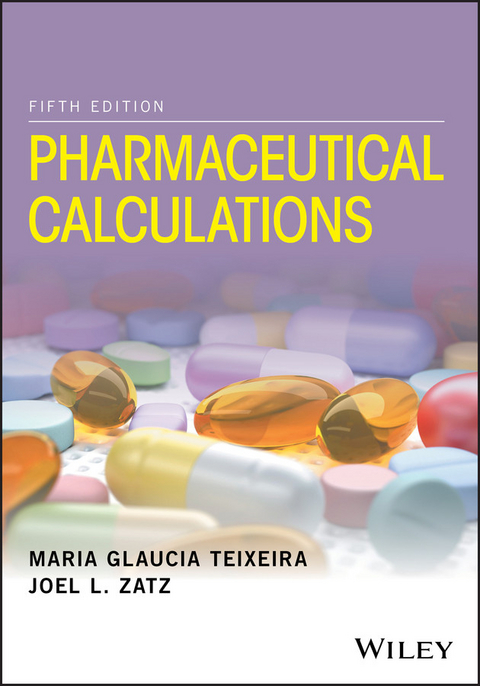
Pharmaceutical Calculations (eBook)
John Wiley & Sons (Verlag)
978-1-118-97852-8 (ISBN)
Retaining the successful previous editions' programmed instructional format, this book improves and updates an authoritative textbook to keep pace with compounding trends and calculations - addressing real-world calculations pharmacists perform and allowing students to learn at their own pace through examples.
- Connects well with the current emphasis on self-paced and active learning in pharmacy schools
- Adds a new chapter dedicated to practical calculations used in contemporary compounding, new appendices, and solutions and answers for all problems
- Maintains value for teaching pharmacy students the principles while also serving as a reference for review by students in preparation for licensure exams
- Rearranges chapters and rewrites topics of the previous edition, making its content ideal to be used as the primary textbook in a typical dosage calculations course for any health care professional
- Reviews of the prior edition: '...a well-structured approach to the topic...' (Drug Development and Industrial Pharmacy) and '...a perfectly organized manual that serves as a expert guide...' (Electric Review)
Maria Glaucia Teixeira, PhD, is Associate Professor Emeritus in the School of Pharmacy at the University of Wyoming, where she retired after 23 years on the faculty, following 10 years as Professor at the Federal University of Ceará in Fortaleza, Brazil. She has received numerous recognitions for her teaching, including the Top Prof and Excellence in Teaching awards while at University of Wyoming. She received her PhD in Pharmacology at Paul Sabatier University, Toulouse, France.
Joel L. Zatz, PhD, is Professor Emeritus at Rutgers, The State University of New Jersey.
Retaining the successful previous editions' programmed instructional format, this book improves and updates an authoritative textbook to keep pace with compounding trends and calculations addressing real-world calculations pharmacists perform and allowing students to learn at their own pace through examples. Connects well with the current emphasis on self-paced and active learning in pharmacy schools Adds a new chapter dedicated to practical calculations used in contemporary compounding, new appendices, and solutions and answers for all problems Maintains value for teaching pharmacy students the principles while also serving as a reference for review by students in preparation for licensure exams Rearranges chapters and rewrites topics of the previous edition, making its content ideal to be used as the primary textbook in a typical dosage calculations course for any health care professional Reviews of the prior edition: "e;...a well-structured approach to the topic..."e; (Drug Development and Industrial Pharmacy) and "e;...a perfectly organized manual that serves as a expert guide..."e; (Electric Review)
Maria Glaucia Teixeira, PhD, is Associate Professor Emeritus in the School of Pharmacy at the University of Wyoming, where she retired after 23 years on the faculty, following 10 years as Professor at the Federal University of Ceará in Fortaleza, Brazil. She has received numerous recognitions for her teaching, including the Top Prof and Excellence in Teaching awards while at University of Wyoming. She received her PhD in Pharmacology at Paul Sabatier University, Toulouse, France. Joel L. Zatz, PhD, is Professor Emeritus at Rutgers, The State University of New Jersey.
Pharmaceutical Calculations 1
Contents 9
Preface 15
Chapter 1: Review of Basic Mathematical Principles 17
1.1. Significant Figures 18
1.2. Rounding off 20
1.3. Fractions 21
1.4. Exponents and Powers 24
1.5. Estimation 26
1.6. Units 28
1.7. Ratio 30
1.8. Proportion 31
1.9. Dimensional Analysis 34
Practice Problems 37
Chapter 2: Systems of Measurement 47
2.1. Metrology 47
2.2. The Metric System 48
2.3. The English Systems 49
2.3.1. The Avoirdupois System 49
2.3.2. The Apothecary or Troy System 49
2.4. Measurement of Weight 49
2.4.1. Metric Weight1 49
2.4.2. English Weight 51
2.4.2.1. Avoirdupois Weight 51
2.4.2.2. Apothecary Weight 52
2.4.3. Practical Weight Equivalents 52
2.5. Measurement of Volume 54
2.5.1. Metric Volume 54
2.5.2. English Volume 55
2.5.3. Practical Volume Equivalents 55
2.6. Measurement of Length 57
2.7. Intersystem Relationships 59
2.8. Household Equivalents and Metric Estimation 60
Practice Problems 65
Chapter 3: Prescriptions and Medication Orders 70
3.1. Prescribing Authority 71
3.2. Components 73
3.3. Practices to Prevent Medication Errors 74
3.4. Common Abbreviations 76
3.5. Outpatient Prescription Drug Orders 85
3.5.1. Prescriptions for Manufactured Drug Products 85
3.5.2. Prescriptions for Compounded Drug Products 85
3.5.2.1. Types of Compounded Orders 86
3.5.2.1.1. Formulation Based on Total Quantity 86
3.5.2.1.2. Formulation Based on Single Dosage Unit 87
3.6. Inpatient Medication Orders 88
3.7. Interpretation 93
3.8. Calculations to Check ``DEA´´ Numbers 93
3.9. Reducing and Enlarging Formulas 96
3.10. Parts Formulas 103
Practice Problems 106
Chapter 4: Weighing and Measuring in Pharmacy Practice 119
4.1. Measurement Errors 119
4.2. Indication of Error 120
4.2.1. Absolute Error: Indication of Error Based on Maximum Deviation and Significant Figures 120
4.2.2. Relative Error: Indication of Error Based on Percentage of Estimated Value 123
4.3. Tolerance in Prescription Compounding and Pharmaceutical Manufacturing 124
4.4. Weighing and Measuring 125
4.4.1. Electronic Balances 125
4.4.2. Prescription Balances: Class A, Torsion 126
4.4.2.1. Sensitivity Requirement (SR) 126
4.4.2.2. Minimum Weighable Quantity (MWQ) or Least Weighable Quantity (LWQ) 126
4.4.2.3. Percent Error 127
4.4.3. Volumetric Devices for Pharmaceutical Measurements 130
4.4.3.1. The Meniscus and Effect of Viscosity 130
4.4.3.2. Graduates 130
4.4.3.3. Pipets (Pipettes) 131
4.4.3.4. Syringes 131
4.4.3.5. Droppers 132
4.5. Aliquot Method and Triturations 135
4.5.1. Solid-Solid Aliquot Method 135
4.5.2. Solid-Solid Triturations 138
4.5.3. Liquid-Liquid Aliquots and Triturations 147
4.5.4. Solid-Liquid Aliquots 152
4.5.5. Serial Dilutions 156
4.6. Density 158
4.7. Specific Gravity 160
Practice Problems 161
Chapter 5: Dosage Calculations 176
5.1. Calculations Involving Dose, Size, Number of Doses, Amount Dispensed, and Quanity of a Specific Ingredient in a Dose 177
5.2. Dosage Measured by Drops 185
5.3. Dosage Based on Body Weight 187
5.4. Dosage Based on Body Surface Area (BSA) 190
5.5. Pediatric and Geriatric Dose Calculations 197
5.6. Chemotherapy Dose Calculations 200
Practice Problems 203
Chapter 6: Drug Concentration Expressions? 219
6.1. Concentration 220
6.2. Percentage Strength Expressions 220
6.2.1. Percent Volume-in-Volume 220
6.2.2. Percent Weight-in-Weight 221
6.2.3. Percent Weight-in-Volume 222
6.2.4. Default Rules for Percentage Expressions 224
6.2.5. Prescriptions and Formulations with Ingredients Listed as Percentage 226
6.2.6. Using Specific Gravity to Calculate the Exact Amount of Solvent in a Solution 231
6.2.7. Converting % w/w into %w/v Using Specific Gravity 233
6.3. Stock Solutions, Concentrates, and Triturations 234
6.4. Saturated Solutions 238
6.5. Ratio Strength Expressions 240
6.5.1. Ratio Volume-in-Volume 240
6.5.2. Ratio Weight-in-Volume 241
6.5.3. Ratio Weight-in-Weight 242
6.6. Other Pharmaceutical Expressions of Drug Concentration 246
6.6.1. Milligrams Per Milliliter (mg/mL) 246
6.6.2. Milligrams Percent (mg%) and Miligrams Per Deciliter (mg/dL) 247
6.6.3. Parts Per Million (ppm) and Parts Per Billion (ppb) 248
6.6.4. Millimols, Milliequivalents, and Milliosmols Per Unit of Volume 250
Practice Problems 251
Chapter 7: Dilution and Concentration 273
7.1. Problem-Solving Methodologies 274
7.1.1. Concentration Principle 274
7.1.2. Mass Balance Equation 276
7.1.2.1. Dilution of Powders or Solid Mixtures 277
7.1.2.2. Mixing Different Strengths 281
7.1.2.3. Modifying the Drug Concentration of a Prepared Product: Increasing Drug Concentration 283
7.1.3. The CQ Equation: Concentration X Quantity 284
7.1.3.1. Expanded CQ Equation 288
7.1.4. Algebraic Calculations Using the Concentration Equation and the CQ Equation 291
7.1.5. Alligation Alternate 299
7.1.5.1. Use of Alligation When Combining More Than Two Products 303
7.2 So, Which Method Should I Use? 307
7.2.1. Stock Solutions Diluted by the Patient 309
Practice Problems 312
Chapter 8: Isotonicity 326
8.1 Principles 326
8.2 Sodium Chloride Equivalent Values 328
8.3 Isotonicity by the Sodium Chloride Equivalent Method 331
8.3.1 Sodium Chloride Equivalent: Method 1 331
8.3.2 Sodium Chloride Equivalent: Method 2 334
8.4 Other Tonicity Agents 335
8.5 Isotonicity When One Ingredient is Already Isotonic 337
8.6 Isotonic Buffered Solutions 339
8.6.1 Using the White-Vincent Method to Adjust Tonicity 339
8.7 Other Methods 342
8.8 Determination of the Tonicity of a Solution (Hypotonic, Isotonic, or Hypertonic) 345
Practice Problems 346
Chapter 9: Dosage Calculations of Electrolytes 356
9.1. Molarity and Molality 357
9.1.1. Mols and Millimols 357
9.1.2. mmol/mL, mmol/L 360
9.2. Electrolyte Dissociation, Valence, Equivalent, and Equivalent Weight 360
9.3. Milliequivalents, mEq/mL, mEq/L 363
9.3.1. Problem-Solving Methods for Milliequivalents 364
9.4. Osmolarity (Osmolar Strength) 370
9.4.1. Milliosmoles and mOsm/L 371
Practice Problems 382
Chapter 10: Calculations for Injectable Medications and Sterile Fluids 394
10.1. Reconstitution of Dry Powders 394
10.1.1. Reconstituting with Volumes Other Than Those on Manufacturer's Label 396
10.1.2. Considering Powder Volume 399
10.1.3. Powders as Compounding Sources of Drugs 401
10.2. Calculations Related to Units/ML (Insulin, Heparin) and Other Units of Potency 402
10.2.1. Calculations of Insulin Single Dose and Combinations 403
10.2.2. Calculations of Heparin Doses 407
10.3. Intravenous Admixtures 408
10.4. Extemporaneous IV Fluids 411
10.5. Flow Rates in Intravenous Sets 413
Practice Problems 415
Chapter 11: Enteral and Parenteral Nutrition 429
11.1. Screening and Assessment of Nutritional Needs 430
11.1.1. Body Mass Index (BMI), Waist Circumference, and Associated Disease Risks 430
11.1.2. Assessment of Malnutrition 432
11.2. Enteral Nutrition 432
11.3. Parenteral Nutrition (PN): 2-in-1 and 3-in-1 Formulations 434
11.4. Calculation of Nutritional Requirements 436
11.4.1. Caloric Requirement Equations 436
11.4.2. Fluid Requirement 441
11.4.3. Protein Requirement (Nitrogen) 441
11.4.4. Carbohydrate and Fat Requirements 444
11.4.5. Micronutrient Requirements (Electrolytes, Vitamins, and Trace Elements) 444
11.5. Calculations for Compounding Parenteral Nutrition 445
11.5.1. Calculation of Electrolytes 446
11.5.2. Calculation of Carbohydrate and Fat 449
11.5.3. Calculation of Protein 451
11.5.4. Calculation of Other Additives 454
11.6. Calculations Related to the Design of a PN 460
Practice Problems 462
Chapter 12: Miscellaneous Practical Calculations in Contemporary Compounding 474
12.1. Compounding with Manufactured Dosage Forms 475
12.1.1. Nonsterile Products 476
12.1.2. Sterile Products 479
12.2. Suppository Calculations 481
12.2.1. Calibration of Molds 481
12.3. Determination of Amount of Base/Powder Occupied by the Drug(S): Solid Dosage Forms 482
12.3.1. Density Factor Method 483
12.3.2. Quantity/Volume of Base Occupied by Drug (or Density Ratio Method) 490
12.3.3. Dosage Replacement Factor Method 491
12.4. Lozenges and Lollipops 495
12.4.1. Lozenge/Lollipop Mold Calibration 495
12.5. Selecting a Capsule Size 496
12.5.1. The Rule of Sixes 496
12.5.2. The Rule of Seven 498
12.5.3. Volume Occupied by Active Ingredient in a Capsule 500
12.6. Primary Emulsion Calculations (4:2:1 Ratio) 501
12.7. A Little Touch of Veterinary Compounding 503
Practice Problems 505
Appendices 515
Appendix 1: Systems of Measurement 516
Appendix 2: Chemical Elements and Atomic Weights 518
Appendix 3: Calibration of Medicinal Dropper 519
Appendix 4: Solutions Used to Compound PN 520
Appendix 5: Conversions: Temperature, Time, Proof Strength 523
Appendix 6: HLB System 527
Appendix 7: Drug As a Base Versus Salt or Ester 530
Appendix 8: pH, Buffers, and Buffer Capacity 533
Appendix 9: Normal Concentration 541
Appendix 10: Biologics for Immunization 543
Literature Consulted 545
Index 547
End User License Agreement 553
| Erscheint lt. Verlag | 31.1.2017 |
|---|---|
| Sprache | englisch |
| Themenwelt | Medizin / Pharmazie ► Gesundheitsfachberufe |
| Medizin / Pharmazie ► Medizinische Fachgebiete ► Pharmakologie / Pharmakotherapie | |
| Medizin / Pharmazie ► Pflege | |
| Medizin / Pharmazie ► Pharmazie ► PTA / PKA | |
| Naturwissenschaften ► Chemie ► Technische Chemie | |
| Technik | |
| Schlagworte | Biostatistics • Biostatistik • Chemie • Chemistry • Medical Science • Medizin • Pharmaceutical & Medicinal Chemistry • Pharmaceutical calculations, pharmacy practice, pharmaceutical measurements, method calculations, dosage calculations, drug concentration, compounding, veterinary pharmacy • Pharmacy • Pharmazeutische u. Medizinische Chemie • Pharmazie • Statistics • Statistik |
| ISBN-10 | 1-118-97852-8 / 1118978528 |
| ISBN-13 | 978-1-118-97852-8 / 9781118978528 |
| Informationen gemäß Produktsicherheitsverordnung (GPSR) | |
| Haben Sie eine Frage zum Produkt? |
 PDF (Adobe DRM)
Kopierschutz: Adobe-DRM
Adobe-DRM ist ein Kopierschutz, der das eBook vor Mißbrauch schützen soll. Dabei wird das eBook bereits beim Download auf Ihre persönliche Adobe-ID autorisiert. Lesen können Sie das eBook dann nur auf den Geräten, welche ebenfalls auf Ihre Adobe-ID registriert sind.
Details zum Adobe-DRM
Dateiformat: PDF (Portable Document Format)
Mit einem festen Seitenlayout eignet sich die PDF besonders für Fachbücher mit Spalten, Tabellen und Abbildungen. Eine PDF kann auf fast allen Geräten angezeigt werden, ist aber für kleine Displays (Smartphone, eReader) nur eingeschränkt geeignet.
Systemvoraussetzungen:
PC/Mac: Mit einem PC oder Mac können Sie dieses eBook lesen. Sie benötigen eine
eReader: Dieses eBook kann mit (fast) allen eBook-Readern gelesen werden. Mit dem amazon-Kindle ist es aber nicht kompatibel.
Smartphone/Tablet: Egal ob Apple oder Android, dieses eBook können Sie lesen. Sie benötigen eine
Geräteliste und zusätzliche Hinweise
Buying eBooks from abroad
For tax law reasons we can sell eBooks just within Germany and Switzerland. Regrettably we cannot fulfill eBook-orders from other countries.
aus dem Bereich