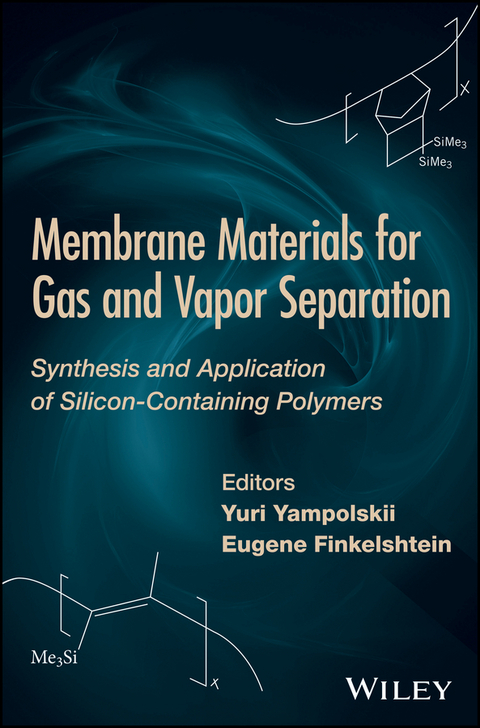
Membrane Materials for Gas and Separation (eBook)
John Wiley & Sons (Verlag)
978-1-119-11272-3 (ISBN)
Si containing polymers have been instrumental in the development of membrane gas separation practices since the early 1970s. Their function is to provide a selective barrier for different molecular species, where selection takes place either on the basis of size or on the basis of physical interactions or both.
- Combines membrane science, organosilicon chemistry, polymer science, materials science, and physical chemistry
- Only book to consider polymerization chemistry and synthesis of Si-containing polymers (both glassy and rubbery), and their role as membrane materials
- Membrane operations present environmental benefits such as reduced waste, and recovered/recycled valuable raw materials that are currently lost to fuel or to flares
Editors
Yuri Yampolskii
Eugene Finkelshtein
A.V. Topchiev Institute of Petrochemical Synthesis, RAS, Moscow, Russia
Si containing polymers have been instrumental in the development of membrane gas separation practices since the early 1970s. Their function is to provide a selective barrier for different molecular species, where selection takes place either on the basis of size or on the basis of physical interactions or both. Combines membrane science, organosilicon chemistry, polymer science, materials science, and physical chemistry Only book to consider polymerization chemistry and synthesis of Si-containing polymers (both glassy and rubbery), and their role as membrane materials Membrane operations present environmental benefits such as reduced waste, and recovered/recycled valuable raw materials that are currently lost to fuel or to flares
Editors Yuri Yampolskii Eugene Finkelshtein A.V. Topchiev Institute of Petrochemical Synthesis, RAS, Moscow, Russia
Title Page 5
Copyright 6
Contents 7
Contributors 13
Preface 17
Chapter 1 Permeability of Polymers 23
1.1 Introduction 23
1.2 Detailed mechanism of sorption and transport 25
1.2.1 Transition-state model 25
1.2.2 Free volume model 26
1.2.3 Sorption isotherms 27
1.3 Concentration dependence of permeability and diffusion coefficients 28
1.4 Effects of properties of gases and polymers on permeation parameters 32
Acknowledgement 35
References 35
Chapter 2 Organosiloxanes (Silicones), Polyorganosiloxane Block Copolymers: Synthesis, Properties, and Gas Permeation Membranes Based on Them 39
2.1 Introduction 39
2.2 Synthesis and transformations of organosiloxanes 39
2.2.1 Polyorganosiloxanes with aminoalkyl groups at silicon 41
2.2.2 Organosilicon alcohols and phenols 43
2.3 Synthesis of polyorganosiloxane block copolymers 45
2.3.1 Polyester(ether)–polyorganosiloxane block copolymers 46
2.3.2 Synthesis of polyurethane–, polyurea–, polyamide–, polyimide–organosiloxane POBCs 47
2.4 Properties of polyorganosiloxane block copolymers 51
2.4.1 Phase state of polyblock organosiloxane copolymers 51
2.5 Morphology of POBCs and its effects on their diffusion properties 52
2.5.1 Types of heterogeneous structure 52
2.6 Some representatives of POBC as membrane materials and their properties 54
2.6.1 Polycarbonate–polysiloxanes 54
2.6.2 Polyurethane(urea)–polysiloxanes 61
2.6.3 Polyimide(amide)–polysiloxanes 64
2.7 Conclusions 67
References 68
Chapter 3 Polysilalkylenes 75
Acknowledgement 87
References 87
Chapter 4 Polyvinylorganosilanes: The Materials for Membrane Gas Separation 91
4.1 Introduction: Historical background 91
4.2 Syntheses and polymerization of vinyltriorganosilanes 93
4.2.1 Syntheses of vinyltriorganosilanes 93
4.2.2 Vinyltriorganosilane (VTOS) polymerization 95
4.2.2.1 VTOS homopolymerization 95
4.2.2.2 Statistical copolymerization of VTOS with other monomers 105
4.2.2.3 Block-copolymerization of VTOS with monomers of other types 107
4.3 Physico-chemical and membrane properties of polymeric PVTOS materials 110
4.4 Concluding remarks 116
4.4 Acknowledgement 117
References 117
Chapter 5 Substituted Polyacetylenes 129
5.1 Introduction 129
5.2 Poly(1-trimethylsilyl-1-propyne) (PTMSP) and related polymers 132
5.2.1 Synthesis and general properties 132
5.2.2 Permeation of gases and liquids 134
5.2.3 Aging effect and cross-linking 136
5.2.4 Free volume 137
5.2.5 Nanocomposites and hybrids 138
5.3 Poly[1-phenyl-2-(p-trimethylsilylphenyl)acetylene] and related polymers 139
5.3.1 Polymer synthesis 140
5.3.2 Gas separation 143
5.4 Desilylated polyacetylenes 146
5.4.1 Desilylation of poly[1(p-trimethylsilylphenyl)-2-phenylacetylene] 146
5.4.2 PDPAs from precursor polymers with various silyl groups 147
5.4.3 Soluble poly(diphenylacetylene)s obtained by desilylation 149
5.4.4 Poly(diarylacetylene)s 150
5.5 Polar-group-containing polyacetylenes 152
5.5.1 Hydroxy group 152
5.5.2 Sulfonated and nitrated poly(diphenylacetylene)s 154
5.5.3 Other polar groups 156
5.6 Concluding remarks 157
References 158
Chapter 6 Polynorbornenes 165
6.1 Introduction 165
6.2 Monomer synthesis 166
6.2.1 Synthesis of silicon-substituted norbornenes and norbornadienes 167
6.2.1.1 [4?+2?]-cycloaddition of Si-substituted ethylenes and acetylenes to cyclopentadiene 167
6.2.1.2 Synthesis of silyl-substituted norbornenes and norbornadienes with alkyl and functional substituents via Si–Cl bond... 172
6.2.1.3 Other approaches to silylnorbornene and norbornadiene preparation 173
6.2.2 Synthesis of Si-containing exo-tricyclo[4.2.1.02,5]non-7-enes 174
6.2.2.1 The [2?+2?+2?]-cycloaddition reaction of quadricyclane with Si-containing alkenes or relative compounds as a simple... 175
6.2.2.2 Cycloaddition of Q with vinylsilanes or relative compounds 176
6.2.2.3 Cycloaddition of Q with Si-containing disubstituted alkenes/acetylenes 179
6.2.2.4 Cycloaddition of Q with Si-containing 1,2,3-trisubstituted alkenes 181
6.3 Metathesis polynorbornenes 185
6.4 Addition polymerization 205
6.4.1 Addition polynorbornenes and polynorbornenes with alkyl side groups 206
6.4.2 Silicon and germanium-substituted polynorbornenes 209
6.4.3 Composites with addition silicon-containing polytricyclononenes 227
6.5 Conclusions 231
6.5 Acknowledgement 232
References 232
Chapter 7 Polycondensation Materials Containing Bulky Side Groups: Synthesis and Transport Properties 245
7.1 Introduction 245
7.2 Synthesis of the polymers 246
7.2.1 Polyimides 246
7.2.1.1 One-step polymerization 246
7.2.1.2 Two-step polymerization 247
7.2.2 Poly(arylene ether)s (PAEs) 249
7.2.3 Aromatic polyamides (PAs) 250
7.2.3.1 Low temperature polymerization 250
7.2.3.2 High temperature polymerization 251
7.3 Effect of different bulky groups on polymer gas transport properties 251
7.3.1 Gas transport properties of the polyimides containing different bulky groups 251
7.3.2 Gas transport properties of polyamides containing different bulky groups 263
7.3.3 Gas transport properties of poly(arylene ether)s containing different bulky groups 270
7.3.4 Concluding remarks 285
References 287
Chapter 8 Gas and Vapor Transport Properties of Si-Containing and Related Polymers 293
8.1 Introduction 293
8.2 Rubbery Si-containing polymers 294
8.2.1 Polysiloxanes 294
8.2.2 Siloxane-containing copolymers (block copolymers, random copolymers and graft copolymers) 296
8.2.3 Polysilmethylenes 299
8.3 Glassy Si-containing polymers 300
8.3.1 Polymers with Si–O–Si bonds in side chains 300
8.3.2 Poly(vinyltrimethyl silane) and related vinylic polymers 304
8.3.3 Metathesis norbornene polymers 307
8.3.4 Additive norbornene polymers 308
8.3.5 Polyacetylenes 312
8.3.6 Other glassy Si-containing polymers 315
8.4 Free volume in Si-containing polymers 316
8.5 Concluding remarks 318
Acknowledgement 320
References 320
Chapter 9 Modeling of Si-Containing Polymers 329
9.1 Introduction 329
9.2 Main-chain silicon-containing polymers 331
9.2.1 Polysiloxanes 331
9.2.2 Polysilanes and silalkylene polymers 336
9.3 Side-chain silicon-containing polymers 338
9.3.1 Poly(vinyltrimethylsilane) 338
9.3.2 Poly[1-(trimethylsilyl)-1-propyne] 339
9.3.2.1 Conformational studies 340
9.3.2.2 Simulation of gas transport 341
9.4 Conclusions 346
Appendices 331
9.A Molecular flexibility 347
9.B Simulation of diffusivity 347
9.B.1 Einstein relationship 347
9.B.2 VACF method 347
9.C Simulation of solubility: Widom method 347
9.D Molecular mechanics force fields 348
9.D.1 DREIDING 348
9.D.2 Polymer-consistent force field (pcff) 348
9.D.3 GROMOS 348
9.D.4 COMPASS 348
References 349
Chapter 10 Pervaporation and Evapomeation with Si-Containing Polymers 357
10.1 Introduction 357
10.2 Structural design of Si-containing polymer membranes 357
10.2.1 Chemical design of Si-containing polymer membrane materials 358
10.2.2 Physical construction of Si-containing polymer membranes 358
10.3 Pervaporation 359
10.3.1 Principle of pervaporation 359
10.3.2 Fundamentals of pervaporation 360
10.3.3 Solution–diffusion model in pervaporation 361
10.4 Evapomeation 362
10.4.1 Principle of evapomeation 362
10.4.2 Principle of temperature-difference controlled evapomeation 363
10.5 Technology of pervaporation with Si-containing polymer membranes 364
10.5.1 Alcohol permselective membranes 364
10.5.2 Hydrocarbon permselective membranes 375
10.5.2.1 Aromatic hydrocarbon removal 375
10.5.2.2 Chlorinated hydrocarbon removal 380
10.5.3 Organic permselective membranes 382
10.5.4 Membranes for separation of organic–organic mixtures 383
10.5.5 Membranes for optical resolution 384
10.6 Technology of evapomeation with Si-containing polymer membranes 385
10.6.1 Permeation and separation by evapomeation 385
10.6.2 Concentration of ethanol by temperature-difference controlled evapomeation 386
10.7 Conclusions 387
References 387
Chapter 11 Si-Containing Polymers in Membrane Gas Separation 395
Executive summary 395
11.1 Introduction 395
11.2 Si-containing polymer membranes used in gas separation 397
11.2.1 Silicon rubber membrane materials 397
11.2.2 Polyacetylene membrane materials 398
11.2.3 Polynorbornene membrane materials 400
11.2.4 Other Si-containing membrane materials 400
11.3 Separations 401
11.4 Membrane modules 403
11.5 Competing technologies for separation of gases 406
11.6 Applications 407
11.6.1 Air separation 407
11.6.2 Hydrogen separation 408
11.6.3 Hydrocarbon separation 412
11.6.4 VOC separation 414
References 415
Index 421
EULA 443
| Erscheint lt. Verlag | 10.1.2017 |
|---|---|
| Sprache | englisch |
| Themenwelt | Naturwissenschaften ► Chemie ► Technische Chemie |
| Technik ► Maschinenbau | |
| Technik ► Umwelttechnik / Biotechnologie | |
| Schlagworte | chemical engineering • Chemische Verfahrenstechnik • materials processing • Materials Science • Materialverarbeitung • Materialwissenschaften • Membran • Membrane Gas SeparationPolycondensation • Membrane materialsSilicon-containing materialsCeramic membranesSustainable processesPermeabilityOrganosiloxanes • Pervaporation • Polymer processing • Polymer Science & Technology • Polymertechnologie • Polymerverarbeitung • Polymerwissenschaft u. -technologie • Separations • Stofftrennverfahren • Trennverfahren |
| ISBN-10 | 1-119-11272-9 / 1119112729 |
| ISBN-13 | 978-1-119-11272-3 / 9781119112723 |
| Informationen gemäß Produktsicherheitsverordnung (GPSR) | |
| Haben Sie eine Frage zum Produkt? |
 PDF (Adobe DRM)
Kopierschutz: Adobe-DRM
Adobe-DRM ist ein Kopierschutz, der das eBook vor Mißbrauch schützen soll. Dabei wird das eBook bereits beim Download auf Ihre persönliche Adobe-ID autorisiert. Lesen können Sie das eBook dann nur auf den Geräten, welche ebenfalls auf Ihre Adobe-ID registriert sind.
Details zum Adobe-DRM
Dateiformat: PDF (Portable Document Format)
Mit einem festen Seitenlayout eignet sich die PDF besonders für Fachbücher mit Spalten, Tabellen und Abbildungen. Eine PDF kann auf fast allen Geräten angezeigt werden, ist aber für kleine Displays (Smartphone, eReader) nur eingeschränkt geeignet.
Systemvoraussetzungen:
PC/Mac: Mit einem PC oder Mac können Sie dieses eBook lesen. Sie benötigen eine
eReader: Dieses eBook kann mit (fast) allen eBook-Readern gelesen werden. Mit dem amazon-Kindle ist es aber nicht kompatibel.
Smartphone/Tablet: Egal ob Apple oder Android, dieses eBook können Sie lesen. Sie benötigen eine
Geräteliste und zusätzliche Hinweise
Buying eBooks from abroad
For tax law reasons we can sell eBooks just within Germany and Switzerland. Regrettably we cannot fulfill eBook-orders from other countries.
aus dem Bereich