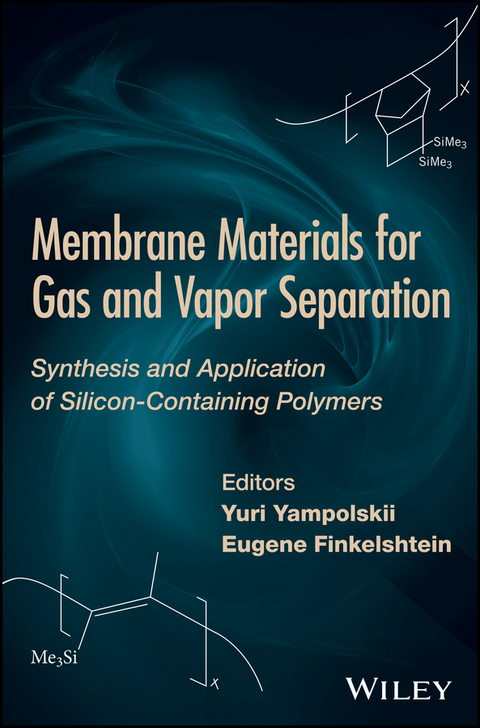
Membrane Materials for Gas and Separation (eBook)
John Wiley & Sons (Verlag)
978-1-119-11273-0 (ISBN)
Si containing polymers have been instrumental in the development of membrane gas separation practices since the early 1970s. Their function is to provide a selective barrier for different molecular species, where selection takes place either on the basis of size or on the basis of physical interactions or both.
- Combines membrane science, organosilicon chemistry, polymer science, materials science, and physical chemistry
- Only book to consider polymerization chemistry and synthesis of Si-containing polymers (both glassy and rubbery), and their role as membrane materials
- Membrane operations present environmental benefits such as reduced waste, and recovered/recycled valuable raw materials that are currently lost to fuel or to flares
Si containing polymers have been instrumental in the development of membrane gas separation practices since the early 1970s. Their function is to provide a selective barrier for different molecular species, where selection takes place either on the basis of size or on the basis of physical interactions or both. Combines membrane science, organosilicon chemistry, polymer science, materials science, and physical chemistry Only book to consider polymerization chemistry and synthesis of Si-containing polymers (both glassy and rubbery), and their role as membrane materials Membrane operations present environmental benefits such as reduced waste, and recovered/recycled valuable raw materials that are currently lost to fuel or to flares
Editors Yuri Yampolskii Eugene Finkelshtein A.V. Topchiev Institute of Petrochemical Synthesis, RAS, Moscow, Russia
Preface
Organosilicon compounds possess a number of specific properties due to the presence of Si‐containing chemical bonds. In general, this makes organosilicon chemistry an effective tool for a planned macromolecular design. Thus, Si–Cl bonds are substantially more active in hydrolysis reactions and in interaction with Grignar reagents than their carbon analogues. Si–H bonds smoothly react with olefins, in contrast to rather chemically passive C–H bonds. The silicon atom has a very weak tendency to formation of multiple bonds under normal conditions. This prevents the possibility of numerous undesirable side chemical processes, such as dehydrochlorination of chlorosilanes, dehydrogenation of hydrosilanes, and some others. At the same time, Si–C and Si–O bonds are quite stable, chemically as well as thermally. These bonds are the main “building blocks” of polycarbosilanes and polysiloxanes. Therefore, carbosilanes and siloxanes form an attractive basis for development of various polymer materials.
Simplicity of incorporation of different organic substituents on the silicon atom, including polar and sterically hindered groups, allows fabrication of a series of desired structures unattainable for purely organic compounds. This is the case for low molecular weight compounds (monomers), as well as for high molecular weight polymers.
Organosilicon monomers allow carbochain glassy polymers possessing high glass transition temperature (Tg) to be obtained by means of polymerization on multiple bonds, according to addition and metathesis schemes. Some monomers can also be used for synthesis of elastomeric polymers with very low Tg by ring opening polymerization via breaking endocyclic Si–C or Si–O bonds. Numerous examples of organosilicon polymers are shown below.
Homochain polymers
Heterochain polymers
Therefore, special peculiarities of organosilicon chemistry, as noted above, allow incorporation of a great variety of substituents on the silicon atom. This makes molecular design of desired polymer materials as well as conscious adjustment of their physicochemical properties realistically feasible.
Among various actual directions of the use of Si‐containing polymer materials, materials for gas and vapor separation membranes form an important and prospective field. Thus, the key to successful development of separation membrane materials is in finding and elaborating convenient methods for synthesis of appropriate monomers and determination of their optimal polymerization conditions, resulting in polymers with good gas transport and film‐forming properties.
Study of gas permeation parameters (permeability, diffusivity, thermodynamic sorption parameters) and important related properties such as free volume is an independent and a wide field of research. Among other tasks, one is to make an appropriate selection of gas mixtures that can be separated by certain membranes. Membrane science and technology related to the problems of gas and vapor separation are in permanent evolution. In this regard, modification of existing polymer membrane materials, searching for optimal conditions of separation and development of original syntheses of novel polymers provide permanent challenges for researchers. Methodologies based on organosilicon chemistry may be quite useful for the modern membrane industry.
All these issues form the subject of this monograph. In it, for the first time, we tried to consider jointly the questions of organosilicon chemistry and membrane science, giving historical backgrounds, outlining the trends of development and providing the contemporary state of the art of both fields.
In Chapter 1 the main parameters of membrane gas separation are defined and explained. Since gas permeation in non‐porous polymer membranes proceeds according to the solution–diffusion mechanism, the role of kinetic and thermodynamic factors in mass transfer through membranes is outlined. The role of the combination of high permeability and selectivity is stressed as a prerequisite of highly efficient membrane materials. Special attention is devoted to the effects of the nature and properties of gas and polymers on the observed gas permeation parameters.
From Chapter 2, consideration of the synthesis and properties of Si‐containing polymers is started. The subject of this chapter is rubbery polymers with flexible Si–O–Si bonds: organosiloxanes and block copolymers containing flexible siloxane blocks. The main feature of siloxanes is their extremely low Tg and, consequently, the very high mobility of their main chains. The chemistry and applications of polyorganosiloxanes and their copolymers have been intensively studied since the 1940s. They have found numerous applications, and one of them is their use as membrane materials. For a long period polydimethylsiloxane (PDMS) was considered as the most permeable polymer among all those known. A great impact on applications of siloxane‐containing polymers started 20–30 years later when block copolymers with rigid and flexible blocks were created and studied. The chapter gives a detailed description of the developed methods of synthesis of the polymers of this class, and numerous results of the studies of their membrane properties.
Interesting analogs of polyorganosiloxane are known; these are polymers where the flexible Si–O bond is replaced by the structurally similar Si–C bond: polysilmethylenes, which are the subject of Chapter 3. A comparison of these two types of polymer permits further elucidation of the role of the flexibility of the main chains of Si‐containing polymers and its effects on permeability and diffusivity. Approaches to the synthesis of polysiloxanes and polysilmethylenes have common features: in both cases it is a scission of strained cycles. However, there are differences between the polymers obtained: the latter have less flexible chains and, hence, their permeability is not that high. The polymers of both classes are rubbers, so the problems that can be solved using the membranes based on them are similar. This is mainly the separation of gaseous hydrocarbons; however, in many cases their relatively high gas permeability justifies consideration of the separation of light gases such as O2/N2 or CO2/CH4.
Since the 1960s a new era has started in the chemistry and physical chemistry of Si‐containing polymers as membrane materials. A big stride was made by creating poly(vinyltrimethyl silane) (PVTMS) and its structural analogs. A general feature of these vinylic polymers, described in Chapter 4, is that they contain Si in side groups and are glassy materials. On the basis of PVTMS the first industrially produced gas separation membrane was fabricated and produced from the end of the 1970s in the Soviet Union. The properties of this polymer, which seemed rather unusual when it was prepared and studied, undoubtedly influenced further activity in the field of Si‐containing membrane materials. The chapter gives a brief review of polymerization chemistry of vinylorganosilanes and emphasizes the role of anionic polymerization. Other vinylic polymers, e.g. Si‐substituted polystyrenes, are also briefly considered.
The theme of glassy Si‐containing polymers obtained an exceelent development in studies of disubstituted Si‐containing polyacetylenes, the subject of Chapter 5. These materials show a wide range of permeability and have demonstrated diverse manifestations of structure–permeability effects. As often occurs, even the first prepared polymer of this class, poly(trimethylsilyl propyne) (PTMSP), revealed record‐breaking permeability. It was with PTMSP that the phenomena of solubility controlled permeation were observed for the first time using glassy membranes. Another interesting reaction was discovered with polyacetylenes – desilylation. It resulted in formation of highly permeable materials that do not contain silicon (solid state elimination of Si‐containing groups with formation of additional free volume elements within the membrane). It is likely that the same concept can be applicable to other classes of glassy polymers that contain C(arom)–Si bonds in side groups.
A wealth of information is reported in Chapter 6. There, the authors deal with numerous Si‐containing glassy polymers of norbornene and polytricyclononenes. An unusual peculiarity of these polymers is that the same monomers can produce materials with entirely different structures, chain rigidities and other properties depending on the selection of the polymerization catalyst. Metathesis polynorbornenes have relatively flexible chains and rather modest gas permeability. Nonetheless, after preparation and investigation of a large number of polynorbornenes with different structures many important observations were made regarding the structure–permeability relationship. Addition Si‐containing polynorbornenes have very rigid main chains (high Tg) and demonstrated high gas permeability, similar to that of polyacetylenes. For this class of polymers solubility‐controlled permeation was also observed.
The subject of Chapter 7 is the description of synthesis and investigation of polyimides and polyamides with bulky side groups (e.g. tert‐butyl or adamantyl). The idea of this chapter is a demonstration that not only Si‐containing side groups but also other bulky substituents can result in significant increases in permeability, often not at the expense of permselectivity. The chapter contains much information...
| Erscheint lt. Verlag | 10.1.2017 |
|---|---|
| Sprache | englisch |
| Themenwelt | Naturwissenschaften ► Chemie ► Technische Chemie |
| Technik ► Maschinenbau | |
| Technik ► Umwelttechnik / Biotechnologie | |
| Schlagworte | chemical engineering • Chemische Verfahrenstechnik • materials processing • Materials Science • Materialverarbeitung • Materialwissenschaften • Membran • Membrane Gas SeparationPolycondensation • Membrane materialsSilicon-containing materialsCeramic membranesSustainable processesPermeabilityOrganosiloxanes • Pervaporation • Polymer processing • Polymer Science & Technology • Polymertechnologie • Polymerverarbeitung • Polymerwissenschaft u. -technologie • Separations • Stofftrennverfahren • Trennverfahren |
| ISBN-10 | 1-119-11273-7 / 1119112737 |
| ISBN-13 | 978-1-119-11273-0 / 9781119112730 |
| Informationen gemäß Produktsicherheitsverordnung (GPSR) | |
| Haben Sie eine Frage zum Produkt? |
 EPUB (Adobe DRM)
Kopierschutz: Adobe-DRM
Adobe-DRM ist ein Kopierschutz, der das eBook vor Mißbrauch schützen soll. Dabei wird das eBook bereits beim Download auf Ihre persönliche Adobe-ID autorisiert. Lesen können Sie das eBook dann nur auf den Geräten, welche ebenfalls auf Ihre Adobe-ID registriert sind.
Details zum Adobe-DRM
Dateiformat: EPUB (Electronic Publication)
EPUB ist ein offener Standard für eBooks und eignet sich besonders zur Darstellung von Belletristik und Sachbüchern. Der Fließtext wird dynamisch an die Display- und Schriftgröße angepasst. Auch für mobile Lesegeräte ist EPUB daher gut geeignet.
Systemvoraussetzungen:
PC/Mac: Mit einem PC oder Mac können Sie dieses eBook lesen. Sie benötigen eine
eReader: Dieses eBook kann mit (fast) allen eBook-Readern gelesen werden. Mit dem amazon-Kindle ist es aber nicht kompatibel.
Smartphone/Tablet: Egal ob Apple oder Android, dieses eBook können Sie lesen. Sie benötigen eine
Geräteliste und zusätzliche Hinweise
Buying eBooks from abroad
For tax law reasons we can sell eBooks just within Germany and Switzerland. Regrettably we cannot fulfill eBook-orders from other countries.
aus dem Bereich