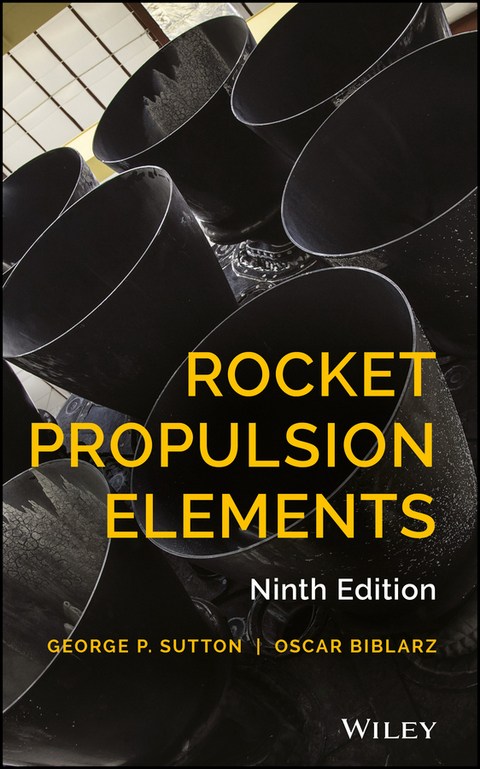
Rocket Propulsion Elements (eBook)
John Wiley & Sons (Verlag)
9781118753910 (ISBN)
THE DEFINITIVE INTRODUCTION TO ROCKET PROPULSION THEORY AND APPLICATIONS
The recent upsurge in global government and private spending and in space flight events has resulted in many novel applications of rocket propulsion technology. Rocket Propulsion Elements remains the definitive guide to the field, providing a comprehensive introduction to essential concepts and applications. Led by industry veteran George P. Sutton and by Professor Oscar Biblarz, this book provides interdisciplinary coverage including thermodynamics, aerodynamics, flight performance, propellant chemistry and more.
This thoroughly revised ninth edition includes discussion and analysis of recent advances in the field, representing an authoritative reference for students and working engineers alike. In any engineering field, theory is only as useful as it is practical; this book emphasizes relevant real-world applications of fundamental concepts to link 'thinking' and 'doing'. This book will help readers:
- Understand the physics of flight and the chemistry of propulsion
- Analyze liquid, solid, gas, and hybrid propellants, and the engines they fuel
- Consider high-temperature combustion, stability, and the principles of electric and chemical propulsion
- Dissect the workings of systems in common use around the world today
- Delve into the latest advances in materials, systems, propellants, and more
Broad in scope, rich in detail, and clear in explanation, this seminal work provides an unparalleled foundation in aerospace engineering topics. Learning through the lens of modern applications untangles complex topics and helps students fully grasp the intricacies on a more intuitive level. Rocket Propulsion Elements, Ninth Edition merges information and utility building a solid foundation for innovation.
GEORGE P. SUTTON is an acknowledged expert on rocket propulsion, and the former Executive Director of Engineering at Rocketdyne (now Aerojet Rocketdyne), and Laboratory Associate at Lawrence Livermore National Laboratory.
OSCAR BIBLARZ is a Professor Emeritus in the Department of Mechanical and Aerospace Engineering at the Naval Postgraduate School in Monterey, California.
GEORGE P. SUTTON is an acknowledged expert on rocket propulsion, and the former Executive Director of Engineering at Rocketdyne (now Aerojet Rocketdyne), and Laboratory Associate at Lawrence Livermore National Laboratory. OSCAR BIBLARZ is a Professor Emeritus in the Department of Mechanical and Aerospace Engineering at the Naval Postgraduate School in Monterey, California.
PREFACE
The rocket propulsion business in the United States of America appears to be changing. In the past, and also currently, the business has been planned, financed, and coordinated mostly by the Department of Defense and NASA. Government funding, government test or launch facilities, and other government support was provided. As it happens in all fields old‐time companies have changed ownership, some have been sold or merged, some went out of business, some reduced the number of employees, and other companies have entered the field. New privately financed companies have sprung up and have developed their own rocket propulsion systems and flight vehicles as well as their own test, manufacturing, and launch facilities. These new companies have received some government contracts. Several privately owned companies have developed on their own useful space vehicles and rocket propulsion systems that were not originally in the government's plan. Although business climate changes noticeably influence rocket activities, it is not the purpose of this book to describe such business effects, but to present rocket propulsion principles and to give recent information and data on technical and engineering aspects of rocket propulsion systems.
All aerospace developments are aimed either at better performance, or higher reliability, or lower cost. In the past, when developing or modifying a rocket propulsion system for space applications, the emphasis has been primarily on very high reliability and, to a lesser extent, on high performance and low cost. Each of the hundreds of components of a propulsion system has to do its job reliably and without failure during operation. Indeed, the reliability of space launches has greatly improved world wide. In recent years emphasis has been placed primarily on cost reduction, but with continuing lower priority efforts to further improve performance and reliability. Therefore, this Ninth Edition has a new section and table on cost reduction of rocket propulsion systems. Also, in this book environmental compatibility is considered to be part of reliability
This Ninth Edition is organized into the same 21 chapters and subjects, as in the Eighth Edition, except that some aspects are treated in more detail. The names of the 21 chapters can be found in the Table of Contents. There are some changes, additions, improvements, and deletions in every chapter. A few problems have printed answers so students or other readers can self‐check their solutions.
About half of this new edition is devoted to chemical rocket propulsion (solid propellant motors, liquid propellant rocket engines, and hybrid rocket propulsion systems). The largest number of individual rocket propulsion systems (currently in use, on stand‐by, or in production) are solid propellant rocket motors; they vary in size, complexity, and duration; most systems are for military or defense applications. The next largest number in production or currently in use for space flight or missile defense are liquid propellant rocket engines; they vary widely in size, thrust or duration. Many people in aerospace consider this rocket propulsion technology to be mature. Enough technical information is available from public sources and from skilled personnel so that any new or modified rocket propulsion system can be developed with some confidence.
There have been several new applications (different flight vehicles, different missions) using existing or modified rocket propulsion systems. Several of these new applications are mentioned in this book.
Compared to the prior edition this new edition has less information or data of recently retired rocket engines, such as the engines for the Space Shuttle (retired in 2011) or Energiya; these have been replaced with facts from rocket propulsion systems that are likely to be in production for a long time. This new edition gives data on several rocket propulsion systems that are currently in production; examples are the RD‐68 and the Russian RD‐191 engines. Relatively little discussion of current research and developments is contained in this Ninth Edition; this is because it is not known when any particular development will lead to a better propulsion system, a better material of construction, a better propellant, or a better method of analysis, even if it appears to be promising at the present time. It is unfortunate that a majority of Research and Development programs do not lead to production applications.
Subjects new to the book include the Life of Liquid Propellant Thrust Chambers, a powerful new solid propellant explosive ingredient and two sections on variable thrust rocket propulsion. The discussion of dinitrogen oxide propellant is new, and additions were made to the write‐ups of hydrogen peroxide and methane. Several different liquid propellant rocket engines are shown as examples of different engine types. The rocket propulsion system of the MESSENGER space probe is described as an example of a multiple thruster pressure feed system; its flow diagram replaces the Eighth Edition's one for the Space Shuttle. The Russian RD‐191 engine (for the Angara series of launch vehicles) serves as an example for a high performance staged combustion engine cycle. The RD‐68A presently has the highest thrust of any liquid oxygen/liquid hydrogen engine and it is an example of an advanced gas generator engine cycle. The RD‐0124 illustrates an upper stage rocket engine with four thrust chambers and a single turbopump. Currently, a new manufacturing process known as Additive Manufacturing is being investigated for replacing parts or components of existing liquid propellant rocket engines.
The Ninth Edition also has the following other subjects, which are new to this book: upper stages with all electric propulsion, a dual inlet liquid propellant centrifugal pump for better cavitation resistance, topping‐off cryogenic propellant tanks just prior to launching, benefits of pulsing of small thrusters, avoiding carbon containing deposits in the passages of liquid propellant cooling jackets, and a two‐kilowatt arcjet. Since it is unlikely that nuclear power rocket propulsion systems development will again be undertaken in the next decade or that gelled propellants or aerospike nozzles will enter into production anytime soon, these three topics have largely been deleted from the new edition.
All Problems and Examples have been reviewed. Some have been modified, and some are new. A few of the problems which were deemed hard to solve have been deleted. The index at the end of the book has been expanded, making it somewhat easier to find specific topics in the book.
Since its first edition in 1949 this book has been a most popular and authoritative work in rocket propulsion and has been acquired by at least 77,000 students and professionals in more than 35 countries. It has been used as a text in graduate and undergraduate courses at about 55 universities. It is the longest living aerospace book ever, having been in print continuously for 67 years. It is cited in two prestigious professional awards of the American Institute of Aeronautics and Astronautics. Earlier editions have been translated into Russian, Chinese, and Japanese. The authors have given lectures and three‐day courses using this book as a text in colleges, companies and Government establishments. In one company all new engineers are given a copy of this book and asked to study it.
As mentioned in prior editions, the reader should be very aware of the hazards of propellants, such as spills, fires, explosions, or health impairments. The authors and the publisher recommend that readers of this book do not work with hazardous propellant materials or handle them without an exhaustive study of the hazards, the behavior, and properties of each propellant, and without rigorous safety training, including becoming familiar with protective equipment. People have been killed, when they failed to do this. Safety training and propellant information is given routinely to employees of organizations in this business. With proper precautions and careful design, all propellants can be handled safely. Neither the authors nor the publisher assume any responsibility for actions on rocket propulsion taken by the reader, either directly or indirectly. The information presented in this book is insufficient and inadequate for conducting propellant experiments or rocket propulsion operations.
This book and its prior editions use both the English Engineering (EE) system of units (foot, pound) and the SI (Systėme International) or metric system of units (m, kg), because most drawings and measurements of components and subassemblies of chemical rocket propulsion systems, much of the rocket propulsion design and most of the manufacturing is still done in EE units, Some colleges and research organizations in the United States, and most propulsion organizations in other countries use the SI system of units. This dual set of units is used, even though the United States has been committed to switch to SI units.
Indeed the authors gratefully acknowledge the good help and information obtained from experts in specific areas of propulsion. James H. Morehart, The Aerospace Corporation, (information on various rocket engines and propellants) 2005 to 2015; Jeffrey S. Kincaid, Vice President (retired), Aerojet Rocketdyne, Canoga Park, CA (RS‐68 engine data and figures, various propulsion data) 2012 to 2915; Roger Berenson, Engine Program Chief Engineer, Aerojet Rocketdyne, Canoga Park, CA, (RS‐68 and RS‐25 engine and general propulsion data) 2015; Mathew Rottmund, United Launch Alliance, Centennial, CO. (launch vehicle propulsion...
| Erscheint lt. Verlag | 30.11.2016 |
|---|---|
| Sprache | englisch |
| Themenwelt | Naturwissenschaften ► Physik / Astronomie ► Astronomie / Astrophysik |
| Technik ► Elektrotechnik / Energietechnik | |
| Technik ► Fahrzeugbau / Schiffbau | |
| Technik ► Luft- / Raumfahrttechnik | |
| Technik ► Maschinenbau | |
| Schlagworte | Aeronautic & Aerospace Engineering • Energie • Energietechnik • Energy • Luft- u. Raumfahrttechnik • Maschinenbau • mechanical engineering • Power Technology & Power Engineering • Raketentriebwerk |
| ISBN-13 | 9781118753910 / 9781118753910 |
| Informationen gemäß Produktsicherheitsverordnung (GPSR) | |
| Haben Sie eine Frage zum Produkt? |
 EPUB (Adobe DRM)
Kopierschutz: Adobe-DRM
Adobe-DRM ist ein Kopierschutz, der das eBook vor Mißbrauch schützen soll. Dabei wird das eBook bereits beim Download auf Ihre persönliche Adobe-ID autorisiert. Lesen können Sie das eBook dann nur auf den Geräten, welche ebenfalls auf Ihre Adobe-ID registriert sind.
Details zum Adobe-DRM
Dateiformat: EPUB (Electronic Publication)
EPUB ist ein offener Standard für eBooks und eignet sich besonders zur Darstellung von Belletristik und Sachbüchern. Der Fließtext wird dynamisch an die Display- und Schriftgröße angepasst. Auch für mobile Lesegeräte ist EPUB daher gut geeignet.
Systemvoraussetzungen:
PC/Mac: Mit einem PC oder Mac können Sie dieses eBook lesen. Sie benötigen eine
eReader: Dieses eBook kann mit (fast) allen eBook-Readern gelesen werden. Mit dem amazon-Kindle ist es aber nicht kompatibel.
Smartphone/Tablet: Egal ob Apple oder Android, dieses eBook können Sie lesen. Sie benötigen eine
Geräteliste und zusätzliche Hinweise
Buying eBooks from abroad
For tax law reasons we can sell eBooks just within Germany and Switzerland. Regrettably we cannot fulfill eBook-orders from other countries.
aus dem Bereich