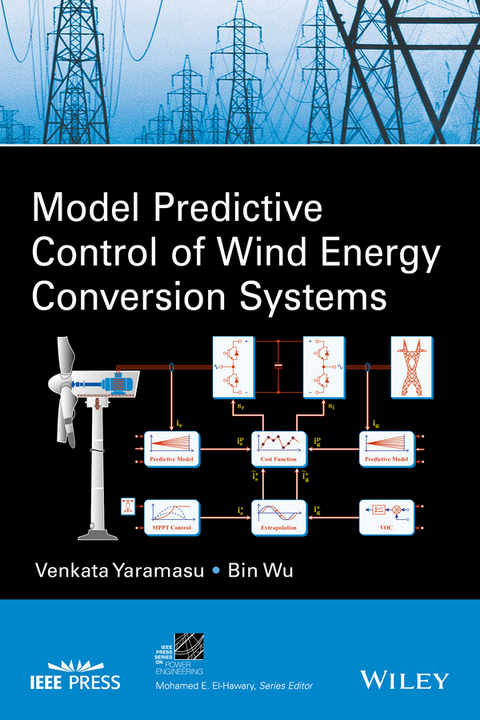
Model Predictive Control of Wind Energy Conversion Systems (eBook)
John Wiley & Sons (Verlag)
978-1-119-08299-6 (ISBN)
Model Predictive Control of Wind Energy Conversion Systems addresses the predicative control strategy that has emerged as a promising digital control tool within the field of power electronics, variable-speed motor drives, and energy conversion systems.
The authors provide a comprehensive analysis on the model predictive control of power converters employed in a wide variety of variable-speed wind energy conversion systems (WECS). The contents of this book includes an overview of wind energy system configurations, power converters for variable-speed WECS, digital control techniques, MPC, modeling of power converters and wind generators for MPC design. Other topics include the mapping of continuous-time models to discrete-time models by various exact, approximate, and quasi-exact discretization methods, modeling and control of wind turbine grid-side two-level and multilevel voltage source converters. The authors also focus on the MPC of several power converter configurations for full variable-speed permanent magnet synchronous generator based WECS, squirrel-cage induction generator based WECS, and semi-variable-speed doubly fed induction generator based WECS. Furthermore, this book:
- Analyzes a wide variety of practical WECS, illustrating important concepts with case studies, simulations, and experimental results
- Provides a step-by-step design procedure for the development of predictive control schemes for various WECS configurations
- Describes continuous- and discrete-time modeling of wind generators and power converters, weighting factor selection, discretization methods, and extrapolation techniques
- Presents useful material for other power electronic applications such as variable-speed motor drives, power quality conditioners, electric vehicles, photovoltaic energy systems, distributed generation, and high-voltage direct current transmission.
- Explores S-Function Builder programming in MATLAB environment to implement various MPC strategies through the companion website
Reflecting the latest technologies in the field, Model Predictive Control of Wind Energy Conversion Systems is a valuable reference for academic researchers, practicing engineers, and other professionals. It can also be used as a textbook for graduate-level and advanced undergraduate courses.
Venkata Yaramasu is currently working as an Assistant Professor of Electrical Engineering in the School of Informatics, Computing, and Cyber Systems, Northern Arizona University, USA. He has published more than 50 peer-reviewed technical papers including 22 journal papers, and 10 technical reports for the industry. Dr. Yaramasu worked closely with Rockwell Automation, Toronto Hydro, Hydro One, Natural Sciences and Engineering Research Council of Canada, Wind Energy Strategic Network and Connect Canada, and completed 8 industrial projects in Power Electronics, Electric Drives and Renewable Energy. Dr. Yaramasu is recipient of over 15 awards for research and teaching excellence.
Bin Wu is currently a Professor in the Department of Electrical and Computer Engineering, Ryerson University, Canada and is the Senior NSERC/Rockwell Automation Industrial Research Chair in Power Electronics and Electric Drives. Dr. Wu has published more than 350 peer-reviewed technical papers, two Wiley-IEEE Press books, and holds more than 30 issued and pending patents in power electronics, adjustable-speed drives and renewable energy systems. He is a Fellow of the Institute of Electrical and Electronic Engineers (IEEE), Engineering Institute of Canada (EIC), and Canadian Academy of Engineering (CAE). Dr. Wu is a Registered Professional Engineer in the Province of Ontario, Canada.
Model Predictive Control of Wind Energy Conversion Systems addresses the predicative control strategy that has emerged as a promising digital control tool within the field of power electronics, variable-speed motor drives, and energy conversion systems. The authors provide a comprehensive analysis on the model predictive control of power converters employed in a wide variety of variable-speed wind energy conversion systems (WECS). The contents of this book includes an overview of wind energy system configurations, power converters for variable-speed WECS, digital control techniques, MPC, modeling of power converters and wind generators for MPC design. Other topics include the mapping of continuous-time models to discrete-time models by various exact, approximate, and quasi-exact discretization methods, modeling and control of wind turbine grid-side two-level and multilevel voltage source converters. The authors also focus on the MPC of several power converter configurations for full variable-speed permanent magnet synchronous generator based WECS, squirrel-cage induction generator based WECS, and semi-variable-speed doubly fed induction generator based WECS. Furthermore, this book: Analyzes a wide variety of practical WECS, illustrating important concepts with case studies, simulations, and experimental results Provides a step-by-step design procedure for the development of predictive control schemes for various WECS configurations Describes continuous- and discrete-time modeling of wind generators and power converters, weighting factor selection, discretization methods, and extrapolation techniques Presents useful material for other power electronic applications such as variable-speed motor drives, power quality conditioners, electric vehicles, photovoltaic energy systems, distributed generation, and high-voltage direct current transmission. Explores S-Function Builder programming in MATLAB environment to implement various MPC strategies through the companion website Reflecting the latest technologies in the field, Model Predictive Control of Wind Energy Conversion Systems is a valuable reference for academic researchers, practicing engineers, and other professionals. It can also be used as a textbook for graduate-level and advanced undergraduate courses.
Venkata Yaramasu is currently working as an Assistant Professor of Electrical Engineering in the School of Informatics, Computing, and Cyber Systems, Northern Arizona University, USA. He has published more than 50 peer-reviewed technical papers including 22 journal papers, and 10 technical reports for the industry. Dr. Yaramasu worked closely with Rockwell Automation, Toronto Hydro, Hydro One, Natural Sciences and Engineering Research Council of Canada, Wind Energy Strategic Network and Connect Canada, and completed 8 industrial projects in Power Electronics, Electric Drives and Renewable Energy. Dr. Yaramasu is recipient of over 15 awards for research and teaching excellence. Bin Wu is currently a Professor in the Department of Electrical and Computer Engineering, Ryerson University, Canada and is the Senior NSERC/Rockwell Automation Industrial Research Chair in Power Electronics and Electric Drives. Dr. Wu has published more than 350 peer-reviewed technical papers, two Wiley-IEEE Press books, and holds more than 30 issued and pending patents in power electronics, adjustable-speed drives and renewable energy systems. He is a Fellow of the Institute of Electrical and Electronic Engineers (IEEE), Engineering Institute of Canada (EIC), and Canadian Academy of Engineering (CAE). Dr. Wu is a Registered Professional Engineer in the Province of Ontario, Canada.
MODEL PREDICTIVE CONTROL OF WIND ENERGY CONVERSION SYSTEMS 3
Contents 9
About the Authors 19
Preface 21
Acknowledgments 25
Acronyms 27
Symbols 31
PART I PRELIMINARIES 39
1 Basics of Wind Energy Conversion Systems (WECS) 41
1.1 Introduction 41
1.2 Wind Energy Preliminaries 43
1.2.1 Installed Wind Power Capacity 43
1.2.2 Wind Kinetic Energy to Electric Energy Conversion 45
1.2.3 Classification of Wind Energy Technologies 47
1.3 Major Components of WECS 54
1.3.1 Mechanical Components 54
1.3.2 Electrical Components 58
1.3.3 Mechanical and Electrical Control Systems 60
1.4 Grid Code Requirements for High-Power WECS 61
1.4.1 Fault Ride-Through 62
1.4.2 Reactive Power Generation 63
1.5 WECS Commercial Configurations 64
1.5.1 Type 1 WECS Configuration 64
1.5.2 Type 2 WECS Configuration 65
1.5.3 Type 3 WECS Configuration 66
1.5.4 Type 4 WECS Configuration 67
1.5.5 Type 5 WECS Configuration 69
1.5.6 Comparison of WECS Configurations 70
1.6 Power Electronics in Wind Energy Systems 71
1.7 Control of Wind Energy Systems 73
1.7.1 TSO/DSO Supervisory Control (Level VI) 75
1.7.2 Wind Farm Centralized Control (Level V) 75
1.7.3 WT Centralized Control (Level IV) 76
1.7.4 Grid Integration and MPPT Control (Level III) 77
1.7.5 Power Converter, Wind Generator, and Grid Control (Level I and II) 82
1.8 Finite Control-Set Model Predictive Control 88
1.8.1 Main Features of FCS-MPC 88
1.8.2 Challenges of FCS-MPC 90
1.9 Classical and Model Predictive Control of WECS 91
1.9.1 Classical Control of WECS 92
1.9.2 Model Predictive Control of WECS 93
1.9.3 Comparison of Classical and Model Predictive Control 95
1.10 Concluding Remarks 96
References 96
2 Review of Generator–Converter Configurations for WECS 99
2.1 Introduction 99
2.2 Requirements for Power Converters in MW-WECS 101
2.3 Overview of Power Converters for WECS 102
2.4 Back-to-Back Connected Power Converters 106
2.4.1 Low-Voltage BTB Converters 106
2.4.2 Medium-Voltage BTB Converters 110
2.4.3 Comparison of BTB Power Converters 113
2.5 Passive Generator-side Power Converters 114
2.5.1 Low-Voltage PGS Converters 115
2.5.2 Medium-Voltage PGS Converters 116
2.6 Power Converters for Multiphase Generators 118
2.6.1 Power Converters for Six-Phase Generators 118
2.6.2 Power Converters for Open-Winding Generators 120
2.7 Power Converters without an Intermediate DC Link 123
2.7.1 Low-Voltage Matrix Converters 123
2.7.2 Medium-Voltage Matrix Converters 124
2.8 Concluding Remarks 125
References 127
3 Overview of Digital Control Techniques 129
3.1 Introduction 129
3.2 The Past, Present, and Future of Control Platforms 131
3.3 Reference Frame Theory 133
3.3.1 Definition of Natural Frame Space Phasor 133
3.3.2 Transformation Between Natural and Stationary Frames 135
3.3.3 Transformation Between Natural and Synchronous Frames 136
3.3.4 Transformation Between Stationary and Synchronous Frames 137
3.4 Digital Control of Power Conversion Systems 137
3.4.1 Block Diagram of Digital Current Control 137
3.4.2 Model of Two-Level VSC for Digital Current Control 138
3.5 Classical Control Techniques 140
3.5.1 Hysteresis Control 140
3.5.2 Linear Control 141
3.6 Advanced Control Techniques 148
3.6.1 Sliding Mode Control 148
3.6.2 Intelligent Control 148
3.7 Predictive Control Techniques 150
3.7.1 Predictive Control with Modulation 150
3.7.2 Predictive Control without Modulation 151
3.8 Comparison of Digital Control Techniques 152
3.9 Concluding Remarks 153
References 154
4 Fundamentals of Model Predictive Control 155
4.1 Introduction 155
4.2 Sampled-Data Model 157
4.3 Basics of Model Predictive Control 158
4.3.1 Operating Principle 158
4.3.2 Design Procedure 159
4.3.3 Implementation of Control Scheme 163
4.3.4 Stability-Related Issues 165
4.4 Cost Function Flexibility 166
4.4.1 Primary Control Objectives 168
4.4.2 Secondary Control Objectives 170
4.5 Weighting Factor Selection 172
4.5.1 Heuristic Selection 172
4.5.2 Per-Unit Method 173
4.5.3 Lookup Table-Based Selection 174
4.5.4 Multiobjective Ranking Algorithm 174
4.6 Delay Compensation Methods 175
4.6.1 Estimation + Prediction Approach 177
4.6.2 Prediction + Double Prediction Approach 177
4.6.3 Prediction + Prediction Approach 178
4.6.4 Long Prediction Horizons 179
4.7 Extrapolation Techniques 179
4.7.1 Discrete Signal Generator 180
4.7.2 Vector Angle Extrapolation 181
4.7.3 Lagrange Extrapolation 181
4.8 Selection of Sampling Time 183
4.9 Concluding Remarks 184
References 184
PART II MODELING OF POWER CONVERTERS AND WIND GENERATORS 187
5 Modeling of Power Converters for Model Predictive Control 189
5.1 Introduction 189
5.2 Objectives for the Modeling of Power Converters 191
5.3 Notation Employed for the Modeling 192
5.4 Two-Level Voltage Source Converter 194
5.4.1 Power Circuit 194
5.4.2 Operating Modes 195
5.4.3 Model of Output AC Voltages 197
5.4.4 Model of Input DC Branch Currents 198
5.5 Extensions to 2L-VSC Modeling 199
5.5.1 Modeling of Multiphase 2L-VSC 199
5.5.2 Modeling of BTB 2L-VSC 199
5.6 Neutral-Point Clamped Converter 200
5.6.1 Power Circuit 200
5.6.2 Operating Modes 201
5.6.3 Model of Output AC Voltages 203
5.6.4 Model of Input DC Branch Currents 203
5.7 Extensions to NPC Converter Modeling 204
5.7.1 Modeling of Multilevel and Multiphase DCC 204
5.7.2 Modeling of BTB NPC Converter 205
5.8 Modeling of Other Power Converters 207
5.8.1 Three-Level Flying Capacitor Converter 207
5.8.2 Current Source Converter 208
5.8.3 Direct Matrix Converter 210
5.8.4 Indirect Matrix Converter 211
5.9 Concluding Remarks 212
References 213
6 Modeling of Wind Generators for Model Predictive Control 215
6.1 Introduction 215
6.2 Overview of Wind Generators for Variable-Speed WECS 217
6.2.1 Synchronous Generators for WECS 217
6.2.2 Induction Generators for WECS 218
6.3 Objectives for the Dynamic Modeling of Wind Generators 219
6.4 Notation Employed for the Dynamic Modeling 220
6.5 Modeling of Permanent Magnet Synchronous Generator 222
6.5.1 Stationary Frame Model 222
6.5.2 Stator Voltages in Synchronous Frame 224
6.5.3 Stator Flux Linkages in Synchronous Frame 225
6.5.4 Stator Current Dynamics in Synchronous Frame 225
6.5.5 Stator Active and Reactive Power 226
6.5.6 Electromagnetic Torque and Rotor Speed 226
6.6 Simulation of Permanent Magnet Synchronous Generator 229
6.7 Modeling of Induction Generator 231
6.7.1 Space Vector Model 231
6.7.2 Modeling in Arbitrary Reference Frame 233
6.7.3 Modeling in Synchronous Reference Frame 234
6.7.4 Modeling in Stationary Reference Frame 236
6.8 Simulation of Induction Generator 239
6.9 Generator Dynamic Models for Predictive Control 242
6.10 Concluding Remarks 243
References 243
7 Mapping of Continuous-Time Models to Discrete-Time Models 245
7.1 Introduction 245
7.2 Model Predictive Control of WECS 247
7.3 Correlation Between CT and DT Models 248
7.3.1 CT and DT State-Space Equations 248
7.3.2 CT and DT Transfer Functions 250
7.4 Overview of Discretization Methods 251
7.5 Exact Discretization by ZOH Method 253
7.6 Approximate Discretization Methods 254
7.6.1 Forward Euler Approximation 255
7.6.2 Backward Euler Approximation 257
7.6.3 Approximation by Bilinear Transformation 260
7.7 Quasi-Exact Discretization Methods 260
7.7.1 Matrix Factorization 261
7.7.2 Truncated Taylor Series 264
7.8 Comparison of Discretization Methods 267
7.9 Offline Calculation of DT Parameters Using MATLAB 269
7.10 Concluding Remarks 271
References 272
PART III CONTROL OF VARIABLE-SPEED WECS 273
8 Control of Grid-side Converters in WECS 275
8.1 Introduction 275
8.2 Configuration of GSCs in Type 3 and 4 WECS 277
8.2.1 Single-Stage Power Conversion 277
8.2.2 Two-Stage Power Conversion 277
8.2.3 Three-Stage Power Conversion 279
8.3 Design and Control of GSC 280
8.3.1 Design of Passive Components 280
8.3.2 Design of Reference DC-Bus Voltage 281
8.3.3 Definition of Grid Power Factor 281
8.3.4 Grid Voltage Orientation 282
8.4 Modeling of Three-Phase GSC 285
8.4.1 Modeling of abc-Frame Grid Currents and Powers 286
8.4.2 Modeling of aß-Frame Grid Currents and Powers 289
8.4.3 Modeling of dq-Frame Grid Currents and Powers 290
8.4.4 Modeling of VSI Output Voltages 292
8.4.5 Modeling of DC Link Capacitors Voltage in NPC Inverter 295
8.5 Calculation of Reference Grid-side Variables 297
8.5.1 Generator-side MPPT 298
8.5.2 Grid-side MPPT 299
8.6 Predictive Current Control of 2L-VSI in dq-Frame 300
8.6.1 Design Procedure 300
8.6.2 Control Algorithm 302
8.6.3 Comparison of the PCC Design with VOC 303
8.6.4 Comparison of GSC Performance with Passive Load Case 304
8.6.5 Switching Frequency Regulation 305
8.7 Predictive Current Control of NPC Inverter in aß-Frame 308
8.7.1 Design Procedure 309
8.7.2 Control Algorithm 311
8.8 Predictive Power Control of NPC Inverter with Grid-side MPPT 315
8.8.1 Design Procedure 315
8.8.2 Control Algorithm 317
8.9 Real-Time Implementation of MPC Schemes 320
8.10 Concluding Remarks 320
References 321
9 Control of PMSG WECS with Back-to-Back Connected Converters 323
9.1 Introduction 323
9.2 Configuration of PMSG WECS with BTB Converters 325
9.2.1 PMSG WECS with LV BTB Converters 325
9.2.2 PMSG WECS with MV BTB Converters 325
9.2.3 Power Flow in PMSG WECS 326
9.3 Modeling of Permanent Magnet Synchronous Generator 327
9.3.1 Steady-State Models of PMSG 327
9.3.2 Continuous-Time Dynamic Models of PMSG 328
9.3.3 Discrete-Time Dynamic Models of PMSG 329
9.4 Control of Permanent Magnet Synchronous Generator 330
9.4.1 Zero d-axis Current Control 330
9.4.2 Maximum Torque per Ampere Control 331
9.5 Digital Control of BTB Converter-Based PMSG WECS 332
9.5.1 Block Diagram of the Digital Control System 332
9.5.2 Control Requirements 332
9.5.3 Notation of Variables 333
9.5.4 Calculation of Reference Control Variables 333
9.6 Predictive Current Control of BTB 2L-VSC-Based PMSG WECS 337
9.6.1 Generator-side Control Scheme 337
9.6.2 Grid-side Control Scheme 340
9.6.3 Control Algorithm 340
9.7 Predictive Current Control of BTB-NPC-Converter-Based PMSG WECS 346
9.7.1 Generator-side Control Scheme 346
9.7.2 Grid-side Control Scheme 349
9.7.3 Control Algorithm 351
9.7.4 Extension of PCC to Other Multilevel Converters 352
9.8 Predictive Torque Control of BTB 2L-VSC-Based PMSG WECS 356
9.8.1 Generator-side Control Scheme 356
9.8.2 Control Algorithm 358
9.8.3 Extension of PTC to BTB NPC Converter 358
9.9 Other MPC Schemes for PMSG WECS 361
9.9.1 Predictive Power Control 361
9.9.2 Predictive Speed Control 361
9.10 Real-Time Implementation of MPC Schemes 362
9.11 Concluding Remarks 364
References 365
10 Control of PMSG WECS with Passive Generator-side Converters 367
10.1 Introduction 367
10.2 Configuration of PMSG WECS with PGS Converters 369
10.2.1 PMSG WECS with LV PGS Converters 369
10.2.2 PMSG WECS with MV PGS Converters 369
10.2.3 Comparison Between BTB and PGS Converters 370
10.3 Modeling of the Two-Level Boost Converter 372
10.3.1 Power Circuit 372
10.3.2 Operating Modes 373
10.3.3 Continuous-Time Model 374
10.3.4 Discrete-Time Model 375
10.4 Modeling of the Three-Level Boost Converter 376
10.4.1 Power Circuit 376
10.4.2 Operating Modes 376
10.4.3 Continuous-Time Model 379
10.4.4 Discrete-Time Model 380
10.4.5 Extension of Modeling to Multilevel Boost Converters 380
10.5 Digital Control of PGS Converter-Based PMSG WECS 381
10.5.1 Block Diagram of Digital Control System 381
10.5.2 Control Requirements 382
10.5.3 Notation of Variables 382
10.5.4 Calculation of Reference Control Variables 383
10.6 Predictive Current Control of 2L-PGS-Converter-Based PMSG WECS 384
10.6.1 Generator-side Control Scheme 384
10.6.2 Control Algorithm 386
10.7 Predictive Current Control of 3L-PGS-Converter-Based PMSG WECS 387
10.7.1 Generator-side Control Scheme 387
10.7.2 Control Algorithm 388
10.8 Analysis of PMSG WECS Performance with PGS Converters 390
10.9 Other MPC Schemes for PMSG WECS 400
10.9.1 Predictive Power Control 401
10.9.2 Predictive Speed Control 401
10.10 Real-Time Implementation of MPC Schemes 401
10.11 Concluding Remarks 403
References 404
11 Control of SCIG WECS with Voltage Source Converters 405
11.1 Introduction 405
11.2 Configuration of SCIG WECS with BTB Converters 407
11.2.1 SCIG WECS with LV BTB Converters 407
11.2.2 SCIG WECS with MV BTB Converters 407
11.3 Modeling of Squirrel-Cage Induction Generator 408
11.3.1 Equivalent Circuit of SCIG 408
11.3.2 Continuous-Time Dynamic Models of SCIG 410
11.3.3 Discrete-Time Dynamic Models of SCIG 411
11.4 Control of Squirrel-Cage Induction Generator 412
11.4.1 Field-Oriented Control 412
11.4.2 Direct Torque Control 415
11.5 Digital Control of BTB Converter-Based SCIG WECS 416
11.5.1 Block Diagram of Digital Control System 416
11.5.2 Calculation of Reference Control Variables 417
11.6 Predictive Current Control of BTB 2L-VSC-Based SCIG WECS 420
11.6.1 Generator-side Control Scheme 38211.6.2 Grid-side Control Scheme 423
11.6.2 Grid-side Control Scheme 423
11.6.3 Control Algorithm 423
11.7 Predictive Torque Control of BTB NPC Converter-Based SCIG WECS 429
11.7.1 Generator-side Control Scheme 429
11.7.2 Grid-side Control Scheme 432
11.7.3 Control Algorithm 432
11.8 Real-Time Implementation of MPC Schemes 436
11.9 Concluding Remarks 438
References 438
12 Control of DFIG WECS with Voltage Source Converters 441
12.1 Introduction 441
12.2 Configuration of DFIG WECS and Power Flow 443
12.2.1 Power Conversion Configuration 443
12.2.2 Power Flow in DFIG WECS 444
12.3 Control of Doubly Fed Induction Generator 445
12.3.1 Stator Flux-Oriented Control 445
12.3.2 Stator Voltage-Oriented Control 446
12.4 Modeling of Doubly Fed Induction Generator 449
12.4.1 Equivalent Circuit of DFIG 449
12.4.2 Correlation Between Rotor Currents and Control Requirements 451
12.4.3 Continuous-Time Dynamic Models of DFIG 451
12.4.4 Discrete-Time Dynamic Models of DFIG 453
12.5 Digital Control of BTB Converter-Based DFIG WECS 455
12.5.1 Block Diagram of Digital Control System 455
12.5.2 Calculation of Reference Control Variables 456
12.6 Indirect Predictive Current Control of DFIG WECS 457
12.6.1 Generator-side Control Scheme 457
12.6.2 Grid-side Control Scheme 461
12.6.3 Control Algorithm 461
12.7 Direct Predictive Current Control of DFIG WECS 468
12.8 Concluding Remarks 473
References 474
Appendix A Turbine and Generator Parameters 475
A.1 Notation of Generator Variables 476
A.2 Base Values 477
A.3 Per-Unit Values 478
A.4 Wind Turbine Parameters 482
A.5 Three-Phase Grid Parameters 483
A.6 Permanent Magnet Synchronous Generator Parameters 484
A.7 Squirrel-Cage Induction Generator Parameters 488
A.8 Doubly Fed Induction Generator Parameters 489
Appendix B Chapter Appendices 491
B.1 Appendix for Chapter 4 491
References 492
B.2 Appendix for Chapter 5 493
Appendix C MATLAB Demo Projects 499
Index 501
IEEE Press Series on Power Engineering 506
EULA 510
| Erscheint lt. Verlag | 23.11.2016 |
|---|---|
| Reihe/Serie | IEEE Press Series on Power and Energy Systems |
| IEEE Press Series on Power Engineering | IEEE Press Series on Power Engineering |
| Sprache | englisch |
| Themenwelt | Naturwissenschaften ► Physik / Astronomie |
| Technik ► Elektrotechnik / Energietechnik | |
| Schlagworte | Control Systems Technology • Electrical & Electronics Engineering • Elektrotechnik u. Elektronik • Energie • Energy • grid-connected voltage-source converters • Leistungselektronik • matrix converters • Power converters • Power Electronics • Predictive control • Regelungstechnik • squirrel-cage induction generator • Windenergie • Wind Energy • wind energy control systems • Wind energy technology |
| ISBN-10 | 1-119-08299-4 / 1119082994 |
| ISBN-13 | 978-1-119-08299-6 / 9781119082996 |
| Informationen gemäß Produktsicherheitsverordnung (GPSR) | |
| Haben Sie eine Frage zum Produkt? |
 PDF (Adobe DRM)
Kopierschutz: Adobe-DRM
Adobe-DRM ist ein Kopierschutz, der das eBook vor Mißbrauch schützen soll. Dabei wird das eBook bereits beim Download auf Ihre persönliche Adobe-ID autorisiert. Lesen können Sie das eBook dann nur auf den Geräten, welche ebenfalls auf Ihre Adobe-ID registriert sind.
Details zum Adobe-DRM
Dateiformat: PDF (Portable Document Format)
Mit einem festen Seitenlayout eignet sich die PDF besonders für Fachbücher mit Spalten, Tabellen und Abbildungen. Eine PDF kann auf fast allen Geräten angezeigt werden, ist aber für kleine Displays (Smartphone, eReader) nur eingeschränkt geeignet.
Systemvoraussetzungen:
PC/Mac: Mit einem PC oder Mac können Sie dieses eBook lesen. Sie benötigen eine
eReader: Dieses eBook kann mit (fast) allen eBook-Readern gelesen werden. Mit dem amazon-Kindle ist es aber nicht kompatibel.
Smartphone/Tablet: Egal ob Apple oder Android, dieses eBook können Sie lesen. Sie benötigen eine
Geräteliste und zusätzliche Hinweise
Buying eBooks from abroad
For tax law reasons we can sell eBooks just within Germany and Switzerland. Regrettably we cannot fulfill eBook-orders from other countries.
aus dem Bereich