The Pauli Exclusion Principle (eBook)
John Wiley & Sons (Verlag)
978-1-118-79529-3 (ISBN)
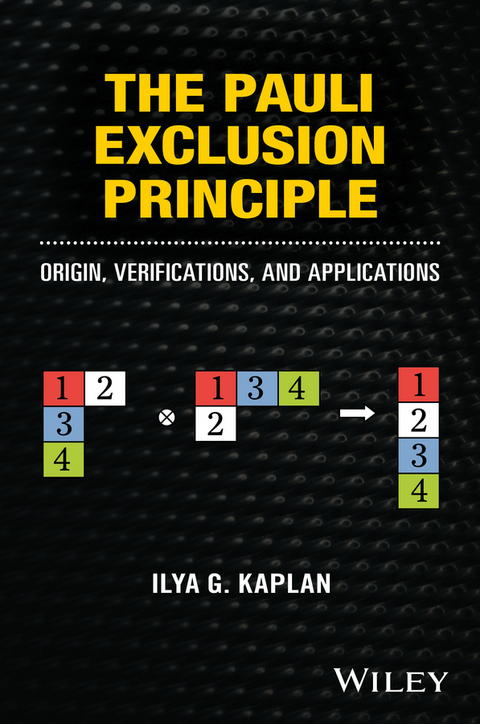
This is the first scientic book devoted to the Pauli exclusion principle, which is a fundamental principle of quantum mechanics and is permanently applied in chemistry, physics, and molecular biology. However, while the principle has been studied for more than 90 years, rigorous theoretical foundations still have not been established and many unsolved problems remain.
Following a historical survey in Chapter 1, the book discusses the still unresolved questions around this fundamental principle. For instance, why, according to the Pauli exclusion principle, are only symmetric and antisymmetric permutation symmetries for identical particles realized, while the Schrödinger equation is satisfied by functions with any permutation symmetry? Chapter 3 covers possible answers to this question. The construction of function with a given permutation symmetry is described in the previous Chapter 2, while Chapter 4 presents effective and elegant methods for finding the Pauli-allowed states in atomic, molecular, and nuclear spectroscopy. Chapter 5 discusses parastatistics and fractional statistics, demonstrating that the quasiparticles in a periodical lattice, including excitons and magnons, are obeying modified parafermi statistics.
With detailed appendices, The Pauli Exclusion Principle: Origin, Verifications, and Applications is intended as a self-sufficient guide for graduate students and academic researchers in the fields of chemistry, physics, molecular biology and applied mathematics. It will be a valuable resource for any reader interested in the foundations of quantum mechanics and its applications, including areas such as atomic and molecular spectroscopy, spintronics, theoretical chemistry, and applied fields of quantum information.
Ilya G. Kaplan, Head of Department, Materials Research Institute, National Autonomous University of Mexico, Mexico
Ilya Kaplan has been studying the Pauli Exclusion Principle for more than 35 years and is a well-known scientist in this field. He has published 4 books in Russian, 4 books in English, including the Wiley title Intermolecular Interactions, and 11 book chapters, one of which was devoted to the Pauli Exclusion Principle. He was also an Associate Editor for Wiley's Handbook of Molecular Physics and Quantum Chemistry, published in 2003.
This is the first scientic book devoted to the Pauli exclusion principle, which is a fundamental principle of quantum mechanics and is permanently applied in chemistry, physics, and molecular biology. However, while the principle has been studied for more than 90 years, rigorous theoretical foundations still have not been established and many unsolved problems remain. Following a historical survey in Chapter 1, the book discusses the still unresolved questions around this fundamental principle. For instance, why, according to the Pauli exclusion principle, are only symmetric and antisymmetric permutation symmetries for identical particles realized, while the Schr dinger equation is satisfied by functions with any permutation symmetry? Chapter 3 covers possible answers to this question. The construction of function with a given permutation symmetry is described in the previous Chapter 2, while Chapter 4 presents effective and elegant methods for finding the Pauli-allowed states in atomic, molecular, and nuclear spectroscopy. Chapter 5 discusses parastatistics and fractional statistics, demonstrating that the quasiparticles in a periodical lattice, including excitons and magnons, are obeying modified parafermi statistics. With detailed appendices, The Pauli Exclusion Principle: Origin, Verifications, and Applications is intended as a self-sufficient guide for graduate students and academic researchers in the fields of chemistry, physics, molecular biology and applied mathematics. It will be a valuable resource for any reader interested in the foundations of quantum mechanics and its applications, including areas such as atomic and molecular spectroscopy, spintronics, theoretical chemistry, and applied fields of quantum information.
Ilya G. Kaplan, Head of Department, Materials Research Institute, National Autonomous University of Mexico, Mexico Ilya Kaplan has been studying the Pauli Exclusion Principle for more than 35 years and is a well-known scientist in this field. He has published 4 books in Russian, 4 books in English, including the Wiley title Intermolecular Interactions, and 11 book chapters, one of which was devoted to the Pauli Exclusion Principle. He was also an Associate Editor for Wiley's Handbook of Molecular Physics and Quantum Chemistry, published in 2003.
Title Page 5
Copyright 6
Contents 9
Preface 13
Chapter 1 Historical Survey 15
1.1 Discovery of the Pauli Exclusion Principle and Early Developments 15
1.2 Further Developments and Still Existing Problems 25
References 35
Chapter 2 Construction of Functions with a Definite Permutation Symmetry 39
2.1 Identical Particles in Quantum Mechanics and Indistinguishability Principle 39
2.2 Construction of Permutation-Symmetric Functions Using the Young Operators 43
2.3 The Total Wave Functions as a Product of Spatial and Spin Wave Functions 50
2.3.1 Two-Particle System 50
2.3.2 General Case of N-Particle System 55
References 63
Chapter 3 Can the Pauli Exclusion Principle Be Proved? 64
3.1 Critical Analysis of the Existing Proofs of the Pauli Exclusion Principle 64
3.2 Some Contradictions with the Concept of Particle Identity and their Independence in the Case of the Multidimensional Pe... 70
References 76
Chapter 4 Classification of the Pauli-Allowed States in Atoms and Molecules 78
4.1 Electrons in a Central Field 78
4.1.1 Equivalent Electrons: L–S Coupling 78
4.1.2 Additional Quantum Numbers: The Seniority Number 85
4.1.3 Equivalent Electrons: j–j Coupling 86
4.2 The Connection between Molecular Terms and Nuclear Spin 88
4.2.1 Classification of Molecular Terms and the Total Nuclear Spin 88
4.2.2 The Determination of the Nuclear Statistical Weights of Spatial States 93
4.3 Determination of Electronic Molecular Multiplets 96
4.3.1 Valence Bond Method 96
4.3.2 Degenerate Orbitals and One Valence Electron on Each Atom 101
4.3.3 Several Electrons Specified on One of the Atoms 105
4.3.4 Diatomic Molecule with Identical Atoms 107
4.3.5 General Case I 112
4.3.6 General Case II 114
References 118
Chapter 5 Parastatistics, Fractional Statistics, and Statistics of Quasiparticles of Different Kind 120
5.1 Short Account of Parastatistics 120
5.2 Statistics of Quasiparticles in a Periodical Lattice 123
5.2.1 Holes as Collective States 123
5.2.2 Statistics and Some Properties of Holon Gas 125
5.2.3 Statistics of Hole Pairs 131
5.3 Statistics of Cooper´s Pairs 135
5.4 Fractional Statistics 138
5.4.1 Eigenvalues of Angular Momentum in the Three- and Two-Dimensional Space 138
5.4.2 Anyons and Fractional Statistics 142
References 147
Appendix A: Necessary Basic Concepts and Theorems of Group Theory 149
A.1 Properties of Group Operations 149
A.1.1 Group Postulates 149
A.1.2 Examples of Groups 151
A.1.3 Isomorphism and Homomorphism 152
A.1.4 Subgroups and Cosets 153
A.1.5 Conjugate Elements. Classes 154
A.2 Representation of Groups 155
A.2.1 Definition 155
A.2.2 Vector Spaces 156
A.2.3 Reducibility of Representations 159
A.2.4 Properties of Irreducible Representations 161
A.2.5 Characters 162
A.2.6 The Decomposition of a Reducible Representation 163
A.2.7 The Direct Product of Representations 165
A.2.8 Clebsch–Gordan Coefficients 168
A.2.9 The Regular Representation 170
A.2.10 The Construction of Basis Functions for Irreducible Representation 171
References 174
Appendix B: The Permutation Group 175
B.1 General Information 175
B.1.1 Operations with Permutation 175
B.1.2 Classes 178
B.1.3 Young Diagrams and Irreducible Representations 179
B.2 The Standard Young–Yamanouchi Orthogonal Representation 181
B.2.1 Young Tableaux 181
B.2.2 Explicit Determination of the Matrices of the Standard Representation 184
B.2.3 The Conjugate Representation 187
B.2.4 The Construction of an Antisymmetric Function from the Basis Functions for Two Conjugate Representations 189
B.2.5 Young Operators 190
B.2.6 The Construction of Basis Functions for the Standard Representation from a Product of N Orthogonal Functions 192
References 195
Appendix C : The Interconnection between Linear Groups and Permutation Groups 196
C.1 Continuous Groups 196
C.1.1 Definition 196
C.1.2 Examples of Linear Groups 199
C.1.3 Infinitesimal Operators 201
C.2 The Three-Dimensional Rotation Group 203
C.2.1 Rotation Operators and Angular Momentum Operators 203
C.2.2 Irreducible Representations 205
C.2.3 Reduction of the Direct Product of Two Irreducible Representations 208
C.2.4 Reduction of the Direct Product of k Irreducible Representations. 3n-j Symbols 211
C.3 Tensor Representations 215
C.3.1 Construction of a Tensor Representation 215
C.3.2 Reduction of a Tensor Representation into Reducible Components 216
C.3.3 Littlewood´s Theorem 221
C.3.4 The Reduction of U2j+1 ? R3 223
C.4 Tables of the Reduction of the Representations U2j+1? to the Group R3 228
References 230
Appendix D: Irreducible Tensor Operators 231
D.1 Definition 231
D.2 The Wigner–Eckart Theorem 234
References 236
Appendix E: Second Quantization 237
References 241
Index 242
EULA 253
| Erscheint lt. Verlag | 15.11.2016 |
|---|---|
| Sprache | englisch |
| Themenwelt | Naturwissenschaften ► Chemie ► Physikalische Chemie |
| Naturwissenschaften ► Physik / Astronomie ► Quantenphysik | |
| Naturwissenschaften ► Physik / Astronomie ► Thermodynamik | |
| Technik | |
| Schlagworte | atomic and molecular physics • Atom- u. Molekülphysik • Atom- u. Molekülphysik • Chemie • Chemistry • Pauli Exclusion Principle, spin-statistics connections, Fermi and Bose statistics, fractional statistics, symmetric and antisymmetric functions, atomic and molecular physics, parastatistics • Pauli-Prinzip • Physical Chemistry • Physics • Physik • Physikalische Chemie • spectroscopy • Spektroskopie |
| ISBN-10 | 1-118-79529-6 / 1118795296 |
| ISBN-13 | 978-1-118-79529-3 / 9781118795293 |
| Informationen gemäß Produktsicherheitsverordnung (GPSR) | |
| Haben Sie eine Frage zum Produkt? |
 PDF (Adobe DRM)
Kopierschutz: Adobe-DRM
Adobe-DRM ist ein Kopierschutz, der das eBook vor Mißbrauch schützen soll. Dabei wird das eBook bereits beim Download auf Ihre persönliche Adobe-ID autorisiert. Lesen können Sie das eBook dann nur auf den Geräten, welche ebenfalls auf Ihre Adobe-ID registriert sind.
Details zum Adobe-DRM
Dateiformat: PDF (Portable Document Format)
Mit einem festen Seitenlayout eignet sich die PDF besonders für Fachbücher mit Spalten, Tabellen und Abbildungen. Eine PDF kann auf fast allen Geräten angezeigt werden, ist aber für kleine Displays (Smartphone, eReader) nur eingeschränkt geeignet.
Systemvoraussetzungen:
PC/Mac: Mit einem PC oder Mac können Sie dieses eBook lesen. Sie benötigen eine
eReader: Dieses eBook kann mit (fast) allen eBook-Readern gelesen werden. Mit dem amazon-Kindle ist es aber nicht kompatibel.
Smartphone/Tablet: Egal ob Apple oder Android, dieses eBook können Sie lesen. Sie benötigen eine
Geräteliste und zusätzliche Hinweise
Buying eBooks from abroad
For tax law reasons we can sell eBooks just within Germany and Switzerland. Regrettably we cannot fulfill eBook-orders from other countries.
aus dem Bereich