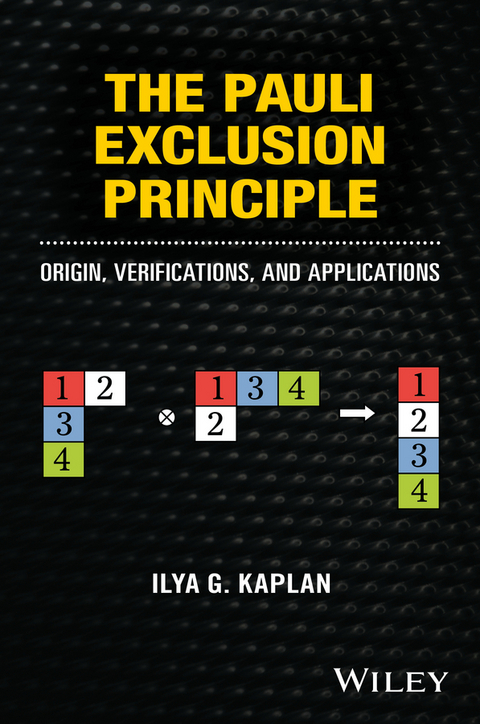
This is the first scientic book devoted to the Pauli exclusion principle, which is a fundamental principle of quantum mechanics and is permanently applied in chemistry, physics, and molecular biology. However, while the principle has been studied for more than 90 years, rigorous theoretical foundations still have not been established and many unsolved problems remain.
Following a historical survey in Chapter 1, the book discusses the still unresolved questions around this fundamental principle. For instance, why, according to the Pauli exclusion principle, are only symmetric and antisymmetric permutation symmetries for identical particles realized, while the Schrödinger equation is satisfied by functions with any permutation symmetry? Chapter 3 covers possible answers to this question. The construction of function with a given permutation symmetry is described in the previous Chapter 2, while Chapter 4 presents effective and elegant methods for finding the Pauli-allowed states in atomic, molecular, and nuclear spectroscopy. Chapter 5 discusses parastatistics and fractional statistics, demonstrating that the quasiparticles in a periodical lattice, including excitons and magnons, are obeying modified parafermi statistics.
With detailed appendices, The Pauli Exclusion Principle: Origin, Verifications, and Applications is intended as a self-sufficient guide for graduate students and academic researchers in the fields of chemistry, physics, molecular biology and applied mathematics. It will be a valuable resource for any reader interested in the foundations of quantum mechanics and its applications, including areas such as atomic and molecular spectroscopy, spintronics, theoretical chemistry, and applied fields of quantum information.
This is the first scientic book devoted to the Pauli exclusion principle, which is a fundamental principle of quantum mechanics and is permanently applied in chemistry, physics, and molecular biology. However, while the principle has been studied for more than 90 years, rigorous theoretical foundations still have not been established and many unsolved problems remain. Following a historical survey in Chapter 1, the book discusses the still unresolved questions around this fundamental principle. For instance, why, according to the Pauli exclusion principle, are only symmetric and antisymmetric permutation symmetries for identical particles realized, while the Schr dinger equation is satisfied by functions with any permutation symmetry? Chapter 3 covers possible answers to this question. The construction of function with a given permutation symmetry is described in the previous Chapter 2, while Chapter 4 presents effective and elegant methods for finding the Pauli-allowed states in atomic, molecular, and nuclear spectroscopy. Chapter 5 discusses parastatistics and fractional statistics, demonstrating that the quasiparticles in a periodical lattice, including excitons and magnons, are obeying modified parafermi statistics. With detailed appendices, The Pauli Exclusion Principle: Origin, Verifications, and Applications is intended as a self-sufficient guide for graduate students and academic researchers in the fields of chemistry, physics, molecular biology and applied mathematics. It will be a valuable resource for any reader interested in the foundations of quantum mechanics and its applications, including areas such as atomic and molecular spectroscopy, spintronics, theoretical chemistry, and applied fields of quantum information.
Ilya G. Kaplan, Head of Department, Materials Research Institute, National Autonomous University of Mexico, Mexico Ilya Kaplan has been studying the Pauli Exclusion Principle for more than 35 years and is a well-known scientist in this field. He has published 4 books in Russian, 4 books in English, including the Wiley title Intermolecular Interactions, and 11 book chapters, one of which was devoted to the Pauli Exclusion Principle. He was also an Associate Editor for Wiley's Handbook of Molecular Physics and Quantum Chemistry, published in 2003.
Preface
Chapter 1 Historical Survey
1.1. Discovery of the Pauli Exclusion Principle and early developments
1.2. Further developments and still existing problems
References
Chapter 2 Construction of Functions with a Definite Permutation Symmetry
2.1. Identical particles in quantum mechanics and indistinguishability principle
2.2. Construction of permutation-symmetrical functions using the Young operators
2.3. The total wave functions as a product of spatial and spin wave functions
2.3.1 Two-particle system
2.3.2 General case of N-particle system
References
Chapter 3 Can the Pauli Exclusion Principle Be Proved?
3.1. Critical analysis of the existing proofs of the Pauli exclusion principle
3.2. Some contradictions with the concept of particle identity and their independence in the case of the multi-dimensional permutation representations
References
Chapter 4 Classification of the Pauli-Allowed States in Atoms and Molecules
4.1. Electrons in a central field
4.1.1 Equivalent electrons. L-S coupling
4.1.2. Additional quantum numbers. The seniority number
4.1.3 Equivalent electrons. j-j coupling
4.2. The connection between molecular terms and nuclear spin
4.2.1 Classification of molecular terms and the total nuclear spin
4.2.2 The determination of the nuclear statistical weights of spatial states
4.3. Determination of electronic molecular multiplets
4.3.1 Valence bond method
4.3.2 Degenerate orbitals and one valence electron on each atom
4.3.3 Several electrons specified on one of the atoms
4.3.4 Diatomic molecule with identical atoms
4.3.5 General case I
4.3.6 General case II
References
Chapter 5 Parastatistics, Fractional Statistics, and Statistics of Quasiparticles of Different Kind
5.1. Short account of parastatistics
5.2. Statistics of quasiparticles in a periodical lattice
5.2.1 Holes as collective states
5.2.2 Statistics and some properties of holon gas
5.2.3 Statistics of hole pairs
5.3 Statistics of Cooper's pairs
5.4 Fractional statistics
5.4.1 Eigenvalues of angular momentum in the three- and two-dimensional space
5.4.2 Anyons and fractional statistics
References
Appendix 1 Necessary Basic Concepts and Theorems of Group Theory
A1.1 Properties of group operations
A1.2 Representation of groups
References
Appendix 2 The Permutation Group
A2.1 General information
A2.2 The standard Young-Yamanouchi orthogonal representation
References
Appendix 3 The Interconnection Between Linear Groups and Permutation Groups.
A3.1 Continuous groups
A3.2 The three-dimensional rotation group
A3.3 Tensor representations
A3.4 Tables of the reductions of the representation to the group R3
References
Appendix 4 Irreducible Tensor Operators
A4.1 Definition
A4.2 The Wigner-Eckart theorem
References
Appendix 5 Second Quantization
References
Index
1
Historical Survey
1.1 Discovery of the Pauli Exclusion Principle and Early Developments
Wolfgang Pauli formulated his principle before the creation of the contemporary quantum mechanics (1925–1927). He arrived at the formulation of this principle trying to explain regularities in the anomalous Zeeman effect in strong magnetic fields. Although in his Princeton address [1], Pauli recalled that the history of the discovery goes back to his student days in Munich. At that time the periodic system of chemical elements was well known and the series of whole numbers 2, 8, 18, 32… giving the lengths of the periods in this table was zealously discussed in Munich. A great influence on Pauli had his participation in the Niels Bohr guest lectures at Göttingen in 1922, when he met Bohr for the first time. In these lectures Bohr reported on his theoretical investigations of the Periodic System of Elements. Bohr emphasized that the question of why all electrons in an atom are not bound in the innermost shell is the fundamental problem in these studies. However, no convincing explanation for this phenomenon could be given on the basis of classical mechanics.
In his first studies Pauli was interested in the explanation of the anomalous type of splitting in the Zeeman effect in strong magnetic fields. As he recalled [1]:
The anomalous type of splitting was especially fruitful because it exhibited beautiful and simple laws, but on the other hand it was hardly understandable, since very general assumptions concerning the electron using classical theory, as well as quantum theory, always led to the same triplet. A closer investigation of this problem left me with the feeling, it was even more unapproachable. A colleague who met me strolling rather aimlessly in the beautiful streets of Copenhagen said to me in a friendly manner, ‘You look very unhappy’; whereupon I answered fiercely, ‘How can one look happy when he is thinking about the anomalous Zeeman effect?’
Pauli decided to analyze the simplest case, the doublet structure of the alkali spectra. In December 1924 Pauli submitted a paper on the Zeeman effect [2], in which he showed that Bohr’s theory of doublet structure based on the nonvanishing angular moment of a closed shell, such as K‐shell of the alkali atoms, is incorrect and closed shell has no angular and magnetic moments. Pauli came to the conclusion that instead of the angular momentum of the closed shells of the atomic core, a new quantum property of the electron had to be introduced. In that paper he wrote, remarkable for that time, prophetic words. Namely:
According to this point of view, the doublet structure of alkali spectra … is due to a particular two‐valuedness of the quantum theoretic properties of the electron, which cannot be described from the classical point of view.
This nonclassical two‐valued nature of electron is now called spin. In anticipating the quantum nature of the magnetic moment of electron before the creation of quantum mechanics, Pauli exhibited a striking intuition.
After that, practically all was ready for the formulation of the exclusion principle. Pauli also stressed the importance of the paper by Stoner [3], which appeared right at the time of his thinking on the problem. Stoner noted that the number of energy levels of a single electron in the alkali metal spectra for the given value of the principal quantum number in an external magnetic field is the same as the number of electrons in the closed shell of the rare gas atoms corresponding to this quantum number. On the basis of his previous results on the classification of spectral terms in a strong magnetic field, Pauli came to the conclusion that a single electron must occupy an entirely nondegenerate energy level [1].
In the paper submitted for publication on January 16, 1925 Pauli formulated his principle as follows [4]:
In an atom there cannot be two or more equivalent electrons, for which in strong fields the values of all four quantum numbers coincide. If an electron exists in an atom for which all of these numbers have definite values, then this state is ‘occupied.’
In this paper Pauli explained the meaning of four quantum numbers of a single electron in an atom, n, l, , and mj (in the modern notations); by n and l he denoted the well known at that time the principal and angular momentum quantum numbers, by j and mj —the total angular momentum and its projection, respectively. Thus, Pauli characterized the electron by some additional quantum number j, which in the case of was equal to . For the fourth quantum number of the electron Pauli did not give any physical interpretations, since he was sure, as we discussed above, that it cannot be described in terms of classical physics.
Introducing two additional possibilities for electron states, Pauli obtained possibilities for the set (n, l, j, mj). That led to the correct numbers 2, 8, 18, and 32 for the lengths of the periods in the Periodic Table of the Elements.
As Pauli noted in his Nobel Prize lecture [5]: “…physicists found it difficult to understand the exclusion principle, since no meaning in terms of a model was given to the fourth degree of freedom of the electron.” Although not all physicists! Young scientists first Ralph Kronig and then George Uhlenbeck and Samuel Goudsmit did not take into account the Pauli words that the electron fourth degree of freedom cannot be described by classical physics and suggested the classical model of the spinning electron. Below I will describe in some detail the discovery of spin using the reminiscences of the main participants of this dramatic story.
Kronig recalled [6] that on January 7, 1925, at the age of 20, he, as a traveling fellow of the Columbia University, arrived in the small German university town of Tübingen to see Landé and Gerlach. At the Institute of Physics Kronig was received by Landé with the remark that it was a very opportune moment, since he was expecting Pauli the following day and he just received a long and very interesting letter from Pauli. In that letter Pauli described his exclusion principle. Pauli’s letter made a great impression on Kronig and it immediately occurred to him that additional to the orbital angular momentum l the momentum can be considered as an intrinsic angular momentum of the electron. The same day Kronig performed calculations of the doublet splitting. The results encouraged him, although the obtained splitting was too large, by a factor of 2. He reported his results to Landé. Landé recommended telling these results to Pauli. Next day Pauli arrived at Tübingen, and Kronig had an opportunity to discuss with him his ideas. As Kronig [6] wrote: “Pauli remarked: ‘Das ist ja ein ganz Einfall’,1 but did not believe that the suggestion had any connection with reality.”
Later Kronig discussed his ideas in Copenhagen with Heisenberg, Kramers, and others and they also did not approve them. Under the impression of the negative reaction of most authoritative physicists and some serious problems in his calculations Kronig did not publish his ideas about a spinning electron. In the letter to van der Waerden [7] Kronig wrote about the difficulties he met in his studies of the spinning electron:
First, the factor 2 already mentioned. Next, the difficulty to understand how a rotation of the electron about its axis would yield a magnetic moment of just one magneton. Next, the necessity to assume, for the rotating charge of an electron of classical size, velocities surpassing the velocity of light. Finally, the smallness of the magnetic moments of atomic nuclei, which were supposed, at that time, to consist of proton and electrons
Independent of Kronig, the Dutch physicists Uhlenbeck and Goudsmit after reading the Pauli paper on his exclusive principle also arrived at the idea of the spinning electron. In his address, delivered at Leiden on the occasion of his Lorentz Professorship, Uhlenbeck [8] told in detail the story of their discovery and its publication.2
According to Uhlenbeck, he and Goudsmit were greatly affected by the Pauli exclusion principle, in particular by the fourth quantum number of the electron. It was a mystery, why Pauli did not suggest any concrete picture for it. Due to their conviction that every quantum number corresponds to a degree of freedom, they decided that the point model for the electron, which had only three degrees of freedom, was not appropriate and the electron should be assumed as a small sphere that could rotate. However, very soon they recognized that the rotational velocity at the surface of the electron had to be many times larger than the velocity of light. As Uhlenbeck writes further,
…we had not the slightest intention of publishing anything. It seems so speculative and bold, that something ought to be wrong with it, especially since Bohr, Heisenberg and Pauli, our great authorities, had never proposed anything of this kind. But of course we told Erenfest. He was impressed at once, mainly, I feel, because of the visual character of our hypothesis, which was very much in his line. … and finally said that it was either highly important or nonsense, and that we should write a short note for Naturwissenschaften and give it to him. He ended with the words ‘und dann werden wir Herrn–Lorentz fragen’.3 This was done. … already next week he...
| Erscheint lt. Verlag | 15.11.2016 |
|---|---|
| Sprache | englisch |
| Themenwelt | Naturwissenschaften ► Chemie ► Physikalische Chemie |
| Naturwissenschaften ► Physik / Astronomie ► Quantenphysik | |
| Naturwissenschaften ► Physik / Astronomie ► Thermodynamik | |
| Technik | |
| Schlagworte | atomic and molecular physics • Atom- u. Molekülphysik • Atom- u. Molekülphysik • Chemie • Chemistry • Pauli Exclusion Principle, spin-statistics connections, Fermi and Bose statistics, fractional statistics, symmetric and antisymmetric functions, atomic and molecular physics, parastatistics • Pauli-Prinzip • Physical Chemistry • Physics • Physik • Physikalische Chemie • spectroscopy • Spektroskopie |
| ISBN-10 | 1-118-79524-5 / 1118795245 |
| ISBN-13 | 978-1-118-79524-8 / 9781118795248 |
| Informationen gemäß Produktsicherheitsverordnung (GPSR) | |
| Haben Sie eine Frage zum Produkt? |
 EPUB (Adobe DRM)
Kopierschutz: Adobe-DRM
Adobe-DRM ist ein Kopierschutz, der das eBook vor Mißbrauch schützen soll. Dabei wird das eBook bereits beim Download auf Ihre persönliche Adobe-ID autorisiert. Lesen können Sie das eBook dann nur auf den Geräten, welche ebenfalls auf Ihre Adobe-ID registriert sind.
Details zum Adobe-DRM
Dateiformat: EPUB (Electronic Publication)
EPUB ist ein offener Standard für eBooks und eignet sich besonders zur Darstellung von Belletristik und Sachbüchern. Der Fließtext wird dynamisch an die Display- und Schriftgröße angepasst. Auch für mobile Lesegeräte ist EPUB daher gut geeignet.
Systemvoraussetzungen:
PC/Mac: Mit einem PC oder Mac können Sie dieses eBook lesen. Sie benötigen eine
eReader: Dieses eBook kann mit (fast) allen eBook-Readern gelesen werden. Mit dem amazon-Kindle ist es aber nicht kompatibel.
Smartphone/Tablet: Egal ob Apple oder Android, dieses eBook können Sie lesen. Sie benötigen eine
Geräteliste und zusätzliche Hinweise
Buying eBooks from abroad
For tax law reasons we can sell eBooks just within Germany and Switzerland. Regrettably we cannot fulfill eBook-orders from other countries.
aus dem Bereich