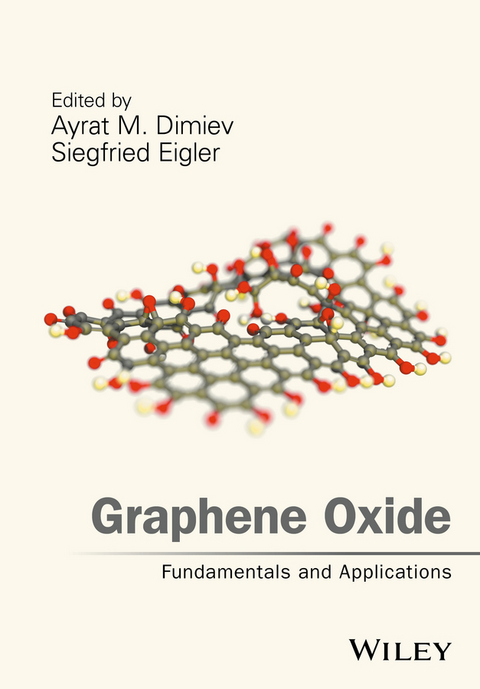
Graphene Oxide (eBook)
John Wiley & Sons (Verlag)
978-1-119-06941-6 (ISBN)
This comprehensive volume systematically describes the fundamental aspects and applications of graphene oxide. The book is designed as an introduction to the topic, so each chapter begins with a discussion on fundamental concepts, then proceeds to review and summarize recent advances in the field. Divided into two parts, the first part covers fundamental aspects of graphene oxide and includes chapters on formation and chemical structure, characterization methods, reduction methods, rheology and optical properties of graphene oxide solutions. Part Two covers numerous graphene oxide applications including field effect transistors, transparent conductive films, sensors, energy harvesting and storage, membranes, composite materials, catalysis and biomedical applications. In each case the differences and advantages of graphene oxide over its non-oxidised counterpart are discussed. The book concludes with a chapter on the challenges of industrial-scale graphene oxide production.
Graphene Oxide: Fundamentals and Applications is a valuable reference for academic researchers, and industry scientists interested in graphene oxide, graphene and other carbon materials.
Dr. Ayrat M. Dimiev, EMD Performance Materials, Darmstadt, Germany.
Since 2009, Dr Dimiev has been working very closely with graphene oxide and other graphitic carbon nanomaterials. He spent five years at Rice University studying fundamental aspects of graphene oxide, resulting in several ground-breaking papers in highly ranked journals including Nature and Science, followed by a period at AZ Electronic Materials where he worked on optimizing mass production of graphene oxide, and on developing novel graphene oxide applications. Dr Dimiev currently works at EMD Performance Materials, a business of Merck KGaA, in Darmstadt, Germany.
Dr. Siegfried Eigler, Chalmers University of Technology, Department of Chemistry and Chemical Engineering, Göteborg, Sweden
Dr Eigler received his PhD in organic chemistry from the Friedrich-Alexander-Universit t Erlangen-Nürnberg in 2006 under the guidance of apl. Prof. Dr. Norbert Jux. Subsequently he conducted basic research on electrically conductive polymers and graphene oxide as an industry chemist. In 2011 he became a lecturer and research associate at the Friedrich-Alexander-Universität Erlangen-Nürnberg, where he did habilitation and in 2016 he became Associate Professor at the Chalmers University of Technology. His research focuses on the controlled chemistry of graphene.
Due to its unique properties, graphene oxide has become one of the most studied materials of the last decade and a great variety of applications have been reported in areas such as sensors, catalysis and biomedical applications. This comprehensive volume systematically describes the fundamental aspects and applications of graphene oxide. The book is designed as an introduction to the topic, so each chapter begins with a discussion on fundamental concepts, then proceeds to review and summarize recent advances in the field. Divided into two parts, the first part covers fundamental aspects of graphene oxide and includes chapters on formation and chemical structure, characterization methods, reduction methods, rheology and optical properties of graphene oxide solutions. Part Two covers numerous graphene oxide applications including field effect transistors, transparent conductive films, sensors, energy harvesting and storage, membranes, composite materials, catalysis and biomedical applications. In each case the differences and advantages of graphene oxide over its non-oxidised counterpart are discussed. The book concludes with a chapter on the challenges of industrial-scale graphene oxide production.Graphene Oxide: Fundamentals and Applications is a valuable reference for academic researchers, and industry scientists interested in graphene oxide, graphene and other carbon materials.
Dr. Ayrat M. Dimiev, EMD Performance Materials, Darmstadt, Germany. Since 2009, Dr Dimiev has been working very closely with graphene oxide and other graphitic carbon nanomaterials. He spent five years at Rice University studying fundamental aspects of graphene oxide, resulting in several ground-breaking papers in highly ranked journals including Nature and Science, followed by a period at AZ Electronic Materials where he worked on optimizing mass production of graphene oxide, and on developing novel graphene oxide applications. Dr Dimiev currently works at EMD Performance Materials, a business of Merck KGaA, in Darmstadt, Germany. Dr. Siegfried Eigler, Chalmers University of Technology, Department of Chemistry and Chemical Engineering, Göteborg, Sweden Dr Eigler received his PhD in organic chemistry from the Friedrich-Alexander-Universit t Erlangen-Nürnberg in 2006 under the guidance of apl. Prof. Dr. Norbert Jux. Subsequently he conducted basic research on electrically conductive polymers and graphene oxide as an industry chemist. In 2011 he became a lecturer and research associate at the Friedrich-Alexander-Universität Erlangen-Nürnberg, where he did habilitation and in 2016 he became Associate Professor at the Chalmers University of Technology. His research focuses on the controlled chemistry of graphene.
Title Page 5
Copyright Page 6
Contents 7
About the Editors 13
List of Contributors 15
Foreword 17
Preface 18
Part I Fundamentals 23
Chapter 1 Graphite Oxide Story – From the Beginning Till the Graphene Hype 25
1.1 Introduction 25
1.2 Preparation of Graphite Oxide 27
1.2.1 Trials for Improving and Simplifying GO Preparation 27
1.2.2 Over-Oxidation of Graphite 30
1.2.3 Formation Mechanism – First Approximation 31
1.3 Discovery of Essential Functional O?Containing Groups and its Relation to the Development of Structural Models 32
1.3.1 Analytical Composition of Graphite Oxide 32
1.3.2 Creation of the Structural Model from 1930 till 2006 33
1.3.3 Considerations for the Formation Mechanism – Second Approximation 38
1.4 Properties of Graphite Oxide 40
1.4.1 Thermal Degradation and its Products 40
1.4.2 Chemical Reduction Reactions 41
1.4.3 Reactions with Acids and Bases 43
1.4.4 “Osmotic Swelling”: Hydration Behavior and Colloid Formation 44
1.4.5 GO Acidity 45
1.4.6 Intercalation and Functionalization Reactions 48
1.4.7 Functional Groups, their Reactions and their Relation to GO Formation and Destruction 50
1.5 Epilogue 51
References 52
Chapter 2 Mechanism of Formation and Chemical Structure of Graphene Oxide 58
2.1 Introduction 58
2.2 Basic Concepts of Structure 59
2.3 Preparation Methods 61
2.4 Mechanism of Formation 63
2.4.1 Theoretical Studies and System Complexity 63
2.4.2 Step 1: Formation of Stage?1 H2SO4?GIC Graphite Intercalation Compound 64
2.4.3 Step 2: Transformation of Stage?1 H2SO4?GIC to Pristine Graphite Oxide 65
2.4.4 Pristine Graphite Oxide Structure 67
2.4.5 Step 3: Delamination of Pristine Graphite Oxide 69
2.5 Transformation of Pristine Graphite Oxide Chemical Structure Upon Exposure to Water 69
2.6 Chemical Structure and Origin of Acidity 73
2.6.1 Structural Models and the Actual Structure 73
2.6.2 Origin of Acidity and the Dynamic Structural Model 79
2.7 Density of Defects and Introduction of Oxo?Functionalized Graphene 86
2.7.1 Oxo-Functionalized Graphene by Charpy–Hummers Approach 87
2.7.2 Oxo-Functionalized Graphene from Graphite Sulfate 91
2.8 Addressing the Challenges of the Two?Component Structural Model 94
2.9 Structure of Bulk Graphite Oxide 98
2.10 Concluding Remarks 102
References 103
Chapter 3 Characterization Techniques 107
3.1 Nuclear Magnetic Resonance Spectroscopy of Graphene Oxide 107
3.1.1 Nuclear Magnetic Resonance Spectroscopy in Solids 107
3.1.2 Nuclear Magnetic Resonance Spectroscopy of Graphene Oxide 109
3.1.3 Discussion 114
3.2 Infrared Spectroscopy 115
3.3 X-ray Photoelectron Spectroscopy 119
3.4 Raman Spectroscopy 122
3.4.1 Introduction 123
3.4.2 Raman Spectroscopy on Molecules 123
3.4.3 Raman Spectroscopy on Graphene, GO and RGO 123
3.4.4 Defects in Graphene 125
3.4.5 Raman Spectra of GO and RGO 126
3.4.6 Statistical Raman Microscopy (SRM) 131
3.4.7 Outlook 132
3.5 Microscopy Methods 133
3.5.1 Scanning Electron Microscopy 135
3.5.2 Atomic Force Microscopy 136
3.5.3 Transmission Electron Microscopy 137
3.5.4 High-Resolution Transmission Electron Microscopy 137
References 140
Chapter 4 Rheology of Graphene Oxide Dispersions 143
4.1 Liquid Crystalline Behaviour of Graphene Oxide Dispersions 143
4.1.1 Liquid Crystals and Onsager’s Theory 143
4.1.2 Nematic Phases in Carbon Nanomaterials 144
4.2 Rheological Behaviour of Aqueous Dispersions of LC?GO 146
4.2.1 Dynamic Shear Properties 147
4.2.2 Steady Shear Properties 150
4.2.3 Recovery of the Structure 155
4.2.4 Tuning the Rheology of GO Dispersions to Enable Fabrication 155
4.2.5 Electro-Optical Switching of LC-GO with an Extremely Large Kerr Coefficient 158
4.3 Comparison with Other Systems 160
4.3.1 Comparison of Aqueous and Polymer Matrix Systems 160
4.3.2 Comparison Between Aqueous Dispersions of GO and Oxidized Carbon Nanotubes: Role of Dimensionality 163
4.4 Summary and Perspectives 164
References 165
Chapter 5 Optical Properties of Graphene Oxide 169
5.1 Introduction 169
5.2 Absorption 170
5.3 Raman Scattering 175
5.4 Photoluminescence 177
5.5 Graphene Oxide Quantum Dots 190
5.6 Applications 191
References 192
Chapter 6 Functionalization and Reduction of Graphene Oxide 197
6.1 Introduction 197
6.2 Diverse Structure of Graphene Oxide 198
6.3 Stability of Graphene Oxide 200
6.3.1 Thermal Stability of Graphene Oxide 200
6.3.2 Stability and Chemistry of Graphene Oxide in Aqueous Solution 201
6.3.3 Stability of Oxo?Functionalized Graphene 204
6.4 Non-Covalent Chemistry 206
6.5 Covalent Chemistry 208
6.5.1 Reactions Mainly at the Basal Plane 209
6.5.2 Consideration About C–C Bond Formation on the Basal Planes 214
6.5.3 Reactions at Edges 214
6.6 Reduction and Disproportionation of Graphene Oxide 222
6.6.1 Reduction 222
6.6.2 Disproportionation 225
6.6.3 Reduction Strategies 229
6.6.4 Reduction of Oxo?Functionalized Graphene 231
6.7 Reactions with Reduced Form of Graphene Oxide 234
6.8 Controlled Chemistry with Graphene Oxide 237
6.8.1 Nomenclature of Polydisperse and Functionalized Graphene 237
6.8.2 Organosulfate in Graphene Oxide – Thermogravimetric Analysis 238
6.8.3 Synthetic Modifications of Oxo?Functionalized Graphene 240
6.9 Discussion 245
References 246
Part II Applications 253
Chapter 7 Field-Effect Transistors, Sensors and Transparent Conductive Films 255
7.1 Field-Effect Transistors 255
7.2 Sensors 259
7.2.1 Gas Sensors 260
7.2.2 Humidity Sensors 262
7.2.3 Biological Sensors 262
7.3 RGO Transparent Conductive Films 265
7.4 Memristors Based on Graphene Oxide 267
7.4.1 Fabrication of Devices 268
7.4.2 Switching Mechanisms 270
References 272
Chapter 8 Energy Harvesting and Storage 279
8.1 Solar Cells 279
8.2 Lithium-Ion Batteries 280
8.2.1 Introduction 280
8.2.2 Electrochemistry Fundamentals 280
8.2.3 Anode Applications 283
8.2.4 Cathode Applications 292
8.2.5 Emerging Applications 297
8.3 Supercapacitors 300
8.3.1 Introduction 300
8.3.2 Electrochemistry Fundamentals 301
8.3.3 Carbon-only Electrodes 302
8.3.4 Pseudo-Capacitive GO–Composite Electrodes 309
8.4 Outlook and Future Development Opportunities 313
References 314
Chapter 9 Graphene Oxide Membrane for Molecular Separation 318
9.1 Rise of Graphene?Based Membranes: Two Approaches 318
9.2 GO Membrane: Structural Point of View 320
9.3 GO Membrane for Gas Separation 321
9.4 GO Membrane for Water Purification and Desalination 327
9.5 Other Membrane Applications 331
9.5.1 Fuel Cell Membrane 331
9.5.2 Ion-Selective Membrane for Next-Generation Batteries 332
9.5.3 Dehydration 333
9.6 Conclusions and Future Prospects 333
References 334
Chapter 10 Graphene Oxide-Based Composite Materials 336
10.1 Introduction 336
10.1.1 How Graphite Met Polymers? 338
10.1.2 Graphite Oxide-Based Composites 340
10.1.3 CNTs Versus Graphene (Oxide) 341
10.2 Why Mix Graphene Oxide and Polymers? 345
10.2.1 Making Stronger Polymers: Mechanical Properties 347
10.2.2 Electrical Properties 355
10.2.3 Thermal Conductivity 361
10.2.4 Barrier Properties 363
10.3 Graphene Oxide or Graphene Oxides? 366
10.3.1 Size Effect 366
10.3.2 Effect of Medium on GO Structure 369
10.3.3 The Purification Process 369
10.3.4 Thermal Instability 371
10.3.5 Health Issues 371
10.3.6 Environmental Impact 373
10.4 Conclusion 373
References 374
Chapter 11 Toxicity Studies and Biomedical Applications of Graphene Oxide 386
11.1 Introduction 386
11.2 Toxicity of Graphene Oxide 387
11.3 On the Toxicity Mechanism 388
11.3.1 Membrane as a Target 388
11.3.2 Oxidative Stress 390
11.3.3 Other Factors 391
11.4 Biomedical Applications of Graphene Oxide 392
11.4.1 Graphene Oxide in Treatment of Cancer and Bacterial Infections 392
11.4.2 Photothermal Therapy 392
11.4.3 Graphene Oxide as a Drug Carrier 393
11.5 Bioanalytical Applications 398
Acknowledgments 400
References 400
Chapter 12 Catalysis 404
12.1 Introduction 404
12.2 Graphene Oxide Properties 405
12.3 Oxidative Activity 406
12.3.1 Oxidation Reactions of GO 406
12.3.2 Oxidation of Sulfur Compounds 413
12.3.3 Functionalized Materials 415
12.4 Polymerization 416
12.5 Oxygen Reduction Reaction 418
12.6 Friedel–Crafts and Michael Additions 421
12.7 Photocatalysis 422
12.8 Catalytic Activity of Other Layered Carbon?Based Materials and Hybrid Materials of GO 422
12.8.1 Non-Functionalized Carbon-Based Nanomaterials 422
12.8.2 Hybrid Catalysts and Alternative Applications 423
12.9 Outlook 426
References 427
Chapter 13 Challenges of Industrial?Scale Graphene Oxide Production 432
13.1 Introduction 432
13.2 Scope and Scale of the Graphene Market 433
13.3 Overview of Graphene Oxide Synthesis 436
13.4 Challenges of Graphene Oxide Production 438
13.4.1 Graphite Sources 438
13.4.2 Reaction Conditions 440
13.4.3 Work-up and Purification 444
13.4.4 Storage, Handling and Quality Control 447
13.5 Concluding Remarks and Future Directions 449
References 450
Vocabulary 454
Index 457
EULA 462
| Erscheint lt. Verlag | 27.9.2016 |
|---|---|
| Sprache | englisch |
| Themenwelt | Naturwissenschaften ► Chemie ► Physikalische Chemie |
| Technik ► Maschinenbau | |
| Schlagworte | Applications • Biomedical Applications • Carbon materials • catalysis • characterization • chemical structure • Chemie • Chemistry • Electrochemistry • Energie • Energiespeicherung • Energy • Energy Storage • Energy Storage Devices • Festkörperchemie • Festkörperchemie • Formation • functionalization • fundamentals • Graphene oxide • Graphenoxid • Kohlenstoffmaterialien • Materials Science • Materialwissenschaften • reduction • solid state chemistry |
| ISBN-10 | 1-119-06941-6 / 1119069416 |
| ISBN-13 | 978-1-119-06941-6 / 9781119069416 |
| Informationen gemäß Produktsicherheitsverordnung (GPSR) | |
| Haben Sie eine Frage zum Produkt? |
 PDF (Adobe DRM)
Kopierschutz: Adobe-DRM
Adobe-DRM ist ein Kopierschutz, der das eBook vor Mißbrauch schützen soll. Dabei wird das eBook bereits beim Download auf Ihre persönliche Adobe-ID autorisiert. Lesen können Sie das eBook dann nur auf den Geräten, welche ebenfalls auf Ihre Adobe-ID registriert sind.
Details zum Adobe-DRM
Dateiformat: PDF (Portable Document Format)
Mit einem festen Seitenlayout eignet sich die PDF besonders für Fachbücher mit Spalten, Tabellen und Abbildungen. Eine PDF kann auf fast allen Geräten angezeigt werden, ist aber für kleine Displays (Smartphone, eReader) nur eingeschränkt geeignet.
Systemvoraussetzungen:
PC/Mac: Mit einem PC oder Mac können Sie dieses eBook lesen. Sie benötigen eine
eReader: Dieses eBook kann mit (fast) allen eBook-Readern gelesen werden. Mit dem amazon-Kindle ist es aber nicht kompatibel.
Smartphone/Tablet: Egal ob Apple oder Android, dieses eBook können Sie lesen. Sie benötigen eine
Geräteliste und zusätzliche Hinweise
Buying eBooks from abroad
For tax law reasons we can sell eBooks just within Germany and Switzerland. Regrettably we cannot fulfill eBook-orders from other countries.
aus dem Bereich