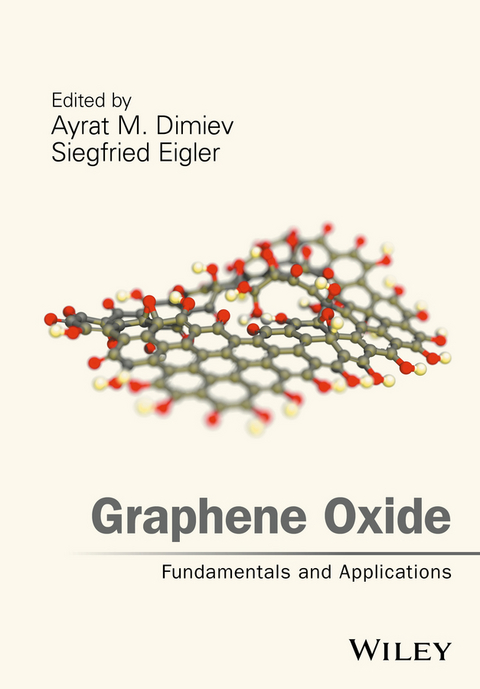
This comprehensive volume systematically describes the fundamental aspects and applications of graphene oxide. The book is designed as an introduction to the topic, so each chapter begins with a discussion on fundamental concepts, then proceeds to review and summarize recent advances in the field. Divided into two parts, the first part covers fundamental aspects of graphene oxide and includes chapters on formation and chemical structure, characterization methods, reduction methods, rheology and optical properties of graphene oxide solutions. Part Two covers numerous graphene oxide applications including field effect transistors, transparent conductive films, sensors, energy harvesting and storage, membranes, composite materials, catalysis and biomedical applications. In each case the differences and advantages of graphene oxide over its non-oxidised counterpart are discussed. The book concludes with a chapter on the challenges of industrial-scale graphene oxide production.
Graphene Oxide: Fundamentals and Applications is a valuable reference for academic researchers, and industry scientists interested in graphene oxide, graphene and other carbon materials.
Due to its unique properties, graphene oxide has become one of the most studied materials of the last decade and a great variety of applications have been reported in areas such as sensors, catalysis and biomedical applications. This comprehensive volume systematically describes the fundamental aspects and applications of graphene oxide. The book is designed as an introduction to the topic, so each chapter begins with a discussion on fundamental concepts, then proceeds to review and summarize recent advances in the field. Divided into two parts, the first part covers fundamental aspects of graphene oxide and includes chapters on formation and chemical structure, characterization methods, reduction methods, rheology and optical properties of graphene oxide solutions. Part Two covers numerous graphene oxide applications including field effect transistors, transparent conductive films, sensors, energy harvesting and storage, membranes, composite materials, catalysis and biomedical applications. In each case the differences and advantages of graphene oxide over its non-oxidised counterpart are discussed. The book concludes with a chapter on the challenges of industrial-scale graphene oxide production.Graphene Oxide: Fundamentals and Applications is a valuable reference for academic researchers, and industry scientists interested in graphene oxide, graphene and other carbon materials.
Dr. Ayrat M. Dimiev, EMD Performance Materials, Darmstadt, Germany. Since 2009, Dr Dimiev has been working very closely with graphene oxide and other graphitic carbon nanomaterials. He spent five years at Rice University studying fundamental aspects of graphene oxide, resulting in several ground-breaking papers in highly ranked journals including Nature and Science, followed by a period at AZ Electronic Materials where he worked on optimizing mass production of graphene oxide, and on developing novel graphene oxide applications. Dr Dimiev currently works at EMD Performance Materials, a business of Merck KGaA, in Darmstadt, Germany. Dr. Siegfried Eigler, Chalmers University of Technology, Department of Chemistry and Chemical Engineering, Göteborg, Sweden Dr Eigler received his PhD in organic chemistry from the Friedrich-Alexander-Universit t Erlangen-Nürnberg in 2006 under the guidance of apl. Prof. Dr. Norbert Jux. Subsequently he conducted basic research on electrically conductive polymers and graphene oxide as an industry chemist. In 2011 he became a lecturer and research associate at the Friedrich-Alexander-Universität Erlangen-Nürnberg, where he did habilitation and in 2016 he became Associate Professor at the Chalmers University of Technology. His research focuses on the controlled chemistry of graphene.
Preface
Graphene oxide (GO) has become one of the most extensively studied materials of the last decade. It has facilitated massive interdisciplinary research in the fields of chemistry, physics and materials science. Due to its unique properties, GO has been successfully tested for numerous applications. This fruitful research has resulted in an enormous number of publications. Several review articles have summarized the most recent advances. However, up to the present day, very little has been done to systematize all the published research, and to assist a non‐expert audience interested in the field. This book is designed to fulfill this task. The content of each chapter and the book in general develops from basic to more complex. The material is presented in the categories typical for the classical fields of science. This makes this book unique and different from the other literature.
Today, keeping track of all the recent publications in the field is difficult even for experts. For non‐experts, it is practically impossible to navigate this ocean of publications. This task is further complicated by confusion that is widespread in the modern GO field. This confusion is caused by the misuse of the main fundamental concepts, and by oversimplification and misinterpretation of GO chemistry. It is very difficult to identify trustable high‐quality publications that correctly employ fundamental chemical terms, and correctly interpret experimental data. In this book, we intend to demonstrate the actual GO chemistry based on trustable publications, with correct usage of the main fundamental concepts, as they have been identified up to now.
Since the beginning of the graphene era in 2004, GO has been closely associated with graphene. At that time, GO was considered mainly as a precursor for graphene. The term “chemically converted graphene” (CCG) was introduced for reduced graphene oxide (RGO) to highlight the graphene‐like nature of RGO. The misuse of the term “graphene” instead of RGO in the literature creates significant confusion among a non‐expert readership. We aim to help readers to differentiate between the two by drawing a clear borderline between graphene and RGO, and by showing where they are similar, and where they are different. Additional confusion arises from the misuse of the term RGO for material obtained by annealing of GO. We highlight that those two are very different materials, and we introduce the term “thermally processed graphene oxide” (tpGO) for the latter.
Since the electrical properties of RGO are inferior of those of real graphene, GO is often considered as graphene’s “younger brother”, or as a low‐grade graphene. This point of view was dominant up until about 2011. Later, it was demonstrated that GO is a unique and valuable material in itself, both from fundamental science perspectives and for practical applications. The main advantage of GO over the graphene counterpart is its solubility and processability in water and in several organic solvents. Another benefit of GO is due to its versatility of chemical modification to alter its properties. The ability for mass production on the scale of tonnes makes GO especially attractive for applications compared to its graphene counterpart. We intend to demonstrate all the advantages and uniqueness of GO in this book.
The book is divided into two parts. Part I focuses on the fundamentals of GO, and Part II on the applications of GO.
Part I starts with research on GO, which has a very long history. It did not start in 2006 with the work on GO reduction, as one might think by looking at the citation indexes of some publications from that period. Very serious and in‐depth studies on GO chemistry were conducted throughout the entire twentieth century. Most of these studies, performed in the best old‐school traditions, were in many ways advantageous when compared to some modern publications. The fundamentality of scientific thinking, the methodology of the research, and, importantly, the trustworthiness of reported data were on a level that is rather rare in the modern GO field. One could easily avoid misinterpretations of experimental results by studying those early works before even designing one’s own experiments. Because of the high importance of that early research, and in an attempt to make the connection between the two eras, we begin the book with a historical retrospective of GO research done in the twentieth century (Chapter 1). This is written by the long‐term expert in the field, one of the developers of the famous Lerf–Klinowski structural model, Anton Lerf.
In the modern literature, the structure of GO is greatly oversimplified. This leads to misinterpretation of the chemical reactions involving GO. Chapter 2, written by Ayrat Dimiev, aims to clarify some aspects of GO structure. In the form typical for textbooks, the mechanism of GO formation, its transformation during aqueous work‐up, and the fine chemical structure of GO are methodologically described. The structure of GO is discussed with respect to its intrinsic chemical properties, such as the acidity of aqueous solutions.
The methods used for GO characterization are reviewed in Chapter 3 in a tutorial manner. This chapter will be of particular importance for researchers entering the field. The advantages and disadvantages of different methods are highlighted. Several examples where different methods have helped to understand the structure of GO are discussed. This chapter is written jointly by the editors, Siegfried Eigler and Ayrat Dimiev.
In aqueous solutions, GO delaminates to single‐layer sheets and forms colloidal solutions. From aqueous solutions, GO flakes can be transferred into the phase of low‐molecular‐weight alcohols; the alcoholic solutions are as stable against precipitation as aqueous ones. At certain concentrations, GO solutions form liquid crystals. The rheology of GO solutions is reviewed in Chapter 4 by Cristina Vallés. Colloid chemistry, surface science, rheology and liquid chemistry of GO are discussed in this chapter.
Due to its electronic configuration, GO possesses a number of remarkable optical properties. As opposed to pristine graphene, GO exhibits photoluminescence in the ultraviolet, visible and near‐infrared regions, depending on its structure. The origins of this emission and other related questions are discussed in Chapter 5 by Anton Naumov.
The chemical properties of GO is the largest, most difficult and most controversial topic. In Chapter 6, written by Siegfried Eigler and Ayrat Dimiev, the following topics are discussed. The thermal and chemical stability of GO is reviewed first, followed by introducing wet‐chemical non‐covalent functionalization protocols. The covalent functionalization of GO, which is discussed next, is a very controversial topic. When well‐known organic chemistry principles are applied to GO, it remains challenging to prove the successful accomplishment of reactions by analyzing the as‐modified GO product. We provide an alternative interpretation for experimental results of some selected examples to demonstrate this challenge. The chemical reduction methods are summarized next, and special emphasis is given to differentiating true chemical reduction from so‐called “thermal reduction”. While discussing GO chemical properties, in parallel with typical GO, we discuss these properties for the oxo‐functionalized graphene (oxo‐G1), a type of GO with very low density of structural defects. This sheds additional light on the role of defects in GO chemistry. Finally, additional properties of oxo‐G1 are introduced. Oxo‐G1 can act as a compound that enables the controlled chemistry for the design and synthesis of functional materials and devices.
In Part II, applications that use the reduced and non‐reduced forms of GO are reviewed separately. A reduced form of GO is required where electrical conductivity is of importance. These applications exploit the graphene‐like properties of RGO and tpGO.
Due to its two‐dimensional character, real graphene is not available in bulk quantities by definition. It is obtained only as a substrate‐supported material either by micromechanical cleavage of graphite, or by chemical vapor deposition (CVD) growth on the surface of a catalytically active metal. The electrical conductivities of RGO and tpGO are three or four orders of magnitude lower than that of real graphene due to the numerous defects or scattering centers in the former. Nevertheless, in applications where bulk forms of graphene are needed, GO derivatives are the only choice. Currently, about 90% of the studies performed with RGO and tpGO use the term “graphene” both in the title and in the abstract. We highlight that GO derivatives, and not real graphene, are used for the applications reviewed in Chapters 7 and 8.
Field‐effect transistors and sensors are the two most promising applications that exploit the unique electronic properties of GO. RGO is also considered as one of the best candidates for fabricating transparent conductive films for many applications, due to its electrical and mechanical properties, reasonable carrier mobility, and optical transparency in the visible range. Chapter 7, written by Samuele Porro and Ignazio Roppolo summarizes the enormous potential for...
| Erscheint lt. Verlag | 27.9.2016 |
|---|---|
| Sprache | englisch |
| Themenwelt | Naturwissenschaften ► Chemie ► Physikalische Chemie |
| Technik ► Maschinenbau | |
| Schlagworte | Applications • Biomedical Applications • Carbon materials • catalysis • characterization • chemical structure • Chemie • Chemistry • Electrochemistry • Energie • Energiespeicherung • Energy • Energy Storage • Energy Storage Devices • Festkörperchemie • Festkörperchemie • Formation • functionalization • fundamentals • Graphene oxide • Graphenoxid • Kohlenstoffmaterialien • Materials Science • Materialwissenschaften • reduction • solid state chemistry |
| ISBN-10 | 1-119-06943-2 / 1119069432 |
| ISBN-13 | 978-1-119-06943-0 / 9781119069430 |
| Informationen gemäß Produktsicherheitsverordnung (GPSR) | |
| Haben Sie eine Frage zum Produkt? |
 EPUB (Adobe DRM)
Kopierschutz: Adobe-DRM
Adobe-DRM ist ein Kopierschutz, der das eBook vor Mißbrauch schützen soll. Dabei wird das eBook bereits beim Download auf Ihre persönliche Adobe-ID autorisiert. Lesen können Sie das eBook dann nur auf den Geräten, welche ebenfalls auf Ihre Adobe-ID registriert sind.
Details zum Adobe-DRM
Dateiformat: EPUB (Electronic Publication)
EPUB ist ein offener Standard für eBooks und eignet sich besonders zur Darstellung von Belletristik und Sachbüchern. Der Fließtext wird dynamisch an die Display- und Schriftgröße angepasst. Auch für mobile Lesegeräte ist EPUB daher gut geeignet.
Systemvoraussetzungen:
PC/Mac: Mit einem PC oder Mac können Sie dieses eBook lesen. Sie benötigen eine
eReader: Dieses eBook kann mit (fast) allen eBook-Readern gelesen werden. Mit dem amazon-Kindle ist es aber nicht kompatibel.
Smartphone/Tablet: Egal ob Apple oder Android, dieses eBook können Sie lesen. Sie benötigen eine
Geräteliste und zusätzliche Hinweise
Buying eBooks from abroad
For tax law reasons we can sell eBooks just within Germany and Switzerland. Regrettably we cannot fulfill eBook-orders from other countries.
aus dem Bereich