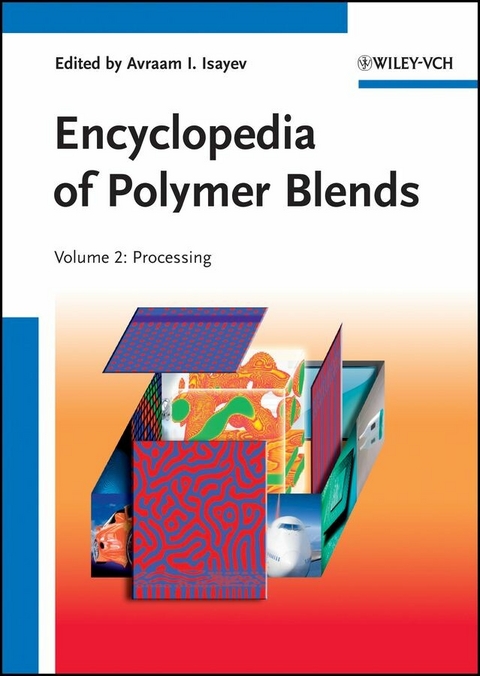
Encyclopedia of Polymer Blends, Volume 2 (eBook)
Wiley-VCH Verlag GmbH & Co. KGaA
978-3-527-80521-1 (ISBN)
Each article is uniformly structured for easy navigation, containing the latest research & development and its basic principles and applications, examples of case studies, laboratory and pilot plant experiments, as well as due reference to the published and patented literature.
Avraam I. Isayev is a Distinguished Professor of Polymer Engineering at the University of Akron. He is a native of Azerbaijan. He received M.Sc. degrees from the Azerbaijan Institute of Oil and Chemistry in Chemical Engineering and the Moscow Institute of Electronic Machine Building in Applied Mathematics and a Ph.D. in Polymer Engineering and Science from the Institute of Petrochemical Synthesis of the USSR Academy of Sciences, Moscow. Before joining the University of Akron in 1983 as an Associate Professor, he was a Senior Research Associate at Cornell University, a Senior Research Fellow at Technion and a Research Associate at the Institute of Petrochemical Synthesis of the USSR Academy of Sciences. He has edited 5 books, published 1 monograph and over 220 journal papers, many book chapters and encyclopedia articles. He has received numerous awards.
Avraam I. Isayev is a Distinguished Professor of Polymer Engineering at the University of Akron. He is a native of Azerbaijan. He received M.Sc. degrees from the Azerbaijan Institute of Oil and Chemistry in Chemical Engineering and the Moscow Institute of Electronic Machine Building in Applied Mathematics and a Ph.D. in Polymer Engineering and Science from the Institute of Petrochemical Synthesis of the USSR Academy of Sciences, Moscow. Before joining the University of Akron in 1983 as an Associate Professor, he was a Senior Research Associate at Cornell University, a Senior Research Fellow at Technion and a Research Associate at the Institute of Petrochemical Synthesis of the USSR Academy of Sciences. He has edited 5 books, published 1 monograph and over 220 journal papers, many book chapters and encyclopedia articles. He has received numerous awards.
Preface
POLYMER BLEND COMPOUNDING AND PROCESSING
Introduction and Early Studies of Blending
Methods of Compounding
Processing Polymer Blends
RHEOLOGY OF POLYMER BLENDS
Introduction
Theoretical Treatment of Polymer Blends
Rheology of Miscible Blends
Rheology of Immiscible Blends
Rheology of Blends with Nanoparticles
Conclusions
COMPOUNDING AND PROCESSING OF PLASTIC/RUBBER BLENDS
Plastic/Rubber Blends
Methods of Blend Preparation
Equipment for Blend Preparation by Melt Mixing of Polymers
Preparation of Physical Blends of Plastics and Rubbers
Crosslinking Agents and Crosslinking Processes
Preparation of the Blends of Plastics and Crosslinked Rubbers
Blends of Plastics and Crosslinked Rubbers by Dynamic Vulcanization
Compatibilization and Compatibilized Blends
Processing of Plastic/Rubber Blends
Conclusions and Outlook
COMPOUNDING AND PROCESSING OF RUBBER/RUBBER BLENDS
Introduction
Elastomers and Tire Compounding
Blending Elastomers
Solubility Parameters
Processing of Elastomer Blends
Secondary Polymer Blends Systems
Elastomer Blends and Tire Performance
Tire Tread Compound Formulary
Summary
EXTRUSION TECHNOLOGY FOR MANUFACTURING POLYMER BLENDS
Introduction
Multiple-Screw Extruders
Most Critical Step in the Production of Polymer Blends - Melting/Mixing
Monitoring of Morphology and Compositions of Polymer Blends
Future Development in Polymer Blends Compounding
MANUFACTURING OF POLYMER BLENDS USING POLYMERIC AND LOW MOLECULAR WEIGHT REACTIVE COMPATIBILIZERS
Introduction
Reactive Blending and Compatibilization
Mixing Mechanism and Morphology Development
Intermeshing Co-Rotating Twin-Screw Extruder
Manufacturing Process Design for Polymer Blending Process
Concluding Remarks
POLYMER BLEND COMPATIBILIZATION ASPECTS OF MORPHOLOGY DEVELOPMENT AND PROCESSING OF MULTIPHASE POLYMER BLEND NANOCOMPOSITES
Introduction: The Promise and Challenge of Polymer Blending
Inorganic Particles in Small Molecule Liquid Emulsion: A Model System for Filled Polymer Blends?
Chemical Aspects of Morphology Development and Processing of Multiphase Polymer Blend Nanocomposites
Engineering Aspects of Morphology Development and Processing of Multiphase Polymer Blend Nanocomposites
Conclusions Preface
POLYMER BLEND COMPOUNDING AND PROCESSING
Introduction and Early Studies of Blending
Methods of Compounding
Processing Polymer Blends
RHEOLOGY OF POLYMER BLENDS
Introduction
Theoretical Treatment of Polymer Blends
Rheology of Miscible Blends
Rheology of Immiscible Blends
Rheology of Blends with Nanoparticles
Conclusions
COMPOUNDING AND PROCESSING OF PLASTIC/RUBBER BLENDS
Plastic/Rubber Blends
Methods of Blend Preparation
Equipment for Blend Preparation by Melt Mixing of Polymers
Preparation of Physical Blends of Plastics and Rubbers
Crosslinking Agents and Crosslinking Processes
Preparation of the Blends of Plastics and Crosslinked Rubbers
Blends of Plastics and Crosslinked Rubbers by Dynamic Vulcanization
Compatibilization and Compatibilized Blends
Processing of Plastic/Rubber Blends
Conclusions and Outlook
COMPOUNDING AND PROCESSING OF RUBBER/RUBBER BLENDS
Introduction
Elastomers and Tire Compounding
Blending Elastomers
Solubility Parameters
Processing of Elastomer Blends
Secondary Polymer Blends Systems
Elastomer Blends and Tire Performance
Tire Tread Compound Formulary
Summary
EXTRUSION TECHNOLOGY FOR MANUFACTURING POLYMER BLENDS
Introduction
Multiple-Screw Extruders
Most Critical Step in the Production of Polymer Blends - Melting/Mixing
Monitoring of Morphology and Compositions of Polymer Blends
Future Development in Polymer Blends Compounding
MANUFACTURING OF POLYMER BLENDS USING POLYMERIC AND LOW MOLECULAR WEIGHT REACTIVE COMPATIBILIZERS
Introduction
Reactive Blending and Compatibilization
Mixing Mechanism and Morphology Development
Intermeshing Co-Rotating Twin-Screw Extruder
Manufacturing Process Design for Polymer Blending Process
Concluding Remarks
POLYMER BLEND COMPATIBILIZATION ASPECTS OF MORPHOLOGY DEVELOPMENT AND PROCESSING OF MULTIPHASE POLYMER BLEND NANOCOMPOSITES
Introduction: The Promise and Challenge of Polymer Blending
Inorganic Particles in Small Molecule Liquid Emulsion: A Model System for Filled Polymer Blends?
Chemical Aspects of Morphology Development and Processing of Multiphase Polymer Blend Nanocomposites
Engineering Aspects of Morphology Development and Processing of Multiphase Polymer Blend Nanocomposites
Conclusions
1
Polymer Blend Compounding and Processing
James L. White and Sug Hun Bumm
1.1 Introduction and Early Studies of Blending
Humankind has been mixing together different materials since the dawn of written history to produce products with improved engineering properties. The term “Bronze Age” (which began around 3000 bc) indicated the blending of tin into copper to improve its mechanical performance. Concrete was also introduced by the ancients with similar purposes in mind.
The polymer industry as we know it dates only from the first part of the nineteenth century, where the major industrial polymers aside from wood were natural rubber (cis-1,4-polyisoprene) from Brazil, gutta-percha (trans-1,4-polyisoprene) from Singapore and Malaya from the 1840s, and natural fibers, including cellulose (cotton, linen) and protein (wool) fibers and leather. Many of the earliest patents involved coating fabrics and leather with natural rubber [1–6]. There was a gradual realization in this period of the usefulness, in terms of improving the properties or rubber, of introducing solid particulates [7–10] or chemicals such as sulfur and its compounds [10–13], which caused vulcanization/crosslinking.
It was only with the commercial appearance of gutta-percha in about 1845 [14–17] that there were investigations of polymer blends (gutta-percha with natural rubber). These were reported in patents of C. Hancock [17, 18], A. Parkes [13] and W. Brockedon and T. Hancock [19] in 1846. All of these inventors knew each other, Two were brothers (C. Hancock and T. Hancock) and two others (Brockedon and Parkes) were at the time business colleagues of the above T. Hancock. The patents cited above generally cite one or more of the others. This all took place in or near London, England.
The mixing processes are usually not critically discussed in these early patents. Brockedon and Hancock [19] indicate they used the single rotor masticating machine discussed in T. Hancock's earlier patents [6, 7]. One can conclude by reading their patents that C. Hancock and Parkes used the same or similar machines. Parkes [13] mentioned using rollers, perhaps similar to the machine of Chaffee's patent [5]. In addition, significant amounts of solvents derived from coal tar were used.
Blending technology developed slowly. The third processable polymer of the nineteenth century was cellulose nitrate, developed by Schonbein [20] as an explosive. An 1855 patent by Parkes [21] describes the blending of natural rubber and gutta-percha with a solution of cellulose nitrate, and fabricating the resultant sheets for various applications.
Cellulose nitrate was a particularly difficult material to work with because it could only be shaped when in solution. We find Parkes [22, 23] a decade later dissolving cellulose nitrate into organic oils, introducing his sulfur dichloride invention into the mix for crosslinking. He also used vegetable oils [22] and blended in camphor [23]. Further efforts to produce cellulose nitrate–camphor compounds were made in 1869–1872 patents of Spill [24, 25] and the Hyatt Brothers [26, 27]. Camphor was useful because it was not volatile and did not evaporate like vegetable oils, leading to residual stresses in products.
Blends involving synthetic polymers were not developed until the twentieth century. The first synthetic high molecular weight polymers were developed by Farbenfabriken Bayer in the first two decades of the twentieth century. These were the first synthetic elastomers. Poly(dimethyl butadiene), widely used in Germany, was used in World War I (Section 1.3.1).
1.2 Methods of Compounding
1.2.1 Batch Mixers
1.2.1.1 Introductory
The earliest blends developed that we discussed in Section 1.1 were prepared in batch mixers, notably T. Hancock's (1820–1838) masticator (or “Pickle” [6, 28]) or Chaffee's (1836) two roll mill [5]. The two roll mill was widely manufactured by machinery companies in the USA and Europe. It became the primary method of preparing compounds in the (natural) rubber industry well into the second decade of the twentieth century [29, 30].
Single-screw extruders seem to have been introduced in the 1870s, but were primarily used for wire coating and profiles.
These were not the only mixing machines developed in the nineteenth century. The food industry, especially the baking industry, had needs for such machines. This led Paul Pfleiderer and Hermann Werner to undertake the manufacture of batch mixers for this purpose in Stuttgart in Germany about 1880 [31–33]. Werner & Pfleiderer GmbH was organized and developed and manufactured a batch mixer based upon a twin rotor design due to Paul Pfleiderer [34]. This was marketed as a “Universal Misch und Knet Maschine.” This is shown in Figure 1.1 and is essentially a double rotor mixer open to the environment. Werner & Pfleiderer subsequently became an international company. They set up Werner & Pfleiderer, Ltd. in London and merged in 1893 with A. M. Perkins and Son of London (whose principal had recently died) to form Werner, Pfleiderer and Perkins [31, 33]. They then had manufacturing facilities in England and could trade within the British Empire.
Figure 1.1 Werner ∓ Pfleiderer 1895 Universal Misch und Knet Maschine.
This seems to have been masterminded by Paul Pfleiderer, who had already moved to England and would manage the company. Hermann Werner remained in Stuttgart. The Perkins family largely withdrew from this company.
In 1897, Werner & Pfleiderer GmbH, presumably together with Werner, Pfleiderer and Perkins, established a manufacturing facility in the United States in Saginaw, Michigan. They, however, lost both their English and American facilities in World War I.
1.2.1.2 Non-intermeshing Rotor Mixers
Werner & Pfleiderer sought to broaden their mixing activities beyond baking dough to industrial materials in general. The internal combustion engine based automobile had its origins in Stuttgart with Gottfried Daimler. The automobile would need tires, which would be largely made out of vulcanized rubber–small particulate compounds. Soon, rubber product manufacturers around the world were trying to produce tires for automobile manufacturers. Most of the mixing at first used large two roll mills [29, 30]. Werner & Pfleiderer GmbH then sought to develop an internal mixer for rubber compounding. It required sturdier rotors than those of Figure 1.1. Such an internal mixer was developed by Kempter [35, 36]. Figure 1.2 shows a 1910 Werner & Pfleiderer Universal Gummi Kneter [32].
Figure 1.2 Werner & Pfleiderer 1910 Universal Gummi Kneter.
As Paul Pfleiderer had become ill in the late 1890s, he along with Hermann Werner decided that he would be replaced at Werner, Pfleiderer and Perkins by F. C. Ihlee. Pfleiderer's son Kurt also worked at the firm. Paul Pfleiderer died in 1903.
Werner, Pfleiderer and Perkins was also concerned with the new tire industry and its needs for mixing machines. D.H. Killheffer [30] describes Banbury's various meetings with Kurt Pfleiderer and of being convinced by him to join Werner & Pfleiderer in Saginaw, Michigan. Banbury was sent to Werner, Pfleiderer and Perkins' facility in Peterborugh, England, where he met with F.C. Ihlee and the chief engineer, J. H. Pointon. This was in late 1913. Banbury later stated that he designed a new set of rotors and these gave improved mixing performance [30]. The rotors were then patented by Pointon in his own name [37], to Banbury's dismay [30].
Banbury now returned to the USA and was soon visiting Werner & Pfleiderer customers. He found there were various problems, including the mixer being open to the atmosphere and the design of the rotors. The mixer's large opening not only lowered the ability of the rotors to mix the compound but allowed various chemicals in the compound, notably amine accelerators, to escape into the atmosphere and poison workers. Banbury saw that the introduction of a ram into the mixer's opening to push the rubber into the rotors would substantially improve the mixing and improve the safety of the workers. In the fall of 1915, he wrote a patent application on an internal mixer with a ram. However, the management of the Saginaw based Werner & Pfleiderer refused to file the application. Banbury then resigned from the firm.
Banbury filed his patent [38] in January 1916 in the United States and sought a new machinery manufacturer to support his efforts [30]. He found this support from the Wanning family and their Birmingham Iron Foundry of Ansonia, CT, to whom he assigned his patent. Banbury was able to negotiate that his name would be associated with the mixer as a trademark. The Banbury® Mixer was born. Banbury's patent drawing showing a mixing chamber with a ram is given in Figure 1.3 [38].
Figure 1.3 Banbury's 1915 US patent drawing showing a ram and mixing chamber. From Reference [38].
Banbury now worked out a more detailed design of his internal mixer, including the ram system, a mixing chamber with a bottom door and cooling channels, a feeding system, and take-off equipment for compounding rubber. These are described in several patent applications that were filed beginning in late 1916 [39–42]. Figures 1.4 and 1.5 show more comprehensive descriptions of...
| Erscheint lt. Verlag | 12.9.2016 |
|---|---|
| Reihe/Serie | Encyclopedia of Polymer Blends |
| Sprache | englisch |
| Themenwelt | Naturwissenschaften ► Chemie |
| Technik | |
| Schlagworte | Chemie • Chemistry • construction materials • Industrial Chemistry • Konstruktionswerkstoffe • Materials Science • Materialwissenschaften • Polymer Blend Compounding and Processing, theology of Extrusion Equipment, Morphology Development During Processing, Droplet Deformation, Polymeric and Low Molecular Weight Reactive Compatibilizers, Theology of Reactive Polymer Blends, Extrusion Equipments and Reactive Blending in Screw Extruders, Polymer Blend Compatibilization by Copolymer and Functional Polymer • Polymer-Blends • Polymergemisch • Polymer processing • Polymer Science & Technology • Polymerverarbeitung • Polymerwissenschaft u. -technologie • Technische u. Industrielle Chemie |
| ISBN-10 | 3-527-80521-4 / 3527805214 |
| ISBN-13 | 978-3-527-80521-1 / 9783527805211 |
| Informationen gemäß Produktsicherheitsverordnung (GPSR) | |
| Haben Sie eine Frage zum Produkt? |
 EPUB (Adobe DRM)
Kopierschutz: Adobe-DRM
Adobe-DRM ist ein Kopierschutz, der das eBook vor Mißbrauch schützen soll. Dabei wird das eBook bereits beim Download auf Ihre persönliche Adobe-ID autorisiert. Lesen können Sie das eBook dann nur auf den Geräten, welche ebenfalls auf Ihre Adobe-ID registriert sind.
Details zum Adobe-DRM
Dateiformat: EPUB (Electronic Publication)
EPUB ist ein offener Standard für eBooks und eignet sich besonders zur Darstellung von Belletristik und Sachbüchern. Der Fließtext wird dynamisch an die Display- und Schriftgröße angepasst. Auch für mobile Lesegeräte ist EPUB daher gut geeignet.
Systemvoraussetzungen:
PC/Mac: Mit einem PC oder Mac können Sie dieses eBook lesen. Sie benötigen eine
eReader: Dieses eBook kann mit (fast) allen eBook-Readern gelesen werden. Mit dem amazon-Kindle ist es aber nicht kompatibel.
Smartphone/Tablet: Egal ob Apple oder Android, dieses eBook können Sie lesen. Sie benötigen eine
Geräteliste und zusätzliche Hinweise
Buying eBooks from abroad
For tax law reasons we can sell eBooks just within Germany and Switzerland. Regrettably we cannot fulfill eBook-orders from other countries.
aus dem Bereich