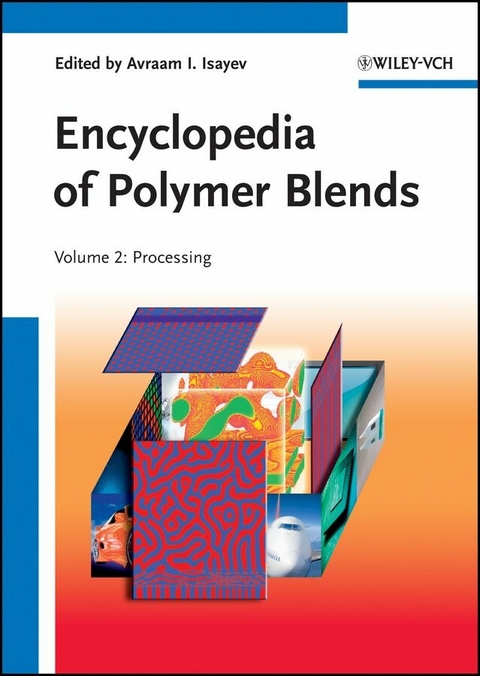
Encyclopedia of Polymer Blends, Volume 2 (eBook)
Wiley-VCH Verlag GmbH & Co. KGaA
978-3-527-80522-8 (ISBN)
Each article is uniformly structured for easy navigation, containing the latest research & development and its basic principles and applications, examples of case studies, laboratory and pilot plant experiments, as well as due reference to the published and patented literature.
Avraam I. Isayev is a Distinguished Professor of Polymer Engineering at the University of Akron. He is a native of Azerbaijan. He received M.Sc. degrees from the Azerbaijan Institute of Oil and Chemistry in Chemical Engineering and the Moscow Institute of Electronic Machine Building in Applied Mathematics and a Ph.D. in Polymer Engineering and Science from the Institute of Petrochemical Synthesis of the USSR Academy of Sciences, Moscow. Before joining the University of Akron in 1983 as an Associate Professor, he was a Senior Research Associate at Cornell University, a Senior Research Fellow at Technion and a Research Associate at the Institute of Petrochemical Synthesis of the USSR Academy of Sciences. He has edited 5 books, published 1 monograph and over 220 journal papers, many book chapters and encyclopedia articles. He has received numerous awards.
Avraam I. Isayev is a Distinguished Professor of Polymer Engineering at the University of Akron. He is a native of Azerbaijan. He received M.Sc. degrees from the Azerbaijan Institute of Oil and Chemistry in Chemical Engineering and the Moscow Institute of Electronic Machine Building in Applied Mathematics and a Ph.D. in Polymer Engineering and Science from the Institute of Petrochemical Synthesis of the USSR Academy of Sciences, Moscow. Before joining the University of Akron in 1983 as an Associate Professor, he was a Senior Research Associate at Cornell University, a Senior Research Fellow at Technion and a Research Associate at the Institute of Petrochemical Synthesis of the USSR Academy of Sciences. He has edited 5 books, published 1 monograph and over 220 journal papers, many book chapters and encyclopedia articles. He has received numerous awards.
Encyclopedia of Polymer Blends 1
Contents 7
Preface 15
List of Contributors 19
1: Polymer Blend Compounding and Processing 21
1.1 Introduction and Early Studies of Blending 21
1.2 Methods of Compounding 22
1.2.1 Batch Mixers 22
1.2.1.1 Introductory 22
1.2.1.2 Non-intermeshing Rotor Mixers 23
1.2.1.3 Intermeshing Rotor Mixers 25
1.2.1.4 Post-World War II Development 27
1.2.2 Continuous Mixers 30
1.2.2.1 Early Activities 30
1.2.2.2 Single-Screw Extrusion 31
1.2.2.3 Co-rotating Twin-Screw Extrusion 31
1.2.2.4 Tangential Counter-Rotating Twin-Screw Extrusion 35
1.2.2.5 Modular Intermeshing Counter-Rotating Twin-Screw Mixer 36
1.2.2.6 Modular Buss Kokneter 36
1.2.3 Comparisons 36
1.3 Processing Polymer Blends 38
1.3.1 Early Synthetic Polymer Blends 38
1.3.2 General Ideas and Stability of Blend Phase Morphology 38
1.3.3 Phase Morphology Variations in Processing Operations 41
1.3.3.1 Melt Spinning 41
1.3.3.2 Die Extrusion 41
1.3.3.3 Injection Molding 42
References 43
2: Rheology of Polymer Blends 47
2.1 Introduction 47
2.1.1 Rheological Models for Miscible Blends 48
2.1.1.1 Solutions 48
2.1.1.2 Homologous Polymer Blends 51
2.1.2 Model Systems for Immiscible Blends 51
2.1.2.1 Interphase and Percolation 51
2.1.2.2 Suspensions 54
2.1.2.3 Emulsion Rheology 59
2.1.2.4 Melt Flow of Block Copolymers 65
2.2 Theoretical Treatment of Polymer Blends 65
2.3 Rheology of Miscible Blends 67
2.3.1 General 67
2.3.2 Phase Separation and Flow 72
2.3.2.1 Influence of Thermodynamics on Rheology 72
2.3.2.2 Influence of Rheology on Thermodynamics 74
2.4 Rheology of Immiscible Blends 77
2.4.1 Rheological Equations of State 77
2.4.2 Morphology of Immiscible Blends 80
2.4.3 Microrheology of Polymer Blends 81
2.4.3.1 Deformation and Breakup of Viscoelastic Drops 81
2.4.3.2 Coalescence of Viscoelastic Drops 83
2.4.4 Flow Imposed Morphology 85
2.4.5 Shear Flows 86
2.4.5.1 Concentration Dependence of Viscosity 86
2.4.5.2 Dynamic Flow 88
2.4.5.3 Steady-State versus Dynamic Viscosity 89
2.4.5.4 Blend Elasticity 90
2.4.6 Elongational Flows 92
2.5 Rheology of Blends with Nanoparticles 96
2.5.1 General 96
2.5.2 Rheology of Blends with Spherical SiO2 Particles 98
2.5.3 Rheology of Blends with Nanoparticles Near Binodal 100
2.5.4 Rheology of Immiscible Blends with Organoclay 101
2.6 Conclusions 103
References 109
3: Compounding and Processing of Plastic/Rubber Blends 129
3.1 Plastic/Rubber Blends 129
3.1.1 Introduction 129
3.1.2 Classification of Polymer Blends 130
3.1.3 Types of Plastic/Rubber Blends 131
3.2 Methods of Blend Preparation 132
3.3 Equipment for Blend Preparation by Melt Mixing of Polymers 133
3.3.1 Batch Mixers 133
3.3.1.1 Roll Mill 133
3.3.1.2 Banbury or Kneader Mixer 134
3.3.2 Continuous Mixers 137
3.3.2.1 Twin-Screw Mixer 137
3.3.2.2 Buss Continuous Kneader 143
3.4 Preparation of Physical Blends of Plastics and Rubbers 145
3.4.1 Laboratory Preparation of the Blends 145
3.4.2 Production of Blends by a Batch Process 147
3.4.3 Production of Blends by a Continuous Process in a Twin-Screw Mixer 148
3.5 Crosslinking Agents and Crosslinking Processes 151
3.6 Preparation of the Blends of Plastics and Crosslinked Rubbers 157
3.6.1 Preparation of Plastic and Crosslinked Rubber Blends (TPVs) by a Batch Process 160
3.6.1.1 Preparation of TPVs in a Brabender 160
3.6.1.2 Production of TPVs in a Banbury or Similar Batch Processing Equipment 161
3.6.1.3 Production of TPVs by a Continuous Process in a Twin-Screw Mixer 163
3.7 Blends of Plastics and Crosslinked Rubbers by Dynamic Vulcanization 164
3.8 Compatibilization and Compatibilized Blends 166
3.8.1 Preparation of a Compatibilizer 168
3.8.2 Production of Compatibilized Blends 169
3.8.3 Compatibilized Blends 169
3.9 Processing of Plastic/Rubber Blends 171
3.9.1 General 171
3.9.2 Injection Molding 172
3.9.3 Extrusion 175
3.10 Conclusions and Outlook 178
References 180
4: Compounding and Processing of Rubber/Rubber Blends 183
4.1 Introduction 183
4.1.1 Fundamentals of Applied Polymer Chemistry 184
4.1.2 Multiple Tg Elastomer Compositions 189
4.2 Elastomers and Tire Compounding 190
4.2.1 Tire Component Parts 191
4.2.2 Tire Elastomers 192
4.3 Blending Elastomers 194
4.4 Solubility Parameters 198
4.4.1 Definition of Solubility Parameters 198
4.4.2 Estimation of Solubility Parameters 200
4.5 Processing of Elastomer Blends 201
4.5.1 General Remarks 201
4.5.2 Natural Rubber/Bromobutyl Rubber Blends 203
4.5.3 Bromobutyl/Butyl Rubber Blends 206
4.5.4 Bromobutyl/Chlorobutyl Rubber Blends 206
4.5.5 Bromobutyl/Styrene Butadiene Rubber Blends 206
4.5.6 Bromobutyl/GPR/EPDM Rubber Triblends 207
4.5.7 Distribution of Compounding Ingredients: Insoluble Chemicals 207
4.5.8 Distribution of Compounding Ingredients: Soluble Chemicals 209
4.5.9 Effect of Blending on Compound Physical Properties 212
4.6 Secondary Polymer Blends Systems 213
4.6.1 Resins Systems 213
4.6.2 Tackifying Resins 214
4.6.3 Reinforcing Resins 214
4.6.4 Curing Resins 216
4.6.5 Polymeric Green Strength Promoters 218
4.7 Elastomer Blends and Tire Performance 219
4.8 Tire Tread Compound Formulary 221
4.9 Summary 223
References 224
5: Extrusion Technology for Manufacturing Polymer Blends 227
5.1 Introduction 227
5.1.1 Hierarchy of Equipment in Manufacturing Polymer Blends 230
5.1.2 Brief Historical Facts and Needs for Manufacturing of Polymer Blends 232
5.2 Multiple-Screw Extruders 232
5.2.1 Twin-Screw Extrusion Technology 232
5.2.1.1 Coperion Werner & Pfleiderer: ZSK MEGAcompounder [8]
5.2.1.2 Effect of Do/Di and Screw Speed on Average Shear Rate 237
5.2.1.3 Leistritz: HSEI (High Speed Energy Input) Twin-Screw Extruder [9] 238
5.2.1.4 KraussMaffei Berstorff Twin-Screw Extrusion System [10] 242
5.2.1.5 Japan Steel Works TEX Twin-Screw Extrusion Systems [11] 243
5.2.1.6 High Efficiency Twin-Screw Extruder [12] 246
5.2.1.7 Intelligent Extruder for Polymer Compounding [13] 247
5.2.2 Single-Screw Extrusion Technology 249
5.2.2.1 High-Performance Screws [18] 251
5.2.2.2 Secondary Mixing Processes and Devices 257
5.2.2.3 Helibar® Transfer Mixing Screw in Groove Barrel 260
5.2.2.4 Dynamic Mixers 261
5.3 Most Critical Step in the Production of Polymer Blends – Melting/Mixing 263
5.3.1 Extrusion Process Simulator Version II (EPSIM II) 263
5.3.2 Twin-Screw Melt Mixing Evaluator (TSMEE) 264
5.3.3 Melting of Virgin Polymers 265
5.3.3.1 Melting and Remelting 266
5.3.4 Classification and Discussion of Melting Mechanisms Important to Polymers 267
5.3.5 Characterization of Mixing Elements 271
5.3.6 Melting of Solid Mixtures of Polymer Blend Components 273
5.3.6.1 Melting Behavior of Single Components and the Blend 274
5.4 Monitoring of Morphology and Compositions of Polymer Blends 277
5.5 Future Development in Polymer Blends Compounding 277
5.5.1 Mass Customization 277
5.5.2 Single-, Twin-, or Multiple-Screw Extruders 279
References 279
6: Manufacturing of Polymer Blends Using Polymericand Low Molecular Weight Reactive Compatibilizers 283
6.1 Introduction 283
6.2 Reactive Blending and Compatibilization 284
6.3 Mixing Mechanism and Morphology Development 285
6.3.1 Distributive Mixing 286
6.3.2 Dispersive Mixing 290
6.3.2.1 Interfacial Tension 290
6.3.2.2 Shear Viscosity of Polymer Blends 292
6.3.3 Morphology Development 293
6.3.3.1 Initial Breakup of Polymer Melt Phases 293
6.3.3.2 Breakup of Liquid Filaments in a Liquid Matrix 295
6.3.3.3 Deformation of Droplets 296
6.3.3.4 Observations on Mechanically Mixed Polymer Blends 300
6.3.3.5 Coalescence 301
6.4 Intermeshing Co-rotating Twin-Screw Extruder 302
6.4.1 Geometry and Flow Mechanisms 302
6.4.1.1 Right-Handed Screw Elements 305
6.4.1.2 Left-Handed Screw Elements 308
6.4.1.3 Kneading Disc Blocks 308
6.4.1.4 Special Distributive Mixing Elements 310
6.4.2 Residence Time Distributions 312
6.4.3 Morphology Development for Reactive Blends 315
6.4.4 Process Simulation of Intermeshing Co-rotating Twin-Screw Extruders 317
6.5 Manufacturing Process Design for Polymer Blending Process 320
6.6 Concluding Remarks 325
References 329
7: Polymer Blend Compatibilization by Copolymersand Functional Polymers 335
7.1 Introduction 335
7.1.1 Polymer Blends and the Need for Compatibilization 335
7.1.2 Compatibilization Routes 336
7.1.3 Reactive Extrusion/Processing 337
7.2 Compatibilization by Copolymers 337
7.3 In Situ Compatibilization or Reactive Blending 340
7.3.1 Kinetics of Melt Coupling Reactions at Interfaces 341
7.3.2 Effect of Interfacial Reactions on the Interface Morphology 343
7.3.3 Effect of the Interfacial Copolymer Structure 344
7.3.4 Effect of the Reactive Precursor Molecular Weight 345
7.3.5 Effect of the Flow 346
7.3.6 Role of the Reaction Rate on the Dispersed Phase Morphology 348
7.3.7 Examples of Applications of Reactive Blending in Polyester and Polyamide Blends 352
7.3.7.1 Polybutadiene Terephthalate Blends 352
7.3.7.2 Polyamide-6 Blends 356
7.4 Application to Manufacturing of Polymer Blends 357
7.4.1 Equipment 357
7.4.1.1 Introduction 357
7.4.1.2 Main Operational Features of Co-rotating Twin-Screw Extruders 360
7.4.2 Evolution Along the Extruder 363
7.4.3 Modeling and Optimization 365
7.5 Conclusions 370
References 371
8: Chemical and Engineering Aspects of Morphology Development and Processing of Multiphase PolymerBlend Nanocomposites 377
8.1 Introduction: The Promise and Challenge of Polymer Blending 377
8.2 Inorganic Particles in Small Molecule Liquid Emulsion: A Model System for Filled Polymer Blends? 378
8.3 Chemical Aspects of Morphology Development and Processing of Multiphase Polymer Blend Nanocomposites 380
8.3.1 Conventional Fillers in Polymer Blends 380
8.3.2 Nanofillers in Polymer Blends 384
8.4 Engineering Aspects of Morphology Development and Processing of Multiphase Polymer Blend Nanocomposites 389
8.4.1 Miscibility, Homogeneity, and Interfaces of Polymer Blends 389
8.4.2 Definition of Mixing and Intermaterial Area Generation 390
8.4.3 Mixing Flow and Kinematics of Mixing 392
8.4.3.1 Intermaterial Area Generation in Miscible Fluids 394
8.4.3.2 Relevance of Intermaterial Area Generation to Dispersive Mixing 401
8.4.4 Demixing of Filler Particles and Droplets Induced by Non-uniform Shear Flows Encountered During Usual Processing Operations 401
8.5 Conclusions 402
References 405
Index 415
End User License Agreement 425
| Erscheint lt. Verlag | 12.9.2016 |
|---|---|
| Reihe/Serie | Encyclopedia of Polymer Blends |
| Sprache | englisch |
| Themenwelt | Naturwissenschaften ► Chemie |
| Technik | |
| Schlagworte | Chemie • Chemistry • construction materials • Industrial Chemistry • Konstruktionswerkstoffe • Materials Science • Materialwissenschaften • Polymer Blend Compounding and Processing, theology of Extrusion Equipment, Morphology Development During Processing, Droplet Deformation, Polymeric and Low Molecular Weight Reactive Compatibilizers, Theology of Reactive Polymer Blends, Extrusion Equipments and Reactive Blending in Screw Extruders, Polymer Blend Compatibilization by Copolymer and Functional Polymer • Polymer-Blends • Polymergemisch • Polymer processing • Polymer Science & Technology • Polymerverarbeitung • Polymerwissenschaft u. -technologie • Technische u. Industrielle Chemie |
| ISBN-10 | 3-527-80522-2 / 3527805222 |
| ISBN-13 | 978-3-527-80522-8 / 9783527805228 |
| Informationen gemäß Produktsicherheitsverordnung (GPSR) | |
| Haben Sie eine Frage zum Produkt? |
 PDF (Adobe DRM)
Kopierschutz: Adobe-DRM
Adobe-DRM ist ein Kopierschutz, der das eBook vor Mißbrauch schützen soll. Dabei wird das eBook bereits beim Download auf Ihre persönliche Adobe-ID autorisiert. Lesen können Sie das eBook dann nur auf den Geräten, welche ebenfalls auf Ihre Adobe-ID registriert sind.
Details zum Adobe-DRM
Dateiformat: PDF (Portable Document Format)
Mit einem festen Seitenlayout eignet sich die PDF besonders für Fachbücher mit Spalten, Tabellen und Abbildungen. Eine PDF kann auf fast allen Geräten angezeigt werden, ist aber für kleine Displays (Smartphone, eReader) nur eingeschränkt geeignet.
Systemvoraussetzungen:
PC/Mac: Mit einem PC oder Mac können Sie dieses eBook lesen. Sie benötigen eine
eReader: Dieses eBook kann mit (fast) allen eBook-Readern gelesen werden. Mit dem amazon-Kindle ist es aber nicht kompatibel.
Smartphone/Tablet: Egal ob Apple oder Android, dieses eBook können Sie lesen. Sie benötigen eine
Geräteliste und zusätzliche Hinweise
Buying eBooks from abroad
For tax law reasons we can sell eBooks just within Germany and Switzerland. Regrettably we cannot fulfill eBook-orders from other countries.
aus dem Bereich