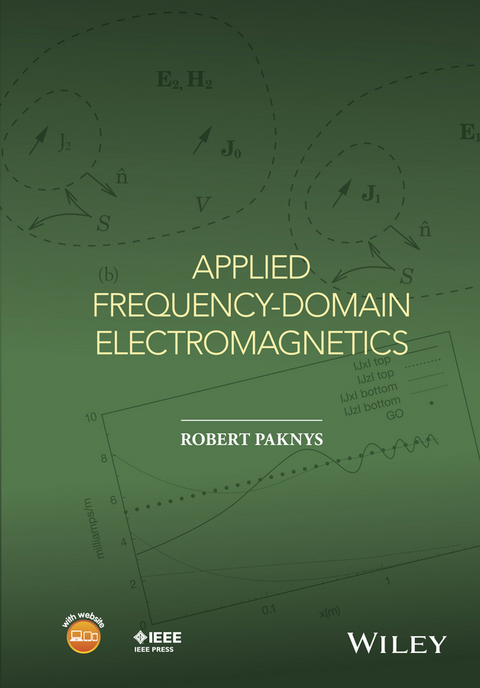
Applied Frequency-Domain Electromagnetics (eBook)
John Wiley & Sons (Verlag)
978-1-118-94055-6 (ISBN)
Understanding electromagnetic wave theory is pivotal in the design of antennas, microwave circuits, radars, and imaging systems. Researchers behind technology advances in these and other areas need to understand both the classical theory of electromagnetics as well as modern and emerging techniques of solving Maxwell's equations. To this end, the book provides a graduate-level treatment of selected analytical and computational methods.
The analytical methods include the separation of variables, perturbation theory, Green's functions, geometrical optics, the geometrical theory of diffraction, physical optics, and the physical theory of diffraction. The numerical techniques include mode matching, the method of moments, and the finite element method. The analytical methods provide physical insights that are valuable in the design process and the invention of new devices. The numerical methods are more capable of treating general and complex structures. Together, they form a basis for modern electromagnetic design.
The level of presentation allows the reader to immediately begin applying the methods to some problems of moderate complexity. It also provides explanations of the underlying theories so that their capabilities and limitations can be understood.
Prof Robert Paknys, Concordia University, Canada
Robert Paknys received the B.Eng. Degree from McGill University in 1979, and the M.Sc. and Ph.D. degrees from Ohio State University in 1982 and 1985, respectively, all in electrical engineering. He joined the Concordia ECE Department as a faculty member in 1989, and is a full professor. He served the department as the undergraduate program director, associate chair, and department chair. He teaches courses in electromagnetics, antennas and microwaves. His research interest is in electromagnetics, with applications to antennas. He has served as a consultant to the government and industry. Dr. Paknys is a member of ACES, a member of CNC-URSI Commission B, a senior member of the IEEE, a registered professional engineer, and a past associate editor (2004-2010) for the IEEE Transactions on Antennas and Propagation.
Understanding electromagnetic wave theory is pivotal in the design of antennas, microwave circuits, radars, and imaging systems. Researchers behind technology advances in these and other areas need to understand both the classical theory of electromagnetics as well as modern and emerging techniques of solving Maxwell's equations. To this end, the book provides a graduate-level treatment of selected analytical and computational methods. The analytical methods include the separation of variables, perturbation theory, Green's functions, geometrical optics, the geometrical theory of diffraction, physical optics, and the physical theory of diffraction. The numerical techniques include mode matching, the method of moments, and the finite element method. The analytical methods provide physical insights that are valuable in the design process and the invention of new devices. The numerical methods are more capable of treating general and complex structures. Together, they form a basis for modern electromagnetic design. The level of presentation allows the reader to immediately begin applying the methods to some problems of moderate complexity. It also provides explanations of the underlying theories so that their capabilities and limitations can be understood.
Prof Robert Paknys, Concordia University, Canada Robert Paknys received the B.Eng. Degree from McGill University in 1979, and the M.Sc. and Ph.D. degrees from Ohio State University in 1982 and 1985, respectively, all in electrical engineering. He joined the Concordia ECE Department as a faculty member in 1989, and is a full professor. He served the department as the undergraduate program director, associate chair, and department chair. He teaches courses in electromagnetics, antennas and microwaves. His research interest is in electromagnetics, with applications to antennas. He has served as a consultant to the government and industry. Dr. Paknys is a member of ACES, a member of CNC-URSI Commission B, a senior member of the IEEE, a registered professional engineer, and a past associate editor (2004-2010) for the IEEE Transactions on Antennas and Propagation.
Cover 1
Title Page 5
Copyright 6
Dedication 7
Contents 9
About the Author 19
Preface 21
Acknowledgements 23
Chapter 1 Background 25
1.1 Field Laws 25
1.2 Properties of Materials 26
1.3 Types of Currents 27
1.4 Capacitors, Inductors 28
1.5 Differential Form 30
1.6 Time-Harmonic Fields 31
1.7 Sufficient Conditions 32
1.8 Magnetic Currents, Duality 33
1.9 Poynting's Theorem 34
1.10 Lorentz Reciprocity Theorem 36
1.11 Friis and Radar Equations 37
1.12 Asymptotic Techniques 39
1.13 Further Reading 40
References 41
Problems 41
Chapter 2 Transverse Electromagnetic Waves 44
2.1 Introduction 44
2.2 Plane Waves 45
2.2.1 Lossy Medium 47
2.2.2 Polarization 50
2.3 Oblique Plane Waves 51
2.4 Plane-Wave Reflection and Transmission 52
2.4.1 Perpendicular Polarization 53
2.4.2 Parallel Polarization 55
2.4.3 The Brewster Angle 56
2.4.4 Total Internal Reflection 57
2.5 Multi-Layer Slab 59
2.6 Impedance Boundary Condition 61
2.6.1 Penetrable Boundary 61
2.6.2 Impenetrable Boundary 63
2.7 Transmission Lines 67
2.7.1 Characteristic Impedance 70
2.7.2 LC Ladder 70
2.7.3 Small Losses 73
2.7.4 Transmission Line Parameters 75
2.7.5 Microstrip, Stripline and Coplanar Lines 76
2.7.6 Reflection and Transmission on a Transmission Line 79
2.7.7 Physical Meaning of Z0 81
2.8 Transverse Equivalent Network 83
2.9 Absorbers 84
2.10 Phase and Group Velocity 85
2.11 Further Reading 88
References 88
Problems 88
Chapter 3 Waveguides and Resonators 93
3.1 Separation of Variables 93
3.2 Rectangular Waveguide 95
3.2.1 Dominant TE10 Mode 98
3.2.2 Fourier Series of Modes 100
3.3 Cylindrical Waves 102
3.4 Circular Waveguide 103
3.4.1 Coaxial Line 105
3.5 Waveguide Excitation 106
3.6 2D Waveguides 107
3.6.1 Parallel-Plate Waveguide 107
3.6.2 Dielectric Slab on PEC Ground 109
3.6.3 Dielectric Slab on PMC Ground 114
3.6.4 Ungrounded Dielectric Slab 115
3.7 Transverse Resonance Method 116
3.8 Other Waveguide Types 119
3.8.1 Ridge Waveguide 119
3.8.2 Finline 121
3.9 Waveguide Discontinuities 123
3.9.1 Irises and Posts 123
3.9.2 Waveguide Step 126
3.10 Mode Matching 126
3.10.1 H-Plane Step 126
3.10.2 Inductive Iris 130
3.11 Waveguide Cavity 133
3.11.1 Rectangular Cavity Q 134
3.11.2 Cylindrical Cavity Resonator 137
3.11.3 Cylindrical Cavity Q 137
3.11.4 Dielectric Resonator 138
3.12 Perturbation Method 140
3.12.1 Material Perturbation 140
3.12.2 Geometry Perturbation 143
3.13 Further Reading 145
References 145
Problems 146
Chapter 4 Potentials, Concepts and Theorems 153
4.1 Vector Potentials A and F 153
4.2 Hertz Potentials 158
4.3 Vector Potentials and Boundary Conditions 159
4.3.1 Az and Fz 159
4.3.2 Hybrid Modes, Ay and Fy 162
4.4 Uniqueness Theorem 166
4.5 Radiation Condition 168
4.6 Image Theory 168
4.7 Physical Optics 170
4.8 Surface Equivalent 171
4.9 Love's Equivalent 175
4.10 Induction Equivalent 177
4.11 Volume Equivalent 178
4.12 Radiation by Planar Sources 180
4.13 2D Sources and Fields 181
4.13.1 z-Directed Source 181
4.13.2 Transverse Source 182
4.13.3 Radiation Integrals 182
4.13.4 2D and 3D Potentials 183
4.14 Derivation of Vector Potential Integral 184
4.15 Solution Without Using Potentials 186
4.16 Further Reading 188
References 188
Problems 188
Chapter 5 Canonical Problems 193
5.1 Cylinder 193
5.1.1 Plane Wave Incidence 193
5.1.2 Line Source Incidence 196
5.1.3 TE Slot 198
5.1.4 TM Dielectric Cylinder 199
5.2 Wedge 199
5.2.1 TM Case 200
5.2.2 TE Case 202
5.3 The Relation Between 2D and 3D Solutions 203
5.3.1 Magnetic Dipole on a Cylinder 204
5.3.2 Electric Dipole Near a Wedge 206
5.3.3 Reciprocity-Based Solutions 207
5.4 Spherical Waves 208
5.4.1 Scattering by a Sphere 210
5.5 Method of Stationary Phase 214
5.6 Further Reading 216
References 217
Problems 217
Chapter 6 Method of Moments 222
6.1 Introduction 222
6.2 General Concepts 222
6.2.1 Point Matching 223
6.2.2 Galerkin's Method 223
6.2.3 Fredholm Integral Equation 224
6.3 2D Conducting Strip 225
6.3.1 TM Case 225
6.3.2 TE Case 228
6.3.3 Self-Impedance Term for the TE Strip 230
6.3.4 Other Source Types 231
6.4 2D Thin Wire MoM 233
6.4.1 One Wire 233
6.4.2 Wire Array 234
6.5 Periodic 2D Wire Array 236
6.5.1 Poisson Summation 236
6.5.2 Scattering Formulation 237
6.5.3 Numerical Considerations 239
6.6 3D Thin Wire MoM 240
6.6.1 The Scattering Problem 241
6.6.2 A Reciprocal Equivalent 242
6.6.3 The Antenna Problem 243
6.6.4 Numerical Considerations 245
6.7 EFIE and MFIE 245
6.8 Internal Resonances 247
6.9 PMCHWT Formulation 248
6.10 Basis Functions 249
6.10.1 Wires 250
6.10.2 Surfaces 250
6.10.3 Volumes 251
6.11 Further Reading 251
References 252
Problems 252
Chapter 7 Finite Element Method 257
7.1 Introduction 257
7.2 Laplace's Equation 257
7.3 Piecewise-Planar Potential 258
7.4 Stored Energy 260
7.5 Connection of Elements 260
7.6 Energy Minimization 263
7.7 Natural Boundary Conditions 264
7.8 Capacitance and Inductance 267
7.9 Computer Program 268
7.10 Poisson's Equation 270
7.11 Scalar Wave Equation 273
7.12 Galerkin's Method 277
7.12.1 Discussion 278
7.12.2 Variational Method 280
7.13 Vector Wave Equation 281
7.14 Other Element Types 281
7.14.1 Node-Based Elements 281
7.14.2 Spurious Modes 283
7.14.3 Edge-Based Elements 283
7.15 Radiating Structures 285
7.15.1 Absorbing Boundary Condition 285
7.15.2 Artificial Absorber 287
7.15.3 Boundary Element Method 287
7.16 Further Reading 288
References 288
Problems 289
Chapter 8 Uniform Theory of Diffraction 292
8.1 Fermat's Principle 292
8.2 2D Fields 293
8.2.1 Reflection 293
8.2.2 Wedge Diffraction 294
8.2.3 Some Rules for Wedge Diffraction 297
8.2.4 Behaviour Near ISB 299
8.3 Scattering and GTD 300
8.4 3D Fields 302
8.4.1 Slot Antenna on a Finite Ground Plane 304
8.4.2 Monopole Antenna on a Finite Ground Plane 306
8.4.3 Astigmatic Fields 307
8.4.4 Reflection 308
8.4.5 Edge Diffraction 309
8.4.6 Curved Edge 310
8.4.7 Monopole on a Disc 310
8.5 Curved Surface Reflection 312
8.5.1 2D Reflection 312
8.5.2 3D Reflection 313
8.6 Curved Wedge Face 315
8.7 Non-Metallic Wedge 315
8.8 Slope Diffraction 316
8.9 Double Diffraction 317
8.10 GTD Equivalent Edge Currents 318
8.11 Surface Ray Diffraction 321
8.11.1 Scattering 321
8.11.2 Radiation 323
8.11.3 Coupling 326
8.11.4 2D and 3D Radiation 328
8.12 Further Reading 330
References 330
Problems 331
Chapter 9 Physical Theory of Diffraction 341
9.1 PO and an Edge 341
9.2 Asymptotic Evaluation 342
9.2.1 PO Endpoint Correction 345
9.2.2 Relationship Between PTD and GTD 346
9.2.3 General Formulas 346
9.3 Reflector Antenna 347
9.3.1 PO Part 348
9.3.2 PTD Part 349
9.4 RCS of a Disc 351
9.4.1 PO Part 351
9.4.2 PTD Part 352
9.5 PTD Equivalent Edge Currents 354
9.6 Further Reading 355
References 355
Problems 355
Chapter 10 Scalar and Dyadic Green's Functions 359
10.1 Impulse Response 359
10.2 Green's Function for A 361
10.3 2D Field Solutions Using Green's Functions 362
10.3.1 2D TM Fields 363
10.3.2 2D TE Fields 364
10.3.3 Free-Space Interpretation 364
10.3.4 Special Green's Functions 365
10.4 3D Dyadic Green's Functions 366
10.5 Some Dyadic Identities 367
10.6 Solution Using a Dyadic Green's Function 368
10.7 Symmetry Property of G 369
10.8 Interpretation of the Radiation Integrals 370
10.9 Free Space Dyadic Green's Function 371
10.10 Dyadic Green's Function Singularity 372
10.10.1 Derivation of Equation (10.71) 373
10.11 Dielectric Rod 374
10.11.1 Numerical Considerations 375
10.12 Further Reading 376
References 376
Problems 376
Chapter 11 Green's Functions Construction I 379
11.1 Sturm-Liouville Problem 379
11.2 Green's Second Identity 380
11.3 Hermitian Property 380
11.4 Particular Solution 381
11.5 Properties of the Green's Function 381
11.6 UT Method 382
11.6.1 Independent Solutions of the SLP 385
11.7 Discrete and Continuous Spectra 386
11.7.1 Complete Set of Eigenfunctions 387
11.7.2 Another Representation of ?(x ? x') 388
11.7.3 A Discrete Spectrum of Eigenfunctions 388
11.7.4 A Continuous Spectrum of Eigenfunctions 390
11.8 Generalized Separation of Variables 392
11.8.1 Reduction to 2D 396
11.8.2 Relation Between 2D and 3D 399
11.9 Further Reading 400
References 400
Problems 400
Chapter 12 Green's Function Construction II 405
12.1 Sommerfeld Integrals 405
12.2 The Function ?(?) = ?k2 - v2 407
12.3 The Transformation v=k sin w 409
12.4 Saddle Point Method 411
12.4.1 First-Order Saddle Point 413
12.4.2 Pole Near Saddle Point 416
12.5 SDP Branch Cuts 417
12.6 Grounded Dielectric Slab 419
12.6.1 Saddle Point Evaluation of Gs 421
12.6.2 Surface and Leaky Waves 424
12.6.3 TE Case 426
12.6.4 Summary 427
12.7 Half Space 427
12.7.1 Asymptotic Evaluation 430
12.7.2 Vertical Electric Dipole 433
12.8 Circular Cylinder 435
12.8.1 Creeping Waves 438
12.8.2 Residue Series 441
12.8.3 Other Boundary Conditions 442
12.9 Strip Grating on a Dielectric Slab 443
12.9.1 Spectral Domain 445
12.9.2 Floquet Harmonics 446
12.9.3 Reflection 449
12.9.4 Discussion 452
12.9.5 Other Related Cases 454
12.10 Further Reading 454
References 455
Problems 455
Appendix A Constants and Formulas 459
A.1 Constants 459
A.2 Definitions 459
A.3 Trigonometry 460
A.4 The Impulse Function 461
Reference 461
Appendix B Coordinates and Vector Calculus 462
B.1 Coordinate Transformations 462
B.2 Volume and Surface Elements 462
B.3 Vector Derivatives 464
B.4 Vector Identities 465
B.5 Integral Relations 466
B.5.1 Green's Identities 467
B.5.2 Helmholtz's Theorem 468
Reference 468
Appendix C Bessel's Differential Equation 469
C.1 Bessel Functions 469
C.2 Roots of Hvp(1,2) (x) = 0 472
C.3 Integrals 472
C.4 Orthogonality 473
C.5 Recursion Relations 473
C.6 Gamma Function 473
C.7 Wronskians 474
C.8 Spherical Bessel Functions 475
References 476
Appendix D Legendre's Differential Equation 477
D.1 Legendre Functions 477
D.2 Associated Legendre Functions 478
D.3 Orthogonality 478
D.4 Recursion Relations 479
D.5 Spherical Form 479
Reference 479
Appendix E Complex Variables 480
E.1 Residue Calculus 480
E.2 Branch Cuts 481
References 482
Appendix F Compilers and Programming 483
F.1 Getting Started 483
F.1.1 Running Linux 484
F.1.2 Running Windows 485
F.1.3 Running OS X 485
F.2 Fortran 90 485
F.2.1 External Subprograms 486
F.2.2 Internal Subprograms 487
F.2.3 Modules 487
F.2.4 Shared Data 488
F.2.5 Integer, Real and Complex Numbers 489
F.2.6 Arrays 489
F.2.7 Input/Output 490
F.2.8 Format Statement 492
F.3 More on the OS 492
F.3.1 Redirection and Pipes 492
F.3.2 Crash Messages 493
F.3.3 Object Files 493
F.3.4 Libraries 494
F.3.5 Paths and Dots 494
F.4 Plotting 494
F.5 Further Reading 495
References 495
Appendix G Numerical Methods 497
G.1 Numerical Integration 497
G.2 Root Finding 500
G.3 Matrix Equations 502
G.4 Matrix Eigenvalues 504
G.5 Bessel Functions 504
G.6 Legendre Polynomials 505
References 505
Appendix H Software Provided 507
Index 509
EULA 514
| Erscheint lt. Verlag | 2.9.2016 |
|---|---|
| Reihe/Serie | IEEE Press |
| Wiley - IEEE | Wiley - IEEE |
| Sprache | englisch |
| Themenwelt | Naturwissenschaften ► Physik / Astronomie ► Elektrodynamik |
| Technik ► Elektrotechnik / Energietechnik | |
| Schlagworte | Antennas & Propagation • Cavity • Conditions • currents • Electrical & Electronics Engineering • Electromagnetic theory • Elektromagnetismus • Elektrotechnik u. Elektronik • Excitation • F • Mikrowellen- u. Hochfrequenztechnik u. Theorie • Planar • potentials • Problems • problems tem • Properties • Radiation • References • reflection • resonance • RF / Microwave Theory & Techniques • Sende- u. Empfangseinrichtungen • Separation • Sources • Variables • Waveguides • Waves |
| ISBN-10 | 1-118-94055-5 / 1118940555 |
| ISBN-13 | 978-1-118-94055-6 / 9781118940556 |
| Informationen gemäß Produktsicherheitsverordnung (GPSR) | |
| Haben Sie eine Frage zum Produkt? |
 PDF (Adobe DRM)
Kopierschutz: Adobe-DRM
Adobe-DRM ist ein Kopierschutz, der das eBook vor Mißbrauch schützen soll. Dabei wird das eBook bereits beim Download auf Ihre persönliche Adobe-ID autorisiert. Lesen können Sie das eBook dann nur auf den Geräten, welche ebenfalls auf Ihre Adobe-ID registriert sind.
Details zum Adobe-DRM
Dateiformat: PDF (Portable Document Format)
Mit einem festen Seitenlayout eignet sich die PDF besonders für Fachbücher mit Spalten, Tabellen und Abbildungen. Eine PDF kann auf fast allen Geräten angezeigt werden, ist aber für kleine Displays (Smartphone, eReader) nur eingeschränkt geeignet.
Systemvoraussetzungen:
PC/Mac: Mit einem PC oder Mac können Sie dieses eBook lesen. Sie benötigen eine
eReader: Dieses eBook kann mit (fast) allen eBook-Readern gelesen werden. Mit dem amazon-Kindle ist es aber nicht kompatibel.
Smartphone/Tablet: Egal ob Apple oder Android, dieses eBook können Sie lesen. Sie benötigen eine
Geräteliste und zusätzliche Hinweise
Buying eBooks from abroad
For tax law reasons we can sell eBooks just within Germany and Switzerland. Regrettably we cannot fulfill eBook-orders from other countries.
aus dem Bereich