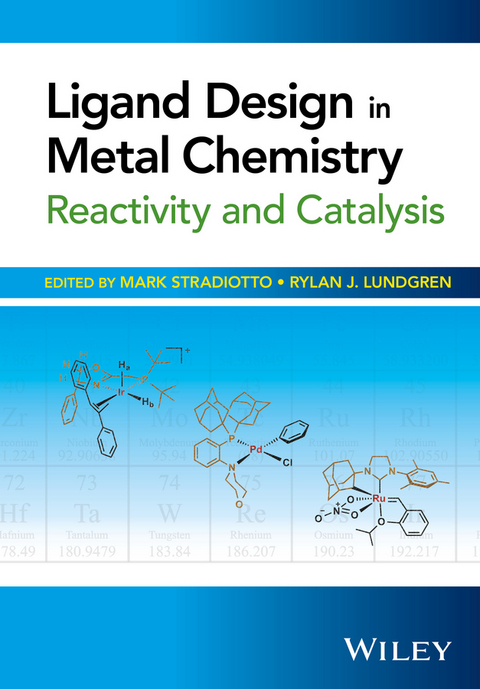
The design of ancillary ligands used to modify the structural and reactivity properties of metal complexes has evolved into a rapidly expanding sub-discipline in inorganic and organometallic chemistry. Ancillary ligand design has figured directly in the discovery of new bonding motifs and stoichiometric reactivity, as well as in the development of new catalytic protocols that have had widespread positive impact on chemical synthesis on benchtop and industrial scales.
Ligand Design in Metal Chemistry presents a collection of cutting-edge contributions from leaders in the field of ligand design, encompassing a broad spectrum of ancillary ligand classes and reactivity applications. Topics covered include:
- Key concepts in ligand design
- Redox non-innocent ligands
- Ligands for selective alkene metathesis
- Ligands in cross-coupling
- Ligand design in polymerization
- Ligand design in modern lanthanide chemistry
- Cooperative metal-ligand reactivity
- P,N Ligands for enantioselective hydrogenation
- Spiro-cyclic ligands in asymmetric catalysis
This book will be a valuable reference for academic researchers and industry practitioners working in the field of ligand design, as well as those who work in the many areas in which the impact of ancillary ligand design has proven significant, for example synthetic organic chemistry, catalysis, medicinal chemistry, polymer science and materials chemistry.
Mark Stradiotto, Department of Chemistry, Dalhousie University, Canada
Rylan Lundgren, Department of Chemistry, University of Alberta, Canada
Both professors have a well-established track-record of working in the field of organometallic ligand design and catalysis, and have published extensively on the subjects of metal-catalyzed cross-coupling, novel transition-metal bond activation, and asymmetric catalysis. They are co-inventors of the now commercialized DalPhos ligand family and have broad experience of the field of ligand design. Professor Stradiotto has worked in the field of organometallic chemistry for the past fourteen years. Professor Lundgren earned his PhD under the supervision of Prof Stradiotto at Dalhousie University in 2010. Following a PDF at MIT and Caltech with Prof. Greg Fu, Rylan accepted a faculty position at the University of Alberta (Canada).
The design of ancillary ligands used to modify the structural and reactivity properties of metal complexes has evolved into a rapidly expanding sub-discipline in inorganic and organometallic chemistry. Ancillary ligand design has figured directly in the discovery of new bonding motifs and stoichiometric reactivity, as well as in the development of new catalytic protocols that have had widespread positive impact on chemical synthesis on benchtop and industrial scales. Ligand Design in Metal Chemistry presents a collection of cutting-edge contributions from leaders in the field of ligand design, encompassing a broad spectrum of ancillary ligand classes and reactivity applications. Topics covered include: Key concepts in ligand design Redox non-innocent ligands Ligands for selective alkene metathesis Ligands in cross-coupling Ligand design in polymerization Ligand design in modern lanthanide chemistry Cooperative metal-ligand reactivity P,N Ligands for enantioselective hydrogenation Spiro-cyclic ligands in asymmetric catalysis This book will be a valuable reference for academic researchers and industry practitioners working in the field of ligand design, as well as those who work in the many areas in which the impact of ancillary ligand design has proven significant, for example synthetic organic chemistry, catalysis, medicinal chemistry, polymer science and materials chemistry.
Mark Stradiotto, Department of Chemistry, Dalhousie University, Canada Rylan Lundgren, Department of Chemistry, University of Alberta, Canada Both professors have a well-established track-record of working in the field of organometallic ligand design and catalysis, and have published extensively on the subjects of metal-catalyzed cross-coupling, novel transition-metal bond activation, and asymmetric catalysis. They are co-inventors of the now commercialized DalPhos ligand family and have broad experience of the field of ligand design. Professor Stradiotto has worked in the field of organometallic chemistry for the past fourteen years. Professor Lundgren earned his PhD under the supervision of Prof Stradiotto at Dalhousie University in 2010. Following a PDF at MIT and Caltech with Prof. Greg Fu, Rylan accepted a faculty position at the University of Alberta (Canada).
Title Page 5
Copyright Page 6
Contents 7
List of Contributors 14
Foreword by Stephen L. Buchwald 16
Foreword by David Milstein 18
Preface 19
Chapter 1 Key Concepts in Ligand Design: An Introduction 21
1.1 Introduction 21
1.2 Covalent bond classification and elementary bonding concepts 22
1.3 Reactive versus ancillary ligands 24
1.4 Strong- and weak-field ligands 24
1.5 Trans effect 26
1.6 Tolman electronic parameter 26
1.7 Pearson acid base concept 28
1.8 Multidenticity, ligand bite angle, and hemilability 28
1.9 Quantifying ligand steric properties 30
1.10 Cooperative and redox non?innocent ligands 32
1.11 Conclusion 32
References 33
Chapter 2 Catalyst Structure and Cis–Trans Selectivity in Ruthenium-based Olefin Metathesis 35
2.1 Introduction 35
2.2 Metathesis reactions and mechanism 37
2.2.1 Types of metathesis reactions 37
2.2.2 Mechanism of Ru?catalyzed olefin metathesis 39
2.2.3 Metallacycle geometry 39
2.2.4 Influencing syn–anti preference of metallacycles 42
2.3 Catalyst structure and E/Z selectivity 44
2.3.1 Trends in key catalysts 44
2.3.2 Catalysts with unsymmetrical NHCs 46
2.3.3 Catalysts with alternative NHC ligands 49
2.3.4 Variation of the anionic ligands 51
2.4 Z-selective Ru-based metathesis catalysts 53
2.4.1 Thiophenolate-based Z-selective catalysts 53
2.4.2 Dithiolate-based Z-selective catalysts 54
2.5 Cyclometallated Z-selective metathesis catalysts 56
2.5.1 Initial discovery 56
2.5.2 Model for selectivity 57
2.5.3 Variation of the anionic ligand 58
2.5.4 Variation of the aryl group 60
2.5.5 Variation of the cyclometallated NHC substituent 61
2.5.6 Reactivity of cyclometallated Z-selective catalysts 62
2.6 Conclusions and future outlook 62
References 63
Chapter 3 Ligands for Iridium?catalyzed Asymmetric Hydrogenation of Challenging Substrates 66
3.1 Asymmetric hydrogenation 66
3.2 Iridium catalysts based on heterobidentate ligands 69
3.3 Mechanistic studies and derivation of a model for the enantioselective step 77
3.4 Conclusion 83
References 84
Chapter 4 Spiro Ligands for Asymmetric Catalysis 86
4.1 Development of chiral spiro ligands 86
4.2 Asymmetric hydrogenation 93
4.2.1 Rh-catalyzed hydrogenation of enamides 93
4.2.2 Rh- or Ir-catalyzed hydrogenation of enamines 93
4.2.3 Ir-catalyzed hydrogenation of ?,?-unsaturated carboxylic acids 95
4.2.4 Ir-catalyzed hydrogenation of olefins directed by the carboxy group 98
4.2.5 Ir-catalyzed hydrogenation of conjugate ketones 99
4.2.6 Ir-catalyzed hydrogenation of ketones 100
4.2.7 Ru-catalyzed hydrogenation of racemic 2-substituted aldehydes via dynamic kinetic resolution 101
4.2.8 Ru-catalyzed hydrogenation of racemic 2-substituted ketones via DKR 102
4.2.9 Ir-catalyzed hydrogenation of imines 104
4.3 Carbon–carbon bond-forming reactions 105
4.3.1 Ni-catalyzed hydrovinylation of olefins 105
4.3.2 Rh-catalyzed hydroacylation 105
4.3.3 Rh-catalyzed arylation of carbonyl compounds and imines 106
4.3.4 Pd-catalyzed umpolung allylation reactions of aldehydes, ketones, and imines 107
4.3.5 Ni-catalyzed three-component coupling reaction 107
4.3.6 Au-catalyzed Mannich reactions of azlactones 109
4.3.7 Rh-catalyzed hydrosilylation/cyclization reaction 109
4.3.8 Au-catalyzed [2?+?2] cycloaddition 110
4.3.9 Au-catalyzed cyclopropanation 111
4.3.10 Pd-catalyzed Heck reactions 111
4.4 Carbon–heteroatom bond-forming reactions 111
4.4.1 Cu-catalyzed N?H bond insertion reactions 111
4.4.2 Cu-, Fe-, or Pd-catalzyed O?H insertion reactions 113
4.4.3 Cu?catalyzed S?H, Si?H and B?H insertion reactions 115
4.4.4 Pd-catalyzed allylic amination 115
4.4.5 Pd-catalyzed allylic cyclization reactions with allenes 117
4.4.6 Pd-catalyzed alkene carboamination reactions 118
4.5 Conclusion 118
References 118
Chapter 5 Application of Sterically Demanding Phosphine Ligands in Palladium-Catalyzed Cross-Coupling leading to C(sp2)?E Bond Formation (E = NH2, OH, and F) 124
5.1 Introduction 124
5.1.1 General mechanistic overview and ancillary ligand design considerations 125
5.1.2 Reactivity challenges 127
5.2 Palladium-catalyzed selective monoarylation of ammonia 128
5.2.1 Initial development 129
5.2.2 Applications in heterocycle synthesis 130
5.2.3 Application of Buchwald palladacycles and imidazole-derived monophosphines 132
5.2.4 Heterobidentate ?2-P,N ligands: chemoselectivity and room temperature reactions 135
5.2.5 Summary 137
5.3 Palladium-catalyzed selective hydroxylation of (hetero)aryl halides 137
5.3.1 Initial development 138
5.3.2 Application of alternative ligand classes 140
5.3.3 Summary 142
5.4 Palladium-catalyzed nucleophilic fluorination of (hetero)aryl (pseudo)halides 143
5.4.1 Development of palladium?catalyzed C(sp2)?F coupling employing (hetero)aryl triflates 144
5.4.2 Discovery of biaryl monophosphine ancillary ligand modification 145
5.4.3 Extending reactivity to (hetero)aryl bromides and iodides 147
5.4.4 Summary 148
5.5 Conclusions and outlook 149
Acknowledgments 150
References 151
Chapter 6 Pd-N-Heterocyclic Carbene Complexes in Cross-Coupling Applications 154
6.1 Introduction 154
6.2 N-heterocyclic carbenes as ligands for catalysis 155
6.3 The relationship between N-heterocyclic carbene structure and reactivity 156
6.3.1 Steric parameters of NHC ligands 156
6.3.2 Electronic parameters of NHC ligands 158
6.3.3 Tuning the electronic properties of NHC ligands 159
6.4 Cross?coupling reactions leading to C?C bonds that proceed through transmetalation 160
6.5 Kumada–Tamao–Corriu 161
6.6 Suzuki–Miyaura 168
6.6.1 The formation of tetra?ortho?substituted (hetero)biaryl compounds 169
6.6.2 Enantioselective Suzuki–Miyaura coupling 173
6.6.3 Formation of sp3?sp3 or sp2?sp3 bonds 176
6.6.4 The formation of (poly)heteroaryl compounds 178
6.7 Negishi coupling 183
6.7.1 Mechanistic studies: investigating the role of additives and the nature of the active transmetalating species 186
6.7.2 Selective cross-coupling of secondary organozinc reagents 188
6.8 Conclusion 190
References 191
Chapter 7 Redox Non-innocent Ligands: Reactivity and Catalysis 196
7.1 Introduction 196
7.2 Strategy I. Redox non-innocent ligands used to modify the Lewis acid–base properties of the metal 199
7.3 Strategy II. Redox non-innocent ligands as electron reservoirs 201
7.4 Strategy III. Cooperative ligand-centered reactivity based on redox active ligands 212
7.5 Strategy IV. Cooperative substrate-centered radical-type reactivity based on redox non-innocent substrates 215
7.6 Conclusion 220
References 221
Chapter 8 Ligands for Iron?based Homogeneous Catalysts for the Asymmetric Hydrogenation of Ketones and Imines 225
8.1 Introduction: from ligands for ruthenium to ligands for iron 225
8.1.1 Ligand design elements in precious metal homogeneous catalysts for asymmetric direct hydrogenation and asymmetric transfer hydrogenation 225
8.1.2 Effective ligands for iron?catalyzed ketone and imine reduction 232
8.1.3 Ligand design elements for iron catalysts 233
8.2 First generation iron catalysts with symmetrical [6.5.6]-P-N-N-P ligands 236
8.2.1 Synthetic routes to ADH and ATH iron catalysts 237
8.2.2 Catalyst properties and mechanism of reaction 238
8.3 Second generation iron catalysts with symmetrical [5.5.5]-P-N-N-P ligands 240
8.3.1 Synthesis of second generation ATH catalysts 240
8.3.2 Asymmetric transfer hydrogenation catalytic properties and mechanism 242
8.3.3 Substrate scope 246
8.4 Third generation iron catalysts with unsymmetrical [5.5.5]-P-NH-N-P? ligands 247
8.4.1 Synthesis of bis(tridentate)iron complexes and P-NH-NH2 ligands 247
8.4.2 Template-assisted synthesis of iron P-NH-N-P? complexes 248
8.4.3 Selected catalytic properties 249
8.4.4 Mechanism 250
8.5 Conclusions 251
Acknowledgments 252
References 252
Chapter 9 Ambiphilic Ligands: Unusual Coordination and Reactivity Arising from Lewis Acid Moieties 257
9.1 Introduction 257
9.2 Design and structure of ambiphilic ligands 258
9.3 Coordination of ambiphilic ligands 262
9.3.1 Complexes featuring a pendant Lewis acid 262
9.3.2 Bridging coordination involving M???Lewis acid interactions 263
9.3.3 Bridging coordination of M?X bonds 268
9.3.4 Ionization of M?X bonds 270
9.4 Reactivity of metallic complexes deriving from ambiphilic ligands 271
9.4.1 Lewis acid enhancement effect in Si?Si and C?C coupling reactions 271
9.4.2 Hydrogenation, hydrogen transfer and hydrosilylation reactions assisted by boranes 275
9.4.3 Activation/functionalization of N2 and CO 282
9.5 Conclusions and outlook 284
References 286
Chapter 10 Ligand Design in Enantioselective Ring?opening Polymerization of Lactide 290
10.1 Introduction 290
10.1.1 Tacticity in PLA 291
10.1.2 Metal catalysts for the ROP of lactide 292
10.1.3 Ligand design in the enantioselective polymerization of racemic lactide 294
10.2 Indium and zinc complexes bearing chiral diaminophenolate ligands 312
10.2.1 Zinc catalysts supported by chiral diaminophenolate ligands 312
10.2.2 The first indium catalyst for lactide polymerization 314
10.2.3 Polymerization of cyclic esters with first generation catalyst 315
10.2.4 Ligand modifications 316
10.3 Dinuclear indium complexes bearing chiral salen-type ligands 317
10.3.1 Chiral indium salen complexes 317
10.3.2 Polymerization studies 317
10.4 Conclusions and future directions 321
References 322
Chapter 11 Modern Applications of Trispyrazolylborate Ligands in Coinage Metal Catalysis 328
11.1 Introduction 328
11.2 Trispyrazolylborate ligands: main features 330
11.3 Catalytic systems based on TpxML complexes (M?=?Cu, Ag) 331
11.3.1 Carbene addition reactions 332
11.3.2 Carbene insertion reactions 334
11.3.3 Nitrene addition reactions 339
11.3.4 Nitrene insertion reactions 341
11.3.5 Oxo transfer reactions 342
11.3.6 Atom transfer radical reactions 344
11.4 Conclusions 346
Acknowledgments 346
References 347
Chapter 12 Ligand Design in Modern Lanthanide Chemistry 350
12.1 Introduction and scope of the review 350
12.2 C-donor ligands 353
12.2.1 Silylalkyls 353
12.2.2 Terphenyls 355
12.2.3 Substituted cyclopentadienyls 356
12.2.4 Constrained geometry cyclopentadienyls 358
12.2.5 Benzene complexes 360
12.2.6 Zerovalent arenes 362
12.2.7 Tethered N-heterocyclic carbenes 363
12.3 N-donor ligands 364
12.3.1 Hexamethyldisilazide 364
12.3.2 Substituted trispyrazolylborates 367
12.3.3 Silyl-substituted triamidoamine, [N(CH2CH2NSiMe2But)3]3– 368
12.3.4 NacNac, {N(Dipp)C(Me)CHC(Me)N(Dipp)}? 369
12.4 P-donor ligands 369
12.4.1 Phospholides 369
12.5 Multiple bonds 370
12.5.1 Ln?CR2 370
12.5.2 Ln???NR 374
12.5.3 Ln???O 375
12.6 Conclusions 376
Notes 377
References 377
Chapter 13 Tight Bite Angle N,O-Chelates. Amidates, Ureates and Beyond 384
13.1 Introduction 384
13.1.1 N,O-Proligands 386
13.1.2 Preparing metal complexes 387
13.2 Applications in reactivity and catalysis 397
13.2.1 Polymerizations 397
13.2.2 Hydrofunctionalization 405
13.3 Conclusions 420
References 421
Index 426
Supplemental Images 444
EULA 456
"Catalysis underpins both modern industrial and academic chemistry, improving reaction sustainability, shaping reaction selectivity and facilitating fundamentally new reaction pathways. While the focus is often on the showpiece metals themselves, the ligands are the true shapers of this reactivity. Stradiotto and Lundgren have curated a collection that certainly celebrates ligands across a wide array of applications. At over 400 pages across 13 chapters written by world leaders in catalysis and ligand design, the book is a modern resource for those working in the area.
The book opens with a chapter detailing the underlying key concepts that feature throughout the rest of the book. This is likely the only chapter which would serve the undergraduate student ? but as a stand-alone chapter would indeed provide a strong additional resource for final year students on a catalysis and/or coordination chemistry course. From there, each chapter captures a specific vignette of relevance to the authors. The overall book is by no means comprehensive in coverage, but it neither intends to be or indeed should be. Instead, it permits the reader to learn about specific topics in the key authors voice, and from a unified perspective of the ligand design...
The book, as a secondary impact, also helps to showcase the important contribution Canadian researchers have made to catalysis and ligand design, with 6 of the 13 chapters written by authors at Canadian universities.
In closing, the collection of articles found in Ligand Design in Metal Chemistry is certainly worthy of a book shelf spot for those working in the field of ligand design in catalysis. As the content of the book is necessarily focussed, this reviewer recommends a thorough read through the table of contents to ensure that chapters of particular interest are complemented by those that will introduce the reader to new areas." (AOC, Feb 2017)
| Erscheint lt. Verlag | 1.9.2016 |
|---|---|
| Vorwort | Stephen L. Buchwald, David Milstein |
| Sprache | englisch |
| Themenwelt | Naturwissenschaften ► Chemie ► Anorganische Chemie |
| Technik | |
| Schlagworte | Ancillary ligand • catalysis • Chemie • Chemistry • Coordination Chemistry • Inorganic Chemistry • Katalyse • Koordinationschemie • Ligand Design • Organic Chemistry • Organometallic Chemistry • Polymer Science & Technology • Polymersynthese • polymer synthesis • Polymerwissenschaft u. -technologie • Transition metal |
| ISBN-13 | 9781118839775 / 9781118839775 |
| Informationen gemäß Produktsicherheitsverordnung (GPSR) | |
| Haben Sie eine Frage zum Produkt? |
 PDF (Adobe DRM)
Kopierschutz: Adobe-DRM
Adobe-DRM ist ein Kopierschutz, der das eBook vor Mißbrauch schützen soll. Dabei wird das eBook bereits beim Download auf Ihre persönliche Adobe-ID autorisiert. Lesen können Sie das eBook dann nur auf den Geräten, welche ebenfalls auf Ihre Adobe-ID registriert sind.
Details zum Adobe-DRM
Dateiformat: PDF (Portable Document Format)
Mit einem festen Seitenlayout eignet sich die PDF besonders für Fachbücher mit Spalten, Tabellen und Abbildungen. Eine PDF kann auf fast allen Geräten angezeigt werden, ist aber für kleine Displays (Smartphone, eReader) nur eingeschränkt geeignet.
Systemvoraussetzungen:
PC/Mac: Mit einem PC oder Mac können Sie dieses eBook lesen. Sie benötigen eine
eReader: Dieses eBook kann mit (fast) allen eBook-Readern gelesen werden. Mit dem amazon-Kindle ist es aber nicht kompatibel.
Smartphone/Tablet: Egal ob Apple oder Android, dieses eBook können Sie lesen. Sie benötigen eine
Geräteliste und zusätzliche Hinweise
Buying eBooks from abroad
For tax law reasons we can sell eBooks just within Germany and Switzerland. Regrettably we cannot fulfill eBook-orders from other countries.
aus dem Bereich