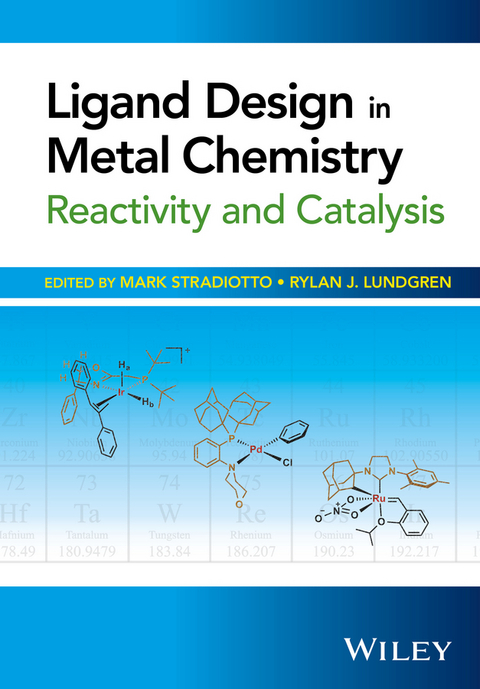
The design of ancillary ligands used to modify the structural and reactivity properties of metal complexes has evolved into a rapidly expanding sub-discipline in inorganic and organometallic chemistry. Ancillary ligand design has figured directly in the discovery of new bonding motifs and stoichiometric reactivity, as well as in the development of new catalytic protocols that have had widespread positive impact on chemical synthesis on benchtop and industrial scales.
Ligand Design in Metal Chemistry presents a collection of cutting-edge contributions from leaders in the field of ligand design, encompassing a broad spectrum of ancillary ligand classes and reactivity applications. Topics covered include:
• Key concepts in ligand design
• Redox non-innocent ligands
• Ligands for selective alkene metathesis
• Ligands in cross-coupling
• Ligand design in polymerization
• Ligand design in modern lanthanide chemistry
• Cooperative metal-ligand reactivity
• P,N Ligands for enantioselective hydrogenation
• Spiro-cyclic ligands in asymmetric catalysis
This book will be a valuable reference for academic researchers and industry practitioners working in the field of ligand design, as well as those who work in the many areas in which the impact of ancillary ligand design has proven significant, for example synthetic organic chemistry, catalysis, medicinal chemistry, polymer science and materials chemistry.
The design of ancillary ligands used to modify the structural and reactivity properties of metal complexes has evolved into a rapidly expanding sub-discipline in inorganic and organometallic chemistry. Ancillary ligand design has figured directly in the discovery of new bonding motifs and stoichiometric reactivity, as well as in the development of new catalytic protocols that have had widespread positive impact on chemical synthesis on benchtop and industrial scales. Ligand Design in Metal Chemistry presents a collection of cutting-edge contributions from leaders in the field of ligand design, encompassing a broad spectrum of ancillary ligand classes and reactivity applications. Topics covered include: Key concepts in ligand design Redox non-innocent ligands Ligands for selective alkene metathesis Ligands in cross-coupling Ligand design in polymerization Ligand design in modern lanthanide chemistry Cooperative metal-ligand reactivity P,N Ligands for enantioselective hydrogenation Spiro-cyclic ligands in asymmetric catalysis This book will be a valuable reference for academic researchers and industry practitioners working in the field of ligand design, as well as those who work in the many areas in which the impact of ancillary ligand design has proven significant, for example synthetic organic chemistry, catalysis, medicinal chemistry, polymer science and materials chemistry.
Mark Stradiotto, Department of Chemistry, Dalhousie University, Canada Rylan Lundgren, Department of Chemistry, University of Alberta, Canada Both professors have a well-established track-record of working in the field of organometallic ligand design and catalysis, and have published extensively on the subjects of metal-catalyzed cross-coupling, novel transition-metal bond activation, and asymmetric catalysis. They are co-inventors of the now commercialized DalPhos ligand family and have broad experience of the field of ligand design. Professor Stradiotto has worked in the field of organometallic chemistry for the past fourteen years. Professor Lundgren earned his PhD under the supervision of Prof Stradiotto at Dalhousie University in 2010. Following a PDF at MIT and Caltech with Prof. Greg Fu, Rylan accepted a faculty position at the University of Alberta (Canada).
Preface
1. Key Concepts in Ligand Design: An Introduction
2. Catalyst structure and cis-trans selectivity in Ru-based olefin metathesis
3. Ligands for Iridium-Catalyzed Asymmetric Hydrogenation of Challenging Substrates
4. Spiro Ligands for Asymmetric Catalysis
5. Application of Sterically Demanding Phosphine Ligands in Palladium-Catalyzed Cross-Coupling leading to C(sp2)-E Bond Formation (E = NH2, OH, and F)
6. Pd-N-Heterocyclic Carbene (NHC) Complexes in Cross-Coupling Applications
7. Redox Non-innocent Ligands: Reactivity and Catalysis
8. Ligands for Iron-based Homogeneous Catalysts for the Asymmetric Hydrogenation of Ketones and Imines
9. Ambiphilic Ligands: Unusual Coordination and Reactivity Arising from Lewis Acid Moieties
10. Ligand Design in Enantioselective Ring Opening Polymerization of Lactide
11. Modern Applications of Tp Ligands in Coinage Metal Catalysis
12. Ligand Design in Modern Lanthanide Chemistry
13. Tight Bite Angle N,O-Chelates. Amidates, Ureates and Beyond
"Catalysis underpins both modern industrial and academic chemistry, improving reaction sustainability, shaping reaction selectivity and facilitating fundamentally new reaction pathways. While the focus is often on the showpiece metals themselves, the ligands are the true shapers of this reactivity. Stradiotto and Lundgren have curated a collection that certainly celebrates ligands across a wide array of applications. At over 400 pages across 13 chapters written by world leaders in catalysis and ligand design, the book is a modern resource for those working in the area.
The book opens with a chapter detailing the underlying key concepts that feature throughout the rest of the book. This is likely the only chapter which would serve the undergraduate student ? but as a stand-alone chapter would indeed provide a strong additional resource for final year students on a catalysis and/or coordination chemistry course. From there, each chapter captures a specific vignette of relevance to the authors. The overall book is by no means comprehensive in coverage, but it neither intends to be or indeed should be. Instead, it permits the reader to learn about specific topics in the key authors voice, and from a unified perspective of the ligand design...
The book, as a secondary impact, also helps to showcase the important contribution Canadian researchers have made to catalysis and ligand design, with 6 of the 13 chapters written by authors at Canadian universities.
In closing, the collection of articles found in Ligand Design in Metal Chemistry is certainly worthy of a book shelf spot for those working in the field of ligand design in catalysis. As the content of the book is necessarily focussed, this reviewer recommends a thorough read through the table of contents to ensure that chapters of particular interest are complemented by those that will introduce the reader to new areas." (AOC, Feb 2017)
1
Key Concepts in Ligand Design: An Introduction
Rylan J. Lundgren1 and Mark Stradiotto2
1 Department of Chemistry, University of Alberta, Edmonton, Alberta, Canada T6G 2G2
2 Department of Chemistry, Dalhousie University, 6274 Coburg Road, PO Box 15000, Halifax, Nova Scotia, Canada B3H 4R2
1.1 Introduction
Organic or main‐group molecules and ions that bind to metal centers to generate coordination complexes are referred to as ligands. Metal–ligand bonding interactions that arise upon coordination of a ligand to a metal serve both to modulate the electronic properties of the metal, and to influence the steric environment of the metal coordination sphere, thereby allowing for some control over the structure and reactivity of metal complexes. Thus, the fields of transition metal and organometallic chemistry, as well as homogeneous metal catalysis, have been greatly enriched by the design and study of new ligand motifs. An understanding of how ligands influence the structural and reactivity properties of metal species has allowed for the discovery of new and improved metal‐catalyzed reactions that are exploited widely in the synthesis of a broad spectrum of molecules (e.g., pharmaceuticals) and materials (e.g., polymers). Moreover, such an understanding has enabled chemists to isolate and interrogate reactive intermediates of relevance to important biological or industrial processes, and to uncover fundamentally new modes of bonding between metal centers and organic or main‐group compounds. This chapter is meant to serve as a brief overview of what the authors believe are some of the important basic concepts when considering how ligands can alter the behavior of soluble metal complexes with respect to chemical reactivity and catalysis. General overviews of ligand structure, bonding, and nomenclature can be found in most introductory inorganic or organometallic textbooks, as can historical aspects of the importance of ligands in the development of these fields. We direct the reader to such resources for a more thorough treatment of the subject.[1]
1.2 Covalent bond classification and elementary bonding concepts
In most simple cases, ligands act as Lewis bases, donating electron density to Lewis acidic metal centers. A prevailing method to classify the number and type of interactions between a metal and ligand, the Covalent Bond Classification, has been formulated by Green and Parkin (Figure 1).[2] Using this formalism, neutral two electron donor fragments are described as L‐type ligands. The metal–ligand bond can be considered a dative interaction, whereby the valence of the metal is not changed upon ligand coordination. For simplicity, formal atom charges on the donor (ligand) and acceptor (metal) atom are invariably not depicted in chemical structures featuring such L‐type interactions. Examples of L‐type ligands include many classical Lewis bases, such as amines and phosphines. Single electron donors (or alternatively described, anionic two electron donors), such as halides, alkoxides, or carbon‐based aryl or alkyl groups, are described as X‐type ligands. The metal–ligand bond can be considered a covalent bond whereby one electron comes from both the metal and the ligand, raising the valence of the metal by one upon ligand coordination. Certain molecules can bind to metals in a fashion such that they accept, rather than donate, two electrons and are classified as Z‐type ligands. This type of dative interaction formally increases the valence state of the metal by two. The most common Z‐type ligands feature B or Al acceptor atoms.
Figure 1 Classification and examples of L, X, and Z ligands according to the Covalent Bond Classification method
Ligands can bind to metals via one or more points of attachment, and/or can engage simultaneously in multiple bonding interactions with a metal center, via combinations of L‐, X‐ and Z‐type interactions. The type and strength of the metal–ligand bonding involved will depend on the metal and oxidation state, among other factors. Prototypical examples of such bonding scenarios include arene–metal structures, where the three double bonds of the aromatic act as electron pair donors (an L3‐type ligand), as well as the cyclopentadienyl group, an L2X‐type ligand (Figure 2a). Simultaneous LX‐type bonding can also arise to generate formal M ═ L double bonds, as is prevalent in many amide and alkoxide complexes (Figure 2b). The classification of these ligands as X‐type or LX‐type ligands is usually evidenced by the crystallographically determined bond angles about the donor atom, in addition to the observed M–L interatomic distance.
Figure 2 (a) Examples of ligands which bind to metals via multiple L‐ or LX‐type interactions. (b) Examples of metal–amide single (X) and double (LX) bonding
From an elementary molecular orbital perspective, filled ligand orbitals, such as lone pairs, donate to metals to form metal–ligand σ bonds while generating an accompanying empty metal–ligand σ* orbital. Ligands can also donate electron density from orbitals of π symmetry. In instances where the metal has empty dπ orbitals, for example d0 metals such as Ti4+, the bond between the metal and the π‐donor ligand can be particularly strong. Ligands possessing empty p orbitals or π* orbitals can act as π acids, accepting electron density from filled metal d orbitals of appropriate energy and symmetry (Figure 3). This type of π backbonding renders the metal center more electrophilic and strengthens the metal–ligand interaction. The combination of σ‐ and π‐bonding interactions will dictate the overall M–L bond strength, as well as the reactivity properties of the M–L fragment.
Figure 3 Simplified schematic of metal–ligand σ and π bonding, as well as π backbonding
1.3 Reactive versus ancillary ligands
When considering the behavior of ligands coordinated to a metal center, two general classifications arise. Reactive ligands, when bound to a metal, undergo chemical change, which can include irreversible chemical transformations or dissociation from the metal. Prototypical examples of reactive ligands include hydride, aryl or alkyl groups. Ancillary ligands are defined as supporting ligands that can modulate the reactivity of a metal center, but do not themselves undergo irreversible transformations (Figure 4). The contents of this book deal generally with ancillary ligand design aimed at modulating the behavior of reactive ligands in reaction chemistry and catalysis. Undesired ancillary ligand reactivity, such as oxidation or cyclometallation, is a common cause of metal complex decomposition or deactivation during catalysis. It should be noted that depending on the reaction setting, a coordinated ligand could behave in a reactive or ancillary manner; CO and olefins serve as examples of such ligands. Non‐innocent and cooperative ligands,[3] discussed in more detail below, operate between these definitions.
Figure 4 An example of a metal complex with ancillary and reactive ligands
1.4 Strong‐ and weak‐field ligands
Ligands have a large influence over the electronic configuration (or spin state), as well as the geometry, of transition metal complexes. Moreover, the ability of ligands to act as π donors or π acceptors can alter the relative energies of the d orbitals on the ligated metal center. Ligands that are π‐accepting, such as CO, CN– or imine‐type donors such as bipyridines, cause a large splitting in the energies of the d orbitals in a ligand field. For example, in ideal octahedral complexes the large energy difference between t2g orbitals (dxz, dyz, dxy) and eg orbitals (dx2–y2, dz2) causes metals of certain d‐electron counts to adopt low‐spin configurations, as in Fe(CN)64–. Conversely, π‐donating ligands, such as halides or alkoxides reduce the energy difference of the t2g and eg orbitals and promote high‐spin configurations as in Fe(H2O)62+ (Figure 5).[1c] Similar trends occur for metals in other coordination geometries, such as tetrahedral or trigonal bipyramidal structures. The ability of ligands to act as donors or acceptors to induce changes in d‐orbital energies (especially for octahedral complexes) can be easily assessed by use of spectroscopic methods, thus giving rise to the spectrochemical series, which ranks ligand π‐bonding strength indirectly by measuring the octahedral eg/t2g energy gap.
Figure 5 Influence of weak‐field and strong‐field ligands on the spin state of two prototypical octahedral d6 metal complexes
Ligand field strength can also affect the geometry of transition metal complexes. An illustrative example is that of four coordinate d8 complexes. Binding to weak‐field ligands promotes the formation of tetrahedral complexes, for example NiCl42– or NiCl2(PPh3)2, whereas strong‐field ligands promote the formation of square planar complexes, such as Ni(CN)42– or NiCl2(PCy3)2 (Figure 6). A similar phenomenon is observed with d6 Fe(II)...
| Erscheint lt. Verlag | 1.9.2016 |
|---|---|
| Vorwort | Stephen L. Buchwald, David Milstein |
| Sprache | englisch |
| Themenwelt | Naturwissenschaften ► Chemie ► Anorganische Chemie |
| Technik | |
| Schlagworte | Ancillary ligand • catalysis • Chemie • Chemistry • Coordination Chemistry • Inorganic Chemistry • Katalyse • Koordinationschemie • Ligand Design • Organic Chemistry • Organometallic Chemistry • Polymer Science & Technology • Polymersynthese • polymer synthesis • Polymerwissenschaft u. -technologie • Transition metal |
| ISBN-13 | 9781118839812 / 9781118839812 |
| Informationen gemäß Produktsicherheitsverordnung (GPSR) | |
| Haben Sie eine Frage zum Produkt? |
 EPUB (Adobe DRM)
Kopierschutz: Adobe-DRM
Adobe-DRM ist ein Kopierschutz, der das eBook vor Mißbrauch schützen soll. Dabei wird das eBook bereits beim Download auf Ihre persönliche Adobe-ID autorisiert. Lesen können Sie das eBook dann nur auf den Geräten, welche ebenfalls auf Ihre Adobe-ID registriert sind.
Details zum Adobe-DRM
Dateiformat: EPUB (Electronic Publication)
EPUB ist ein offener Standard für eBooks und eignet sich besonders zur Darstellung von Belletristik und Sachbüchern. Der Fließtext wird dynamisch an die Display- und Schriftgröße angepasst. Auch für mobile Lesegeräte ist EPUB daher gut geeignet.
Systemvoraussetzungen:
PC/Mac: Mit einem PC oder Mac können Sie dieses eBook lesen. Sie benötigen eine
eReader: Dieses eBook kann mit (fast) allen eBook-Readern gelesen werden. Mit dem amazon-Kindle ist es aber nicht kompatibel.
Smartphone/Tablet: Egal ob Apple oder Android, dieses eBook können Sie lesen. Sie benötigen eine
Geräteliste und zusätzliche Hinweise
Buying eBooks from abroad
For tax law reasons we can sell eBooks just within Germany and Switzerland. Regrettably we cannot fulfill eBook-orders from other countries.
aus dem Bereich