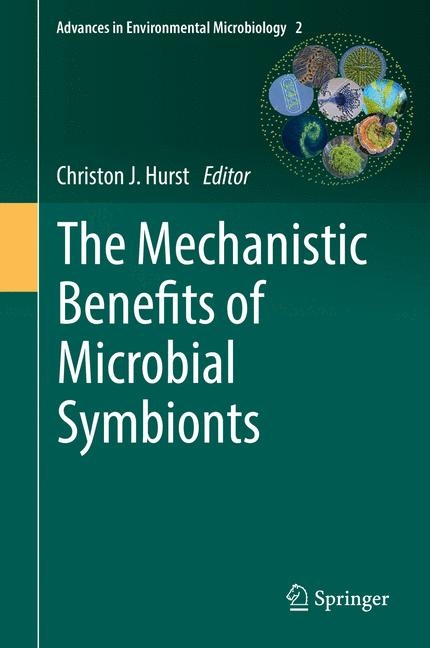
The Mechanistic Benefits of Microbial Symbionts (eBook)
315 Seiten
Springer International Publishing (Verlag)
978-3-319-28068-4 (ISBN)
This volume summarizes recent advances in our understanding of the mechanisms that produce successful symbiotic partnerships involving microorganisms. It begins with a basic introduction to the nature of and mechanistic benefits derived from symbiotic associations. Taking that background knowledge as the starting point, the next sections include chapters that examine representative examples of coevolutionary associations that have developed between species of microbes, as well as associations between microbes and plants. The authors conclude with a section covering a broad range of associations between microbes and invertebrate animals, in which they discuss the spectrum of hosts, with examples ranging from bryozoans and corals to nematodes, arthropods, and cephalopods. Join the authors on this journey of understanding!
Symbiotic associations: all about chemistry.- Phage conversion and the role of bacteriophage and host functions in regulation of diphtheria toxin production by Corynebacterium diphtheriae.- Syntrophic growth of Symbiobacterium in association with free-living bacteria.- The mechanism of symbiotic nitrogen fixation.- Antimicrobials and the natural biology of a bacterial-nematode symbiosis.- The role of symbionts in the evolution of termites and their rise to ecological dominance in the tropics.- Diverse bacteriophage roles in an aphid-bacterial defensive mutualism.- Symbiotic Streptomyces provide antifungal defense in solitary wasps.- Watersipora subtorquata and the possible role of its associated microbes – an attempt to explain the extraordinary invasion success of this marine bryozoan species.- Animal-Symbiodinium symbioses: foundations of coral reef ecosystems.-Fiat lux: the squid-vibrio association as a model for understanding host-microbe associations.
| Erscheint lt. Verlag | 24.5.2016 |
|---|---|
| Reihe/Serie | Advances in Environmental Microbiology | Advances in Environmental Microbiology |
| Zusatzinfo | XII, 315 p. 47 illus., 24 illus. in color. |
| Verlagsort | Cham |
| Sprache | englisch |
| Themenwelt | Naturwissenschaften ► Biologie ► Ökologie / Naturschutz |
| Technik | |
| Schlagworte | Aphid-bacterial defensive mutualism • Bacteria-insect mutualisms • Bacterial-nematode symbiosis • Corynebacterium diphtheriae • Diphtheria toxin production • Microbial symbioses • Symbiobacterium • Symbiont-host relationships • Symbiotic associations • Symbiotic nitrogen fixation • Symbiotic Streptomyces • Syntrophic growth |
| ISBN-10 | 3-319-28068-6 / 3319280686 |
| ISBN-13 | 978-3-319-28068-4 / 9783319280684 |
| Informationen gemäß Produktsicherheitsverordnung (GPSR) | |
| Haben Sie eine Frage zum Produkt? |
 PDF (Wasserzeichen)
DRM: Digitales Wasserzeichen
Dieses eBook enthält ein digitales Wasserzeichen und ist damit für Sie personalisiert. Bei einer missbräuchlichen Weitergabe des eBooks an Dritte ist eine Rückverfolgung an die Quelle möglich.
Dateiformat: PDF (Portable Document Format)
Mit einem festen Seitenlayout eignet sich die PDF besonders für Fachbücher mit Spalten, Tabellen und Abbildungen. Eine PDF kann auf fast allen Geräten angezeigt werden, ist aber für kleine Displays (Smartphone, eReader) nur eingeschränkt geeignet.
Systemvoraussetzungen:
PC/Mac: Mit einem PC oder Mac können Sie dieses eBook lesen. Sie benötigen dafür einen PDF-Viewer - z.B. den Adobe Reader oder Adobe Digital Editions.
eReader: Dieses eBook kann mit (fast) allen eBook-Readern gelesen werden. Mit dem amazon-Kindle ist es aber nicht kompatibel.
Smartphone/Tablet: Egal ob Apple oder Android, dieses eBook können Sie lesen. Sie benötigen dafür einen PDF-Viewer - z.B. die kostenlose Adobe Digital Editions-App.
Buying eBooks from abroad
For tax law reasons we can sell eBooks just within Germany and Switzerland. Regrettably we cannot fulfill eBook-orders from other countries.
aus dem Bereich