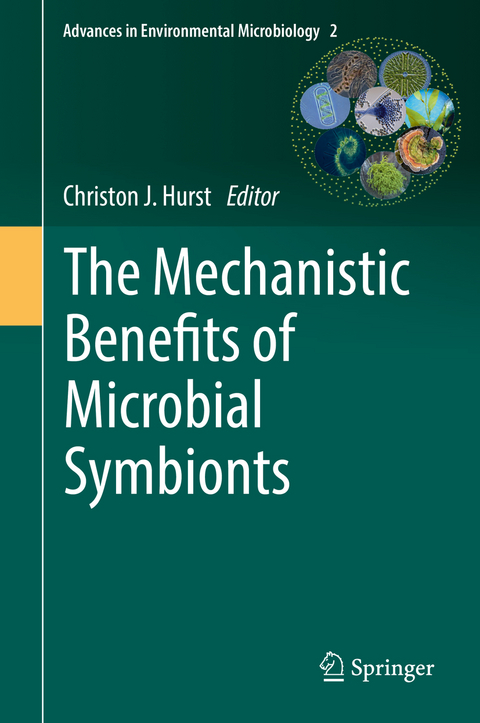
The Mechanistic Benefits of Microbial Symbionts
Springer International Publishing (Verlag)
978-3-319-28066-0 (ISBN)
Symbiotic associations: all about chemistry.- Phage conversion and the role of bacteriophage and host functions in regulation of diphtheria toxin production by Corynebacterium diphtheriae.- Syntrophic growth of Symbiobacterium in association with free-living bacteria.- The mechanism of symbiotic nitrogen fixation.- Antimicrobials and the natural biology of a bacterial-nematode symbiosis.- The role of symbionts in the evolution of termites and their rise to ecological dominance in the tropics.- Diverse bacteriophage roles in an aphid-bacterial defensive mutualism.- Symbiotic Streptomyces provide antifungal defense in solitary wasps.- Watersipora subtorquata and the possible role of its associated microbes - an attempt to explain the extraordinary invasion success of this marine bryozoan species.- Animal-Symbiodinium symbioses: foundations of coral reef ecosystems.-Fiat lux: the squid-vibrio association as a model for understanding host-microbe associations.
| Erscheinungsdatum | 08.10.2016 |
|---|---|
| Reihe/Serie | Advances in Environmental Microbiology |
| Zusatzinfo | XII, 315 p. 47 illus., 24 illus. in color. |
| Verlagsort | Cham |
| Sprache | englisch |
| Maße | 155 x 235 mm |
| Themenwelt | Naturwissenschaften ► Biologie ► Ökologie / Naturschutz |
| Schlagworte | Animal physiology • Aphid-bacterial defensive mutualism • Bacteria-insect mutualisms • Bacterial-nematode symbiosis • Biomedical and Life Sciences • Corynebacterium diphtheriae • Diphtheria toxin production • evolutionary biology • microbial ecology • Microbial symbioses • Microbiology • Plant Physiology • Symbiobacterium • Symbiont-host relationships • Symbiotic associations • Symbiotic nitrogen fixation • Symbiotic Streptomyces • Syntrophic growth |
| ISBN-10 | 3-319-28066-X / 331928066X |
| ISBN-13 | 978-3-319-28066-0 / 9783319280660 |
| Zustand | Neuware |
| Informationen gemäß Produktsicherheitsverordnung (GPSR) | |
| Haben Sie eine Frage zum Produkt? |
aus dem Bereich