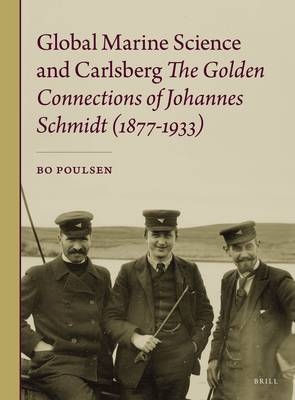
Global Marine Science and Carlsberg - The Golden Connections of Johannes Schmidt (1877-1933)
Brill (Verlag)
9789004316362 (ISBN)
By accident, the world-famous brewery Carlsberg became a central force in global marine science during the first three decades of the 20th century. Within a core group of scientists and managers, Johannes Schmidt (1877-1933) was the key figure combining the efforts of the International Council for the Exploration of the Sea (ICES), the Danish state and several private companies. Launching 26 oceangoing expeditions Schmidt made landmark discoveries such as the breeding ground for the Atlantic eel in the Sargasso Sea. The scientific frontier was pushed literally kilometres into the deep sea and across the World’s oceans. While the formal North Atlantic Empire of the small state of Denmark was in decline, an informal empire of science was erected instead.
Shortlisted for the Society for Nautical Research Anderson Medal for published works on Maritime History in 2016.
Bo Poulsen, Ph.D. (2006), University of Southern Denmark, is Associate Professor of Environmental History at Aalborg University. For his interdisciplinary work, such as the monograph Dutch Herring (Aksant, 2008), he has been awarded the Danish Research Project of the Year Award and the Hoogendijk Prize.
List of figures, tables and illustrations 9
Acknowledgements 13
Introduction 17
A symmetrical biography 20
Actors and structures – money and conflict 21
Main argument 25
To sea – a placeless place 26
Historiography 29
Archival source material 33
1 Formative years (1877–1903) 37
The Carlsberg Brewery 38
The Carlsberg Laboratory 42
The Carlsberg Foundation 44
Student years 46
Ingeborg 49
The Siam Expedition, 1899–1900 51
Teaching assistant and doctoral thesis 54
Conclusion 55
2 The legend of the unintentional eel larvae 57
The state of fisheries in Danish society 59
The Danish Biological Station and C. G. J. Petersen 61
Petersen’s eel investigations 65
Leptocephalus brevirostris 67
An international research station 69
Schmidt enters marine science 70
Formalizing international marine science 71
Central Bureau in Copenhagen 73
Implementing ICES agreements in Danish marine science 75
Acquiring Thor 76
1903 Instructions 77
Hiring Johannes Schmidt 77
Trawling deep waters 79
Bjarni Sæmundsson 80
1904 – Eel in the North Atlantic 82
The telegram announcement 83
Petersen on the Atlantic larvae 85
Straying off the Danish ICES areas 87
Petersen’s light experiment 89
Conclusion 90
3 Petersen’s attempted coup d’état 93
Downsizing the Danish commission 94
A strained relationship 95
Danish commission taking stock of investigations in 1907 96
Petersen’s memorandum to the Ministry of Agriculture 97
Petersen’s job offer 100
Rebel assistants 102
Petersen’s last bout in the commission 106
Restructuring the Danish commission – enter Johannes Schmidt 108
Different personalities 109
Biologisk Station after 1908 109
Conflict resurfaced in 1916 111
Schmidt becomes a member of the Kommissionen for Havundersøgelser 111
Conclusion 112
4 The Mediterranean expeditions (1908–1910) 117
Stormy welcome to the Mediterranean winter 119
Probing a mare incognitum 123
National fame and well-paid jobs 126
Proposing a summer cruise to the Mediterranean 127
Network mobilization 129
Return to the Mediterranean in the summer of 1910 132
Scientific results from the Mediterranean 134
‘Sickening to think that the Norwegians will come first’ 135
Conclusion 137
5 Director at the Carlsberg Laboratorium 139
Laboratory legacy 139
Terms of employment 141
An inside job 144
Research topics at the laboratory 146
Hereditary qualities of a scent 149
‘Racial Investigations’ 152
The ‘diallel crossings’ 156
Investigations with Zoarces 158
A chicken farm 161
Conclusion 162
6 Carlsberg appreciation 165
Schmidt’s laboratory expenses 165
Carlsberg Laboratory appreciation 170
The globetrotter director 171
The slightest undercurrent of critique 177
The unfortunate Klöcker 178
Taking stock of the lab after Schmidt 182
Conclusion 188
7 Atlantic adventures 191
The Danish West Indies and marine science 192
Foreningen De Danske Atlanterhavsøer 195
Marine research initiatives and the Danish West Indies 197
Ships of opportunity 199
Funding the trip with Margrethe – Vendsyssel Packing Co Ltd 200
Hops across the Atlantic 205
Troubled testing of Margrethe 207
Final instructions 208
Eel plans stranded in the Caribbean 209
Green turtles and red goatfish 213
Conclusion 216
8 Collecting funds for an Atlantic deep sea investigation 217
Finding ‘a rich man’ post the Margrethe 217
World War One – marine science in dry-dock 219
ICES and the Danish commission during World War One 220
Schmidt’s dismal search for money 1914–16 222
To catch a goldfish 223
An Atlantic deep sea expedition 225
Confidential news from Drechsel 227
Collecting cash funds 229
Conclusion 229
9 Resistance from the sea – Danish marine scientists and the sale of the Danish West Indies 233
Johannes Schmidt’s expert opinion 235
‘It is despicable to sell parts of one’s country’ 236
Andersen and Glückstadt before the commission 237
Andersen’s influence on the decision to sell 238
Public debates and De Danske Atlanterhavsøer 239
Marine scientists’ agitation 240
Support from Andreas de Richelieu 243
The scientists’ no-confidence motion 244
Tropics sold for gold and Greenland 246
Conclusion 246
10 The Atlantic expeditions with the M/S Dana 249
‘You will be dancing like a bear’ 249
Peace and further planning 251
The terms of using the motor schooner M/S Dana 253
‘A New Danish Deep Sea Expedition’ Press release 255
Reconnecting with ICES 258
The 1920 and 1921 expeditions with M/S Dana 259
Conclusion 263
11 The great Atlantic expedition with the R/V Dana 265
Buying the R/V Dana 265
Kick off and Schmidt’s nationalism 270
Pacific dreams 271
Carlsberg Foundation as a strategic resource 274
Probing the Pacific 276
Drechsel’s disappointment 278
Homecoming 281
Deep sea anglerfish and spirula 282
Total expenditure 285
The ageing of the freshwater eel in open sea 287
Film, fame, and medals 289
Conclusion 292
12 Marking cod and territory in the North Atlantic 295
Denmark in ICES 296
Collaboration – and ‘The Norse issue’ 297
Marking cod and territory in 1924 301
The life history of commercial species 312
Tagging on to the genetic studies 317
The importance of nurseries 319
Conclusion 320
13 Organizing the Carlsberg Expedition around the world 323
Eels east of Suez 324
Recreation and work around the World 326
Fundraising in the USA 329
Approaching the Carlsberg Foundation 333
A census of marine life – the cruise plan presented 335
Planning equipment, engine, and crew 338
Institutional arrangements 343
Conclusion 345
14 Around the World in Two Years349
Leaving Copenhagen 349
Across the Pacific 352
Official representation in New Zealand and Australia 353
South East Asian travels spring and summer 1929 357
Life on board 361
The lure of ethnographica 369
Conclusion 372
15 Stretching the expedition, stretching ties to Carlsberg 375
Overspending and changing plans? 375
Going south round of Africa 386
Return to the Mediterranean 388
‘To the honour of Denmark’ 393
Pelted with unpleasantness 396
Total costs 400
Conclusion 402
16 Measures of impact and legacy 405
Popularising marine science 406
The last project 407
Indo-Pacific eel 410
Hydrography and the Carlsberg Ridge 411
The Dana Reports and Carlsberg legacy 415
Medals of impact 417
The continental drift – and eels 419
The Galathea II Expedition and beyond 420
Conclusion 422
17 A fortunate man 425
The manager 428
The fundraiser 432
An accidental institutionalization 439
Eugen Warming 441
Carl H. Ostenfeld 442
Christian F. Drechsel 445
C. G. Joh Petersen 446
Technological leaps 447
Cosmopolitan conservatives 449
An informal maritime empire 454
Conclusion 456
Summary 459
Archival sources 469
Carlsberg Archives 469
Carlsberg Foundation, Copenhagen 474
Archives of the Danish Film Institute 476
Rigsarkivet (Public Records Office), Copenhagen 476
Royal Library, Copenhagen 484
The Archives of the Museum of Natural History 495
Published sources 497
Index 515
| Erscheinungsdatum | 22.08.2016 |
|---|---|
| Verlagsort | Leiden |
| Sprache | englisch |
| Maße | 193 x 260 mm |
| Gewicht | 1407 g |
| Themenwelt | Naturwissenschaften ► Biologie ► Ökologie / Naturschutz |
| ISBN-13 | 9789004316362 / 9789004316362 |
| Zustand | Neuware |
| Informationen gemäß Produktsicherheitsverordnung (GPSR) | |
| Haben Sie eine Frage zum Produkt? |
aus dem Bereich