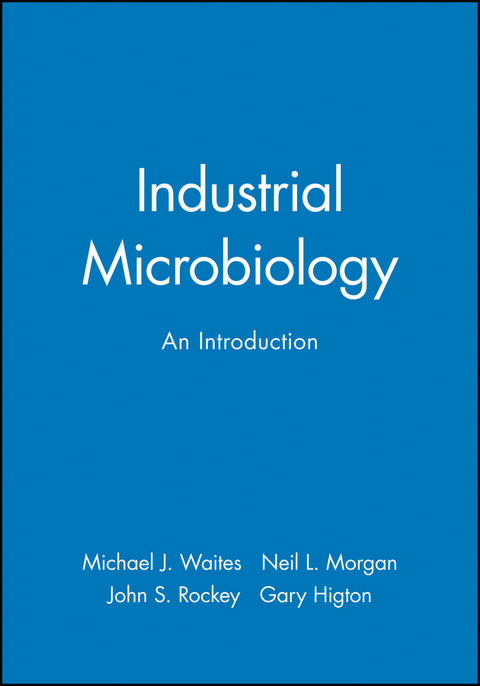
Industrial Microbiology (eBook)
John Wiley & Sons (Verlag)
978-1-118-68739-0 (ISBN)
Aimed at undergraduates studying the applied aspects of biology, particularly those on biotechnology and microbiology courses and students of food science and biochemical engineering, this text provides a wide-ranging introduction to the field of industrial microbiology. The content is divided into three sections:
- key aspects of microbial physiology, exploring the versatility of microorganisms, their diverse metabolic activities and products
- industrial microorganisms and the technology required for large-scale cultivation and isolation of fermentation products
- investigation of a wide range of established and novel industrial fermentation processes and products
Written by experienced lecturers with industrial backgrounds, Industrial Microbiology provides the reader with groundwork in both the fundamental principles of microbial biology and the various traditional and novel applications of microorganisms to industrial processes, many of which have been made possible or enhanced by recent developments in genetic engineering technology.
- A wide-ranging introduction to the field of industrial microbiology
- Based on years of teaching experience by experienced lecturers with industrial backgrounds
- Explains the underlying microbiology as well as the industrial application.
Content is divided into three sections:
1. key aspects of microbial physiology, exploring the versatility of microorganisms, their diverse metabolic activities and products
2. industrial microorganisms and the technology required for large-scale cultivation and isolation of fermentation products
3. investigation of a wide range of established and novel industrial fermentation processes and products
Michael J. Waites and Neil L. Morgan are the authors of Industrial Microbiology: An Introduction, published by Wiley.
Of major economic, environmental and social importance, industrial microbiology involves the utilization of microorganisms in the production of a wide range of products, including enzymes, foods, beverages, chemical feedstocks, fuels and pharmaceuticals, and clean technologies employed for waste treatment and pollution control. Aimed at undergraduates studying the applied aspects of biology, particularly those on biotechnology and microbiology courses and students of food science and biochemical engineering, this text provides a wide-ranging introduction to the field of industrial microbiology. The content is divided into three sections: key aspects of microbial physiology, exploring the versatility of microorganisms, their diverse metabolic activities and products industrial microorganisms and the technology required for large-scale cultivation and isolation of fermentation products investigation of a wide range of established and novel industrial fermentation processes and products Written by experienced lecturers with industrial backgrounds, Industrial Microbiology provides the reader with groundwork in both the fundamental principles of microbial biology and the various traditional and novel applications of microorganisms to industrial processes, many of which have been made possible or enhanced by recent developments in genetic engineering technology. A wide-ranging introduction to the field of industrial microbiology Based on years of teaching experience by experienced lecturers with industrial backgrounds Explains the underlying microbiology as well as the industrial application. Content is divided into three sections: 1. key aspects of microbial physiology, exploring the versatility of microorganisms, their diverse metabolic activities and products 2. industrial microorganisms and the technology required for large-scale cultivation and isolation of fermentation products 3. investigation of a wide range of established and novel industrial fermentation processes and products
Michael J. Waites and Neil L. Morgan are the authors of Industrial Microbiology: An Introduction, published by Wiley.
Preface.
Acknowledgements.
Introduction To Industrial Microbiology.
Part I: Microbial Physiology.
1. Microbial Cell Structure And Function.
2. Microbial Growth And Nutrition.
3. Microbial Metabolism.
Part II: Bioprocessing.
4. Industrial Microorganisms.
5. Fermentation Media.
6. Fermentation Systems.
7. Downstream Processing.
8. Product Development, Regulation And Safety.
Part III: Industrial Processes And Products.
9. Microbial Enzymes.
10. Fuels And Industrial Chemicals.
11. Health Care Products.
12. Food And Beverage Fermentations.
13. Food Additives.
14. Microbial Biomass Production.
15. Environmental Biotechnology.
16. Microbial Biodeterioration Of Materials And Its Control.
17. Animal And Plant Cell Culture.
Index
Introduction to industrial microbiology
Traditional fermentation processes, such as those involved in the production of fermented dairy products and alcoholic beverages, have been performed for thousands of years. However, it is less than 150 years ago that the scientific basis of these processes was first examined. The birth of industrial microbiology largely began with the studies of Pasteur. In 1857 he finally demonstrated beyond doubt that alcoholic fermentation in beer and wine production was the result of microbial activity, rather than being a chemical process. Prior to this, Cagniard-Latour, Schwann and several other notable scientists had connected yeast activities with fermentation processes, but they had largely been ignored. Pasteur also noted that certain organisms could spoil beer and wine, and that some fermentations were aerobic, whereas others were anaerobic. He went on to devise the process of pasteurization, a major contribution to food and beverage preservation, which was originally developed to preserve wine. In fact, many of the early advances of both pure and applied microbiology were through studies on beer brewing and wine making. Pasteur’s publications, Études sur le Vin (1866), Études sur la Bière (1876) and others, were important catalysts for the progress of industrial fermentation processes. Of the further advances that followed, none were more important than the development of pure culture techniques by Hansen at the Carlsberg Brewery in Denmark. Pure strain brewing was carried out here for the first time in 1883, using a yeast isolated by Hansen, referred to as Carlsberg Yeast No. 1 (Saccharomyces carlsbergensis, now classified as a strain of Saccharomyces cerevisiae).
During the early part of the 20th century, further progress in this field was relatively slow. Around the turn of the century there had been major advancements in the large-scale treatment of sewage, enabling significant improvement of public health in urban communities. However, the first novel industrial-scale fermentation process to be introduced was the acetone–butanol fermentation, developed by Weizmann (1913–15) using the bacterium Clostridium acetobutylicum. In the early 1920s an industrial fermentation process was also introduced for the manufacture of citric acid, employing a filamentous fungus (mould), Aspergillus niger. Further innovations in fermentation technology were greatly accelerated in the 1940s through efforts to produce the antibiotic penicillin, stimulated by the vital need for this drug during World War II. Not only did production rapidly move from small-scale surface culture to large-scale submerged fermentations, but it led to great advances in both media and microbial strain development. The knowledge acquired had a great impact on the successful development of many other fermentation industries.
More recent progress includes the ability to produce monoclonal antibodies for analytical, diagnostic, therapeutic and purification purposes, pioneered by Milstein and Kohler in the early 1970s. However, many of the greatest advances have followed the massive developments in genetic engineering (recombinant DNA technology) over the last 20 years. This technology has had, and will continue to have, a tremendous influence on traditional, established and novel fermentation processes and products. It allows genes to be transferred from one organism to another and allows new approaches to strain improvement. The basis of gene transfer is the insertion of a specific gene sequence from a donor organism, via an expression vector, into a suitable host. Hosts for expression vectors can be prokaryotes such as the bacterium Escherichia coli; alternatively, where post-translational processing is required, as with some human proteins, a eukaryotic host is usually required, e.g. a yeast.
A vast range of important products, many of which were formerly manufactured by chemical processes, are now most economically produced by microbial fermentation and biotransformation processes. Microorganisms also provide valuable services. They have proved to be particularly useful because of the ease of their mass cultivation, speed of growth, use of cheap substrates that in many cases are wastes, and the diversity of potential products. In addition, their ability to readily undergo genetic manipulation has opened up almost limitless possibilities for new products and services from the fermentation industries.
Successful development of a fermentation process requires major contributions from a wide range of other disciplines, particularly biochemistry, genetics and molecular biology, chemistry, chemical and process engineering, and mathematics and computer technology. A typical operation involves both upstream processing (USP) and downstream processing (DSP) stages (Fig. i). The USP is associated with all factors and processes leading to and including the fermentation, and consists of three main areas.
1 The producer microorganism. Key factors relating to this aspect are: the strategy for initially obtaining a suitable industrial microorganism, strain improvement to enhance productivity and yield, maintenance of strain purity, preparation of a reliable inoculum and the continuing development of selected strains to improve the economic efficiency of the process. For example, the production of stable mutant strains that vastly overproduce the target compound is often essential.
Some microbial products are primary metabolites, produced during active growth (the trophophase), which include amino acids, organic acids, vitamins and industrial solvents such as alcohols and acetone. However, many of the most important industrial products are secondary metabolites, which are not essential for growth, e.g. alkaloids and antibiotics. These compounds are produced in the stationary phase of a batch culture, after microbial biomass production has peaked (the idiophase).
Fig. i Outline of a fermentation process.
2 The fermentation medium. The selection of suitable cost-effective carbon and energy sources, and other essential nutrients, along with overall media optimization are vital aspects of process development to ensure maximization of yield and profit. In many instances, the basis of industrial media are waste products from other industrial processes, notably sugar processing wastes, lignocellulosic wastes, cheese whey and corn steep liquor.
3 The fermentation. Industrial microorganisms are normally cultivated under rigorously controlled conditions developed to optimize the growth of the organism or production of a target microbial product. The synthesis of microbial metabolites is usually tightly regulated by the microbial cell. Consequently, in order to obtain high yields, the environmental conditions that trigger regulatory mechanisms, particularly repression and feedback inhibition, must be avoided.
Fermentations are performed in large fermenters often with capacities of several thousand litres. These range from simple tanks, which may be stirred or unstirred, to complex integrated systems involving varying levels of computer control. The fermenter and associated pipework, etc., must be constructed of materials, usually stainless steel, that can be repeatedly sterilized and that will not react adversely with the microorganisms or with the target products. The mode of fermenter operation (batch, fed-batch or continuous systems), the method of its aeration and agitation, where necessary, and the approach taken to process scale-up have major influences on fermentation performance.
Conventional DSP includes all unit processes that follow fermentation. They involve cell harvesting, cell disruption, product purification from cell extracts or the growth medium, and finishing steps. However, attempts are now being made to integrate fermentation with DSP operations, which often increases process productivity. Overall, DSP must employ rapid and efficient methods for the purification of the product, while maintaining it in a stable form. This is especially important where products are unstable in the impure form or subject to undesirable modifications if not purified rapidly. For some products, especially enzymes, retention of their biological activity is vital. Finally, there must be safe and inexpensive disposal of all waste products generated during the process.
Fermentation products
The overall economics of fermentation processes are influenced by the costs of raw materials and consumables, utilities, labour and maintenance, along with fixed charges, working capital charges, factory overheads and operating outlay. Fermentation products can be broadly divided into two categories: high volume, low value products or low volume, high value products. Examples of the first category include most food and beverage fermentation products, whereas many fine chemicals and pharmaceuticals are in the latter category.
Food, beverages, food additives and supplements
A wide range of fermented foods and beverages have been produced throughout recorded history. They continue to be major fermentation products worldwide and are of vast economic importance. Fermented dairy products, for example, result from the activities of lactic acid bacteria in milk, which modify flavour and texture, and increase long-term product stability. Yeasts are exploited in the production of alcoholic beverages, notably beer and wine, due to their ability to ferment sugars, derived from various plant sources, to ethanol. Most processes use strains of one species, S. cerevisiae, and other strains of this yeast are used...
| Erscheint lt. Verlag | 22.5.2013 |
|---|---|
| Sprache | englisch |
| Themenwelt | Naturwissenschaften ► Biologie ► Mikrobiologie / Immunologie |
| Technik | |
| Schlagworte | Aspects • Biotechnologie i. d. Biowissenschaften • Biotechnology • Biowissenschaften • clean • Engineering • Field • food science • Industrial • Introduction • Life Sciences • Major • Microbiology • Microbiology & Virology • microorganisms • Mikrobiologie u. Virologie • particularly • Production • Products • Range • Technologies • undergraduates • Utilization • Waste • wide • wideranging |
| ISBN-10 | 1-118-68739-6 / 1118687396 |
| ISBN-13 | 978-1-118-68739-0 / 9781118687390 |
| Informationen gemäß Produktsicherheitsverordnung (GPSR) | |
| Haben Sie eine Frage zum Produkt? |
 EPUB (Adobe DRM)
Kopierschutz: Adobe-DRM
Adobe-DRM ist ein Kopierschutz, der das eBook vor Mißbrauch schützen soll. Dabei wird das eBook bereits beim Download auf Ihre persönliche Adobe-ID autorisiert. Lesen können Sie das eBook dann nur auf den Geräten, welche ebenfalls auf Ihre Adobe-ID registriert sind.
Details zum Adobe-DRM
Dateiformat: EPUB (Electronic Publication)
EPUB ist ein offener Standard für eBooks und eignet sich besonders zur Darstellung von Belletristik und Sachbüchern. Der Fließtext wird dynamisch an die Display- und Schriftgröße angepasst. Auch für mobile Lesegeräte ist EPUB daher gut geeignet.
Systemvoraussetzungen:
PC/Mac: Mit einem PC oder Mac können Sie dieses eBook lesen. Sie benötigen eine
eReader: Dieses eBook kann mit (fast) allen eBook-Readern gelesen werden. Mit dem amazon-Kindle ist es aber nicht kompatibel.
Smartphone/Tablet: Egal ob Apple oder Android, dieses eBook können Sie lesen. Sie benötigen eine
Geräteliste und zusätzliche Hinweise
Buying eBooks from abroad
For tax law reasons we can sell eBooks just within Germany and Switzerland. Regrettably we cannot fulfill eBook-orders from other countries.
aus dem Bereich