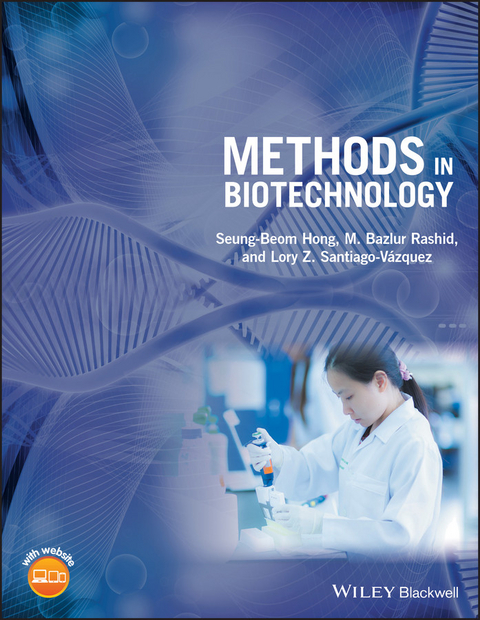
Methods in Biotechnology (eBook)
John Wiley & Sons (Verlag)
978-1-119-15680-2 (ISBN)
As rapid advances in biotechnology occur, there is a need for a pedagogical tool to aid current students and laboratory professionals in biotechnological methods; Methods in Biotechnology is an invaluable resource for those students and professionals.
Methods in Biotechnology engages the reader by implementing an active learning approach, provided advanced study questions, as well as pre- and post-lab questions for each lab protocol. These self-directed study sections encourage the reader to not just perform experiments but to engage with the material on a higher level, utilizing critical thinking and troubleshooting skills.
This text is broken into three sections based on level - Methods in Biotechnology, Advanced Methods in Biotechnology I, and Advanced Methods in Biotechnology II. Each section contains 14-22 lab exercises, with instructor notes in appendices as well as an answer guide as a part of the book companion site. This text will be an excellent resource for both students and laboratory professionals in the biotechnology field.SEUNG-BEOM HONG is a Visiting Assistant Professor of Biotechnology at the University of Houston-Clear Lake in Houston, TX, USA.
M. BAZLUR RASHID is an Associate Professor of Biology and Biotechnology and former Program Chair of Biotechnology at the University of Houston-Clear Lake in Houston, TX, USA.
LORY Z. SANTIAGO-VÁZQUEZ is an Associate Professor of Biotechnology at the University of Houston-Clear Lake in Houston, TX, USA.
As rapid advances in biotechnology occur, there is a need for a pedagogical tool to aid current students and laboratory professionals in biotechnological methods; Methods in Biotechnology is an invaluable resource for those students and professionals. Methods in Biotechnology engages the reader by implementing an active learning approach, provided advanced study questions, as well as pre- and post-lab questions for each lab protocol. These self-directed study sections encourage the reader to not just perform experiments but to engage with the material on a higher level, utilizing critical thinking and troubleshooting skills. This text is broken into three sections based on level Methods in Biotechnology, Advanced Methods in Biotechnology I, and Advanced Methods in Biotechnology II. Each section contains 14-22 lab exercises, with instructor notes in appendices as well as an answer guide as a part of the book companion site. This text will be an excellent resource for both students and laboratory professionals in the biotechnology field.
SEUNG-BEOM HONG is a Visiting Assistant Professor of Biotechnology at the University of Houston-Clear Lake in Houston, TX, USA. M. BAZLUR RASHID is an Associate Professor of Biology and Biotechnology and former Program Chair of Biotechnology at the University of Houston-Clear Lake in Houston, TX, USA. LORY Z. SANTIAGO-VÁZQUEZ is an Associate Professor of Biotechnology at the University of Houston-Clear Lake in Houston, TX, USA.
Introduction to biotechnology lab
To work in biotechnology requires you to perform experiments using a variety of biochemicals, tools, and instruments and record your result data. The quality of work is more important than the quantity of work to generate a reliable and acceptable product of new findings as a result of scientific research experiments. Regardless of the work environment, attention to detail is particularly important to work in a professional manner for carrying out procedures using necessary equipment and instruments correctly. During this process, you must also keep to safety rules that deal with potential risks and hazards associated with output and input materials of each experiment. Lab safety influences lab productivity because quality work is highly dependent on both safe performance and health status of workers. Unsafe performance or operational activity is a leading cause of the loss of or damage to laboratory resources. Perhaps one of the most important elements of Good Laboratory Practice (GLP) is the accurate documentation of written records. However, injuries or illness caused by neglecting precautionary safety measures will in turn have a negative impact on the investigator's mental and physical activities for written records. Safety should be a priority always regardless of the experiment. Because science is a very human activity, workers should maintain the integrity in conducting experiments and reporting scientific findings. Accordingly, you should familiarize yourself with safety issues and take necessary measures to prevent work-related injuries and incidents. In addition, you should also practice good work habits along with lab etiquette to promote a cheerful and productive working atmosphere. The compiled lists of lab safety, good work habits, lab etiquette, and record keeping guidelines, which are routinely practiced by skilled workers, are described in the following pages.
Lab safety
The instructor should distribute a copy of the safety issues and have students read and sign up to them so that they can understand the risk of accidents associated with lab exercises and accept personal responsibility for risk prevention. The instructor should introduce a biotechnology laboratory facility showing safety-related materials and equipment and explaining how to implement safety measures during the first class meeting.
- 1. Place all clothing, unnecessary books, handbags, and backpacks away from your work bench area. Your work space must be kept free of articles not actually in use.
- 2. Eating, drinking, smoking, chewing gum, and cosmetic application are forbidden in the lab at all times.
- 3. Wear a laboratory coat and safety goggles to protect clothing and eyes from UV exposure, vaporized mist, and accidental splashing or rubbing of chemical solutions.
- 4. Wear closed-toed shoes. Sandals are prohibited.
- 5. Do not pipette by mouth. Keep your hands away from your mouth, eyes, or face.
- 6. Do not dispose of broken glass or contaminated items in a regular garbage can. Place all broken glass into a labeled glass waste box only, all used plastic pipettes into a labeled cardboard box, needles and razor blades into a sharps container, all contaminated biological items into an autoclave biohazard bag, and all hazardous chemicals in labeled waste containers at a designated area.
- 7. Wear gloves whenever instructed in the lab procedures.
- 8. Remove gloves before touching shared surfaces, such as light switches, door knobs and handles, phones, and keyboards.
- 9. Clean your workbench area with a disinfectant before and after each lab period.
- 10. Clean up any spilled chemicals, solutions, media, and cultures (balance, pH meter, centrifuge, incubator, microwave oven, etc.) promptly.
- 11. Tie long hair back to minimize fire hazard and contamination of experiments and cultures.
- 12. Do not wear loose or flowing clothing or dangling jewelry in the laboratory.
- 13. Be aware of Bunsen burner flame and turn off immediately when not in use. Never leave the open flame unattended. Shut off the gas outlet valve to turn off the burner.
- 14. Place a danger sign of a hot surface after you use heat to dissolve in a hot plate magnetic stirrer.
- 15. Never heat (autoclave, hot plate stir, or microwave) a solution in an airtight container. Pressure buildup may cause the container to explode.
- 16. Do not tighten the bottle caps soon after autoclaving as this will stress the vessel, resulting in either deforming plastic ware or breaking glassware.
- 17. Do not put hot glassware on cold surfaces, or cold glassware on hot surfaces. It will crack after a sudden temperature change. Cool or warm all glassware slowly to avoid breakage.
- 18. Always balance a centrifuge rotor by placing the tubes containing samples of nearly equal weight symmetrically inside the rotor, and cap the tubes tightly before centrifugation.
- 19. Always open the bottles containing hazardous (flammable, explosive, corrosive, and toxic) materials under the ventilated fume hood, keeping its sash down as far as possible.
- 20. Locate fire extinguisher, fire blanket, eyewash station, safety shower, fume hood, Material Safety Data Sheet (MSDS) reference folder, hazardous chemical waste containers, chemical spill kit, first aid kit, emergency exit, and emergency telephone.
- 21. Comply with all listed safety and waste disposal procedures with regards to biological and biochemical hazardous materials imposed by the regulatory agency of your institution. Ask the instructor before you discard if you are not sure.
- 22. Never uncover the lid of Petri plates contaminated with fungi and molds to prevent the air-borne spread of spores that not only contaminate lab space but also cause negative effects on human health.
- 23. Wash your hands thoroughly to remove any residual chemicals and biological organisms before leaving the laboratory.
- 24. Report all accidents immediately to the instructor or teaching assistant for assistance.
I have read and agreed to abide by the above safety precautions agreement.
- Student Name and ID:
- Sign:
- Date:
Good work habits
Students with good work habits tend to be more successful in their duties than poorly organized individuals. Below are recommended examples of good work habits for students to manage time and effort, as well as organize materials and work space for productivity and quality of their lab activity.
- 1. Keep your assigned work area clear of unnecessary items (backpack, computer, etc.).
- 2. Keep everything you need within reach, gather all materials, label as needed, and set up disposal areas before you begin. This requires planning ahead with protocols.
- 3. Sign in a logbook of commonly used equipment before you start working if it is needed.
- 4. Never do protocols from memory; always read every step every time you follow a procedure and then check it off as it is completed.
- 5. Always replace the lid immediately after dispensing stock solutions and chemicals. Otherwise evaporation of solutions, hydration of chemicals, and contamination will occur.
- 6. Keep test tubes and microcentrifuge tubes in racks at all times.
- 7. Not all compounds are soluble in water; check whether it is the correct solvent before use.
- 8. Make sure to use clean, dry vessels including bottle, beaker, flask, and graduated cylinder.
- 9. Rinse with tap water and wash the vessels after use as quickly as possible; invisible chemical residue film or agar solution film dried does not easily come off. The longer it is left unwashed, the harder it will be to clean.
- 10. Use an appropriate container for storage (e.g., a dark one for light-sensitive compounds).
- 11. Store stock solutions and media at an appropriate temperature (25 °C room, 4 °C refrigerator, – 20 °C or – 80 °C freezer).
- 12. Make small aliquots if necessary to avoid contamination and repeated freezing–thawing that can destabilize and cause damage to nearly all biological components.
- 13. Eliminate or minimize air bubbles that interfere with nearly all biological experiments (enzyme reactions, agar plate, running gel, membrane blotting, chromatography, etc.).
- 14. Label the reagent name, concentration, pH if it is important, date of preparation, and the name of the person who prepared it.
- 15. Always label the bottom edge of the Petri plate since the lid may become separated from the actual plate containing the growth medium.
- 16. Save the lab materials, including disposable items; calculate how many and how much you will need economically and take only necessary numbers and amounts of supplies.
- 17. Do not return the leftover reagents to the original stock bottles after use. This is not the way to save. Keep them separately if you want to use them again.
- 18. Return all reagents, cultures, vessels, and pipettes to their proper storage places before leaving the lab.
Lab etiquette
The guidelines below are intended to foster an amicable and trustful environment in the laboratory where many lab colleagues share common facilities and thus conflict of interest may often arise. Below is the list of ethical issues made based on the experiences...
| Erscheint lt. Verlag | 12.5.2016 |
|---|---|
| Sprache | englisch |
| Themenwelt | Naturwissenschaften ► Biologie ► Mikrobiologie / Immunologie |
| Naturwissenschaften ► Chemie | |
| Technik ► Umwelttechnik / Biotechnologie | |
| Schlagworte | Active learning • Biotechnological Methods • Biotechnologie • Biotechnologie i. d. Biowissenschaften • Biotechnology • Biowissenschaften • Laboratory • laboratory protocols • Life Sciences • <p>biotechnology • study sections</p> |
| ISBN-10 | 1-119-15680-7 / 1119156807 |
| ISBN-13 | 978-1-119-15680-2 / 9781119156802 |
| Informationen gemäß Produktsicherheitsverordnung (GPSR) | |
| Haben Sie eine Frage zum Produkt? |
 EPUB (Adobe DRM)
Kopierschutz: Adobe-DRM
Adobe-DRM ist ein Kopierschutz, der das eBook vor Mißbrauch schützen soll. Dabei wird das eBook bereits beim Download auf Ihre persönliche Adobe-ID autorisiert. Lesen können Sie das eBook dann nur auf den Geräten, welche ebenfalls auf Ihre Adobe-ID registriert sind.
Details zum Adobe-DRM
Dateiformat: EPUB (Electronic Publication)
EPUB ist ein offener Standard für eBooks und eignet sich besonders zur Darstellung von Belletristik und Sachbüchern. Der Fließtext wird dynamisch an die Display- und Schriftgröße angepasst. Auch für mobile Lesegeräte ist EPUB daher gut geeignet.
Systemvoraussetzungen:
PC/Mac: Mit einem PC oder Mac können Sie dieses eBook lesen. Sie benötigen eine
eReader: Dieses eBook kann mit (fast) allen eBook-Readern gelesen werden. Mit dem amazon-Kindle ist es aber nicht kompatibel.
Smartphone/Tablet: Egal ob Apple oder Android, dieses eBook können Sie lesen. Sie benötigen eine
Geräteliste und zusätzliche Hinweise
Buying eBooks from abroad
For tax law reasons we can sell eBooks just within Germany and Switzerland. Regrettably we cannot fulfill eBook-orders from other countries.
aus dem Bereich