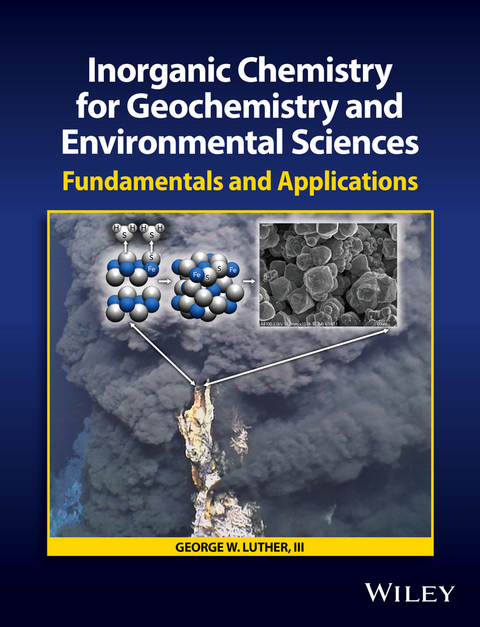
Inorganic Chemistry for Geochemistry and Environmental Sciences (eBook)
John Wiley & Sons (Verlag)
978-1-118-85141-8 (ISBN)
Inorganic Chemistry for Geochemistry and Environmental Sciences: Fundamentals and Applications discusses the structure, bonding and reactivity of molecules and solids of environmental interest, bringing the reactivity of non-metals and metals to inorganic chemists, geochemists and environmental chemists from diverse fields. Understanding the principles of inorganic chemistry including chemical bonding, frontier molecular orbital theory, electron transfer processes, formation of (nano) particles, transition metal-ligand complexes, metal catalysis and more are essential to describe earth processes over time scales ranging from 1 nanosec to 1 Gigayr.
Throughout the book, fundamental chemical principles are illustrated with relevant examples from geochemistry, environmental and marine chemistry, allowing students to better understand environmental and geochemical processes at the molecular level.
Topics covered include:
• Thermodynamics and kinetics of redox reactions
• Atomic structure
• Symmetry
• Covalent bonding, and bonding in solids and nanoparticles
• Frontier Molecular Orbital Theory
• Acids and bases
• Basics of transition metal chemistry including
• Chemical reactivity of materials of geochemical and environmental interest
Supplementary material is provided online, including PowerPoint slides, problem sets and solutions.
Inorganic Chemistry for Geochemistry and Environmental Sciences is a rapid assimilation textbook for those studying and working in areas of geochemistry, inorganic chemistry and environmental chemistry, wishing to enhance their understanding of environmental processes from the molecular level to the global level.
Professor George W. Luther, III, School of Marine Science & Policy, University of Delaware, USA
Professor Luther has joint appointments in the Department of Chemistry and Biochemistry, Department of Civil and Environmental Engineering and the Department of Plant and Soil Science.
Professor Luther taught an ACS accredited course on advanced inorganic chemistry from 1973-1986 to senior undergraduate students. As he moved into environmental and marine chemistry, he began using environmental examples in inorganic chemistry. In 1988, he started a similar course titled 'Marine Inorganic Chemistry' that has been taught biannually at the University of Delaware, attracting students in Chemical Oceanography, Chemistry and Biochemistry, Geology / Geochemistry, Civil and Environmental Engineering and Plant and Soil Science.
In 2013, Professor Luther was awarded the Geochemistry Division Medal by the American Chemical Society for his wide-ranging contributions to aqueous geochemistry. He is recognised for the application of physical inorganic chemistry to the transfer of electrons between chemical compounds in the environment, and also the development of chemical sensors for quantifying the presence of elements and compounds in natural waters.
Professor Luther was named a fellow of the American Association for the Advancement of Science in 2011 and the American Geophysical Union in 2012.
Inorganic Chemistry for Geochemistry and Environmental Sciences: Fundamentals and Applications discusses the structure, bonding and reactivity of molecules and solids of environmental interest, bringing the reactivity of non-metals and metals to inorganic chemists, geochemists and environmental chemists from diverse fields. Understanding the principles of inorganic chemistry including chemical bonding, frontier molecular orbital theory, electron transfer processes, formation of (nano) particles, transition metal-ligand complexes, metal catalysis and more are essential to describe earth processes over time scales ranging from 1 nanosec to 1 Gigayr. Throughout the book, fundamental chemical principles are illustrated with relevant examples from geochemistry, environmental and marine chemistry, allowing students to better understand environmental and geochemical processes at the molecular level. Topics covered include: Thermodynamics and kinetics of redox reactions Atomic structure Symmetry Covalent bonding, and bonding in solids and nanoparticles Frontier Molecular Orbital Theory Acids and bases Basics of transition metal chemistry including Chemical reactivity of materials of geochemical and environmental interest Supplementary material is provided online, including PowerPoint slides, problem sets and solutions. Inorganic Chemistry for Geochemistry and Environmental Sciences is a rapid assimilation textbook for those studying and working in areas of geochemistry, inorganic chemistry and environmental chemistry, wishing to enhance their understanding of environmental processes from the molecular level to the global level.
Professor George W. Luther, III, School of Marine Science & Policy, University of Delaware, USA Professor Luther has joint appointments in the Department of Chemistry and Biochemistry, Department of Civil and Environmental Engineering and the Department of Plant and Soil Science. Professor Luther taught an ACS accredited course on advanced inorganic chemistry from 1973-1986 to senior undergraduate students. As he moved into environmental and marine chemistry, he began using environmental examples in inorganic chemistry. In 1988, he started a similar course titled 'Marine Inorganic Chemistry' that has been taught biannually at the University of Delaware, attracting students in Chemical Oceanography, Chemistry and Biochemistry, Geology / Geochemistry, Civil and Environmental Engineering and Plant and Soil Science. In 2013, Professor Luther was awarded the Geochemistry Division Medal by the American Chemical Society for his wide-ranging contributions to aqueous geochemistry. He is recognised for the application of physical inorganic chemistry to the transfer of electrons between chemical compounds in the environment, and also the development of chemical sensors for quantifying the presence of elements and compounds in natural waters. Professor Luther was named a fellow of the American Association for the Advancement of Science in 2011 and the American Geophysical Union in 2012.
Chapter 1
Inorganic Chemistry and the Environment
1.1 Introduction
Understanding the atomic structure of the atom is important to understanding how atoms combine to build molecules including minerals, aqueous materials, and gases. However, nature builds the atoms of the elements starting with the simplest elements, hydrogen and helium, which are the most abundant in the cosmos. As described in the Big Bang Theory [1–6 and references therein], the origin of the universe (and the periodic table) started with elementary particles under enormous gravitational attraction concentrated in an extremely densely packed point, which exploded causing an expanding universe and the release of enormous energy and fundamental particles. Within 0.01 s of the Big Bang, temperatures have been predicted to be in the range of –. After 100 s and on cooling to , the elementary particles began to combine under the force of gravity. Here, positively charged protons and neutral neutrons start to combine to form the lighter elements (nucleosynthesis) and their isotopes. Their combination in the nucleus occurs by the strong force, which is the short-range attractive force between protons and neutrons that binds these particles in the nucleus while overcoming the repulsive force of the protons with each other. At this time and under these conditions, the electrons are totally ionized from the nucleus and cannot combine with the elements until cooling occurs at about . At this lower temperature, the electromagnetic force begins to take effect and the combination of the electrons with the positive nuclei to form neutral atoms occurs. Once there is a buildup of neutral atoms, chemical processes can occur that eventually lead to life and biological processes.
1.1.1 Energetics of Processes
To understand the energies associated with a wide range of processes at temperatures from absolute zero to these extreme Big Bang temperatures, the Boltzmann energy-temperature relationship (Equation 1.1) provides perspective:
where ; multiplying by (as ) gives E in units of eV (electron volts). Figure 1.1 is a plot of E (eV) versus that gives the temperature and corresponding energy at which several well-known processes occur. Multiplying by Avogadro's number provides R, the gas constant, and E in units of .
Figure 1.1 Log–log plot of energy versus temperature; circles include the temperature at which some familiar chemical and physical processes including hydrothermal vents (∼360 °C) found on deep ocean ridges occur. Triangles indicate the T and E parameters for nucleosynthesis in a sun that has 10–20 times the mass of our sun
Before continuing with the process of nucleosynthesis, it is necessary to define the general symbol used for nuclides, which includes their nuclear and charged properties, as where El is the element symbol, (total number of protons and neutrons or total nucleons), (number of protons) and is the charge due to loss or gain of electrons. The difference of A − Z equals the number of neutrons (N). Isotopes of an element have different atomic masses and the same atomic number due to a different number of neutrons in the nucleus.
Immediately after the Big Bang, the buildup of He (and other light elements) from protons and neutrons occurred through several multistep nuclear processes. Equations 1.2–1.5 show one example (positive charges are omitted for simplicity after Equation 1.2). The free neutron has a half-life of 13 min so the formation of hydrogen (Equation 1.2) occurs rapidly with formation of the electron ( or ) and one of the neutrinos (another radiation component; see Table 1.1). The first nuclear reaction in this sequence is between the proton () and the neutron to form positively charged deuterium (deuteron, ), and the buildup of eventually leads to positively charged tritium () and positively charged helium () formation. For example, continued reaction of the proton with the deuteron produces the doubly charged (Helium-3). Under these extreme temperatures , the repulsive forces of the positively charged particles can be overcome so that the charged particles combine in the nucleus, which has a size on the order of diameter. (At higher temperatures, the can decay due to photodissociation.) can then combine with another neutron to form (also known as the alpha particle; Helium-4) where indicates gamma rays that are at the high energy region of the electromagnetic spectrum (Figure 1.2). The energy released for Equation 1.3 and subsequent reactions is substantial, and maintains or increases the initial temperature. Because of these extreme temperatures, the elements were actually in a plasma state.
Table 1.1 Some important atomic and subatomic particles. One atomic mass unit (amu) equals 1.6606 × 10− 27 kg (the atomic mass constant) and the elementary charge is 1.602 × 10− 19 coulomb (C). Spin is in units of h/(2π) or (h = Planck's constant). β− and β+ are ejected from the nucleus with β+ formally an antiparticle to β−; the reaction of β− with β+ leads to their annihilation and release of γ-ray energy. The electron neutrino, υe or υ−, and the positron neutrino, e or υ+ (also known as the antineutrino), account for excess energy release during nuclear reactions (there are two other neutrinos and antineutrinos that are not important to this discussion)
| Symbol | Particle | Mass (amu) [7, 8] | Mass # | Charge | Spin |
| or | beta particle | 0 |
| or | Positron | 0 |
| Proton | 1.007277 | 1 | +1 |
| H atom | 1.007825 | 1 | 0 |
| Neutron | 1.008665 | 1 | 0 |
| alpha particle | 4.00120 | 4 | 0 |
| -ray | gamma ray | 0 | 0 | 0 | 1 |
| or | Neutrino | 0 | 0 |
| e or | Antineutrino | 0 | 0 |
Figure 1.2 The electromagnetic spectrum is given in terms of wavelength and frequency (, bottom axis) and energy in eV and Joule per atom (top axis; see (Equation 3.2; recall ). . The types of spectroscopic techniques for these energy regions are at the bottom
1.2 Neutron–Proton Conversion
The proton and the neutron interconvert in atoms to increase nuclear stability via the weak nuclear force that operates at [4]. Equation 1.2 is an example of spontaneous beta emission (decay) of the neutron. Other examples of neutron conversion to a proton via reaction with a particle and an electron neutrino are given in Equations 1.6a and 1.6b, respectively. The proton is stable to decay so requires another particle (Equation 1.6c) or energy (antineutrino; Equation 1.6d) to transform it to a neutron.
1.3 Element Burning Reactions – Buildup of Larger Elements
Further buildup of the elements occurs in the stars and during stellar explosions (supernovae), and the energy released for those reactions above and subsequent reactions is substantial (Section 1.4). The initial process in stellar nuclear synthesis is hydrogen burning (our sun is undergoing this process), which is described with the following set of equations (1.7a–1.7d) and which occurs at temperatures of .
is the positron (also given as ) and is one of the neutrinos.
The sum of Equations 1.7a–1.7c gives the overall nuclear reaction to produce the alpha particle, (Equation 1.7d), and is one of three proton–proton chain sequences [6].
Once helium is produced, the core of the star continues to collapse and gravitational forces drive the temperature up to where fuses with itself in a reaction sequence (Equations 1.8a–1.8d) to form (half-life of ), which rapidly fuses with another to form carbon (the triple process), which can react further with helium. This sequence is one of the helium burning reaction sequences.
Another...
| Erscheint lt. Verlag | 17.5.2016 |
|---|---|
| Sprache | englisch |
| Themenwelt | Naturwissenschaften ► Chemie ► Anorganische Chemie |
| Naturwissenschaften ► Chemie ► Organische Chemie | |
| Naturwissenschaften ► Chemie ► Physikalische Chemie | |
| Naturwissenschaften ► Geowissenschaften ► Geologie | |
| Technik | |
| Schlagworte | Anorganische Chemie • aquatic chemistry • Boden- u. Geochemie • Chemical Oceanography • Chemie • Chemistry • Civil and environmental engineering • earth sciences • Environmental Chemistry • Frontier molecular orbital theory • Geochemie • Geochemie, Mineralogie • Geochemistry • Geochemistry & Minerology • Geowissenschaften • Inorganic Chemistry • Marine chemistry • redox processes • Soil & Geochemistry • Soil and plant chemistry • Umweltwissenschaften |
| ISBN-10 | 1-118-85141-2 / 1118851412 |
| ISBN-13 | 978-1-118-85141-8 / 9781118851418 |
| Informationen gemäß Produktsicherheitsverordnung (GPSR) | |
| Haben Sie eine Frage zum Produkt? |
 EPUB (Adobe DRM)
Kopierschutz: Adobe-DRM
Adobe-DRM ist ein Kopierschutz, der das eBook vor Mißbrauch schützen soll. Dabei wird das eBook bereits beim Download auf Ihre persönliche Adobe-ID autorisiert. Lesen können Sie das eBook dann nur auf den Geräten, welche ebenfalls auf Ihre Adobe-ID registriert sind.
Details zum Adobe-DRM
Dateiformat: EPUB (Electronic Publication)
EPUB ist ein offener Standard für eBooks und eignet sich besonders zur Darstellung von Belletristik und Sachbüchern. Der Fließtext wird dynamisch an die Display- und Schriftgröße angepasst. Auch für mobile Lesegeräte ist EPUB daher gut geeignet.
Systemvoraussetzungen:
PC/Mac: Mit einem PC oder Mac können Sie dieses eBook lesen. Sie benötigen eine
eReader: Dieses eBook kann mit (fast) allen eBook-Readern gelesen werden. Mit dem amazon-Kindle ist es aber nicht kompatibel.
Smartphone/Tablet: Egal ob Apple oder Android, dieses eBook können Sie lesen. Sie benötigen eine
Geräteliste und zusätzliche Hinweise
Buying eBooks from abroad
For tax law reasons we can sell eBooks just within Germany and Switzerland. Regrettably we cannot fulfill eBook-orders from other countries.
aus dem Bereich