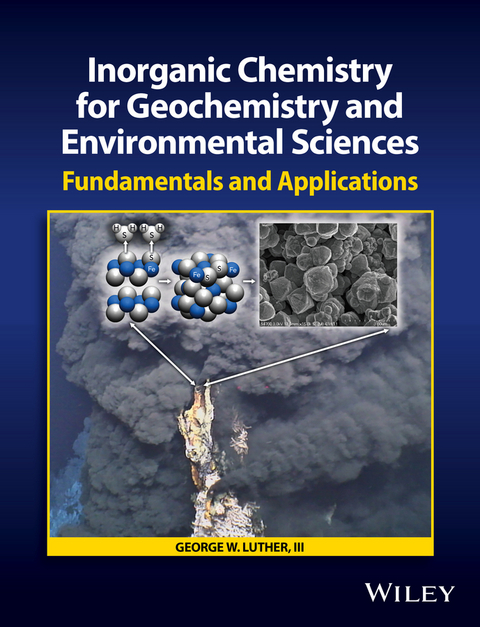
Inorganic Chemistry for Geochemistry and Environmental Sciences (eBook)
John Wiley & Sons (Verlag)
978-1-118-85140-1 (ISBN)
Inorganic Chemistry for Geochemistry and Environmental Sciences: Fundamentals and Applications discusses the structure, bonding and reactivity of molecules and solids of environmental interest, bringing the reactivity of non-metals and metals to inorganic chemists, geochemists and environmental chemists from diverse fields. Understanding the principles of inorganic chemistry including chemical bonding, frontier molecular orbital theory, electron transfer processes, formation of (nano) particles, transition metal-ligand complexes, metal catalysis and more are essential to describe earth processes over time scales ranging from 1 nanosec to 1 Gigayr.
Throughout the book, fundamental chemical principles are illustrated with relevant examples from geochemistry, environmental and marine chemistry, allowing students to better understand environmental and geochemical processes at the molecular level.
Topics covered include:
• Thermodynamics and kinetics of redox reactions
• Atomic structure
• Symmetry
• Covalent bonding, and bonding in solids and nanoparticles
• Frontier Molecular Orbital Theory
• Acids and bases
• Basics of transition metal chemistry including
• Chemical reactivity of materials of geochemical and environmental interest
Supplementary material is provided online, including PowerPoint slides, problem sets and solutions.
Inorganic Chemistry for Geochemistry and Environmental Sciences is a rapid assimilation textbook for those studying and working in areas of geochemistry, inorganic chemistry and environmental chemistry, wishing to enhance their understanding of environmental processes from the molecular level to the global level.
Professor George W. Luther, III, School of Marine Science & Policy, University of Delaware, USA
Professor Luther has joint appointments in the Department of Chemistry and Biochemistry, Department of Civil and Environmental Engineering and the Department of Plant and Soil Science.
Professor Luther taught an ACS accredited course on advanced inorganic chemistry from 1973-1986 to senior undergraduate students. As he moved into environmental and marine chemistry, he began using environmental examples in inorganic chemistry. In 1988, he started a similar course titled 'Marine Inorganic Chemistry' that has been taught biannually at the University of Delaware, attracting students in Chemical Oceanography, Chemistry and Biochemistry, Geology / Geochemistry, Civil and Environmental Engineering and Plant and Soil Science.
In 2013, Professor Luther was awarded the Geochemistry Division Medal by the American Chemical Society for his wide-ranging contributions to aqueous geochemistry. He is recognised for the application of physical inorganic chemistry to the transfer of electrons between chemical compounds in the environment, and also the development of chemical sensors for quantifying the presence of elements and compounds in natural waters.
Professor Luther was named a fellow of the American Association for the Advancement of Science in 2011 and the American Geophysical Union in 2012.
Inorganic Chemistry for Geochemistry and Environmental Sciences: Fundamentals and Applications discusses the structure, bonding and reactivity of molecules and solids of environmental interest, bringing the reactivity of non-metals and metals to inorganic chemists, geochemists and environmental chemists from diverse fields. Understanding the principles of inorganic chemistry including chemical bonding, frontier molecular orbital theory, electron transfer processes, formation of (nano) particles, transition metal-ligand complexes, metal catalysis and more are essential to describe earth processes over time scales ranging from 1 nanosec to 1 Gigayr. Throughout the book, fundamental chemical principles are illustrated with relevant examples from geochemistry, environmental and marine chemistry, allowing students to better understand environmental and geochemical processes at the molecular level. Topics covered include: Thermodynamics and kinetics of redox reactions Atomic structure Symmetry Covalent bonding, and bonding in solids and nanoparticles Frontier Molecular Orbital Theory Acids and bases Basics of transition metal chemistry including Chemical reactivity of materials of geochemical and environmental interest Supplementary material is provided online, including PowerPoint slides, problem sets and solutions. Inorganic Chemistry for Geochemistry and Environmental Sciences is a rapid assimilation textbook for those studying and working in areas of geochemistry, inorganic chemistry and environmental chemistry, wishing to enhance their understanding of environmental processes from the molecular level to the global level.
Professor George W. Luther, III, School of Marine Science & Policy, University of Delaware, USA Professor Luther has joint appointments in the Department of Chemistry and Biochemistry, Department of Civil and Environmental Engineering and the Department of Plant and Soil Science. Professor Luther taught an ACS accredited course on advanced inorganic chemistry from 1973-1986 to senior undergraduate students. As he moved into environmental and marine chemistry, he began using environmental examples in inorganic chemistry. In 1988, he started a similar course titled 'Marine Inorganic Chemistry' that has been taught biannually at the University of Delaware, attracting students in Chemical Oceanography, Chemistry and Biochemistry, Geology / Geochemistry, Civil and Environmental Engineering and Plant and Soil Science. In 2013, Professor Luther was awarded the Geochemistry Division Medal by the American Chemical Society for his wide-ranging contributions to aqueous geochemistry. He is recognised for the application of physical inorganic chemistry to the transfer of electrons between chemical compounds in the environment, and also the development of chemical sensors for quantifying the presence of elements and compounds in natural waters. Professor Luther was named a fellow of the American Association for the Advancement of Science in 2011 and the American Geophysical Union in 2012.
| Erscheint lt. Verlag | 5.5.2016 |
|---|---|
| Sprache | englisch |
| Themenwelt | Naturwissenschaften ► Chemie ► Anorganische Chemie |
| Naturwissenschaften ► Chemie ► Organische Chemie | |
| Naturwissenschaften ► Chemie ► Physikalische Chemie | |
| Naturwissenschaften ► Geowissenschaften ► Geologie | |
| Technik | |
| Schlagworte | Anorganische Chemie • aquatic chemistry • Boden- u. Geochemie • Chemical Oceanography • Chemie • Chemistry • Civil and environmental engineering • earth sciences • Environmental Chemistry • Frontier molecular orbital theory • Geochemie • Geochemie, Mineralogie • Geochemistry • Geochemistry & Minerology • Geowissenschaften • Inorganic Chemistry • Marine chemistry • redox processes • Soil & Geochemistry • Soil and plant chemistry • Umweltwissenschaften |
| ISBN-10 | 1-118-85140-4 / 1118851404 |
| ISBN-13 | 978-1-118-85140-1 / 9781118851401 |
| Informationen gemäß Produktsicherheitsverordnung (GPSR) | |
| Haben Sie eine Frage zum Produkt? |
 PDF (Adobe DRM)
Kopierschutz: Adobe-DRM
Adobe-DRM ist ein Kopierschutz, der das eBook vor Mißbrauch schützen soll. Dabei wird das eBook bereits beim Download auf Ihre persönliche Adobe-ID autorisiert. Lesen können Sie das eBook dann nur auf den Geräten, welche ebenfalls auf Ihre Adobe-ID registriert sind.
Details zum Adobe-DRM
Dateiformat: PDF (Portable Document Format)
Mit einem festen Seitenlayout eignet sich die PDF besonders für Fachbücher mit Spalten, Tabellen und Abbildungen. Eine PDF kann auf fast allen Geräten angezeigt werden, ist aber für kleine Displays (Smartphone, eReader) nur eingeschränkt geeignet.
Systemvoraussetzungen:
PC/Mac: Mit einem PC oder Mac können Sie dieses eBook lesen. Sie benötigen eine
eReader: Dieses eBook kann mit (fast) allen eBook-Readern gelesen werden. Mit dem amazon-Kindle ist es aber nicht kompatibel.
Smartphone/Tablet: Egal ob Apple oder Android, dieses eBook können Sie lesen. Sie benötigen eine
Geräteliste und zusätzliche Hinweise
Buying eBooks from abroad
For tax law reasons we can sell eBooks just within Germany and Switzerland. Regrettably we cannot fulfill eBook-orders from other countries.
aus dem Bereich