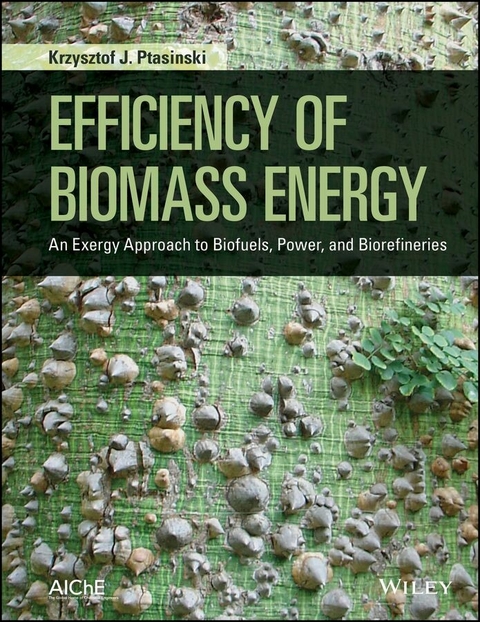
Efficiency of Biomass Energy (eBook)
784 Seiten
Wiley (Verlag)
978-1-119-11814-5 (ISBN)
Details energy and exergy efficiencies of all major aspects of bioenergy systems
- Covers all major bioenergy processes starting from photosynthesis and cultivation of biomass feedstocks and ending with final bioenergy products, like power, biofuels, and chemicals
- Each chapter includes historical developments, chemistry, major technologies, applications as well as energy, environmental and economic aspects in order to serve as an introduction to biomass and bioenergy
- A separate chapter introduces a beginner in easy accessible way to exergy analysis and the similarities and differences between energy and exergy efficiencies are underlined
- Includes case studies and illustrative examples of 1st, 2nd, and 3rd generation biofuels production, power and heat generation (thermal plants, fuel cells, boilers), and biorefineries
- Traditional fossil fuels-based technologies are also described in order to compare with the corresponding bioenergy systems
Krzysztof J. Ptasinski, Ph.D., D.Sc., has over 40 years of experience in academic teaching and research in chemical engineering and energy technology. He has held appointments at the Eindhoven University of Technology and the University of Twente (the Netherlands) as well as the Warsaw University of Technology and as visiting professor at the Silesian University of Technology (Poland). His pioneering research on application of exergy analysis to biomass and bioenergy is internationally acclaimed. He is the author and co-author of more than 200 publications, including 19 book chapters and 75 research papers. Currently he serves as an Executive Editor Biomass and Bioenergy - Energy, The International Journal.
Chapter 1
Bioenergy Systems: An Overview
The use of fossil fuels that are currently our major energy sources leads to undesired effects such as global warming, environmental pollution, and health damage. Moreover, an increased consumption of fossil energy results in a fast depletion. Therefore, it is desired that renewable energy sources, such as biomass, solar, and geothermal, should replace fossil fuels. Biomass was the first fuel used by people that had dominated the global energy supply until the nineteenth century and is still used mainly in rural areas of developing countries for cooking and heating. However, biomass can be converted into all major energy carriers such as electricity, heat, and transport fuels as well as a wide diversity of chemicals and materials that are presently produced from fossil fuels. Biomass as a sustainable energy source can significantly contribute to the future world energy supply. This chapter presents a brief introduction to biomass and bioenergy systems. We start this chapter with a discussion of current energy and environmental problems in Section 1.1. Section 1.2 is an introduction to bioenergy systems, including historical development, biomass resources, and their characteristics as well as environmental impact and economics. Biomass conversion processes, including pretreatment, thermochemical, biochemical, and chemical conversion, are reviewed in Section 1.3. Finally, Section 1.4 is devoted to the utilization of biomass for transport fuels, power generation, heating, and chemicals.
1.1 Energy and the Environment
1.1.1 Global Energy Consumption
Energy is commonly considered as one of the most essential elements in the development of human civilization. We need energy for almost all activities, such as food, clothing, shelter, materials, transportation, and communication. The demand for energy has continuously increased since the beginning of human civilization. In the hunter–gatherer society, man used food as the main energy source. After the fire discovery, energy was also used for heat and light as well as cooking and roasting. About 10,000 years ago, the agricultural technology started that increased energy demand for field irrigation, soil cultivation and crops production, and nonagricultural purposes, such as tools made from wood and iron. Since the industrial revolution in the nineteenth century, large amounts of energy have been required for new applications, such as steam and internal combustion engines and various electrical equipment.
Figure 1.1 illustrates the change of world population and primary energy consumption from 1890 to 2010. In this period, the world population has increased by a factor of more than 4, from 1.6 to 6.8 billion people. On the other hand, the global primary energy consumption has increased by a factor of more than 17, from 31 to 539 EJ/year. Between 1890 and 2010, the per capita consumption of primary energy (expressed as power expenditure) has quadrupled from 0.61 to 2.52 kW/capita. This amount significantly exceeds the energy of the Western food consumption of about 0.2 kW/capita, which is sufficient for the human existence.
Figure 1.1 World population and primary energy consumption, 1890–2010
(sources: Klass, 1998; UN, 1999; IEA, 2013).
However, the regional distribution of energy use is very diverse. Table 1.1 summarizes the 2010 population, total primary energy consumption, and primary energy consumption per capita (expressed as power expenditure) of several countries selected from all continents, including developed and less developed countries. The world's highest energy consumption per capita relates to the developed countries in North America, such as Canada (12.9) and the United States (10.6), Europe, such as France (5.7), Germany (5.7), and the United Kingdom (4.8), and Asia, such as Japan (5.7 kW/cap). On the other hand, major parts of the world population consume much less energy per capita, particularly in the developing countries such as India (0.63), Bangladesh (0.21), and in Africa, such as Ethiopia (0.053 kW/cap).
Table 1.1 Energy Characteristics for Several Countries, 2010
Source: EIA (2013a).
| Country | Population (million) | Primary Energy Consumption (EJ/year) | Primary Energy Consumption Per Capita (kW/cap)a | Energy Intensity (MJ/US$2005) | Carbon Dioxide Emissions (Mton/year) |
| The United States | 309.3 | 103.4 | 10.6 | 7.92 | 5,637 |
| Canada | 33.8 | 13.7 | 12.9 | 11.4 | 547 |
| Mexico | 112.5 | 7.69 | 2.17 | 8.33 | 432 |
| Germany | 81.6 | 14.7 | 5.68 | 5.01 | 793 |
| France | 64.9 | 11.6 | 5.71 | 5.28 | 389 |
| The United Kingdom | 62.3 | 9.41 | 4.78 | 4.04 | 529 |
| Russia | 142.5 | 30.9 | 6.88 | 34.2 | 1,642 |
| Brazil | 195.8 | 11.9 | 1.93 | 10.9 | 451 |
| Argentina | 41.3 | 3.53 | 2.71 | 13.9 | 174 |
| China | 1,330.1 | 106.4 | 2.54 | 27.7 | 7,997 |
| India | 1,173.1 | 23.1 | 0.625 | 18.5 | 1,601 |
| Japan | 127.6 | 23.0 | 5.71 | 5.01 | 1,180 |
| Bangladesh | 156.1 | 1.04 | 0.212 | 13.4 | 57.0 |
| Saudi Arabia | 25.7 | 8.28 | 10.2 | 23.0 | 469 |
| South Africa | 49.1 | 5.90 | 3.81 | 20.5 | 473 |
| Egypt | 80.5 | 3.49 | 1.38 | 27.8 | 191 |
| Ethiopia | 86.0 | 0.144 | 0.053 | 7.16 | 6.45 |
| World | 6,863.2 | 538.7 | 2.49 | 10.5 | 31,502 |
| aExpressed by power expenditure. |
The highest energy consumers are China and the United States that use 19.8 and 19.3% of the world's primary energy, respectively. To the world's 10 highest primary energy consumers also belong Russia (5.7), India (4.3), Japan (4.3), Germany (2.7), Canada (2.5), Brazil (2.2), France (2.2), and the United Kingdom (1.7%). The top 10 countries consume more than one-third of the world's total primary energy.
Table 1.1 also presents the energy intensity of economic output that is expressed as a ratio between the primary energy use and the gross domestic product (GDP) (in US$2005). Generally, more developed countries show lower energy intensity of their economy that is mainly due to the higher efficiency of energy conversion. Some countries, such as Russia, China, and less developed countries consume more primary energy per GDP, which is largely due to a less efficient economic system. However, differences in the energy intensity are also caused by other factors, such as country size, climate, composition of primary energy supply, and differences in an industrial structure (Smil, 2000).
It is expected that energy consumption will significantly increase in the future. This is mostly due to two effects, namely, the expected population growth in the future and the increase of energy use per capita in less developed countries. According to the Shell energy scenarios, the global primary energy consumption in 2050 can range between 770 and 880 EJ/year, depending on the future pattern of energy consumption (Shell, 2008). The United Nations Development Program foresees in 2050 the primary energy consumption in the range of 600–1040 EJ/year and in 2100 in the range of 880–1860, depending on the population and economic growth (UNDP, 2000).
Historical energy use shows a very large change not only in the amount of consumed energy, as described above, but also in the pattern of energy sources. Human civilization has used biomass (mainly wood fuel) as a primary energy source for a long time until the beginning of the industrial revolution. The fossil fuels era began at the end of the nineteenth century when coal started to replace wood as the primary fuel. Later, other fossil fuels, such as oil and natural gas, were available in large amounts and low cost. Figure 1.2 illustrates the historical primary energy consumption pattern for the United States for the years 1850, 1930, and 2010. In 1850, wood was the dominant fuel contributing more than 90% to the primary energy consumption in the United States. Eighty years later in 1930, biomass was replaced by coal as the main fuel that contributed 58% to the primary energy consumption. The same year the remaining fossil fuels were oil (25%) and natural gas (8%), whereas the share of biomass was reduced to 6% only. Eighty years later, in 2010, fossil fuels contributed 83% to the primary energy consumption, whereas the remaining primary energy was supplied as nuclear electric (8.6%), biomass (4.4%), and other renewables (3.9%). Figure...
| Erscheint lt. Verlag | 11.5.2016 |
|---|---|
| Sprache | englisch |
| Themenwelt | Naturwissenschaften ► Chemie ► Technische Chemie |
| Naturwissenschaften ► Physik / Astronomie ► Angewandte Physik | |
| Technik ► Elektrotechnik / Energietechnik | |
| Technik ► Umwelttechnik / Biotechnologie | |
| Schlagworte | bioenergy • Biofuels • Biokraftstoff • biomass • Biomasse • Biorefinery • chemical engineering • Chemie • Chemische Verfahrenstechnik • Chemistry • Energie • Energieeffizienz • Energy • energy efficiency • Environmental Chemistry • exergy • Fuel cells • Gasification • photosynthesis • Power generation • renewable energy • thermodynamics • Umweltchemie |
| ISBN-10 | 1-119-11814-X / 111911814X |
| ISBN-13 | 978-1-119-11814-5 / 9781119118145 |
| Informationen gemäß Produktsicherheitsverordnung (GPSR) | |
| Haben Sie eine Frage zum Produkt? |
 EPUB (Adobe DRM)
Kopierschutz: Adobe-DRM
Adobe-DRM ist ein Kopierschutz, der das eBook vor Mißbrauch schützen soll. Dabei wird das eBook bereits beim Download auf Ihre persönliche Adobe-ID autorisiert. Lesen können Sie das eBook dann nur auf den Geräten, welche ebenfalls auf Ihre Adobe-ID registriert sind.
Details zum Adobe-DRM
Dateiformat: EPUB (Electronic Publication)
EPUB ist ein offener Standard für eBooks und eignet sich besonders zur Darstellung von Belletristik und Sachbüchern. Der Fließtext wird dynamisch an die Display- und Schriftgröße angepasst. Auch für mobile Lesegeräte ist EPUB daher gut geeignet.
Systemvoraussetzungen:
PC/Mac: Mit einem PC oder Mac können Sie dieses eBook lesen. Sie benötigen eine
eReader: Dieses eBook kann mit (fast) allen eBook-Readern gelesen werden. Mit dem amazon-Kindle ist es aber nicht kompatibel.
Smartphone/Tablet: Egal ob Apple oder Android, dieses eBook können Sie lesen. Sie benötigen eine
Geräteliste und zusätzliche Hinweise
Buying eBooks from abroad
For tax law reasons we can sell eBooks just within Germany and Switzerland. Regrettably we cannot fulfill eBook-orders from other countries.
aus dem Bereich