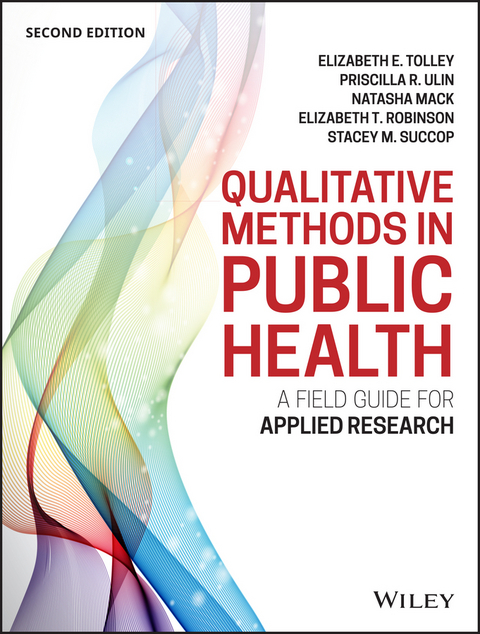
Qualitative Methods in Public Health (eBook)
John Wiley & Sons (Verlag)
978-1-118-83467-1 (ISBN)
Qualitative Methods in Public Health: A Field Guide for Applied Research, 2nd Edition provides a practical orientation to conducting effective qualitative research in the public health sphere. With thorough examination and simple explanations, this book guides you through the logic and workflow of qualitative approaches, with step-by-step guidance on every phase of the research. Students learn how to identify and make use of theoretical frameworks to guide your study, design the study to answer specific questions, and achieve their research goals.
Data collection, analysis, and interpretation are given close attention as the backbone of a successful study, and expert insight on reporting and dissemination helps you get your work noticed. This second edition features new examples from global health, including case studies specifically illustrating study design, web and mobile technologies, mixed methods, and new innovations in information dissemination. Pedagogical tools have been added to help enhance your understanding of research design and implementation, and extensive appendices show you how these concepts work in practice.
Qualitative research is a powerful tool for public health, but it's very easy to get it wrong. Careful study design and data management are critical, and it's important to resist drawing conclusions that the data cannot support. This book shows you how to conduct high-quality qualitative research that stands up to review.
ELIZABETH E. TOLLEY is a senior scientist and Director of the Social and Behavioral Health Sciences division of FHI 360.
PRISCILLA R. ULIN is retired from Family Health International (now FHI 360), where she was senior research scientist in the Social and Behavioral Sciences division.
NATASHA MACK is a researcher in the Social and Behavioral Health Sciences division at FHI 360.
ELIZABETH T. ROBINSON is the senior advisor for communications at the University of North Carolina at Chapel Hill's MEASURE Evaluation project.
STACEY M. SUCCOP is a research associate in the Scientific Affairs department at FHI 360.
Qualitative Methods in Public Health: A Field Guide for Applied Research, 2nd Edition provides a practical orientation to conducting effective qualitative research in the public health sphere. With thorough examination and simple explanations, this book guides you through the logic and workflow of qualitative approaches, with step-by-step guidance on every phase of the research. Students learn how to identify and make use of theoretical frameworks to guide your study, design the study to answer specific questions, and achieve their research goals. Data collection, analysis, and interpretation are given close attention as the backbone of a successful study, and expert insight on reporting and dissemination helps you get your work noticed. This second edition features new examples from global health, including case studies specifically illustrating study design, web and mobile technologies, mixed methods, and new innovations in information dissemination. Pedagogical tools have been added to help enhance your understanding of research design and implementation, and extensive appendices show you how these concepts work in practice. Qualitative research is a powerful tool for public health, but it's very easy to get it wrong. Careful study design and data management are critical, and it's important to resist drawing conclusions that the data cannot support. This book shows you how to conduct high-quality qualitative research that stands up to review.
ELIZABETH E. TOLLEY is a senior scientist and Director of the Social and Behavioral Health Sciences division of FHI 360. PRISCILLA R. ULIN is retired from Family Health International (now FHI 360), where she was senior research scientist in the Social and Behavioral Sciences division. NATASHA MACK is a researcher in the Social and Behavioral Health Sciences division at FHI 360. ELIZABETH T. ROBINSON is the senior advisor for communications at the University of North Carolina at Chapel Hill's MEASURE Evaluation project. STACEY M. SUCCOP is a research associate in the Scientific Affairs department at FHI 360.
Cover 1
Title Page 5
Copyright 6
Contents 9
List of of Figures, Tables, and Boxes 15
List of Case Studies 19
Foreword 21
Acknowledgments 23
About the Authors 25
Chapter 1 Invitation to Explore 31
Our Purpose 32
What Is Qualitative Research? 34
Quantitative or Qualitative? 36
Application of Research to Action 37
Advances in Cross-Cultural Understanding of Health and Health-Related Behavior 38
Global Health Patterns 39
Increased Awareness of Issues in Human Rights 40
Getting Started 41
Key Terms 43
Review Questions 44
References 44
Chapter 2 The Language and Logic of Qualitative Research 47
Frameworks for Research: Paradigms, Theories, and Conceptual Models 48
Three Theoretical Paradigms for Public Health Research 49
Using Qualitative Methods to Develop Theory 57
Substantive Theories and Conceptual Models 58
Social-Ecological Model 60
Health Belief Model 60
Social Cognitive Theory 62
Diffusion of Innovations 63
Resiliency Theory 64
Standards for Qualitative Research 65
Judging Quality: The Search for Trustworthy Data 65
Summary 68
Key Terms 69
Recommended Readings 70
Review Questions 70
References 70
Chapter 3 Designing the Study 75
Background and Rationale 77
Stating the Research Problem 78
Study Purpose: Formative, Descriptive, Explanatory, or Transformative Research 78
Conceptualizing the Problem in a Larger Framework 81
Developing Study Objectives 83
Using Documentary Sources 84
Data From Human Subjects 85
Selection: Theoretical or a Priori? 86
Sample Selection Techniques 87
Sample Size 87
Recruiting Participants 90
Data Collection Methods 91
A Practical Strategy for Mixed-Method Design 93
Selecting Data Collection Methods 97
Individual Interviews or Focus Groups? 99
Collecting Data 101
Analyzing the Data 102
Disseminating Results 104
Research Ethics: Decisions for the Protection of Study Participants 104
Obtaining Informed Consent 105
Risk to Participants 105
The Signed Consent Form-Do You Need It? 106
Other Considerations: Budget and Time 108
Summary 109
Key Terms 109
Recommended Readings 111
Review Questions 111
References 111
Chapter 4 Collecting Qualitative Data 115
Observation 116
Unobtrusive Techniques 117
Interactive (Participatory) Techniques 119
Interviews and Focus Groups 128
Developing Interview and Focus Group Topic/Question Guides 128
Asking Qualitative Research Questions 131
Framing Qualitative Questions 134
In-Depth Interviews 137
Stages of the Interview (and Focus Group Discussion) 138
Focus Groups 143
Structured Data Collection Techniques 157
Freelisting and Pile Sorts 157
Photo Elicitation 159
Photovoice 159
Vignettes 161
Body Mapping 162
Social Network Analysis 163
Summary 164
Key Terms 165
Review Questions 167
Recommended Readings 167
References 168
Chapter 5 Logistics in the Field 173
Introduction to the Community: Building Rapport 175
Stakeholders 176
Family Influences 178
Involving Policymakers and Change Agents 178
Project Advisory Committees 179
Developing the Field Team 180
Field Assistants 180
The Professional Field Team 181
Training 182
The Training Plan 184
Skills Practice 185
Sensitive Topics 186
Field Materials 187
Pilot Testing 188
Field Logistics 189
Supervision and Monitoring 191
Generating Data Files 192
Transcription and Translation 193
Data Management and Storage 195
Timelines and Budgets 196
Summary 198
Key Terms 199
Review Questions 200
Recommended Readings 200
References 201
Chapter 6 Qualitative Data Analysis 203
Basic Steps in Qualitative Data Analysis 205
Step 1. Reading: Developing an Intimate Relationship with the Data 206
Reading for Content 206
Noting Quality 208
Identifying Patterns 208
Step 2. Coding: Identifying the Emerging Themes 209
What Aspects of the Text Are Coded? 209
Developing a Codebook 212
Applying Codes 213
Team-Based Coding and Intercoder Reliability 213
Advantages of Continuous Coding 218
Computer Software 219
Coding Reports: Building Theme-Related Files 226
Step 3. Displaying Data: Distinguishing Nuances of a Topic 229
Writing Data Display Memos 229
Developing Hypotheses, Questioning, and Verifying 231
Attention to Data Credibility 232
Step 4. Data Reduction: Getting the Big Picture 234
Step 5. Interpretation 237
Synthesizing Findings: Gaps and Connections 238
Interpretation of Qualitative Data in a Mixed-Method Design 240
Establishing Trustworthiness 242
Credibility 242
Dependability 243
Confirmability 243
Transferability 244
Summary 245
Key Terms 246
Review Questions 247
Recommended Readings 247
References 247
Chapter 7 Disseminating Qualitative Research 249
Research Ethics Require Dissemination 252
An Inclusive Dissemination Process Promotes Use 253
How to Develop a Communication and Dissemination Strategy 254
Choosing a Format for Dissemination 270
How to Disseminate to Community Stakeholders 271
How to Disseminate to Research Participants 273
How to Disseminate to Policy Audiences 273
How to Disseminate to Other Researchers 275
How to Disseminate via Oral Presentations 276
How to Disseminate via Final Reports 277
Outcome Indicators for Dissemination 277
Summary 279
Key Terms 280
Review Questions 280
Recommended Readings 280
References 281
Chapter 8 Putting It Into Words 285
The Role of Writing in Responsible Conduct of Research 286
Before You Write 288
Recognize When to Write 288
Chronicle What You Have Learned 289
Choose an Audience and Format 290
Select a Target Journal for Your Scientific Article 294
Authorship Considerations for Scientific Articles 295
Writing Your Article or Report 297
Statement of Purpose 297
Outline 298
Introduction Section 298
Methods Section 300
Results Section 303
Discussion Section 311
Conclusion Section 313
Acknowledgments Section 314
After You Write 314
Internal Review 314
Submitting Your Article to a Journal 315
When to Stop Writing 319
External Review: Assessing the Product 319
Summary 321
Key Terms 322
Review Questions 322
Recommended Readings 322
References 323
Appendix 1 Case Studies 325
Appendix 2 Examples of Oral Consent Forms 377
Appendix 3 Participant Observation Notes 381
Appendix 4 Topic Guides With Pictures 389
Appendix 5 Sample Interviewer Training Program Agendas and Training Schedules 399
Appendix 6 Sample Budget Categories for Planning Qualitative Data Collection 403
Appendix 7 Coding Summary Report 407
Appendix 8 Example of Data Analysis Memo 413
Appendix 9 Making Study Findings Accessible to Other Researchers 417
Appendix 10 Dissemination Materials for Community Stakeholders 425
Appendix 11 Sample Briefs to Share Qualitative Study Findings with Policy Audiences 435
Appendix 12 Sample Dissemination Strategy for Advocacy 443
Appendix 13 Where to Publish 447
Appendix 14 Who Is an Author? 461
Index 463
EULA 483
| Erscheint lt. Verlag | 24.3.2016 |
|---|---|
| Reihe/Serie | Jossey-Bass Public Health |
| Jossey-Bass Public Health/Health Services Text | Jossey-Bass Public Health/Health Services Text |
| Sprache | englisch |
| Themenwelt | Medizin / Pharmazie ► Allgemeines / Lexika |
| Studium ► Querschnittsbereiche ► Prävention / Gesundheitsförderung | |
| Naturwissenschaften | |
| Schlagworte | Elizabeth Robinson • Elizabeth Tolley • FHI 360 • Gesundheits- u. Sozialwesen • Health & Social Care • Natasha Mack • Pricilla R. Ulin • Public Health • Public Health / Ausbildung u. Verhaltensweisen • Public Health Behavior & Education • public health data • public health data collection • Public Health Research • public health study methods • Qualitative Data Analysis • Qualitative Data Collection • qualitative data interpretation • qualitative methods • Qualitative Methods in Public Health: A Field Guide for Applied Research, 2nd Edition • Qualitative research design • qualitative research guide • Qualitative Research Methods • qualitative research textbook • reporting qualitative data • Stacey Succop |
| ISBN-10 | 1-118-83467-4 / 1118834674 |
| ISBN-13 | 978-1-118-83467-1 / 9781118834671 |
| Informationen gemäß Produktsicherheitsverordnung (GPSR) | |
| Haben Sie eine Frage zum Produkt? |
 PDF (Adobe DRM)
Kopierschutz: Adobe-DRM
Adobe-DRM ist ein Kopierschutz, der das eBook vor Mißbrauch schützen soll. Dabei wird das eBook bereits beim Download auf Ihre persönliche Adobe-ID autorisiert. Lesen können Sie das eBook dann nur auf den Geräten, welche ebenfalls auf Ihre Adobe-ID registriert sind.
Details zum Adobe-DRM
Dateiformat: PDF (Portable Document Format)
Mit einem festen Seitenlayout eignet sich die PDF besonders für Fachbücher mit Spalten, Tabellen und Abbildungen. Eine PDF kann auf fast allen Geräten angezeigt werden, ist aber für kleine Displays (Smartphone, eReader) nur eingeschränkt geeignet.
Systemvoraussetzungen:
PC/Mac: Mit einem PC oder Mac können Sie dieses eBook lesen. Sie benötigen eine
eReader: Dieses eBook kann mit (fast) allen eBook-Readern gelesen werden. Mit dem amazon-Kindle ist es aber nicht kompatibel.
Smartphone/Tablet: Egal ob Apple oder Android, dieses eBook können Sie lesen. Sie benötigen eine
Geräteliste und zusätzliche Hinweise
Buying eBooks from abroad
For tax law reasons we can sell eBooks just within Germany and Switzerland. Regrettably we cannot fulfill eBook-orders from other countries.
aus dem Bereich