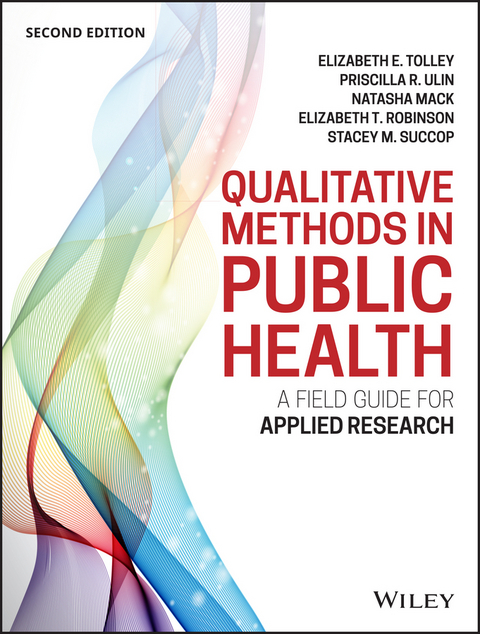
Qualitative Methods in Public Health (eBook)
John Wiley & Sons (Verlag)
978-1-118-83465-7 (ISBN)
Qualitative Methods in Public Health: A Field Guide for Applied Research, 2nd Edition provides a practical orientation to conducting effective qualitative research in the public health sphere. With thorough examination and simple explanations, this book guides you through the logic and workflow of qualitative approaches, with step-by-step guidance on every phase of the research. Students learn how to identify and make use of theoretical frameworks to guide your study, design the study to answer specific questions, and achieve their research goals.
Data collection, analysis, and interpretation are given close attention as the backbone of a successful study, and expert insight on reporting and dissemination helps you get your work noticed. This second edition features new examples from global health, including case studies specifically illustrating study design, web and mobile technologies, mixed methods, and new innovations in information dissemination. Pedagogical tools have been added to help enhance your understanding of research design and implementation, and extensive appendices show you how these concepts work in practice.
Qualitative research is a powerful tool for public health, but it's very easy to get it wrong. Careful study design and data management are critical, and it's important to resist drawing conclusions that the data cannot support. This book shows you how to conduct high-quality qualitative research that stands up to review.
ELIZABETH E. TOLLEY is a senior scientist and Director of the Social and Behavioral Health Sciences division of FHI 360.
PRISCILLA R. ULIN is retired from Family Health International (now FHI 360), where she was senior research scientist in the Social and Behavioral Sciences division.
NATASHA MACK is a researcher in the Social and Behavioral Health Sciences division at FHI 360.
ELIZABETH T. ROBINSON is the senior advisor for communications at the University of North Carolina at Chapel Hill's MEASURE Evaluation project.
STACEY M. SUCCOP is a research associate in the Scientific Affairs department at FHI 360.
ELIZABETH E. TOLLEY is a senior scientist and Director of the Social and Behavioral Health Sciences division of FHI 360. PRISCILLA R. ULIN is retired from Family Health International (now FHI 360), where she was senior research scientist in the Social and Behavioral Sciences division. NATASHA MACK is a researcher in the Social and Behavioral Health Sciences division at FHI 360. ELIZABETH T. ROBINSON is the senior advisor for communications at the University of North Carolina at Chapel Hill's MEASURE Evaluation project. STACEY M. SUCCOP is a research associate in the Scientific Affairs department at FHI 360.
List of of Figures, Tables, and Boxes
List of Case Studies
Preface or Foreword
Acknowledgements
About the Authors
Chapter One
Invitation to Explore
Our Purpose
What Is Qualitative Research?
Getting Started
Chapter Two
The Language and Logic of Qualitative Research
Frameworks for Research: Paradigms, Theories and Conceptual Models
Using Qualitative Methods to Develop Theory
Substantive Theories and Conceptual Models
Standards for Qualitative Research
Chapter Three
Designing the Study
Background and Rationale
Developing Study Objectives
Using Documentary Sources
Data from Human Subjects
Data Collection Methods
Collecting Data
Analyzing the Data
Disseminating Results
Research Ethics: Decisions for the Protection of Study Participants
Other Considerations: Budget and Time
Chapter Four
Collecting Qualitative Data:
The Science and the Art
Observation
Interviews and Focus Groups
Structured Data Collection Techniques
Chapter Five
Logistics in the Field
Introduction to the Community: Building Rapport
Involving Policymakers and Change Agents
Developing the Field Team
Training
Field Materials
Pilot Testing
Field Logistics
Supervision and Monitoring
Generating Data Files
Transcription and Translation
Data Management and Storage
Timelines and Budgets
Chapter Six
Qualitative Data Analysis
Principles of Qualitative Data Analysis: Keeping the Research Purpose in Mind
Basic Steps in Qualitative Data Analysis
Step 1. Reading: Developing an Intimate Relationship with the Data
Step 2. Coding: Identifying the Emerging Themes
Computer Software
Step 3. Displaying Data: Distinguishing Nuances of a Topic
Developing Hypotheses, Questioning, and Verifying
Step 4. Data Reduction: Getting the Big Picture
Step 5. Interpretation
Chapter Seven
Disseminating Qualitative Research
Chapter Eight: Putting It into Words
Reporting Qualitative Research Results in Scientific Journals and Reports
The Role of Writing in Responsible Conduct of Research
Before You Write
Writing Your Article or Report
After You Write
Appendix One
Examples of Oral Consent Forms
Appendix Two
Topic Guides with Pictures
Appendix Three
Participant Observation Notes
Appendix Four
Sample Interviewer Training Program Agendas and Training Schedules
Appendix Five
Sample Budget Categories for Planning Qualitative Data Collection
Appendix Six
Coding Summary Report
Appendix Seven
Example of Data Analysis Memo
Appendix Eight
Where to Publish
Appendix Nine
Research Brief: Communicating Partial Protection of Voluntary Medical Male Circumcision
Appendix Ten
Who Is an Author?
Appendix Eleven
Sample Brochures to Share Qualitative Study Findings with Participating Communities
Appendix Twelve
Making Study Findings Accessible to Other Researchers
Chapter 1
Invitation to Explore
Objectives:
- To introduce researchers to qualitative methods in public health research, including those whose training and experience may be predominantly in quantitative methods
- To describe the basic characteristics of a qualitative research approach
- To show how qualitative methods can shed new light on complex questions in public health
- To highlight the aspects of qualitative research methodology presented in this book, including content new to this second edition
WHY DO SOME PROGRAMS succeed and others fail? Why are screening programs underused? Why does chronic disease go untreated? Why do countless couples know how to protect themselves from sexually transmitted infection but do not do so? How does a community mobilize itself to solve a persistent health problem? Questions like these may be all too familiar to readers of this field guide—public health practitioners, researchers, and program planners, many of whom have worked for years to protect health and prevent disease in highly vulnerable populations.
Advances in the biomedical and population sciences have brought the means to better health within reach of people around the world. Yet, evidence of escalating disease and inadequate health systems and resources in many countries tell us that there is still much we do not know. How do women and men understand and actually use the technical information they receive to make critical decisions that affect their lives and their children's lives? By opening windows on cultural understandings of health and disease, methods of qualitative research can help us comprehend some of these old problems in new ways.
Our Purpose
The purpose of this book is to make the methods of qualitative science more accessible to researchers and practitioners challenged by problems that affect the public's health. Qualitative design can help us understand the underlying behaviors, attitudes, and perceptions that determine health outcomes; it can identify the social, programmatic, and structural impediments to use of existing services; and it can shed light on how to design new development interventions so they align with the socioeconomic realities of their intended beneficiaries and therefore have a greater potential for success.
We write not only for the qualitative researcher but also for applied social scientists, epidemiologists, health providers, health educators, program managers, and others whose training and experience may be predominantly in quantitative methods. Our readers will be students as well as professionals looking for ways to probe more deeply the whys and hows of questions they may partially have answered in terms of how much and how many. They will want to know what qualitative methods can offer to improve their practice or strengthen their research findings. And many of our readers will be training others to ask the same kinds of questions, to listen, and to observe.
Numerous disciplines have contributed to the phenomenal growth of public health research and practice. Sociology, anthropology, psychology, economics, demography, environmental science, medical geography, medicine, and nursing, among others, have brought their unique perspectives and methods to a multidisciplinary understanding of health and wellness. Parallel advances in these disciplines have resulted in different ways of conceptualizing and addressing issues as diverse as health decision making, health promotion, health systems strengthening, child survival, compliance, substance abuse, adolescent sexuality, domestic violence, and gender relations. Similar progress in service delivery research and evaluation has given us a broader understanding of providers' knowledge and values, client–provider communication, and issues related to the accessibility and quality of health care for populations at risk.
Much of this work has focused on objective questions, such as numbers of births, patterns of illegal drug use, trends in disease prevalence, and numerous factors that predict health behavioral outcomes. Research designs traditionally have been quantitative, describing measurable phenomena, projecting trends, and sometimes discovering causal relationships. Psychological research in health behavior has developed primarily from a quantitative perspective, contributing useful rating scales and behavioral indicators, along with case study methods and tools for observation. Anthropologists and qualitative sociologists have approached some of the same problems from different perspectives, focusing on cultural norms and relationships that influence how people interact and act on everyday experiences (Bernard, 1995; Knodel, 1997). Their methods rely primarily on techniques of observation, participation, guided discussion, in-depth interviewing, life histories, and secondary analysis of documentary data. Emerging methods increasingly used in qualitative research include network analysis and geo-health mapping, using innovative technologies such as data visualization applications and mobile data collection tools.
To conduct rigorous research, investigators must use an appropriate study design, data collection methods, and analytic procedures. Yet there is much overlap among different disciplinary approaches. Quantitative researchers at times use qualitative methods to guide a sampling design or to develop a sensitive data collection tool. Anthropologists and qualitative sociologists turn to quantitative methods when they want to describe a population or measure some tendency they may have observed qualitatively. Quantitative research with representative samples can produce hard, factual, reliable outcome data that usually are generalizable to wider populations (Steckler, McLeroy, Goodman, Bird, & McCormick, 1992). But most quantitative studies lack contextual detail and reflect a limited range of responses (Carey, 1993). On the other hand, qualitative methods elicit rich, contextual data, but their small samples and flexible design usually are not appropriate if the study objective is to describe larger populations with statistical accuracy (Patton, 2002). As a result, researchers have increasingly adopted creative new ways to combine techniques in a research design (Creswell, Klassen, Plano Clark, & Smith, 2011; Teddlie & Tashakkori, 2009), letting the strengths of one method compensate for the limitations of another to yield a more powerful methodology.
We have written this guide not to promote one methodology over another, but because many quantitatively trained health professionals, policymakers, and researchers are looking for ways to expand their methodological options with new tools for answering difficult questions.
In searching the literature on qualitative research, we found it divided between manuals that summarize specific techniques for designing and conducting health-related studies (Campbell, 1999; Hudelson, 1994; Yoddumnern, Mahidon, & Sangkhom, 1993) and more comprehensive texts for general academic audiences (Denzin & Lincoln, 2005, 2011; Guest, Namey, & Mitchell, 2012; Patton, 2002; Rossman & Rallis, 1998). Missing from most manuals was a theoretical basis for qualitative decisions, and few texts included strategies to address practical health research issues and problems that arise in the field. Nor did we find clear guidelines for dealing with the large volume of transcripts that qualitative data collection on sensitive topics often generates. Another gap in the literature was the lack of direction for writing and disseminating qualitative results. Our intent, therefore, is to show first how qualitative methods can shed new light on perplexing questions and, second, to provide basic skills to design, conduct, and disseminate the research.
This volume presents practical strategies and methods for using qualitative research, along with the basic logic and rationale for qualitative research decisions. The guide makes researchers aware of the complexities, advantages, and limitations of qualitative research. Its eight chapters cover a wide range of topics and guide readers through every phase of research—from defining the language and logic of qualitative research, to study design, to the collection, analysis, interpretation, reporting, and dissemination of data.
What Is Qualitative Research?
A challenge to the author of any book on qualitative research is to answer the common sense question: What is it? Although there is no short, comprehensive definition, the unique organizing framework is a theoretical and methodological focus on complex relations between (1) personal and social meanings, (2) individual and cultural practices, and (3) the material environment or context. Similarly, there is no universal blueprint for doing qualitative research, but some basic concepts and principles, described next and summarized in Box 1.1, are common in most qualitative research approaches.
Box 1.1: Characteristics of Qualitative Research
- Explores and discovers
- Seeks depth of understanding
- Views social phenomena holistically
- Provides insight into the meanings of decisions and actions
- Asks why, how, and under what circumstance things occur
- Uses interpretive and other open-ended methods
- Is iterative rather than fixed
- Is emergent rather than prestructured
- Involves respondents as active participants rather than as subjects
- Defines the investigator as an instrument in the research process
- Qualitative...
| Erscheint lt. Verlag | 29.3.2016 |
|---|---|
| Reihe/Serie | Jossey-Bass Public Health |
| Jossey-Bass Public Health/Health Services Text | Jossey-Bass Public Health/Health Services Text |
| Sprache | englisch |
| Themenwelt | Medizin / Pharmazie ► Allgemeines / Lexika |
| Studium ► Querschnittsbereiche ► Prävention / Gesundheitsförderung | |
| Naturwissenschaften | |
| Schlagworte | Elizabeth Robinson • Elizabeth Tolley • FHI 360 • Gesundheits- u. Sozialwesen • Health & Social Care • Natasha Mack • Pricilla R. Ulin • Public Health • Public Health / Ausbildung u. Verhaltensweisen • Public Health Behavior & Education • public health data • public health data collection • Public Health Research • public health study methods • Qualitative Data Analysis • Qualitative Data Collection • qualitative data interpretation • qualitative methods • Qualitative Methods in Public Health: A Field Guide for Applied Research, 2nd Edition • Qualitative research design • qualitative research guide • Qualitative Research Methods • qualitative research textbook • reporting qualitative data • Stacey Succop |
| ISBN-10 | 1-118-83465-8 / 1118834658 |
| ISBN-13 | 978-1-118-83465-7 / 9781118834657 |
| Informationen gemäß Produktsicherheitsverordnung (GPSR) | |
| Haben Sie eine Frage zum Produkt? |
 EPUB (Adobe DRM)
Kopierschutz: Adobe-DRM
Adobe-DRM ist ein Kopierschutz, der das eBook vor Mißbrauch schützen soll. Dabei wird das eBook bereits beim Download auf Ihre persönliche Adobe-ID autorisiert. Lesen können Sie das eBook dann nur auf den Geräten, welche ebenfalls auf Ihre Adobe-ID registriert sind.
Details zum Adobe-DRM
Dateiformat: EPUB (Electronic Publication)
EPUB ist ein offener Standard für eBooks und eignet sich besonders zur Darstellung von Belletristik und Sachbüchern. Der Fließtext wird dynamisch an die Display- und Schriftgröße angepasst. Auch für mobile Lesegeräte ist EPUB daher gut geeignet.
Systemvoraussetzungen:
PC/Mac: Mit einem PC oder Mac können Sie dieses eBook lesen. Sie benötigen eine
eReader: Dieses eBook kann mit (fast) allen eBook-Readern gelesen werden. Mit dem amazon-Kindle ist es aber nicht kompatibel.
Smartphone/Tablet: Egal ob Apple oder Android, dieses eBook können Sie lesen. Sie benötigen eine
Geräteliste und zusätzliche Hinweise
Buying eBooks from abroad
For tax law reasons we can sell eBooks just within Germany and Switzerland. Regrettably we cannot fulfill eBook-orders from other countries.
aus dem Bereich