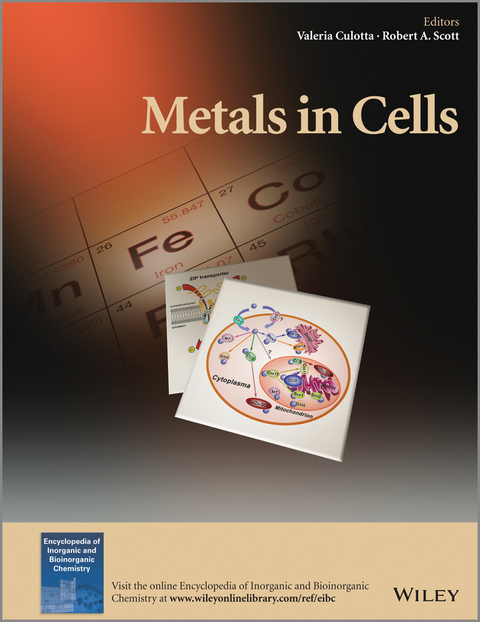
Metals in Cells (eBook)
John Wiley & Sons (Verlag)
978-1-118-63686-2 (ISBN)
Over the last three decades a lot of research on the role of metals in biochemistry and medicine has been done. As a result many structures of biomolecules with metals have been characterized and medicinal chemistry studied the effects of metal containing drugs.
This new book (from the EIBC Book Series) covers recent advances made by top researchers in the field of metals in cells [the 'metallome'] and include: regulated metal ion uptake and trafficking, sensing of metals within cells and across tissues, and identification of the vast cellular factors designed to orchestrate assembly of metal cofactor sites while minimizing toxic side reactions of metals. In addition, it features aspects of metals in disease, including the role of metals in neuro-degeneration, liver disease, and inflammation, as a way to highlight the detrimental effects of mishandling of metal trafficking and response to 'foreign' metals. With the breadth of our recently acquired understanding of metals in cells, a book that features key aspects of cellular handling of inorganic elements is both timely and important. At this point in our understanding, it is worthwhile to step back and take an expansive view of how far our understanding has come, while also highlighting how much we still do not know.
The content from this book will publish online, as part of EIBC in December 2013, find out more about the Encyclopedia of Inorganic and Bioinorganic Chemistry, the essential online resource for researchers and students working in all areas of inorganic and bioinorganic chemistry.
Prof. Robert A. Scott (Editor-in-Chief Encyclopedia of Inorganic and Bioinorganic Chemistry)
Distinguished Research Professor, University of Georgia, USA.
Prof. Valeria Culotta, Biochemistry and Molecular Biology Department, Joint Departmental Affiliations Environmental Health Sciences
Research in the Culotta lab focuses on the role of metal ions and oxygen radicals in biology and disease. Metal ions such as copper, iron and manganese are not only trace nutrients but can be quite toxic. One mechanism of toxicity is through generation of reactive oxygen species (ROS) that have been implicated in numerous human disorders from neurodegeneration to cancer to aging. Through molecular genetic approaches and high through-put genetic screens in yeast, we have identified a number genes and pathways that are involved in transition metal and reactive oxygen metabolism. Virtually all are well conserved throughout eukaryotes including humans. Our laboratory uses a combination of yeast, C. elegans and cell culture systems at the crossroads of bioinorganic chemistry, cell biology and molecular genetics.
Over the last three decades a lot of research on the role of metals in biochemistry and medicine has been done. As a result many structures of biomolecules with metals have been characterized and medicinal chemistry studied the effects of metal containing drugs. This new book (from the EIBC Book Series) covers recent advances made by top researchers in the field of metals in cells [the metallome ] and include: regulated metal ion uptake and trafficking, sensing of metals within cells and across tissues, and identification of the vast cellular factors designed to orchestrate assembly of metal cofactor sites while minimizing toxic side reactions of metals. In addition, it features aspects of metals in disease, including the role of metals in neuro-degeneration, liver disease, and inflammation, as a way to highlight the detrimental effects of mishandling of metal trafficking and response to "e;foreign"e; metals. With the breadth of our recently acquired understanding of metals in cells, a book that features key aspects of cellular handling of inorganic elements is both timely and important. At this point in our understanding, it is worthwhile to step back and take an expansive view of how far our understanding has come, while also highlighting how much we still do not know. The content from this book will publish online, as part of EIBC in December 2013, find out more about the Encyclopedia of Inorganic and Bioinorganic Chemistry, the essential online resource for researchers and students working in all areas of inorganic and bioinorganic chemistry.
Prof. Robert A. Scott (Editor-in-Chief Encyclopedia of Inorganic and Bioinorganic Chemistry) Distinguished Research Professor, University of Georgia, USA. Prof. Valeria Culotta, Biochemistry and Molecular Biology Department, Joint Departmental Affiliations Environmental Health Sciences Research in the Culotta lab focuses on the role of metal ions and oxygen radicals in biology and disease. Metal ions such as copper, iron and manganese are not only trace nutrients but can be quite toxic. One mechanism of toxicity is through generation of reactive oxygen species (ROS) that have been implicated in numerous human disorders from neurodegeneration to cancer to aging. Through molecular genetic approaches and high through-put genetic screens in yeast, we have identified a number genes and pathways that are involved in transition metal and reactive oxygen metabolism. Virtually all are well conserved throughout eukaryotes including humans. Our laboratory uses a combination of yeast, C. elegans and cell culture systems at the crossroads of bioinorganic chemistry, cell biology and molecular genetics.
| Erscheint lt. Verlag | 16.3.2016 |
|---|---|
| Reihe/Serie | EIC Books |
| EIC Books | EIC Books |
| Sprache | englisch |
| Themenwelt | Naturwissenschaften ► Biologie ► Biochemie |
| Naturwissenschaften ► Chemie ► Anorganische Chemie | |
| Technik | |
| Schlagworte | Bioanorganische Chemie • Biochemical • bioinorganic chemistry • Biology • biomolecules • Biowissenschaften • Bound • Cell & Molecular Biology • characterized • Chemie • Chemistry • Drugs • Elements • Enzymes & Receptors • Enzyme u. Rezeptoren • Explosive • First • Function • Functions • growth • halfcentury • inorganic • Last • Life Sciences • metalcontaining • metals • Parallel • proteins • result • Role • Structures • tightly • Zell- u. Molekularbiologie |
| ISBN-10 | 1-118-63686-4 / 1118636864 |
| ISBN-13 | 978-1-118-63686-2 / 9781118636862 |
| Informationen gemäß Produktsicherheitsverordnung (GPSR) | |
| Haben Sie eine Frage zum Produkt? |
 PDF (Adobe DRM)
Kopierschutz: Adobe-DRM
Adobe-DRM ist ein Kopierschutz, der das eBook vor Mißbrauch schützen soll. Dabei wird das eBook bereits beim Download auf Ihre persönliche Adobe-ID autorisiert. Lesen können Sie das eBook dann nur auf den Geräten, welche ebenfalls auf Ihre Adobe-ID registriert sind.
Details zum Adobe-DRM
Dateiformat: PDF (Portable Document Format)
Mit einem festen Seitenlayout eignet sich die PDF besonders für Fachbücher mit Spalten, Tabellen und Abbildungen. Eine PDF kann auf fast allen Geräten angezeigt werden, ist aber für kleine Displays (Smartphone, eReader) nur eingeschränkt geeignet.
Systemvoraussetzungen:
PC/Mac: Mit einem PC oder Mac können Sie dieses eBook lesen. Sie benötigen eine
eReader: Dieses eBook kann mit (fast) allen eBook-Readern gelesen werden. Mit dem amazon-Kindle ist es aber nicht kompatibel.
Smartphone/Tablet: Egal ob Apple oder Android, dieses eBook können Sie lesen. Sie benötigen eine
Geräteliste und zusätzliche Hinweise
Buying eBooks from abroad
For tax law reasons we can sell eBooks just within Germany and Switzerland. Regrettably we cannot fulfill eBook-orders from other countries.
aus dem Bereich