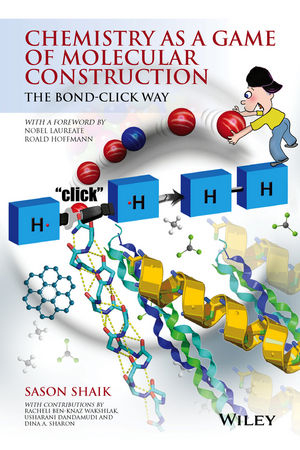
Chemistry as a Game of Molecular Construction (eBook)
John Wiley & Sons (Verlag)
978-1-119-00143-0 (ISBN)
Chemistry as a Game of Molecular Construction: The Bond-Click Way utilizes an innovative and engaging approach to introduce students to the basic concepts and universal aspects of chemistry, with an emphasis on molecules beauty and their importance in our lives. Offers a unique approach that portrays chemistry as a window into mankind s material-chemical essence Reveals the beauty of molecules through the click method, a teaching methodology comprised of the process of constructing molecules from building blocks Styles molecular construction in a way that reveals the universal aspect of chemistry Allows students to construct molecules, from the simple hydrogen molecule all the way to complex strands of DNA, thereby showing the overarching unity of matter Provides problems sets and solutions for each chapter
Sason S. Shaik, PhD, is a Professor and the Director of the Lise Meitner-Minerva Center for Computational Quantum Chemistry in the Hebrew University in Jerusalem. He has been a Fulbright Fellow (1974-1979) and became a Fellow of the AAAS in 2005. Among his awards are the Israel Chemical Society Medal for the Outstanding Young Chemist (1987), the Alexander von Humboldt Senior Award in 1996-1999, the 2001 Kolthoff Award, the 2001 Israel Chemical Society Prize, and the 2007 Schrödinger Medal of WATOC. His research interests are in the use of quantum chemistry to develop paradigms that can pattern data and lead to the generation and solution of new problems. From 1981-1992, the main focus of his research was on valence bond theory and its relationship to MO theory, and during that time, he developed a general model of reactivity based on a blend of VB and MO elements. In 1994, he entered the field of oxidation and bond activation by metal oxo catalysts and enzymes, an area where he has contributed several seminal ideas (e.g., two-state reactivity) that led to resolution of major controversies and new predictions.
PREFACE
COMMENTS TO THE TEACHERS/STUDENTS
This book presents a new way of teaching chemistry. It was written after more than 20 years of teaching introductory chemistry to chemistry-majors, and about 9 years of teaching a course called “Chemistry as a Game of LEGO.” This course was based on material taken from the introductory course I lectured to chemistry majors and then to social scientists and students of humanities. This experience strengthened my feeling that one could teach chemistry to anyone at most ages and project the immense beauty of this science. This is what this book is all about.
During these years, I was extremely fortunate to have teaching assistants and demonstrators who shared my enthusiasm. One of them is Racheli Ben-Knaz (at present, Ben-Knaz Wakshlak). Others were the demonstrators Calvin Delano and Yohann Aouat, who were magicians with a flair for entertaining and staging the “magic of chemistry.”
With Racheli, who contributed the demonstrations included in this book, I had a special rapport. She was a student in all the courses I have given in the Hebrew University since 2003, and she always excelled. But more importantly, her hunger and enthusiasm for knowledge and wisdom made her an ideal student and then a wonderful teaching assistant. During the 3 years we taught the course “Chemistry as a Game of LEGO,” we used to meet frequently to converse about the course material. Our dialogue has become a tool for grooming the ideas and communicating also to students. It also gave us the feeling that we are not only preparing lectures but also staging them so we could impress upon the audience the beauty of our science.
Since I keep a diary, I have documented key points from these conversations. After some experiences in writing trialogues with Roald Hoffmann, I realized that the discussions with Racheli could be interesting for the teachers and students of this textbook. Based on the points I had, I reconstructed, with due freedom, the discussions as conversations on contents of each lecture.
Another person who will appear in these conversations is Usharani Dandamudi (Usha for short). Usha has been an excellent postdoctoral fellow in my group for over 4 years. She too has innate hunger and enthusiasm for knowledge and wisdom. Her subtle understanding of chemistry, dedication to research, and curiosity gradually attracted her to the book that I have been writing starting June 2013. <AUTHOR: Please update the sentence “Her subtle understanding…June 2013” as per current status.>She finally joined us and took care of all the artwork, in addition to reading the entire book and providing insightful feedback. You will see Usha's name in conversations on the contents of some lectures.
A third person that became instrumental in the completion of this book is Dina Sharon, a Princeton Graduate, who has visited my group for 9 months as a Fulbright Scholar. In her hands, almost every detail in the art items and their captions was thoroughly investigated. She found errors that both Usha and I overlooked, and if the art items are now flawless (I hope so), it is due to Dina's incredible editing talents.
The conversations that precede the lectures not only tell about the contents of the lecture, but are also intended occasionally for advising the teacher (e.g., if a certain lecture requires a slide presentation, demonstration tutorial, etc.), and at times providing also background material. These “corridors” into the lectures are generally lighthearted and you may find at least some of them fun to read. An example follows right away, in the dialogue Racheli and I conducted after having started to get some referee reports on the book from the various publishers.
Picture P.1 The author and the two contributors (Racheli in the left photo, Usha in the right photo) to the textbook in conversations.
I owe Racheli, Usha, and Dina a debt of gratitude for their unwavering enthusiasm and assistance during the project. Dina and Usha were hugely important in helping to bring the book to final production. My research associate David Danovich has been helpful in proofreading of the references. I owe a debt of gratitude to Assaf Friedler, Santiago Alvarez, Philip Ball, Zvi Rappoport, Michael Michman, David Avnir, Carol Parish, Helmut Schwarz, Niaz Mansoor, and Roald Hoffmann; who have read some or all of the lectures. Roald participated in the conversation on contents of Lecture 7, and was very encouraging throughout the project. His reading of the entire book and comments were extremely useful. His Preface made me blush… Michael read the book and his message, “the book is a bomb,” sounded divine to my ears. He also designed some of the art in the book. Carol's and Helmut's comments were equally uplifting. Discussions with Avinoam Ben-Shaul on solvation were enlightening. Zehava Cohen drew some of the beautiful artwork in the book.
Thanks are owed also to my colleagues Assaf Friedler and David Avnir at the Hebrew university, who urged me ceaselessly to teach the LEGO course. Ms. Ester Ben-Shoan, the department's administrator, has been a source of major support for the course. She also attended it successfully in 2013. Calvin and Yohann made enchanting contributions to the lectures and their demonstrations enlivened the lectures.
I owe special thanks to my Editor, Anita Lekhwani from Wiley Hoboken, who has been a positive force in my decision to start and finish the project. Her assistant Cecilia Tsai was very helpful in getting permissions, which is the single-most frustrating part of putting a book together.
Every writer of a book has ups and downs. Let me confess mine. In many moments, throughout the time between June 2013 and April 2014, I had the feeling that the completion of the book will require a miracle. This feeling was intensified when I left Israel for two sabbatical months as an Alexander von Humboldt Fellow, and started arranging many seminars and trips. As the schedule during and after my sabbatical looked rather hectic, it was clear to me that the book would be delayed indefinitely. But miracles do happen! Away from my usual place, a great piece of mind engulfed me, and despite the relatively little time I had to devote to the book, I still managed to complete the four final chapters with ease<AUTHOR: Please check the edit made to “Away from my usual place…ease.”> Who said that changes make copping difficult? I owe a debt of gratitude to my Berliner hosts Martin Kaupp and Helmut Schwarz.
Finally, the textbook contains problem sets (and answers in the ending chapter of the textbook) for every lecture. These problems may be helpful for the teacher to prepare the tutoring sessions and “home” assignments. Any teachers, students, who wish to communicate with the author on aspects of the book, are welcome to do so by e-mail (sason@yfaat.ch.huji.ac.il and sason.shaik@gmail.com).
SASON SHAIK
The Hebrew University
Jerusalem, Israel
A CONVERSATION ON THE TEXTBOOK AND ITS INTENDED READERS
- Sason:
-
I am ready for your interview, Racheli. Let's see what you have in mind…
- Racheli:
-
Let me provoke you gently, Sason. Why should someone start using this book? After all, time is precious, and chemistry is not overly cool.
- Sason:
-
Elementary, my dear Racheli. Let me remind you, if you already forgot what a colleague wrote on the book proposal: “I am convinced that any book, which achieves teaching the most important concepts of general chemistry, in a simple and understandable manner, is highly needed.”
This is what the book is all about. It takes the reader into a fascinating journey that shows the universal aspect of chemistry: It argues quite playfully, I think, that we are made of chemical matter, the same matter as any other chemical matter, and hence the book makes a point why knowledge of chemistry is so essential to Mankind.
There is a unity of matter from H2 to the DNA molecule, and chemists have achieved this amazing feat in the 300–350 years of chemistry. In this context, chemistry is a central pillar of human culture. Why not learn about this culture?
I am really provoked now Racheli. I have to introduce the textbook to the prospective readers, and tell them may be what is so special about it.
- Racheli:
-
Oh Sason, no need to preach here. Why not let the book speak for itself?
- Sason:
-
Now, now Racheli, you flipping from being provocative to optimistic… This is the sign of youth… but I am old-fashioned and I believe in telling “my captive audience” what's in store for them…
- Racheli:
-
OK Sason, since you insist…
- Sason:
-
When I started my academic position as a Lecturer in Ben-Gurion University, in 1980, my first teaching assignments were courses in “general chemistry.” Initially, I used a few textbooks for my teaching. Some of these started with the quantum model of the atom and the quantum revolution that ushered it… Others started from quantitative topics like, units (energy, force, distance…), moles, pKa, pH, strong and weak electrolytes, the kinetic theory of gases, etc.
The molecule was of course there all along, but how to construct it from atoms, how to...
| Erscheint lt. Verlag | 4.2.2016 |
|---|---|
| Co-Autor | Racheli Ben-Knaz Wakshlak, Usharani Dandamudi, Dina A. Sharon |
| Vorwort | Roald Hoffmann |
| Sprache | englisch |
| Themenwelt | Naturwissenschaften ► Chemie ► Allgemeines / Lexika |
| Naturwissenschaften ► Chemie ► Technische Chemie | |
| Technik ► Maschinenbau | |
| Schlagworte | atomic connectivity • Atomic structure • atoms • chemical engineering • Chemie • Chemische Verfahrenstechnik • Chemistry • covalent bonds • DNA • Electrons • ionic Bonds • Materials Science • Materialwissenschaften • Molecular Architecture • molecular structure • Molecules • organic molecules • Polymers • proteins • RNA • transition metal complexes |
| ISBN-10 | 1-119-00143-9 / 1119001439 |
| ISBN-13 | 978-1-119-00143-0 / 9781119001430 |
| Informationen gemäß Produktsicherheitsverordnung (GPSR) | |
| Haben Sie eine Frage zum Produkt? |
 EPUB (Adobe DRM)
Kopierschutz: Adobe-DRM
Adobe-DRM ist ein Kopierschutz, der das eBook vor Mißbrauch schützen soll. Dabei wird das eBook bereits beim Download auf Ihre persönliche Adobe-ID autorisiert. Lesen können Sie das eBook dann nur auf den Geräten, welche ebenfalls auf Ihre Adobe-ID registriert sind.
Details zum Adobe-DRM
Dateiformat: EPUB (Electronic Publication)
EPUB ist ein offener Standard für eBooks und eignet sich besonders zur Darstellung von Belletristik und Sachbüchern. Der Fließtext wird dynamisch an die Display- und Schriftgröße angepasst. Auch für mobile Lesegeräte ist EPUB daher gut geeignet.
Systemvoraussetzungen:
PC/Mac: Mit einem PC oder Mac können Sie dieses eBook lesen. Sie benötigen eine
eReader: Dieses eBook kann mit (fast) allen eBook-Readern gelesen werden. Mit dem amazon-Kindle ist es aber nicht kompatibel.
Smartphone/Tablet: Egal ob Apple oder Android, dieses eBook können Sie lesen. Sie benötigen eine
Geräteliste und zusätzliche Hinweise
Buying eBooks from abroad
For tax law reasons we can sell eBooks just within Germany and Switzerland. Regrettably we cannot fulfill eBook-orders from other countries.
aus dem Bereich