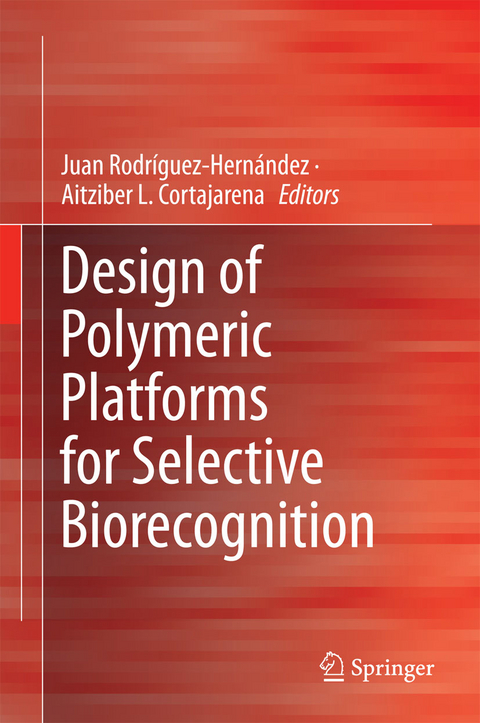
Design of Polymeric Platforms for Selective Biorecognition (eBook)
VIII, 389 Seiten
Springer International Publishing (Verlag)
9783319170619 (ISBN)
Dr. Juan Rodríguez-Hernández is tenured scientist at the Instituto de Ciencia y Tecnologia de Polimeros (Madrid-Spain) since 2008. He obtained his PhD from the Max-Planck Institute for Polymer Research in Mainz, Germany in 2003. He then joined the Laboratoire de Chimie des Polymères Organiques in Bordeaux France as post-doc and later as research fellow until 2008. His research interests include micro/nanostructuration of polymeric surfaces, the preparation of smart surfaces and the control of the interaction of surfaces with microorganisms.
Dr. Aitziber L. Cortajarena earned her Ph.D. in Biochemistry from the Universidad del País Vasco in 2002. Then, she joined the group of Prof. L. Regan at Yale University, USA, as a Postdoctoral Fellow. She worked on protein design, structure, and function. She joined IMDEA Nanociencia as Group Leader in 2010 and started her independent research lines. Her research focuses on protein engineering for biotechnological applications and the generation of biofunctional nanostructures, surfaces, and bioinspired materials for applications in nano-biotechnology and nanomedicine.
Dr. Juan Rodríguez-Hernández is tenured scientist at the Instituto de Ciencia y Tecnologia de Polimeros (Madrid-Spain) since 2008. He obtained his PhD from the Max-Planck Institute for Polymer Research in Mainz, Germany in 2003. He then joined the Laboratoire de Chimie des Polymères Organiques in Bordeaux France as post-doc and later as research fellow until 2008. His research interests include micro/nanostructuration of polymeric surfaces, the preparation of smart surfaces and the control of the interaction of surfaces with microorganisms.Dr. Aitziber L. Cortajarena earned her Ph.D. in Biochemistry from the Universidad del País Vasco in 2002. Then, she joined the group of Prof. L. Regan at Yale University, USA, as a Postdoctoral Fellow. She worked on protein design, structure, and function. She joined IMDEA Nanociencia as Group Leader in 2010 and started her independent research lines. Her research focuses on protein engineering for biotechnological applications and the generation of biofunctional nanostructures, surfaces, and bioinspired materials for applications in nano-biotechnology and nanomedicine.
Chapter 1. Selective Biorecognition On Polymer Surfaces: General Issues
Dr. J Rodríguez-Hernández, Dr. A L. Cortajarena)
Chapter 2. Patterning And Functionalization Of Polymeric Surfaces
Dr. J. Rodriguez-Hernandez)
Chapter 3. Biorecognition Molecules: Types And Molecular Basis And Development Of Specificity
(Dr. A. L. Cortajarena, Dr. Robert Collins)
Chapter 4. Chemical Surface Biofunctionalization Of Polymers
(Dr. Guillaume Delaittre)
Chapter 5. Gradient Polymer Surfaces For Biomedical Applications
(Prof. Nikolaj Gadegaard)
Chapter 6. Polymer Replication Techniques
(Prof. Nikolaj Gadegaard)
Chapter 7. Lithographic Processes For The Design Of Biosurfaces
(Prof. Nicolas Delorme)
Chapter 8. Inkjet Printing Of Biomolecules For Biorecognition
(Dr. Daniel Citterio)
Chapter 9. Honeycomb Structured Films Prepared By Breath Figures: Fabrication And Application For Biorecognition Purposes
(Dr. Alexandra Muñoz-Bonilla, Dr. J Rodríguez-Hernández)
Chapter 10. Polymer Brushes With Precise Architectures For Molecular Biorecognition
(Dr. Rodrigo Navarro)
Chapter 11. Microfluidic Systems With Functional Patterned Surface For Biomedical Applications
(Dr. Kin Fong Lei)
Chapter 12. Biopatterns Created Using Colloidal Templates
(Dr. Qin Li)
Chapter 13. Electrochemical Approaches For Molecular Surface Imprinting Of Polymers. Towards Fully Synthetic Receptors For Selective Recognition Of Proteins
(Prof. Frieder W. Scheller, Dr. Decha Dechtrirat, Aysu Yarman)
Chapter 14. Bio-Nanostructured Interfaces Fabricated By Scanning Probe Nanolithography (Spn) (Dr. J. Rodríguez-Hernández)
Chapter 15. Conclusions And Perspectives
(Dr. J. Rodríguez-Hernández, Dr. A. L. Cortajarena)
| Erscheint lt. Verlag | 21.8.2015 |
|---|---|
| Zusatzinfo | VIII, 389 p. 165 illus., 111 illus. in color. |
| Verlagsort | Cham |
| Sprache | englisch |
| Themenwelt | Naturwissenschaften ► Physik / Astronomie |
| Technik ► Maschinenbau | |
| Wirtschaft | |
| Schlagworte | Biointerfaces • Biomolecular Specificity • Biorecognition Moieties • Biorecognition Platforms • Biotechnology • Cell Immobilization • Functional Surfaces • polymer surfaces • Selective Immobilization • Surface Chemistry • surface patterning |
| ISBN-13 | 9783319170619 / 9783319170619 |
| Informationen gemäß Produktsicherheitsverordnung (GPSR) | |
| Haben Sie eine Frage zum Produkt? |
 PDF (Wasserzeichen)
DRM: Digitales Wasserzeichen
Dieses eBook enthält ein digitales Wasserzeichen und ist damit für Sie personalisiert. Bei einer missbräuchlichen Weitergabe des eBooks an Dritte ist eine Rückverfolgung an die Quelle möglich.
Dateiformat: PDF (Portable Document Format)
Mit einem festen Seitenlayout eignet sich die PDF besonders für Fachbücher mit Spalten, Tabellen und Abbildungen. Eine PDF kann auf fast allen Geräten angezeigt werden, ist aber für kleine Displays (Smartphone, eReader) nur eingeschränkt geeignet.
Systemvoraussetzungen:
PC/Mac: Mit einem PC oder Mac können Sie dieses eBook lesen. Sie benötigen dafür einen PDF-Viewer - z.B. den Adobe Reader oder Adobe Digital Editions.
eReader: Dieses eBook kann mit (fast) allen eBook-Readern gelesen werden. Mit dem amazon-Kindle ist es aber nicht kompatibel.
Smartphone/Tablet: Egal ob Apple oder Android, dieses eBook können Sie lesen. Sie benötigen dafür einen PDF-Viewer - z.B. die kostenlose Adobe Digital Editions-App.
Buying eBooks from abroad
For tax law reasons we can sell eBooks just within Germany and Switzerland. Regrettably we cannot fulfill eBook-orders from other countries.
aus dem Bereich