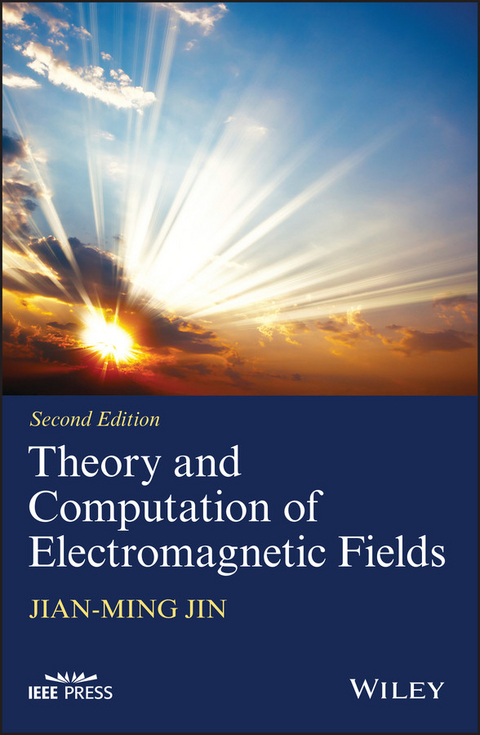
Theory and Computation of Electromagnetic Fields (eBook)
John Wiley & Sons (Verlag)
978-1-119-10809-2 (ISBN)
Reviews the fundamental concepts behind the theory and computation of electromagnetic fields
The book is divided in two parts. The first part covers both fundamental theories (such as vector analysis, Maxwell's equations, boundary condition, and transmission line theory) and advanced topics (such as wave transformation, addition theorems, and fields in layered media) in order to benefit students at all levels. The second part of the book covers the major computational methods for numerical analysis of electromagnetic fields for engineering applications. These methods include the three fundamental approaches for numerical analysis of electromagnetic fields: the finite difference method (the finite difference time-domain method in particular), the finite element method, and the integral equation-based moment method. The second part also examines fast algorithms for solving integral equations and hybrid techniques that combine different numerical methods to seek more efficient solutions of complicated electromagnetic problems.
Theory and Computation of Electromagnetic Fields, Second Edition:
- Provides the foundation necessary for graduate students to learn and understand more advanced topics
- Discusses electromagnetic analysis in rectangular, cylindrical and spherical coordinates
- Covers computational electromagnetics in both frequency and time domains
- Includes new and updated homework problems and examples
JIAN-MING JIN, Ph.D., is the Y. T. Lo Chair Professor in Electrical and Computer Engineering and Director of the Electromagnetics Laboratory and Center for Computational Electromagnetics at the University of Illinois at Urbana-Champaign. He authored The Finite Element Method in Electromagnetics, Third Edition (Wiley 2014) and Electromagnetic Analysis and Design in Magnetic Resonance Imaging, and co-authored Computation of Special Functions (Wiley 1996), Finite Element Analysis of Antennas and Arrays (Wiley 2008), and Fast and Efficient Algorithms in Computational Electromagnetics. A Fellow of the IEEE, he is listed by ISI among the world's most cited authors.
JIAN-MING JIN, Ph.D., is the Y. T. Lo Chair Professor in Electrical and Computer Engineering and Director of the Electromagnetics Laboratory and Center for Computational Electromagnetics at the University of Illinois at Urbana-Champaign. He authored The Finite Element Method in Electromagnetics, Third Edition (Wiley 2014) and Electromagnetic Analysis and Design in Magnetic Resonance Imaging, and co-authored Computation of Special Functions (Wiley 1996), Finite Element Analysis of Antennas and Arrays (Wiley 2008), and Fast and Efficient Algorithms in Computational Electromagnetics. A Fellow of the IEEE, he is listed by ISI among the world's most cited authors.
Preface
As is implicit in its title, this book consists of two parts. Part 1 is on the theory of electromagnetic fields and is intended to serve as a textbook for an entry-level graduate course on electromagnetics. Part 2 is on the computation of electromagnetic fields and is intended for an advanced-level graduate course on computational electromagnetics. While there are several textbooks available for the entry-level graduate electromagnetics course, no textbook is available for the advanced course on computational electromagnetics. This book is intended to fill this void and present the electromagnetic theory in a systematic manner so that students can advance from the first course to the second without much difficulty.
Although the first part of the book covers the standard basic electromagnetic theory, the coverage is different from that of existing textbooks, mainly because of the undergraduate curriculum reform that has happened during the past two decades. Many universities have reduced the number of required courses in order to give students more freedom to design their own portfolios. As a result, only one electromagnetics course is required for undergraduate students in most electrical engineering departments in the country. New graduate students come to take the graduate electromagnetics course with significant differences in their knowledge of the basic electromagnetic theory. To meet the challenge to benefit all students of different levels, our course contents cover both fundamental theories (such as vector analysis, Maxwell's equations and boundary conditions, and transmission-line theory) and advanced topics (such as wave transformation, addition theorems, and scattering by a layered sphere).
When writing the first part of this book, the author has kept the following in mind. First, this book is not intended to be an extensive reference book on electromagnetic theory. It should cover only the fundamental components that electrical engineering graduate students need to know so that they have the foundation to learn more advanced topics in the future, and all the material can be taught within one semester. Therefore, we have to be very selective in choosing topics to be covered. Second, the style of the book should fit classroom teaching and self-learning, rather than use as a reference book. For example, it would be desirable for a reference book to have a chapter to present a complete theory of Green's functions. However, for classroom teaching, it would be better to introduce new ideas and concepts piece by piece as needed. Third, the writing and teaching should adhere to the central theme that the entire electromagnetic theory is developed based on Maxwell's equations by using mathematics as a tool. The treatment of every subject should start with Maxwell's equations or something based on Maxwell's equations directly.
The second part of the book covers a few major computational methods for numerical analysis of electromagnetic fields for engineering applications. These include the finite difference method (and the finite difference time-domain method in particular), the finite element method, and the integral equation-based moment method. These three methods are chosen because they represent the three fundamental approaches for numerical analysis of electromagnetic fields. Once the students are familiar with these three methods, they can learn other numerical methods easily. This part also covers fast algorithms for solving integral equations and hybrid techniques that combine different numerical methods to seek for more efficient and capable solutions of complicated electromagnetic problems. The computational electromagnetics course based on this part has become increasingly popular as more areas use computational electromagnetics as an analysis and simulation tool for dealing with electromagnetic problems. At the University of Illinois, this course has been taken by many students outside the electromagnetics major and some even outside the electrical engineering major.
The following is a summary of the material covered in this book. Chapter 1 presents the basic electromagnetic theory, which includes a brief review of vector analysis, Maxwell's equations in both integral and differential forms, boundary conditions at the interface between different media and at the surface of a perfect conductor, constitutive relations that characterize the electromagnetic properties of a medium, the concepts of electromagnetic energy and power, and Maxwell's equations for time-harmonic fields. In this chapter, the symbolic vector method is introduced to facilitate the vector analysis, and Maxwell's equations in integral form have been treated as fundamental postulates to derive Maxwell's equations in differential form and various boundary conditions.
In Chapter 2, we deal with electromagnetic fields radiated in free space by solving Maxwell's equations in differential form with the aid of the constitutive relations. Scalar and vector potentials are introduced as auxiliary functions to facilitate the solution. The advantage of using these auxiliary potential functions is discussed. The concept of Green's functions and dyadic Green's functions is also introduced as a means to relate the field to its source. The far-field approximation of the radiated field is considered, and the results are used to derive the Sommerfeld radiation condition.
Chapter 3 presents some important theorems and principles that can be derived from Maxwell's equations. The first is the uniqueness theorem, which is then used as a foundation to develop the image theory and the surface equivalence principle. The induction theorem, the physical equivalent, and the solution to aperture radiation are also derived as an application of the surface equivalence principle. The symmetry in Maxwell's equations is explored to develop the duality principle, and the electromagnetic Babinet's principle is presented along with its application to complementary structures.
The objective of Chapter 4 is to consider a uniform plane wave and examine its propagation in an unbounded homogeneous medium to gain a better understanding of the characteristics of wave propagation. The basic transmission-line theory is reviewed first, to introduce some basic concepts related to wave propagation such as propagation and attenuation constants and various velocities. The wave equation is then solved by separation of variables in rectangular coordinates, and the basic characteristics of a plane wave such as wave impedance and polarizations are discussed. A few simple boundary-value problems are solved, which include plane waves generated by a current sheet and reflection and transmission of a plane wave at an interface between two different half-spaces. Also discussed are plane wave propagation in uniaxial, gyrotropic, chiral, and metamaterial media and transmission into a left-handed medium.
In Chapter 5, we deal with wave propagation in either homogeneously filled or inhomogeneously filled uniform waveguides and dielectric waveguides and electromagnetic resonance in cavities. We first present a general analysis and derive the basic characteristics for waveguides and cavities, and then we use a rectangular waveguide and cavity to illustrate the analysis and the basic properties. The perturbational method is introduced to calculate the attenuation constants and quality factors for imperfect waveguides and cavities and to analyze the resonance variation due to material and geometry perturbations in a cavity. The analysis of hybrid modes in a partially filled waveguide and in a grounded dielectric slab waveguide is described in detail. Field excitation by a current source in a waveguide and a multilayered medium is also discussed because of its importance in practical applications.
In Chapter 6, we discuss electromagnetic analysis in the cylindrical coordinate system. We first discuss the solution of the Helmholtz equation by the method of separation of variables and derive cylindrical wave functions. We then employ cylindrical wave functions to analyze circular and coaxial waveguides and cavities. This is followed by the analysis of wave propagation along a circular dielectric waveguide. After that, we derive a wave transformation that expands a plane wave in terms of cylindrical wave functions. The derived wave transformation is then used for solving various scattering problems involving a conducting or dielectric cylinder. Finally, we discuss a few radiation problems in which a line current or a cylindrical surface current radiates in the presence of a conducting cylinder or a conducting wedge. The solution is used to derive the Sommerfeld radiation condition for two-dimensional fields and to illustrate the phenomenon of the transverse field singularity at a conductingedge.
In Chapter 7, we discuss electromagnetic analysis in a spherical coordinate system. We first discuss the solution of the Helmholtz equation by the method of separation of variables and derive spherical wave functions. We then employ spherical wave functions to analyze a spherical cavity and a biconical antenna. This is followed by a wave transformation that expands a plane wave in terms of spherical wave functions. The derived wave transformation is then used for solving various scattering problems involving a conducting or a dielectric sphere. Finally, we consider the problem of radiation of a point charge to derive the addition theorem for spherical wave functions and the radiation of a spherical surface current in the presence of a sphere or a cone to illustrate the radiation analysis in...
| Erscheint lt. Verlag | 26.8.2015 |
|---|---|
| Reihe/Serie | IEEE Press |
| Wiley - IEEE | Wiley - IEEE |
| Sprache | englisch |
| Themenwelt | Naturwissenschaften ► Physik / Astronomie ► Elektrodynamik |
| Technik ► Elektrotechnik / Energietechnik | |
| Schlagworte | Bessel functions • Electrical & Electronics Engineering • electromagnetic field theory • Electromagnetic theory • Elektromagnetismus • Elektrotechnik u. Elektronik • Finite Electric Dipole • Green’s Theorems • Helmholtz decomposition theorem • Infinitesimal Electric Dipole • Lorenz Gauge Condition • Maxwell’s equations • Numerical Methods & Algorithms • Numerische Methoden u. Algorithmen • Plane waves • Poynting’s Theorem • Reciprocity theorems • Scattering Analysis • The Finite Difference Method • the finite element method • The Lorentz Force Law • The Method of Moments • Time-Harmonic Fields • Transmission Line Theory • Uniform Cavities • Uniform Waveguides • Vector analysis • Wave Transformation • Yee’s FDTD Scheme |
| ISBN-10 | 1-119-10809-8 / 1119108098 |
| ISBN-13 | 978-1-119-10809-2 / 9781119108092 |
| Informationen gemäß Produktsicherheitsverordnung (GPSR) | |
| Haben Sie eine Frage zum Produkt? |
 EPUB (Adobe DRM)
Kopierschutz: Adobe-DRM
Adobe-DRM ist ein Kopierschutz, der das eBook vor Mißbrauch schützen soll. Dabei wird das eBook bereits beim Download auf Ihre persönliche Adobe-ID autorisiert. Lesen können Sie das eBook dann nur auf den Geräten, welche ebenfalls auf Ihre Adobe-ID registriert sind.
Details zum Adobe-DRM
Dateiformat: EPUB (Electronic Publication)
EPUB ist ein offener Standard für eBooks und eignet sich besonders zur Darstellung von Belletristik und Sachbüchern. Der Fließtext wird dynamisch an die Display- und Schriftgröße angepasst. Auch für mobile Lesegeräte ist EPUB daher gut geeignet.
Systemvoraussetzungen:
PC/Mac: Mit einem PC oder Mac können Sie dieses eBook lesen. Sie benötigen eine
eReader: Dieses eBook kann mit (fast) allen eBook-Readern gelesen werden. Mit dem amazon-Kindle ist es aber nicht kompatibel.
Smartphone/Tablet: Egal ob Apple oder Android, dieses eBook können Sie lesen. Sie benötigen eine
Geräteliste und zusätzliche Hinweise
Buying eBooks from abroad
For tax law reasons we can sell eBooks just within Germany and Switzerland. Regrettably we cannot fulfill eBook-orders from other countries.
aus dem Bereich