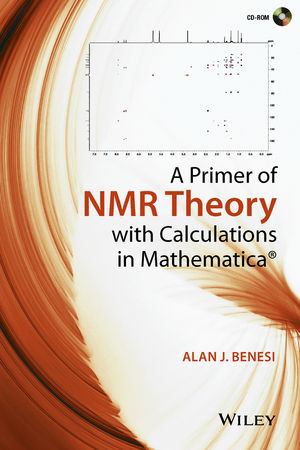
A Primer of NMR Theory with Calculations in Mathematica (eBook)
John Wiley & Sons (Verlag)
978-1-119-05215-9 (ISBN)
- Provides short, focused chapters with brief explanations of well-defined topics with an emphasis on a mathematical description
- Presents essential results from quantum mechanics concisely and for easy use in predicting and simulating the results of NMR experiments
- Includes Mathematica notebooks that implement the theory in the form of text, graphics, sound, and calculations
- Based on class tested methods developed by the author over his 25 year teaching career. These notebooks show exactly how the theory works and provide useful calculation templates for NMR researchers
Alan J. Benesi was Director of the Pennsylvania State University NMR Facility from 1987-2012. He earned his Ph.D. in Biophysics at the University of California, Berkeley, in 1975. He has published many papers related to solid state and liquid state NMR, solid state and liquid state NMR relaxation, and rotational and translational diffusion.
Presents the theory of NMR enhanced with Mathematica notebooks Provides short, focused chapters with brief explanations of well-defined topics with an emphasis on a mathematical description Presents essential results from quantum mechanics concisely and for easy use in predicting and simulating the results of NMR experiments Includes Mathematica notebooks that implement the theory in the form of text, graphics, sound, and calculations Based on class tested methods developed by the author over his 25 year teaching career. These notebooks show exactly how the theory works and provide useful calculation templates for NMR researchers
Alan J. Benesi was Director of the Pennsylvania State University NMR Facility from 1987-2012. He earned his Ph.D. in Biophysics at the University of California, Berkeley, in 1975. He has published many papers related to solid state and liquid state NMR, solid state and liquid state NMR relaxation, and rotational and translational diffusion.
Cover 1
Half-Title Page 3
Title Page 5
Copyright Page 6
Contents 7
Preface 11
Chapter 1 Introduction 13
Chapter 2 Using Mathematica Homework Philosophy
Chapter 3 The NMR Spectrometer 17
Chapter 4 The NMR Experiment 21
Chapter 5 Classical Magnets and Precession 25
Explanation of Mathematica Programming in magdipoleanimation.nb 27
Chapter 6 The Bloch Equation in the Laboratory Reference Frame 31
Explanation of bloch1.nb 32
Chapter 7 The Bloch Equation in the Rotating Frame 35
Explanation of bloch2animation.nb 37
Explanation of bloch3animation.nb 37
Homework 38
Chapter 8 The Vector Model 39
Chapter 9 Fourier Transform of the NMR Signal 45
Explanation of fouriertransform2.nb 45
Homework 46
Chapter 10 Essentials of Quantum Mechanics 47
Chapter 11 The Time-Dependent Schrödinger Equation, Matrix Representation of Nuclear Spin Angular Momentum Operators 51
Explanation of vector_matrix.nb 53
Explanation of matrep2.nb 54
Explanation of matrixformoperators.nb 54
Homework 54
Chapter 12 The Density Operator 55
Chapter 13 The Liouville–von Neumann Equation 57
Chapter 14 The Density Operator at Thermal Equilibrium 59
Explanation of equil_densitymatrix.nb 61
Chapter 15 Hamiltonians of NMR: Isotropic Liquid-State Hamiltonians 63
Chapter 16 The Direct Product Matrix Representation of Coupling Hamiltonians HJ and HD 69
Explanation of directproduct.nb 71
Homework 72
Chapter 17 Solving the Liouville–Von Neumann Equation for the Time Dependence of the Density Matrix 73
Case 1 Diagonal Hamiltonian 74
Case 2 Nondiagonal Hamiltonian 75
Explanation of densitymatrix_primer.nb 76
Chapter 18 The Observable NMR Signal 79
Explanation of ladder_operator.nb 80
Chapter 19 Commutation Relations of Spin Angular Momentum Operators 81
Explanation of commutators.nb 84
Homework 84
Chapter 20 The Product Operator Formalism 85
Explanation of shortspin.nb 86
Explanation of poma.nb 87
Chapter 21 NMR Pulse Sequences and Phase Cycling 89
Chapter 22 Analysis of Liquid-State NMR Pulse Sequences with the Product Operator Formalism 93
Explanation of 1pulseshort.nb 96
Explanation of echooneortwo.nb 97
Chapter 23 Analysis of the Inept Pulse Sequence with Program Shortspin and Program Poma 99
Explanation of inept.nb 100
Explanation of ineptpoma.nb 101
Homework 102
Chapter 24 The Radio Frequency Hamiltonian 103
Explanation of excitation_bandwidth.nb 105
Chapter 25 Comparison of 1D and 2D NMR 107
Chapter 26 Analysis of the HSQC, HMQC, and DQF-COSY 2D NMR Experiments 111
Explanation of hsqc_shortspin.nb 114
Explanation of hsqc_poma.nb 115
Explanation of hmqc_shortspin.nb 116
Explanation of hmqc_poma.nb 116
Homework 117
Chapter 27 Selection of Coherence Order Pathways with Phase Cycling 119
Explanation of phaseshift.nb 124
Explanation of phasecycle.nb 125
Explanation of double_quantum_poma.nb 125
Homework 126
Chapter 28 Selection of Coherence Order Pathways with Pulsed Magnetic Field Gradients 127
Homework 133
Chapter 29 Hamiltonians of NMR: Anisotropic Solid-State Internal Hamiltonians in Rigid Solids 135
Explanation of solid_hamiltonians.nb 140
Explanation of hcs_cartesian.nb 141
Explanation of wigrot.nb 142
Explanation of hcsstatlineshape.nb 142
Homework 143
Chapter 30 Rotations of Real Space Axis Systems—Cartesian Method 145
Explanation of euler.nb 146
Explanation of rotations.nb 147
Homework 147
Chapter 31 Wigner Rotations of Irreducible Spherical Tensors 149
Explanation of wigner_orthogonality.nb 153
Explanation of spherical_tensors_wigner.nb 153
Homework 154
Chapter 32 Solid-State NMR Real Space Spherical Tensors 155
Static Samples of Powdered Solids 155
Static Single Crystals 156
Multiple Hamiltonians and Real Space Tensors for Static Powdered Solid Samples 156
Magic Angle Spinning of Powdered Solid Samples 157
Explanation of real_tensor_solid.nb 158
Homework 159
Chapter 33 Time-Independent Perturbation Theory 161
Explanation of rigiddeutlineshapes.nb 166
Explanation of Hq2pert.nb 166
Explanation of Hq2pert2.nb 167
Homework 167
Chapter 34 Average Hamiltonian Theory 169
Explanation of Hqavg2 170
Explanation of Hqavg2new.nb 170
Homework 171
Chapter 35 The Powder Average 173
Time-Independent Perturbation Theory Powder Spectra 173
Powder Average Density Operator 174
Explanation of repulsionbook.nb 174
Chapter 36 Overview of Molecular Motion and NMR 177
Homework 179
Chapter 37 Slow, Intermediate, And Fast Exchange In Liquid?State Nmr Spectra 181
Explanation of twosite exchange.nb 184
Homework 184
Chapter 38 Exchange in Solid-State NMR Spectra 185
Explanation of tetrahedral jump wignerology.nb 189
Explanation of tetrahedron.nb 190
Explanation of tetrahedraljumpspowder.nb 190
Explanation of tetjumpspowderfid.nb 191
Explanation of tetrahedral fast jump wignerology.nb 192
Explanation of c2jumpfast.nb 192
Homework 193
Chapter 39 NMR Relaxation: What is NMR Relaxation and What Causes It? 195
Explanation of spectraldensity.nb 198
Homework 199
Chapter 40 Practical Considerations for the Calculation of NMR Relaxation Rates 201
Chapter 41 The Master Equation for NMR Relaxation—Single Spin Species I 203
General Derivation 203
Quadrupolar Relaxation, I = 1 208
Homonuclear Relaxation of Dipolar and J-Coupled Spins (e.g., Two I = 1/2 Coupled Spins) 210
Chemical Shift Relaxation 212
Explanation of spintensors_matrix.nb 213
Explanation of ClebschGordan.nb 214
Explanation of spintensor_couple_matrix.nb 214
Homework 215
Chapter 42 Heteronuclear Dipolar and J Relaxation 217
Chapter 43 Calculation of Autocorrelation Functions, Spectral Densities, and NMR Relaxation Times for Jump Motions in Solids 223
Explanation of torchiaszabotetqcceta_book.nb 228
Explanation of c2jumpstorchiaszabo_book.nb 230
Homework 231
Chapter 44 Calculation of Autocorrelation Functions and Spectral Densities for Isotropic Rotational Diffusion 233
Explanation of isotropicrotdiffy.nb 235
Homework 236
Chapter 45 Conclusion 237
Bibliography 239
Index 243
CD-ROM Content 249
EULA 250
| Erscheint lt. Verlag | 19.5.2015 |
|---|---|
| Sprache | englisch |
| Themenwelt | Naturwissenschaften ► Chemie ► Analytische Chemie |
| Naturwissenschaften ► Physik / Astronomie ► Elektrodynamik | |
| Technik | |
| Schlagworte | Chemie • Chemistry • NMR, NMR theory, solid state NMR, NMR relaxation, NMR pulse sequences, NMR simulations, Molecular Motion and NMR, Density Operator, Density Matrix, Wigner rotations, spherical tensors, product operator theory, jump motions in solids, rotational diffusion in liquids • NMR Spectroscopy / MRI / Imaging • NMR-Spektroskopie • NMR-Spektroskopie / MRT / Bildgebende Verfahren • Organic Chemistry • Organische Chemie • Physics • Physik |
| ISBN-10 | 1-119-05215-7 / 1119052157 |
| ISBN-13 | 978-1-119-05215-9 / 9781119052159 |
| Informationen gemäß Produktsicherheitsverordnung (GPSR) | |
| Haben Sie eine Frage zum Produkt? |
 PDF (Adobe DRM)
Kopierschutz: Adobe-DRM
Adobe-DRM ist ein Kopierschutz, der das eBook vor Mißbrauch schützen soll. Dabei wird das eBook bereits beim Download auf Ihre persönliche Adobe-ID autorisiert. Lesen können Sie das eBook dann nur auf den Geräten, welche ebenfalls auf Ihre Adobe-ID registriert sind.
Details zum Adobe-DRM
Dateiformat: PDF (Portable Document Format)
Mit einem festen Seitenlayout eignet sich die PDF besonders für Fachbücher mit Spalten, Tabellen und Abbildungen. Eine PDF kann auf fast allen Geräten angezeigt werden, ist aber für kleine Displays (Smartphone, eReader) nur eingeschränkt geeignet.
Systemvoraussetzungen:
PC/Mac: Mit einem PC oder Mac können Sie dieses eBook lesen. Sie benötigen eine
eReader: Dieses eBook kann mit (fast) allen eBook-Readern gelesen werden. Mit dem amazon-Kindle ist es aber nicht kompatibel.
Smartphone/Tablet: Egal ob Apple oder Android, dieses eBook können Sie lesen. Sie benötigen eine
Geräteliste und zusätzliche Hinweise
Buying eBooks from abroad
For tax law reasons we can sell eBooks just within Germany and Switzerland. Regrettably we cannot fulfill eBook-orders from other countries.
aus dem Bereich