Computational Pharmaceutics (eBook)
John Wiley & Sons (Verlag)
978-1-118-57396-9 (ISBN)
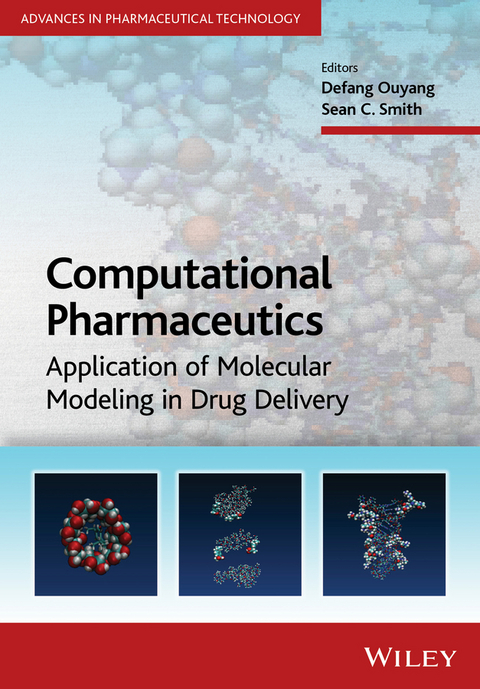
Molecular modeling techniques have been widely used in drug discovery fields for rational drug design and compound screening. Now these techniques are used to model or mimic the behavior of molecules, and help us study formulation at the molecular level. Computational pharmaceutics enables us to understand the mechanism of drug delivery, and to develop new drug delivery systems.
The book discusses the modeling of different drug delivery systems, including cyclodextrins, solid dispersions, polymorphism prediction, dendrimer-based delivery systems, surfactant-based micelle, polymeric drug delivery systems, liposome, protein/peptide formulations, non-viral gene delivery systems, drug-protein binding, silica nanoparticles, carbon nanotube-based drug delivery systems, diamond nanoparticles and layered double hydroxides (LDHs) drug delivery systems.
Although there are a number of existing books about rational drug design with molecular modeling techniques, these techniques still look mysterious and daunting for pharmaceutical scientists. This book fills the gap between pharmaceutics and molecular modeling, and presents a systematic and overall introduction to computational pharmaceutics. It covers all introductory, advanced and specialist levels. It provides a totally different perspective to pharmaceutical scientists, and will greatly facilitate the development of pharmaceutics. It also helps computational chemists to look for the important questions in the drug delivery field.
This book is included in the Advances in Pharmaceutical Technology book series.
Dr Defang Ouyang is at the Institute of Medical Sciences, University of Macau in China as well as Aston University, UK. He has a multi-disciplinary and unique background and expertise in both drug delivery and molecular modeling. He completed his PhD at The University of Queensland, Australia in 2010. Since joining Aston, he has pioneered the application of molecular modeling techniques in the field of drug delivery - 'computational pharmaceutics', including cyclodextrin-drug complexes, solid dispersions, non-viral gene delivery systems and liposome formulations. So far, he has authored over 20 refereed publications, consisting of an invited book, a book chapter, invited reviews, journal articles, conference papers and patents.
Professor Sean C. Smith is at the School of Chemical Engineering, University of New South Wales, Australia. He was previously Director of the Center for Nanophase Materials Sciences at Oak Ridge National Laboratory, USA. He is firmly established internationally as a significant figure in the field of theoretical and computational chemistry. His contributions include theoretical studies of chemical reactions, material sciences, nano science and biological sciences. His publications include one book, three invited chapters, three invited reviews, and 203 refereed journal articles.
Molecular modeling techniques have been widely used in drug discovery fields for rational drug design and compound screening. Now these techniques are used to model or mimic the behavior of molecules, and help us study formulation at the molecular level. Computational pharmaceutics enables us to understand the mechanism of drug delivery, and to develop new drug delivery systems. The book discusses the modeling of different drug delivery systems, including cyclodextrins, solid dispersions, polymorphism prediction, dendrimer-based delivery systems, surfactant-based micelle, polymeric drug delivery systems, liposome, protein/peptide formulations, non-viral gene delivery systems, drug-protein binding, silica nanoparticles, carbon nanotube-based drug delivery systems, diamond nanoparticles and layered double hydroxides (LDHs) drug delivery systems. Although there are a number of existing books about rational drug design with molecular modeling techniques, these techniques still look mysterious and daunting for pharmaceutical scientists. This book fills the gap between pharmaceutics and molecular modeling, and presents a systematic and overall introduction to computational pharmaceutics. It covers all introductory, advanced and specialist levels. It provides a totally different perspective to pharmaceutical scientists, and will greatly facilitate the development of pharmaceutics. It also helps computational chemists to look for the important questions in the drug delivery field. This book is included in the Advances in Pharmaceutical Technology book series.
Dr Defang Ouyang is at the Institute of Medical Sciences, University of Macau in China as well as Aston University, UK. He has a multi-disciplinary and unique background and expertise in both drug delivery and molecular modeling. He completed his PhD at The University of Queensland, Australia in 2010. Since joining Aston, he has pioneered the application of molecular modeling techniques in the field of drug delivery - "computational pharmaceutics", including cyclodextrin-drug complexes, solid dispersions, non-viral gene delivery systems and liposome formulations. So far, he has authored over 20 refereed publications, consisting of an invited book, a book chapter, invited reviews, journal articles, conference papers and patents. Professor Sean C. Smith is at the School of Chemical Engineering, University of New South Wales, Australia. He was previously Director of the Center for Nanophase Materials Sciences at Oak Ridge National Laboratory, USA. He is firmly established internationally as a significant figure in the field of theoretical and computational chemistry. His contributions include theoretical studies of chemical reactions, material sciences, nano science and biological sciences. His publications include one book, three invited chapters, three invited reviews, and 203 refereed journal articles.
Chapter 1. Introduction of computational pharmaceutics
Defang Ouyang
Chapter 2. Crystal energy landscapes for aiding crystal form selection
Sarah Price
Chapter 3. Solubilization of poor-soluble drugs in cyclodextron formulation
Defang Ouyang
Chapter 4. Molecular Modeling for Polymeric and Micellar Drug Delivery
Sharon M. Loverde
Chapter 5. Solid dispersion - a pragmatic method to improve the bioavailability of poorly soluble drugs
Defang Ouyang
Chapter 6. Computer simulations of lipid membranes and liposomes for drug delivery
Becky Notman
Chapter 7. Molecular modeling for protein aggregation and formulation
Jim Warwicker
Chapter 8. Computational simulation of drug delivery by nano-materials at molecular level
Youyong Li
Chapter 9. Molecular and analytical modeling of nanodiamond for drug delivery applications
Amanda Barnard
Chapter 10. Molecular modeling of LDH drug delivery systems
Vinuthaa Murthy
Chapter 11. Molecular dynamics simulation as a tool to study the efficacy of PEGylation
Alex Bunker
Chapter 12. Synchrotron Radiation Micro Computed Tomography: a new approach for quantitative 3D structural architecture of drug delivery systems
Jiwen Zhang
Chapter 13. Pharmacokinetic modelling and simulation in drug delivery
Raj
Index
| Erscheint lt. Verlag | 18.5.2015 |
|---|---|
| Reihe/Serie | Advances in Pharmaceutical Technology |
| Advances in Pharmaceutical Technology | Advances in Pharmaceutical Technology |
| Mitarbeit |
Herausgeber (Serie): Dennis Douroumis, Alfred Fahr, Juergen Siepmann, Martin J. Snowden, Vladimir P. Torchilin |
| Sprache | englisch |
| Themenwelt | Naturwissenschaften ► Chemie ► Technische Chemie |
| Technik | |
| Schlagworte | Chemie • Chemistry • Computational Chemistry • Computational Chemistry & Molecular Modeling • Computational Chemistry u. Molecular Modeling • computational pharmaceutics • Computer Modelling • Drug Delivery • Drug Formulation & Delivery • Formulation • molecular dynamics • Molecular Modelling • nanomedicine • Nanomedizin • Nanotechnologie • nanotechnology • Pharmaceutics • Pharmacokinetic Modelling • Pharmazie • Wirkstoffformulierung, Wirkstofftransport |
| ISBN-10 | 1-118-57396-X / 111857396X |
| ISBN-13 | 978-1-118-57396-9 / 9781118573969 |
| Informationen gemäß Produktsicherheitsverordnung (GPSR) | |
| Haben Sie eine Frage zum Produkt? |
 PDF (Adobe DRM)
Kopierschutz: Adobe-DRM
Adobe-DRM ist ein Kopierschutz, der das eBook vor Mißbrauch schützen soll. Dabei wird das eBook bereits beim Download auf Ihre persönliche Adobe-ID autorisiert. Lesen können Sie das eBook dann nur auf den Geräten, welche ebenfalls auf Ihre Adobe-ID registriert sind.
Details zum Adobe-DRM
Dateiformat: PDF (Portable Document Format)
Mit einem festen Seitenlayout eignet sich die PDF besonders für Fachbücher mit Spalten, Tabellen und Abbildungen. Eine PDF kann auf fast allen Geräten angezeigt werden, ist aber für kleine Displays (Smartphone, eReader) nur eingeschränkt geeignet.
Systemvoraussetzungen:
PC/Mac: Mit einem PC oder Mac können Sie dieses eBook lesen. Sie benötigen eine
eReader: Dieses eBook kann mit (fast) allen eBook-Readern gelesen werden. Mit dem amazon-Kindle ist es aber nicht kompatibel.
Smartphone/Tablet: Egal ob Apple oder Android, dieses eBook können Sie lesen. Sie benötigen eine
Geräteliste und zusätzliche Hinweise
Buying eBooks from abroad
For tax law reasons we can sell eBooks just within Germany and Switzerland. Regrettably we cannot fulfill eBook-orders from other countries.
aus dem Bereich