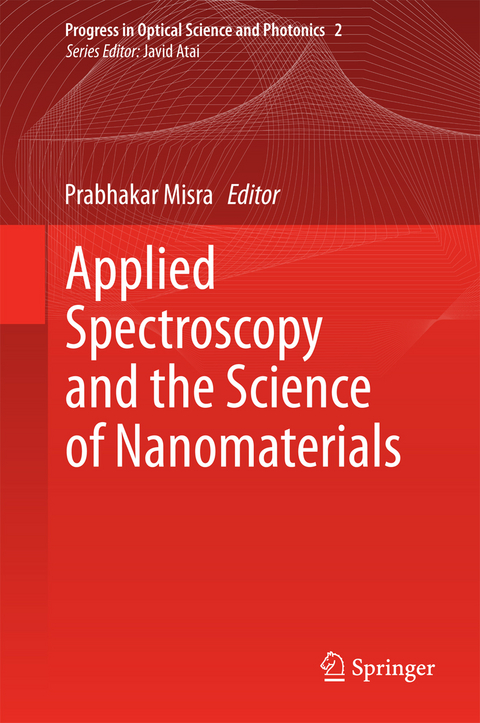
Applied Spectroscopy and the Science of Nanomaterials (eBook)
XII, 277 Seiten
Springer Singapore (Verlag)
978-981-287-242-5 (ISBN)
This book focuses on several areas of intense topical interest related to applied spectroscopy and the science of nanomaterials. The eleven chapters in the book cover the following areas of interest relating to applied spectroscopy and nanoscience:
· Raman spectroscopic characterization, modeling and simulation studies of carbon nanotubes,
· Characterization of plasma discharges using laser optogalvanic spectroscopy,
· Fluorescence anisotropy in understanding protein conformational disorder and aggregation,
· Nuclear magnetic resonance spectroscopy in nanomedicine,
· Calculation of Van der Waals interactions at the nanoscale,
· Theory and simulation associated with adsorption of gases in nanomaterials,
· Atom-precise metal nanoclusters,
· Plasmonic properties of metallic nanostructures, two-dimensional materials, and their composites,
· Applications of graphene in optoelectronic devices and transistors,
· Role of graphene in organic photovoltaic device technology,
· Applications of nanomaterials in nanomedicine.
Dr. Prabhakar Misra received his Ph.D. from The Ohio State University in 1986. After a post-doctoral fellowship at the Laser Spectroscopy Facility of The Ohio State University, he joined Howard University in Washington, DC. He was a Visiting Scholar in 1990 at Northwestern University in Evanston, IL. He is currently a Professor of Physics and Director of the Laser Spectroscopy Laboratory at Howard University. He has served as Chair of the Department of Physics & Astronomy (2010-14) and the President of the Howard University Chapter of Sigma Xi, the Scientific Research Society (2013-14). Dr. Misra has been involved in basic and applied spectroscopic research that spans more than 25 years in the field of atomic and molecular physics and has contributed extensively to the spectroscopic characterization of stable and unstable molecular species, which have included free radicals and ions that impact combustion and plasma processes. He has served as co-editor of the book titled Ultraviolet Spectroscopy and UV Lasers (Marcel Dekker/CRC Press, 2002) and the research monograph Fundamentals & Current Topics in Molecular Structure Research (Research Signpost, 2011). He is a Visiting Scientist at the NASA Goddard Space Flight Center, Greenbelt, MD, where he has been involved in the development of an extensive database and spectral library of organic molecules for the Curiosity rover, which has relevance to the search for life on planets such as Mars. His current research interests involve the detailed characterization of a variety of nanomaterials (e.g. graphene, carbon nanotubes and metal oxides) using Raman Spectroscopy and Molecular Dynamics Simulations. Dr. Misra has been a recipient of the NASA Administrator's Fellowship Program (NAFP) award, an NRC faculty fellowship at the Aeronautics and Space Engineering Board of the National Academy of Sciences in Washington, DC, and the Fulbright Scholar award. He is a Senior Member of the Optical Society of America and a Fellow of the American Society for Laser Medicine and Surgery.
This book focuses on several areas of intense topical interest related to applied spectroscopy and the science of nanomaterials. The eleven chapters in the book cover the following areas of interest relating to applied spectroscopy and nanoscience: * Raman spectroscopic characterization, modeling and simulation studies of carbon nanotubes, * Characterization of plasma discharges using laser optogalvanic spectroscopy,* Fluorescence anisotropy in understanding protein conformational disorder and aggregation,* Nuclear magnetic resonance spectroscopy in nanomedicine,* Calculation of Van der Waals interactions at the nanoscale,* Theory and simulation associated with adsorption of gases in nanomaterials,* Atom-precise metal nanoclusters, * Plasmonic properties of metallic nanostructures, two-dimensional materials, and their composites,* Applications of graphene in optoelectronic devices and transistors,* Role of graphene in organic photovoltaic device technology,* Applications of nanomaterials in nanomedicine.
Dr. Prabhakar Misra received his Ph.D. from The Ohio State University in 1986. After a post-doctoral fellowship at the Laser Spectroscopy Facility of The Ohio State University, he joined Howard University in Washington, DC. He was a Visiting Scholar in 1990 at Northwestern University in Evanston, IL. He is currently a Professor of Physics and Director of the Laser Spectroscopy Laboratory at Howard University. He has served as Chair of the Department of Physics & Astronomy (2010-14) and the President of the Howard University Chapter of Sigma Xi, the Scientific Research Society (2013-14). Dr. Misra has been involved in basic and applied spectroscopic research that spans more than 25 years in the field of atomic and molecular physics and has contributed extensively to the spectroscopic characterization of stable and unstable molecular species, which have included free radicals and ions that impact combustion and plasma processes. He has served as co-editor of the book titled Ultraviolet Spectroscopy and UV Lasers (Marcel Dekker/CRC Press, 2002) and the research monograph Fundamentals & Current Topics in Molecular Structure Research (Research Signpost, 2011). He is a Visiting Scientist at the NASA Goddard Space Flight Center, Greenbelt, MD, where he has been involved in the development of an extensive database and spectral library of organic molecules for the Curiosity rover, which has relevance to the search for life on planets such as Mars. His current research interests involve the detailed characterization of a variety of nanomaterials (e.g. graphene, carbon nanotubes and metal oxides) using Raman Spectroscopy and Molecular Dynamics Simulations. Dr. Misra has been a recipient of the NASA Administrator's Fellowship Program (NAFP) award, an NRC faculty fellowship at the Aeronautics and Space Engineering Board of the National Academy of Sciences in Washington, DC, and the Fulbright Scholar award. He is a Senior Member of the Optical Society of America and a Fellow of the American Society for Laser Medicine and Surgery.
Raman Spectroscopy, Modeling and Simulation Studies of Carbon Nanotubes.- Laser Optogalvanic Spectroscopy and Collisional State Dynamics Associated with Hollow Cathode Discharge Plasmas.- Applications of Fluorescence Anisotropy in Understanding Protein Conformational Disorder and Aggregation.- Nuclear Magnetic Resonance Spectroscopy in Nanomedicine.- An Efficient Coupled Dipole Method for the accurate calculation of van der Waals interactions at the nanoscale.- Adsorption of Gases in Nanomaterials: Theory and Simulations.- Atom‐Precise Metal Nanoclusters.- Plasmonic Properties of Metallic Nanostructures, Two Dimensional Materials, and Their Composites.- Application of Graphene within Optoelectronic Devices and Transistor.- The Versatile Role of Graphene in Organic Photovoltaic Device Technology.- Nanomaterials in Nanomedicine.
| Erscheint lt. Verlag | 21.10.2014 |
|---|---|
| Reihe/Serie | Progress in Optical Science and Photonics | Progress in Optical Science and Photonics |
| Zusatzinfo | XII, 277 p. 118 illus. |
| Verlagsort | Singapore |
| Sprache | englisch |
| Themenwelt | Naturwissenschaften ► Physik / Astronomie |
| Technik ► Maschinenbau | |
| Schlagworte | Adsorption of Gases • Carbon Nanotubes • Discharge Plasmas • Fluorescence Anisotropy • Graphene • Graphene Nanotransistors • Hollow Cathodes • Laser Optogalvanic Spectroscopy • metal nanoclusters • Modeling and simulations • nanomaterials • nanomedicine • Nuclear Magnetic Resonance Spectroscopy • optoelectronics • Photovoltaic devices • plasmonics • protein conformation • Raman spectroscopy • Two-Dimensional Materials • Van der Waals interactions |
| ISBN-10 | 981-287-242-6 / 9812872426 |
| ISBN-13 | 978-981-287-242-5 / 9789812872425 |
| Informationen gemäß Produktsicherheitsverordnung (GPSR) | |
| Haben Sie eine Frage zum Produkt? |
 PDF (Wasserzeichen)
DRM: Digitales Wasserzeichen
Dieses eBook enthält ein digitales Wasserzeichen und ist damit für Sie personalisiert. Bei einer missbräuchlichen Weitergabe des eBooks an Dritte ist eine Rückverfolgung an die Quelle möglich.
Dateiformat: PDF (Portable Document Format)
Mit einem festen Seitenlayout eignet sich die PDF besonders für Fachbücher mit Spalten, Tabellen und Abbildungen. Eine PDF kann auf fast allen Geräten angezeigt werden, ist aber für kleine Displays (Smartphone, eReader) nur eingeschränkt geeignet.
Systemvoraussetzungen:
PC/Mac: Mit einem PC oder Mac können Sie dieses eBook lesen. Sie benötigen dafür einen PDF-Viewer - z.B. den Adobe Reader oder Adobe Digital Editions.
eReader: Dieses eBook kann mit (fast) allen eBook-Readern gelesen werden. Mit dem amazon-Kindle ist es aber nicht kompatibel.
Smartphone/Tablet: Egal ob Apple oder Android, dieses eBook können Sie lesen. Sie benötigen dafür einen PDF-Viewer - z.B. die kostenlose Adobe Digital Editions-App.
Buying eBooks from abroad
For tax law reasons we can sell eBooks just within Germany and Switzerland. Regrettably we cannot fulfill eBook-orders from other countries.
aus dem Bereich