Experimental Approaches and Applications (eBook)
232 Seiten
Elsevier Science (Verlag)
978-1-4832-6830-9 (ISBN)
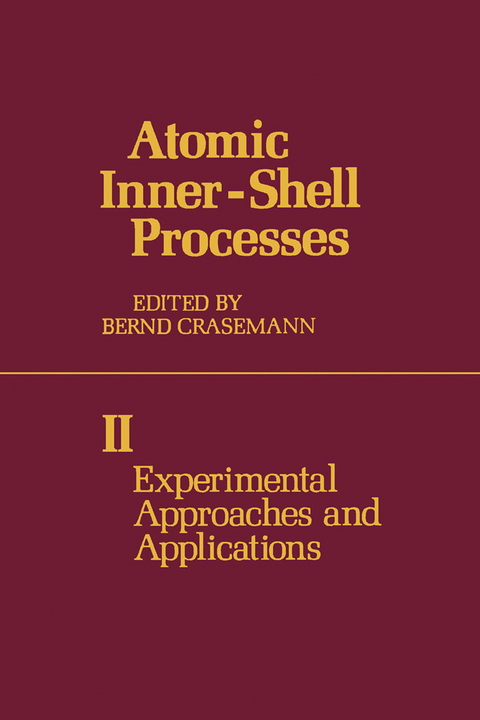
Atomic Inner-Shell Processes, Volume II: Experimental Approaches and Applications focuses on the physics of atomic inner shells, with emphasis on experimental aspects including the use of radioactive atoms for studies of atomic transition probabilities. Surveys of modern techniques of electron and photon spectrometry are also presented, and selected practical applications of inner-shell processes are outlined. Comprised of six chapters, this volume begins with an overview of the general principles underlying the experimental techniques that make use of radioactive isotopes for inner-shell transition measurements. The discussion then turns to electron spectrometry, its instrumentation as well as basic and operational principles; X-ray diffraction spectrometry, paying particular attention to types of X-ray spectrometers and general characteristics of crystal spectrometers; spectrometry with solid-state detectors; and proportional-counter spectrometry. The final chapter considers some practical applications of inner-shell ionization phenomena, with particular reference to X-ray fluorescence analysis and astrophysics. This book should be valuable to physicists and other scientists who plan to engage in research on atomic inner-shell processes.
Front Cover 1
Experimental Approaches and Applications 4
Copyright Page 5
Table of Contents 6
List of Contributors 8
Contents of Volume I 9
Preface 10
Chapter 1. Inner-Shell Transition Measurements with Radioactive Atoms 14
1.1. Introduction 15
1.2. Fluorescence, Auger, and Coster–Kronig Yields 15
1.3. Decay of Double Inner-Shell Vacancy States 31
1.4. Auger-Electron Intensities 36
1.5. Relative x-Ray Intensities 38
1.6. Measurement of Widths 40
1.7. Directional Correlations 41
References 43
Chapter 2. Electron Spectrometry 46
2.1. Introduction 47
2.2. Instrumentation 49
2.3. Some Basic and Operational Principles 56
2.4. Photoelectron Spectrometry 64
2.5. Auger-Electron Spectrometry 78
2.6. The All-Electron Experiment 86
2.7. Miscellaneous 89
References 90
Chapter 3. x-Ray Diffraction Spectrometry 96
3.1. Introduction 97
3.2. Types of x-Ray Spectrometers 100
3.3. General Characteristics of Crystal Spectrometers 107
3.4. Diffraction by a Plane Crystal 109
3.5. Instrumental Effects in Two-Crystal Spectrometers 116
3.6. Instrumental Effects in Bent-Crystal Spectrometers 123
References 131
Chapter 4. Spectrometry with Solid-State Detectors 136
4.1. Introduction 137
4.2. Basic Characteristics of x-Ray and Electron Spectrometers 138
4.3. x-Ray Spectrometers 163
4.4. Electron Spectrometers 170
4.5. Concluding Remarks 174
References 176
Chapter 5. Proportional-Counter Spectrometry 182
5.1. Introduction 182
5.2. Gas Multiplication 184
5.3. Energy Resolution 186
5.4. Risetime and Pulse Shape 187
5.5. Wall Effects 188
5.6. Spurious Counts and Afterpulses 189
5.7. Single-Electron Spectrometry 189
5.8. Spectrometry of Few-Electron Events 190
5.9. Position-Sensitive Proportional Counters 192
5.10. Proportional Counters with Special Innovations and Applications 193
5.11. Conclusion 196
References 197
Chapter 6. Some Practical Applications of Inner-Shell lonization Phenomena 200
6.1. Introduction 200
6.2. x-Ray Fluorescence Analysis 202
6.3. Astrophysical Applications 211
References 215
Author Index 218
Subject Index 229
| Erscheint lt. Verlag | 22.10.2013 |
|---|---|
| Sprache | englisch |
| Themenwelt | Naturwissenschaften ► Physik / Astronomie ► Quantenphysik |
| Technik | |
| ISBN-10 | 1-4832-6830-6 / 1483268306 |
| ISBN-13 | 978-1-4832-6830-9 / 9781483268309 |
| Informationen gemäß Produktsicherheitsverordnung (GPSR) | |
| Haben Sie eine Frage zum Produkt? |
 PDF (Adobe DRM)
Kopierschutz: Adobe-DRM
Adobe-DRM ist ein Kopierschutz, der das eBook vor Mißbrauch schützen soll. Dabei wird das eBook bereits beim Download auf Ihre persönliche Adobe-ID autorisiert. Lesen können Sie das eBook dann nur auf den Geräten, welche ebenfalls auf Ihre Adobe-ID registriert sind.
Details zum Adobe-DRM
Dateiformat: PDF (Portable Document Format)
Mit einem festen Seitenlayout eignet sich die PDF besonders für Fachbücher mit Spalten, Tabellen und Abbildungen. Eine PDF kann auf fast allen Geräten angezeigt werden, ist aber für kleine Displays (Smartphone, eReader) nur eingeschränkt geeignet.
Systemvoraussetzungen:
PC/Mac: Mit einem PC oder Mac können Sie dieses eBook lesen. Sie benötigen eine
eReader: Dieses eBook kann mit (fast) allen eBook-Readern gelesen werden. Mit dem amazon-Kindle ist es aber nicht kompatibel.
Smartphone/Tablet: Egal ob Apple oder Android, dieses eBook können Sie lesen. Sie benötigen eine
Geräteliste und zusätzliche Hinweise
Buying eBooks from abroad
For tax law reasons we can sell eBooks just within Germany and Switzerland. Regrettably we cannot fulfill eBook-orders from other countries.
aus dem Bereich