Condensed Matter (eBook)
646 Seiten
Elsevier Science (Verlag)
978-1-4832-1869-4 (ISBN)
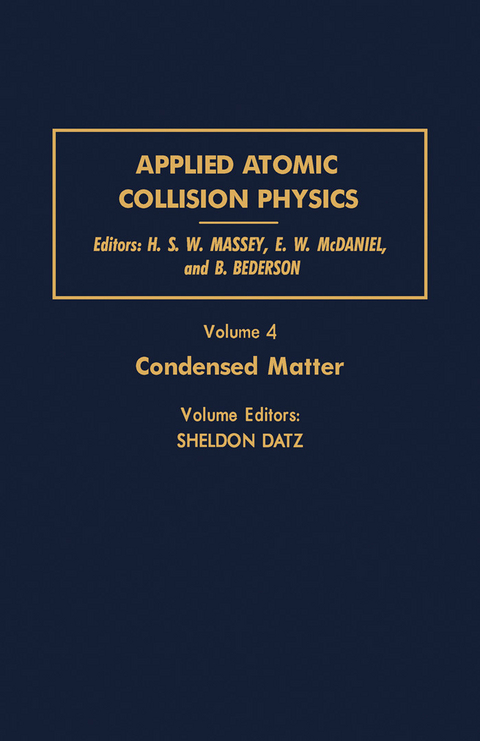
Applied Atomic Collision Physics, Volume 4: Condensed Matter deals with the fundamental knowledge of collision processes in condensed media. The book focuses on the range of applications of atomic collisions in condensed matter, extending from effects on biological systems to the characterization and modification of solids. This volume begins with the description of some aspects of the physics involved in the production of ion beams. The radiation effects in biological and chemical systems, ion scattering and atomic diffraction, x-ray fluorescence analysis, and photoelectron and Auger spectroscopy are discussed in detail. The final two chapters in the text cover two areas of ion beam materials modification: ion implantation in semiconductors and microfabrication. This text is a good reference material for physics graduate students, experimental and theoretical physicists, and chemists.
Front Cover 1
Condensed Matter 4
Copyright Page 5
Table of Contents 6
Treatise Preface 12
Preface 14
Chapter 1. Heavy Ion Charge States 16
I. Introduction 17
II. Basic Processes and Mathematical Description of Charge Exchange 20
III. Experimental Aspects 26
IV. Electron Capture 31
V. Electron Loss 37
VI. Equilibrium Charge-State Distributions 41
VII. Gas and Solid Effects 50
References 52
Chapter 2. Ionization Phenomena and Sources of Ions 58
I. Introduction 59
II. Ion Source Selection Considerations 61
III. Vapor Transport Methods 65
IV. Positive Ionization Phenomena and Sources 69
V. Negative Ionization Phenomena and Sources 143
VI. Ion Extraction and Optics of the Extraction Region References 172
References 186
Chapter 3. Radiation Physics as a Basis of Radiation Chemistry and Biology 194
I. What are the Problems of Radiation Physics? 194
II. Problems of Class I: How Do Radiations Degrade in Matter? 199
III. Problems of Class II: How Does Matter Change after Receiving Energy from Radiation? 209
IV. Some Notions of Radiation Chemistry and Biology 235
V. Concluding Remarks 243
References 244
Chapter 4. Low Energy Ion Scattering and Atomic Diffraction 252
I. Ion Scattering Spectrometry (ISS) 253
II. Scattering of Atomic Beams at Thermal Energies 265
References 273
Chapter 5. High Energy Ion Scattering 276
I. Introduction 276
II. Physics of Ion Scattering in Amorphous Solids 277
III. Atomic Composition of Surface Layers 282
IV. MeV Ion Scattering in Single Crystals 289
V. Structure Analysis in Crystalline Solids 297
VI. Summary 312
References 312
Chapter 6. Inelastic Surface Collisions 314
I. Introduction 314
II. Ion-Induced Auger Spectra 315
III. Ion Neutralization at Surfaces 320
IV. Excitation of Projectiles 329
V. Optical Emission for Target Species 333
VI. Conclusion 337
References 338
Chapter 7. Secondary Ion Mass Spectrometry 342
I. Introduction 342
II. The Sputtering Process 344
III. Sputtered Ion Emission: Phenomena and Models 351
IV. Instrumentation 363
V. Applications of Secondary Ion Mass Spectrometry 368
VI. Conclusion 389
References 390
Chapter 8. The Time-of-Flight Atom Probe and Field Ion Microscopy 394
I. Introduction 395
II. Basic Principles 397
III. Field Ion Microscope and Atom-Probe FIM 399
IV. Atomic Processes on Solid Surfaces 407
V. Atom-Probe Analyses 414
VI. Summary 420
References 420
Chapter 9. Ion-Induced X-Ray Emission 422
I. Introduction 422
II. Coulomb lonization 423
III. Proton-Induced X-Ray Emission (PIXE) 427
IV. Heavy-Ion-Induced X-Ray Emission 435
References 441
Chapter 10. X-Ray Fluorescence Analysis 444
I. Introduction 444
II. Development of the Physics 448
III. Development of the Analytical Application 451
IV. Comparison to Other Analytical Techniques 456
V. X-Ray Fluorescence Analysis in Industry 458
VI. Conclusions 461
References 462
Chapter 11. Photoelectron and AugerSpectroscopy 464
I. Introduction 465
II. Description of the Processes 466
III. Experimental Considerations 479
IV. Applications 501
Acknowledgments 553
References 553
Chapter 12. Ion Implantation in Semiconductors 560
1. Introduction 465
II. Depth Distributions in Implanted and Annealed Samples 466
III. Implantation Damage 566
IV. Electrical Activity 575
V. Recoil Implantation 578
VI. Annealing of Disorder by Irradiation 581
VII. Summary 586
References 586
Chapter 13. Microfabrication 592
1. Introduction 592
II. Microfabrication Processes 593
III. Pattern Replication (Lithography) 597
IV. Pattern Transfer 612
V. Discussion 620
References 623
Index 628
| Erscheint lt. Verlag | 22.10.2013 |
|---|---|
| Sprache | englisch |
| Themenwelt | Naturwissenschaften ► Physik / Astronomie ► Quantenphysik |
| Technik | |
| ISBN-10 | 1-4832-1869-4 / 1483218694 |
| ISBN-13 | 978-1-4832-1869-4 / 9781483218694 |
| Informationen gemäß Produktsicherheitsverordnung (GPSR) | |
| Haben Sie eine Frage zum Produkt? |
 PDF (Adobe DRM)
Kopierschutz: Adobe-DRM
Adobe-DRM ist ein Kopierschutz, der das eBook vor Mißbrauch schützen soll. Dabei wird das eBook bereits beim Download auf Ihre persönliche Adobe-ID autorisiert. Lesen können Sie das eBook dann nur auf den Geräten, welche ebenfalls auf Ihre Adobe-ID registriert sind.
Details zum Adobe-DRM
Dateiformat: PDF (Portable Document Format)
Mit einem festen Seitenlayout eignet sich die PDF besonders für Fachbücher mit Spalten, Tabellen und Abbildungen. Eine PDF kann auf fast allen Geräten angezeigt werden, ist aber für kleine Displays (Smartphone, eReader) nur eingeschränkt geeignet.
Systemvoraussetzungen:
PC/Mac: Mit einem PC oder Mac können Sie dieses eBook lesen. Sie benötigen eine
eReader: Dieses eBook kann mit (fast) allen eBook-Readern gelesen werden. Mit dem amazon-Kindle ist es aber nicht kompatibel.
Smartphone/Tablet: Egal ob Apple oder Android, dieses eBook können Sie lesen. Sie benötigen eine
Geräteliste und zusätzliche Hinweise
Buying eBooks from abroad
For tax law reasons we can sell eBooks just within Germany and Switzerland. Regrettably we cannot fulfill eBook-orders from other countries.
aus dem Bereich