Plasmas (eBook)
516 Seiten
Elsevier Science (Verlag)
978-1-4832-1867-0 (ISBN)
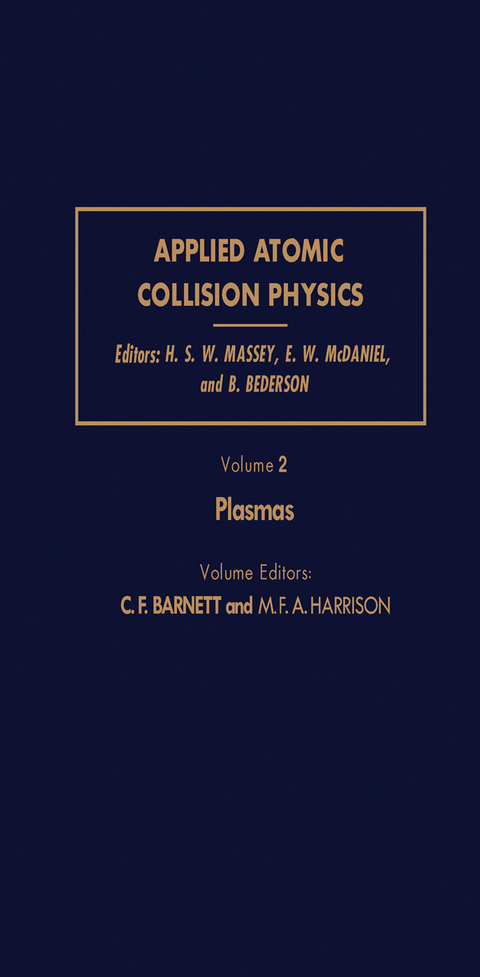
Applied Atomic Collision Physics, Volume 2: Plasmas covers topics on magnetically confined plasmas. The book starts by providing the history of fusion research and describing the various approaches in both magnetically and inertially confined plasmas. The text then gives a general discussion of the basic concepts and properties in confinement and heating of a plasma. The theory of atomic collisions that result in excited quantum states, particularly highly ionized impurity atoms; and diverse diagnostic topics such as emission spectra, laser scattering, electron cyclotron emission, particle beams, and bremsstrahlung are also considered. The book further tackles heating of plasma by energetic particles; the boundary or edge plasma and particle-surface interactions; and the role of atomic physics in hot dense plasmas. Physicists and people involved in plasma and fusion energy studies will find the book invaluable.
Front Cover 1
Plasmas
4
Copyright Page 5
Table of Contents 6
List of Contributors 10
Treatise Preface 12
Preface 14
Chapter 1. Introduction 16
I. Evolution of Atomic Physics in Fusion Research 16
II. Approaches to Fusion 20
III. Atomic Physics in Fusion 36
References 38
Chapter 2. Basic Concepts of Fusion Research 42
I. Introduction 42
II. The Principles of a D-T Fusion Reactor 43
III. Magnetic Confinement of Fusion Plasmas 47
IV. Energy Balance Conditions in a Magnetically Confined Fusion Plasma
51
V. Auxiliary Heating 57
VI. Inertial Confinement 61
Acknowledgment 64
References 64
Chapter 3. Atomic Radiation from Low Density Plasma 66
I. Preliminary Discussion 67
II. The Boltzmann Equation 70
III. Components of the Statistical Balance Equations 75
IV. The Collective Viewpoint of Ionization and Recombination 86
V. The Distribution among the Stages of Ionization 96
VI. Spectral Line Intensities 100
VII. Radiated Power Loss 112
References 123
Chapter 4. Properties of Magnetically Confined Plasmas in Tokamaks 128
I. Introduction 129
II. Magnetic Configuration 131
III. Moment Equations 137
IV. Particle Balance 141
V. Energy Balance 145
VI. Impurity Transport 151
References 153
Chapter 5. Diagnostics 156
Chapter 5A. Diagnostics Based on Emission Spectra 158
I. Introduction 158
II. Ionization quilibrium 159
IV. Spectral Features and Their Diagnostic Application to Fusion Plasmas 184
V. Neutral-Beam Spectroscopy 196
VI. Basic Atomic Physics 198
References 201
Chapter 5B. Laser Diagnostics 206
I. Introduction 207
II. Faraday Rotation 207
III. Interferometry 214
IV. Thomson Scattering 226
Acknowledgments 239
References 239
Chapter 5C. Plasma Diagnostics Using Electron Cyclotron Emission 242
I. Introduction 242
II. The Theory of Electron Cyclotron Emission 244
III. Instrumentation 248
IV. Applications 255
V. Concluding Remarks 259
Acknowledgment 261
References 261
Chapter 5D. Particle Plasma Diagnostics 264
I. Introduction 264
II. Particle Diagnostic Atomic Physics 266
III. Neutral-Particle Spectrometers Used in DeterminingIon Temperatures 272
IV. Plasma Ion Density and Effective Charge by Neutral-Beam Attenuation 293
V. Beam Scattering Diagnostics 297
VI. Impurity Ion Density 301
VII. Magnetic Field Measurements 305
VIII. Heavy-Ion Beam Probe 311
References 318
Chapter 5E. The Electron Bremsstrahlung Spectrum from Neutral Atoms and Ions 322
I. Introduction 322
II. Bremsstrahlung in a Plasma: Observablesand Assumptions 323
III. Coulomb Spectrum 326
IV. Atomic Electron Screening Effects for an Isolated Atomor Ion 328
V. End Points of the Spectrum: Elastic Scattering and Direct Radiative Recombination 330
VI. Angular Distributions and Polarization Correlations 332
VII. Bremsstrahlung Emission in Hot Dense Plasmas 333
References 334
Chapter 6. Heating of Plasma by Energetic Particles
338
Chapter 6A. Introduction 340
Reference 341
Chapter 6B.Trapping and Thermalizationof Fast Ions 342
I. Introduction 342
II. Fast-Ion Deposition 343
III. The Slowing Down of the Fast Ions 347
IV. Energy and Momentum Transfer Rates 349
V. Effect on Plasma Temperature, Current, and Rotation 350
References 353
Chapter 6C. Neutral-Beam Formationand Transport 354
I. Introduction 354
II. Ion Beam Extraction and Acceleration 356
III. Plasma Sources for Positive Ions 367
IV. Beam Transport in a Gas Neutralizer 378
V. Negative-Ion Beams 387
Acknowledgment 392
References 393
Chapter 6D. Alpha-Particle Heating 396
I. Alpha-Particle Production and Heating 396
II. Fast-Alpha-Particle Diagnostics 402
III. Alpha-Particle Ash 405
Acknowledgments 408
References 408
7. Boundary Plasma 410
I. Description of the Boundary Region 410
II. The Boundary of a Toroidal Device 414
III. The Sheath and Long-Range Electric Field Regions 428
IV. Particle-Surface Interactions 431
V. Atomic Processes in the Boundary Plasma 438
VI. Significance of the Boundary Plasma 451
Acknowledgment 452
References 452
8. Atomic Phenomena in Hot Dense Plasmas
456
I. Introduction 456
II. The Plasma Environment 458
III. Perturbations of Atomic Structure 465
IV. Perturbations of Atomic Collisions 475
V. Formation of Spectral Lines 482
VI. Dielectronic Recombination 494
Acknowledgments 497
References 497
Index 502
| Erscheint lt. Verlag | 11.9.2013 |
|---|---|
| Sprache | englisch |
| Themenwelt | Naturwissenschaften ► Physik / Astronomie ► Quantenphysik |
| Technik | |
| ISBN-10 | 1-4832-1867-8 / 1483218678 |
| ISBN-13 | 978-1-4832-1867-0 / 9781483218670 |
| Informationen gemäß Produktsicherheitsverordnung (GPSR) | |
| Haben Sie eine Frage zum Produkt? |
 PDF (Adobe DRM)
Kopierschutz: Adobe-DRM
Adobe-DRM ist ein Kopierschutz, der das eBook vor Mißbrauch schützen soll. Dabei wird das eBook bereits beim Download auf Ihre persönliche Adobe-ID autorisiert. Lesen können Sie das eBook dann nur auf den Geräten, welche ebenfalls auf Ihre Adobe-ID registriert sind.
Details zum Adobe-DRM
Dateiformat: PDF (Portable Document Format)
Mit einem festen Seitenlayout eignet sich die PDF besonders für Fachbücher mit Spalten, Tabellen und Abbildungen. Eine PDF kann auf fast allen Geräten angezeigt werden, ist aber für kleine Displays (Smartphone, eReader) nur eingeschränkt geeignet.
Systemvoraussetzungen:
PC/Mac: Mit einem PC oder Mac können Sie dieses eBook lesen. Sie benötigen eine
eReader: Dieses eBook kann mit (fast) allen eBook-Readern gelesen werden. Mit dem amazon-Kindle ist es aber nicht kompatibel.
Smartphone/Tablet: Egal ob Apple oder Android, dieses eBook können Sie lesen. Sie benötigen eine
Geräteliste und zusätzliche Hinweise
Buying eBooks from abroad
For tax law reasons we can sell eBooks just within Germany and Switzerland. Regrettably we cannot fulfill eBook-orders from other countries.
aus dem Bereich